WVIA Original Documentary Films
The Secrets Beneath Hazleton
Season 2026 Episode 1 | 29m 31sVideo has Closed Captions
Beneath the streets of Hazleton, Pennsylvania, lies a world forgotten by time.
Beneath the streets of Hazleton, Pennsylvania, lies a world forgotten by time - a network of hidden tunnels, abandoned mine shafts, and underground structures that hold the secrets of the past. The Secrets Beneath Hazleton aims to bring these long-buried secrets to light and explore their historical significance for a whole new generation.
Problems playing video? | Closed Captioning Feedback
Problems playing video? | Closed Captioning Feedback
WVIA Original Documentary Films is a local public television program presented by WVIA
WVIA Original Documentary Films
The Secrets Beneath Hazleton
Season 2026 Episode 1 | 29m 31sVideo has Closed Captions
Beneath the streets of Hazleton, Pennsylvania, lies a world forgotten by time - a network of hidden tunnels, abandoned mine shafts, and underground structures that hold the secrets of the past. The Secrets Beneath Hazleton aims to bring these long-buried secrets to light and explore their historical significance for a whole new generation.
Problems playing video? | Closed Captioning Feedback
Where to Watch WVIA Original Documentary Films
WVIA Original Documentary Films is available to stream on pbs.org and the PBS app.
Providing Support for PBS.org
Learn Moreabout PBS online sponsorship- [Announcer] Grant funding has been provided by the Pasco L. Schiavo Memorial Charitable Fund of The Luzerne Foundation.
(soft music) This program is made possible through support from the following sponsors.
Earth Conservancy.
For 30 years, revitalizing the mine-scarred landscape of the Wyoming Valley through reclamation, watershed restoration, and conservation work.
More about the environmental and economic transformation at earthconservancy.org.
Space Time Mead & Cider Works, with locations in Dunmore and Quakertown, Pennsylvania, a PA Preferred Winery, using locally grown and harvested ingredients including honey, maple, and apple sourced from local producers.
Spacetimemeadworks.com.
Support has also been provided by Whitaker & DeAngelo Private Wealth Management.
(water drips) (suspenseful music) (water trickles) (suspenseful music) (water splashes) - [Phil] Do you have the feeling that things are about to get really interesting?
Anytime you pop out a rock tunnel like this, you're almost bound to see something crazy.
- [Justin] Most people don't realize that Hazleton's built on layers and underneath almost every part of the city, there's another world.
- [Narrator] What if the city you thought you knew was only half the story?
- [Phil] And this thing goes hundreds of feet back up to the surface.
- [Narrator] Beneath Hazleton is another city.
One of springs, tunnels, and spaces history left behind.
- [Phil] We are entering a different world.
- It's a history lesson.
You have to know where you've been to know where you're going.
- Well, it's all right.
I don't think they need these doors anymore, huh?
(suspenseful music) - [Narrator] Welcome to "The Secrets Beneath Hazleton".
- Okay.
You ready to roll?
- [Crew Member] You ready, Betty?
- I'm ready.
I am Betty Probert, long-time Hazleton resident.
My husband, John Probert, and myself were both born and raised in Hazleton and John was very, very interested in history his entire life.
He has collected so much information about the city of Hazleton and I have learned that history because of him.
This is Hazleton in 1884.
It was drawn.
There was a person in a hot air balloon up by the hospital and our house is on here and it shows its original location, on the corner of Fern and Laurel Streets.
John became interested in Hazleton's hidden history because he had grandparents that lived into their 90s and he spend a lot of time with them.
He met a lot of older people who gave their stories to him and he started compiling that information.
Soon, he was known as The Historian and if anyone came upon books or photographs or interesting stories, they sought him and gave it to him.
These are two paintings.
They are copies of paintings that were done by James Moran.
This is Wyoming Street.
This is Broad Street.
And right here is the railing going down to one of the underground bathrooms, also known as the comfort stations.
- I'm Thomas Gabos.
I'm the President of the Hazleton Historical Society.
I got a call from somebody from the mayor's office and they said, "They're gonna be filling in the two comfort stations.
Is there anything down there you would like?"
This was one of the stall doors from the men's room side and I guess this would hold the nickels and that would open it up.
When I was a child, my mom and I used to come downtown on a Wednesday night when our downtown was filled with people, the sidewalks were packed, and she would say to me, "Do you have to use the bathroom?"
I'd say yes or no but if I did, I went down into those comfort stations.
My mom would send me down, I would slip underneath.
(Thomas laughs) (bold bright music) - We are headed to the Hazleton Cemetery Association, also known as the Vine Street Cemetery.
(door shuts) (gentle tense music) In the Summer of 2008, a benefactor was willing to replace the sidewalk along Vine Street from Diamond Avenue to Maple Street.
Contractor was chosen.
The contractor was working, removing the original sidewalk, when he called our house and said... - [Contractor] John, you've got to get down here.
- So John went down.
Had no idea what it would be.
The contractor found a large void under the sidewalk and it also went diagonal under Vine Street.
John described it as very, very deep, probably 100 feet or more, and very wide.
The hole went on an angle that way, across Vine Street.
- They call the contractor in and when it happened, saw that there was a big opening there so he called some of his men, said, "Put a ladder down there.
Let's see what's down there," and they noticed that was the shallow part of the mine but it went deeper as it went down towards Broad Street.
- [Betty] In September of 2024, I found out that there was another subsidence.
- [Speaker] Oh, it only goes about, doesn't go too far over that way.
- So this entire area was dug up, filled in, and once it was filled properly, the city came and actually poured the new sidewalk here.
(gentle tense music) (footsteps crunch) There's wood holding the surfaces up and the wood is deteriorating and that could cause the surfaces to go down and I believe that we are going to see more subsidences in the city, in general.
If someone was concerned about subsidence right where we are standing, I would say, "Don't worry about it because it has been filled, it has been tamped down, it has been finished with a sidewalk and it is very, very sturdy so don't worry about that."
- Justin Emershaw, Chief Mine Engineer in Hazleton.
There's Vine Street.
Most people don't realize that Hazleton's built on layers.
I like to think of it as you have your buildings that you could see on the surface, then you have your sub-surface buildings, then you have your underground utilities, and then you have the mines, which I like to call it sub-level three.
All right, so over here, we have a bunch of mine maps and, I'm trying to find the one that we looked at last time.
Think it was this one.
Let's take a look here.
So this is a newer laminated copy of the All Veins map of Hazleton, dated 1907.
A mine map is like an x-ray of the city and when you align these underneath modern topography and put them in a transparent view, you can see all the different streets and where buildings are and you can see the workings underneath every part of the city.
(gentle music) So the subsidence in the Vine Street Cemetery occurred right in the southern corner here and what's interesting, looking at this map now, the Wharton came really close to the surface right here and if you look at these elevations, there's two I found on here, this is a survey mark on the corner of the block right here, 1670.7, and here's a survey mark.
It's saying 1663.8.
That's seven feet of ground between the top of that breast and the street.
That's crazy.
I heard a long time ago that there was, that something opened up near the cemetery and I do remember looking at this, but I never realized how close they mined the Wharton right to the cemetery.
That is crazy.
(gentle music) That corner of the cemetery that collapsed near Vine Street, those workings are dating back to the 1870s, 1890s.
And even back then, it wasn't common for them to drive too close to the surface and not leave enough rock.
And that's why you had the, the sidewalk failure there.
The foreman probably reamed somebody out that day for getting that close to the surface because that, that is really close.
The shallower outcrops were the first areas of coal that were worked.
Back in the early 1800s, the technology just wasn't there to get deep into the underground mine.
(carts rattle) (gentle music) A subsidence in one part of the city doesn't mean the entire city's structural integrity is at risk.
If you look at Hazleton specifically, engineers were specific to leave 8 million tons of coal in pillar support to support the city.
Underneath the city of Hazleton was only mined one time.
They never came back for second mining or third mining, which we call robbing.
So all of those pillars were left specifically to support the town.
(water sloshes) The mines in Hazleton are in excess of over 1200 feet deep.
Lowest level would be the ninth level at Hazleton number one, which is approximately 835 feet underground.
(tense music) - That's so cool, isn't it?
Alright, let's head down into the abyss.
I'm Phil Kudey.
I have a YouTube channel called Amazing PA where we explore underground mines, tunnels, and lost history in Northeast PA.
(footsteps crunch) Looks like a roller coaster.
To be honest, I didn't really know anything about Hazleton.
I just heard stories and rumors and until I actually went out by myself one morning, crawled into a gopher-sized hole in the ground, and ended up in a city beneath the city.
What we have is a hospital on the right and some kind of office or supply room on the left.
Now this is creepy.
I wonder how many patients were laid out on that bed.
The sheer amount of equipment that was left behind underground in Hazleton seems to be very different than other mines I've seen.
I'm not really sure why everything was left there, but it's almost like they just finished work one day and up and left.
They left paperwork, they left their tools, machines, coal carts, everything.
Look at that.
The light bulb is still in the ceiling.
We're losing our history.
It's all disappearing.
We have limited access to see these places for the last time.
Underground and abandoned mines, you have to deal with gases, high levels of carbon dioxide and nitrogen, roof falls.
You might get lost, the floor might give out.
(floor clatters) Oh!
I'm going through the floor.
It's a very serious situation that I don't take lightly, but the clock is ticking on getting one last chance, one last opportunity to see these places before they're gone forever.
She is an absolute beauty.
(gentle music) I swore I just heard electricity turn on.
You definitely feel a connection to history when you're shining that light through these tunnels for the first time and walk through these empty spaces, you really do feel a connection to the men that spent their lives down there.
(gentle music) The most remarkable sight that I experienced underneath Hazleton was an underground motor barn and a hoist room made of solid concrete.
It's all still down there to this day.
They used to repair the mine carts underground.
It's actually quite remarkable that they didn't even have to come to the surface to do these types of repairs.
Still has doors on it too.
Light switches in the wall.
That's a nice shovel.
What's different about the mines in Hazleton is everything is still there to this day.
Check this out.
We are entering a different world.
(gentle tense music) Check out these old porcelain insulators.
(footsteps crunch) - These names that you've seen underground in the video clips demonstrate that not only was it the epicenter for employment in Hazleton, but it also became a tour mine for engineering, geology students.
They came from universities to study mining, surveying, civil engineering underground and that's why you see all the names, the professor names, the class dates.
It's showing you that there were class trips to Hazleton when mining was huge, when it was as big as it ever was.
When I first saw those names, a couple of us got together that are really nerds with mining.
We took a screenshot of the names, went and dug through the yearbooks at Lehigh University and it was amazing to see that they were all mine engineers, every one of them.
(bold bright music) (mouse clicks) You had students coming here by invitation of the coal company to learn, in Hazleton, how they mine anthracite.
It's just crazy.
You know, these are names and memories from generations of people that immigrated to this country.
Many of them died.
I had two, my great-grandparents, they died in the mines.
You know, my one grandfather on my mom's side was kicked in the head by mule so he died at, I think the age of 28.
And they never really got to see what their hard work helped develop, which is the city that we know it today.
(gentle bright music) (gentle music) - My father and I, we were in a basement of a building on Broad Street.
I looked over and I saw a door that was all bolted shut and boarded up.
And I said to him, "Where does that go?"
He said, "It leads out under the sidewalk and from there, into the mines."
I was 10 years old when that happened, and that might have been my first inkling of how I became interested in the history of the town.
- My name is George F. Hayden.
I am the owner and developer of the Markle Building in Hazleton, Pennsylvania.
You know, Hazleton has a bad rap.
This is where everything started.
This is where the industrial revolution pretty much started.
You know, coal was king.
It still is today in a lot of ways, but our region, you know, it was destroyed by some of the strippings and some of the coal areas that were stripped and left so people just thought of it as a dump site and it's not really a dump site.
This is an area where a lot of great people live, w lot of great people have prospered, and a lot of families have grown up.
(door opens) (engine rumbles) So we're on the airport beltway and we're heading right to downtown Hazleton.
(gentle suspenseful music) There's a lot in this city that either people pass every day without even realizing the history behind it, some of it is still hidden, and some of it has already been filled in and lost.
It's the eye of the beholder.
If you look closer, there is history all around you.
The people of this area don't really know all the history of what happened in Hazleton and how it got built.
You know, they closed a lot of it up because of the safety reasons and they didn't want people to get into the areas, but there was tunnels everywhere.
But my understanding is those mines and those tunnels still go down through Hazleton.
Even the local historians don't know everything that is hidden beneath the city.
Underneath the Marco building, there used to be a barbershop and it came right off of Broad Street and you could also get there from when you walked in the lobby, right down into the basement.
This was the original first entrance, and then they added the second entrance.
And then right here, they had a set of steps going down that went right down to the basement.
So you would walk in and over here, you'd go right down to the basement.
(elevator shuts) (elevator dings) You see these steps?
Remember I told you upstairs, they used to be this in that lobby area?
These are the steps going down.
And they went right through here.
There used to be windows in here and that's where they went to the barbershop, right here.
And so there were stairs that you walked right down into the barbershop and these are the windows and it went right down the whole side.
Unfortunately, a lot of it got closed up when they did the renovation of downtown Broad Street.
That had to all be filled in.
I specifically remember walking into that barbershop area and just wished that I could find a barber chair yet.
But none of that was there anymore.
The sidewalk is right there.
That's where they filled in with all the concrete.
That's why you see all that filled in.
That's all concrete, solid concrete there.
There also was a whole lot of doorways and things that went under the buildings that apparently there was access to different areas.
Over here, there was a door here that you could see the layers of concrete.
You used to be able to walk in there and it was all underneath the sidewalk.
It was an all open cavern.
The whole thing was open underneath there.
(gentle suspenseful music) There's a lot of little things I've discovered.
There's a, like a well casing in the boiler room that has a W on it.
And when you open it up, you could hear the water in it and it probably goes down to one of the mines.
- We are in a home on Laurel Street in Hazleton because we had heard that there is access to an underground spring that is running under the basement and we came to check it out and most likely, this is a spring that begins on Spring Street in Hazleton, an appropriate name.
John was walking to work and he noticed water coming out of the middle of the street on Magnolia Street, between Laurel and Wyoming.
We were friends with the manager of the water company so John called him as soon as he got to work and told him there was a water leak.
And the manager told him, "It is not a water leak, it is the underground springs that are rising to the surface of the street."
(water trickles) There are several springs and Spring Street is the headwaters of the springs and they do go through the city and they do get together.
And I was told that they do go through a tunnel and that's just another thing hidden below us.
- My name is Jeff Cusat.
I'm the Mayor of Hazleton.
My father's side of the family moved to the Hazleton in 1917.
We still reside in the same house that my great-grandfather purchased.
We have eight homes on the same block.
So it's really nice that, you know, the family has stuck together through all of it.
It's very sad that a lot of the places that were here, you know, they're filled in.
They were destroyed, they were looked upon as something that could just be moved away.
It's a shame that, you know, they're not there and there's not enough documentation, there's not enough pictures of this stuff.
If it's not documented now, it's gonna be gone for good.
(gentle music) Not all of Hazleton's history is buried underground.
We have some amazing history right here in City Hall.
- [Interviewer] Now, why do you find this so fascinating and what does the history of this bell tower mean to you?
- It's just, it's, you'll never find something like this put together again.
The craftsmanship that went into this.
City Hall has seen three major remodels and it's just, it's just so dated and historic that I just love being up here.
(gentle music) (clock ticks) - I did not come from a coal mining family.
I did not learn about it in school.
It's one of those things that it took to my mid-thirties to start learning about and it's really changed my view on everything in this area, in Northeast PA.
I guess I missed this turn on the way up.
I look at Hazleton completely different now that I've explored what's underneath it.
I think people should take great pride in knowing the hard work that went into building that city.
It wasn't an easy job.
I mean, people gave their lives for it so they should be very proud and look more into the history of the city that they live in.
- Okay, let's see what we have.
I do believe that people that are just moving into the Hazleton area can embrace the history.
Last summer, I found out that the person I was talking to would often come over to the cemetery and John would walk him through the cemetery and give him the history and he absolutely loved it.
And John would be able to tell you when every house was built.
It's also important just to know what is under us.
- Hazleton was built on immigrants.
They were recruited by agents that said, "Come to America.
There's work.
We're looking for skilled miners, laborers."
Unfortunately when they got here, it wasn't what was promised to them.
(gentle music) (cats rattle) I think the people moving to Hazleton today can absolutely have some personal pride in knowing that this city was built on immigration and now we're the next generation coming to the city very much for the same reason.
- And then these are the weights that still operate.
They still have to wind the clock.
People are coming here now.
It's like being here 100 years ago.
Immigrants came here, they wanted a better life for their family.
I really think that if people understood where the first residents of Hazleton came from, what they went through to build this community, then you'll respect it more, you'll respect your neighbors more, and everything just meshes better when you understand what the foundation of a community was built on.
(bright music) People of Hazleton not only just build the city.
We helped build the country, you know?
The coal that we mined from here was shipped all over the country to heat the steel factories.
We were, nationally, one of the most important cities there was at one time.
(bright music) - We have a tourist attraction underneath our feet.
People need to realize what is underneath them and how this history could really benefit the city.
It's there for the taking.
- I think if Hazleton had the opportunity to have a historic mine trip, it would be the greatest thing that that city had in many, many, many years.
You know, if there had be a tourist destination to see the history, to show what built the city to what it is.
Amazing opportunity the city has if it could ever get to the point where we could open up a safe tour of under the city.
- You know, it would bring Hazleton back on the maps.
- It would be a dream come true and I think the residents and the people from around Northeast PA in general would be really appreciative of it.
- Everything is changing.
More people are moving in, older people are moving away, they're forgetting what was here.
So I really think that it's very important that we get everything documented now, you know, so we have an accurate history.
- Once you understand what's underneath Hazleton, it gives you a lot of personal pride to know that's what built it.
- It's a history lesson.
You have to know where you've been to know where you're going.
End of story.
(bright orchestral music) (bright music continues)
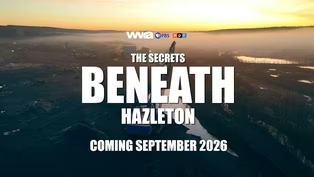
The Secrets Beneath Hazleton - Preview
Preview: S2026 Ep1 | 1m 3s | Premieres Monday, September 21st at 7pm on WVIA TV (1m 3s)
Providing Support for PBS.org
Learn Moreabout PBS online sponsorship New Episode
- Arts and Music

Innovative musicians from every genre perform live in the longest-running music series.

- Arts and Music
The Best of the Joy of Painting with Bob Ross
A pop icon, Bob Ross offers soothing words of wisdom as he paints captivating landscapes.
 New Season








 New Episode
 New Episode
Support for PBS provided by:
WVIA Original Documentary Films is a local public television program presented by WVIA