
The Siege of Bryan Station
Clip: Season 31 Episode 8 | 6m 7sVideo has Closed Captions
Learn about the siege at Bryan's Station.
In the waning days of the Revolutionary War, a siege at Bryan's Station in what is now Lexington, Ky., gave rise to a little-known tale of female heroism.
Problems playing video? | Closed Captioning Feedback
Problems playing video? | Closed Captioning Feedback
Kentucky Life is a local public television program presented by KET
You give every Kentuckian the opportunity to explore new ideas and new worlds through KET. Visit the Kentucky Life website.
The Siege of Bryan Station
Clip: Season 31 Episode 8 | 6m 7sVideo has Closed Captions
In the waning days of the Revolutionary War, a siege at Bryan's Station in what is now Lexington, Ky., gave rise to a little-known tale of female heroism.
Problems playing video? | Closed Captioning Feedback
How to Watch Kentucky Life
Kentucky Life is available to stream on pbs.org and the free PBS App, available on iPhone, Apple TV, Android TV, Android smartphones, Amazon Fire TV, Amazon Fire Tablet, Roku, Samsung Smart TV, and Vizio.
Providing Support for PBS.org
Learn Moreabout PBS online sponsorshipIn times of war, women have taken on many challenges.
Whether single-handedly keeping the family farm going, working on the production line in factories or shipyards, or serving tours of duty in war zones, women have always stepped up to answer the call.
This was especially evident during the Revolutionary War when the Women of Kentucky's Bryan Station settlement displayed remarkable bravery in the face of danger.
In a little-known place along the southern bank of the Elkhorn Creek, not far from the bustle of downtown Lexington, there lies a simple memorial from 1896.
The first monument in the world built by women to honor women.
Women about whom author, Virginia Webb Howard wrote, in an era when men and their deeds were what made history, their story captured the imagination of generations to come.
The area is known as Bryan Station, a fort founded in 1779 and populated with brave men and women who were settling the frontier.
It was said that Kentucky was settled with the axe and the rifle.
The axe to fell trees and build cabins and guns or rifles with which to hunt, as well as to defend their homes.
Life was tough, especially for women.
Women had to be incredibly resilient.
These women helped with the agriculture, the tending of livestock.
They made clothes, they cooked, and they bore incredible quantities of children.
It was a life that required them to take many different roles.
We're looking at women as workers as well as warriors in the 1780s.
Later on, those roles are pulled back, but in the 1780s, we see women as industrial workers.
Bryan Station is a really good example of the kind of enterprising women that's coming into Kentucky at that time.
It was a violent time around the fortified settlement.
Despite the end of the Revolutionary War in the East, Native Americans and British Canadian forces still roamed the frontier.
There were very few battles on the frontier.
There were lots of skirmishes, ambushes, massacres, chases.
Bryan Station was in the midst of an international conflict.
Really what we're talking about is raiders coming down and trying to take a stand against all of the people coming in from the East.
In August 1782, the battle came to Bryan Station under the British Canadian captain, William Coldwell.
The settlers were outgunned and outmanned.
There were only 44 gun-bearing men against a force of 50 or 60 American and British loyalists and a force of what's estimated to be about 300 Indians.
Historians write the settlers knew the Native Americans were there and wanted the men to come out of the fort to be ambushed.
They created a plan for the women to come down to the well and get water just like they normally would.
Just like they had been watching them and watching them, a pattern.
They agreed to come down to the well and pretend like everything was okay, but they were scared to death.
They didn't really know if they would make it back.
They bring back enough water using wooden pails and piggins, and noggins, all different kinds of water-carrying equipment to outfit the fort for several days.
Women in that fort were very brave.
Living on the frontier was an act of bravery in itself, and many of them suffered and fought alongside the men.
Whether that story of leaving the fort and, in fact, playing a ruse in order to secure the water, which they very much needed inside the station, that to me is a wonderful story, and I hope it's true.
The Native Americans and British Canadian troops later attacked the fort.
Fierce fighting raged for two days.
The troops withdrew when they heard reinforcements were on the way and made their way north.
The settlers pursued the Native American and British Canadian troops for about 60 miles to Robertson County.
They then faced off during the Battle of Blue Licks, which ended up being a devastating loss for the settlers.
It wasn't until the War of 1812 that many Kentuckians would feel safe on the frontier, and it wasn't until 1896 that the importance of the women who risked their lives to carry the water was recognized by the Daughters of the American Revolution with a monument near Bryan Station and their crucial water source.
Those daughters and those women are the ones that really kept this country going.
They recognized the importance of history, family, God, and country, and they formed ladies societies to preserve and protect history.
The memorial stands just five feet high and 12 feet in diameter, but the words from historian, George Rank stand the test of time.
The women of ancient Sparta pointed out the heroic way.
The women of pioneer Kentucky trod it.
Rank's memorial and his inscription that he wrote for the memorial describes, I think, in a beautiful way, how in the 1890s, the Daughters of the American Revolution offered a story about the importance of women in Kentucky history.
[music playing]
Video has Closed Captions
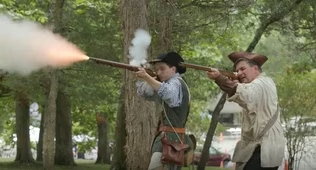
Clip: S31 Ep8 | 5m 4s | Chip learns about the battle of the Blue Licks. (5m 4s)
Video has Closed Captions
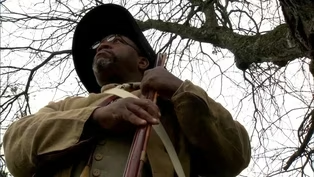
Clip: S31 Ep8 | 7m 25s | Learn about the fascinating life of African-American Revolutionary War soldier Daniel Goff. (7m 25s)
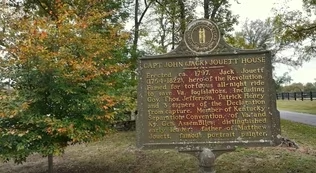
Jack Jouett House Historic Site
Video has Closed Captions
Clip: S31 Ep8 | 3m 34s | We’ll learn more about Revolutionary War hero Jack Jouett in this story. (3m 34s)
Providing Support for PBS.org
Learn Moreabout PBS online sponsorship












Support for PBS provided by:
Kentucky Life is a local public television program presented by KET
You give every Kentuckian the opportunity to explore new ideas and new worlds through KET. Visit the Kentucky Life website.