
The State of Immigration in Michigan
Season 6 Episode 4 | 26m 46sVideo has Closed Captions
One Detroit examines the state of immigration in Michigan today | Episode 604
This week, One Detroit examines Michigan's immigration status and the impacts the state has seen from refugee resettlement over the past 20 years with inside move-in day for some Afghan families resettling in Ypsilanti. Then, Jawad Sukhanyar, an Afghan journalist tells his story of escaping Taliban forces. Plus, examine the economic and cultural drivers that come from refugee resettlement.
Problems playing video? | Closed Captioning Feedback
Problems playing video? | Closed Captioning Feedback
One Detroit is a local public television program presented by Detroit PBS
The State of Immigration in Michigan
Season 6 Episode 4 | 26m 46sVideo has Closed Captions
This week, One Detroit examines Michigan's immigration status and the impacts the state has seen from refugee resettlement over the past 20 years with inside move-in day for some Afghan families resettling in Ypsilanti. Then, Jawad Sukhanyar, an Afghan journalist tells his story of escaping Taliban forces. Plus, examine the economic and cultural drivers that come from refugee resettlement.
Problems playing video? | Closed Captioning Feedback
How to Watch One Detroit
One Detroit is available to stream on pbs.org and the free PBS App, available on iPhone, Apple TV, Android TV, Android smartphones, Amazon Fire TV, Amazon Fire Tablet, Roku, Samsung Smart TV, and Vizio.
Providing Support for PBS.org
Learn Moreabout PBS online sponsorship- [Will] Just ahead on One Detroit, we're examining Michigan's immigration status.
We'll take you to Eastern Michigan University, where several Afghan refugees are making their home on campus.
Plus, a journalist from Afghanistan talks about his harrowing escape from his homeland and how he came to settle in Michigan.
And we'll take a closer look at the efforts to welcome more immigrants to our state.
It's all coming up on One Detroit.
- [Announcer] From Delta faucets to Behr paint, Masco Corporation is proud to deliver products that enhance the way consumers all over the world experience and enjoy their living spaces.
Masco, serving Michigan communities since 1929.
- [Announcer] Support for this program is provided by the Cynthia and Edsel Ford Fund for Journalism at Detroit Public TV, the Kresge Foundation, Community Foundation for Southeast Michigan.
- [Announcer] The DTE Foundation is a proud sponsor of Detroit Public TV.
Among the state's largest foundations committed to Michigan-focused giving, we support organizations that are doing exceptional work in our state.
Visit DTEFoundation.com to learn more.
- [Announcer] Business Leaders For Michigan, dedicated to making Michigan a top 10 state for jobs, personal income and a healthy economy.
Also brought to you by, and viewers like you.
(exciting music) - [Will] On this week's One Detroit, the state of immigration in Michigan.
Coming up, we'll take a closer look at the issues that have restricted the number of foreign-born resettling in Michigan and how that could be changing under president Joe Biden.
We'll talk with immigration experts and the immigrants who have made Michigan their new home.
Plus, the collapse of the Afghanistan government sent one journalist fleeing to Michigan to escape the Taliban.
Jawad Sukhanyar talks with One Detroit - He came here with nothing and didn't have people like JFS, in order to survive.
But first up, more than 1,000 Afghan refugees are expected to eventually settle in Michigan as tension continues to rise in Afghanistan.
Several families are being welcomed to the campus of Eastern Michigan University in Ypsilanti.
(soft music) - [Frances] Move-in day for some Afghan families at Eastern Michigan University.
- There's a lot of challenges to resettling this many people this quickly.
- [Frances] Last summer, Afghans mobbed the Kabul Airport trying to get out, people who'd helped American occupation forces fearing for their lives as the Taliban took control.
Now more than 70,000 are finding new homes across the US.
In Ypsilanti, EMU President James M. Smith realized his school could help.
- It's a think tank out of Washington, DC where a number of university presidents have come together to talk about immigration issues.
We've dealt with everything from DACA to visa problems to welcoming students to our campus in a time where we thought maybe the federal government wasn't quite as welcoming in their messaging.
We immediately, as we were having these discussions with other presidents said you know, we actually do have living environments on our campus that are not fully booked.
- [Frances] EMU connected with Jewish Family Services of Washtenaw County.
- Jewish Family Services is contracted to serve 300 Afghans.
They started arriving in October.
We expect all of our 300 to arrive by mid-February.
That is an unprecedented volume of people.
To the best of my knowledge, there's never been this many people who arrived so quickly.
- This January, more Afghans arrived.
12 families in all are expected, moving in with the help of EMU students.
This is good team effort.
I really appreciate this.
- We work together.
- Just instantly, I was thrown into how can I help?
- The minute we learned about it, we jumped on it as quick as we could to get things moving.
- There's always been opportunities at Eastern to volunteer, but none of them have been as big and important as this one felt.
- It's really cool that we as a local area can help on a national issue.
- [Frances] EMU's motto, All are Welcome Here, can be seen all over campus, serving an international community of students and scholars, a draw for many from diverse backgrounds.
- I've been all over the country.
I have to tell you that this community is something really special.
- [Frances] Student Body Vice President, Auryon Azar, American-born.
His family fled Iran more than two decades ago.
- My family had to overcome ridiculous circumstances in order to be able to make it to this country.
- [Frances] Student Body President Luis Romero's father came to West Michigan from Honduras.
EM University to give them that actual support.
- This project has awakened a number of really heartfelt stories in our own students.
- [Frances] Lauren London is EMU's General Counsel.
- It's a labor of love for them, truly, to be able to help new families move in, and not just move in, but feel comfortable and feel supported in the environment where they are.
- There's a lot of trauma for the Afghan population because of how quickly they had to leave their country, and they had to leave everything behind.
They came with no mementos, no pictures.
Oftentimes if they did pack things, they were left in the rush at the airport.
- They can speak good English, so we got across, they expressed to me how the living conditions were very difficult back home, and how they just wanted an opportunity to get out.
And when they found the JFS, when they found Eastern, when this opportunity came up, they were very thankful.
They pounced on it, and they're just normal people like me and you.
They just want a chance at life.
- We are also currently working on getting bus passes for the residents here so they're gonna have easy and free transportation around the community.
And then we also are getting some meal swipes and vouchers so they can go to the commons and become a little more integrated into our Ypsilantic, in our Eastern Michigan specifically community.
- Gimme a call if you need me.
- I will, thanks.
- [Frances] 1,300 Afghans are expected to make their homes across the state.
Mira Sussman of Jewish Family Services said the resettlement project still needs help, not just food and monetary support.
- The biggest challenge that we're having, and I hear this all over the country, is housing.
There is no housing stock.
These families are often really large and they need three or four bedroom units.
- You have to imagine when you come from across the world, you're isolated.
Maybe some of your family is still in your home country.
You're worried about them and you don't have anyone to confide in or spend time with.
- [Frances] Auryon Azar has already spent time with some of the new arrivals.
- In our culture, meal sharing is a really, really profound experience.
So things like having the right spices, having the right cookware and having the right space to share while you're having a meal are incredibly important, and so I think that some of us have been able to bring that perspective to this entire move-in process.
- What has been the community's reaction to the refugees?
Has there been any pushback?
- Pushback's been pretty minimal.
The one thing we do hear is there's a lot of people in the community already who need help, who need housing, who need food, who need jobs, and we absolutely empathize with that and totally agree.
But this agency, our job is to work with refugees.
(soft music) - [Will] The withdrawal of the United States' military from Afghanistan was scheduled to be complete on August 31st, 2021, bringing an end to the longest war in American history.
As US forces receded, the Taliban overpowered what was left of Afghan military and immediately took control.
The last city to fall was Kabul.
- Well, the day before Kabul fell on August 13, things were already tense in Afghanistan, especially in Kabul.
The city was populated.
There was a calm, but you would see that a storm was coming towards the city anyway.
- Jawad Sukhanyar was still in Kabul, trying to find a way to get his family out of the country.
What was the situation the day before you left, and what was going through your mind?
- You could see that something was happening.
Something was going to happen, and it wasn't right, but no one really expected that on August 15 suddenly things turned around.
- On August 15, 2021, Afghan president Ashraf Ghani flees.
Afghanistan's government collapses.
What was your main concern at that moment?
- Well, when we hear that the Taliban are in the city and it's like around 1:30 in the afternoon, we just start rushing here and there, reaching out people.
I start texting my colleagues at the New York Times and texting friends outside the country, reaching out people in the states via WhatsApp and trying to tell them that well, it's already too late.
We are stuck here.
We had to maintain like a situation of calmness in the family because I have my little kids with me.
I had my wife and my mom and I didn't want anyone to freak out.
In the meantime I understood what was going on and what could happen.
- [Will] Jawan's contacts at the New York Times told him to make his way to the airport, where thousands of civilians were trying to escape.
Taliban militants took over part of the airport.
Jawad and his family hid with relatives for another two days before they could be evacuated.
- So we all went to the airport and found each other and made a group.
But then our first attempt to leave the country didn't work, because things got out of control and hectic and there was no flights, and already thousands and thousands of people were at the airport and everyone wanted to leave.
Yeah, it was a mess.
- Once you got to the US, what was the sense of relief?
Was there a sense of relief?
And how has this transition in settling been going for you and your family?
- It took us two weeks to finally get to the US.
We were evacuated by C-17 military planes first from Kabul to Qatar.
And from Qatar we had the longest flight all the way to Mexico City with two stops on the way, one in Morocco, Africa, and two in Mexico itself.
So in Mexico, we were received by our senior editors and colleagues from the New York Times.
They provided us housing and accommodations.
After four or five days, I don't remember exactly, we were able to get on a civilian plane and be flown to Houston, Texas.
- What was it that made you decide to come to Ann Arbor, or was it much of a choice?
How did you end up from Houston to where you are today?
- We knew that if we wanted to go to the US, we would definitely go to Michigan, because it has been welcoming before, and I'm sure that's where we would be able to get resettled.
And when we got to Houston, I told my colleagues at the New York Times that if I have an option where to get settled, I would go to Michigan because I'm going to do my fellowship there, as well as I'll settle in there.
So that's what made us choose Michigan, and it has been very welcoming and we really appreciate all those people who helped us do this.
- Do you feel that you'll ever have the chance to go back?
Do you hope that you'll ever have the chance to go back, and is that something that you want for you and your family?
- Yeah, there is a strong attachment between me and all Afghans and our country, but when we left Afghanistan in August, there were moments that will, things would come to my mind that, well, this could be the last time you are leaving this country, and I would get very emotional.
You know, that's the country that I was born and I was raised and I had hopes and ambitions for and I had big dreams.
I had invested all my life and whatever I had there and I never thought that one day I would be forced to leave that country that I called home.
(soft music) - In Lansing, we don't have too much Cuban food.
I think that is a good idea, make a business of Cuban food.
- [Bill] You'll find Yohana Ferra's Habana Delights Food Truck in Lansing's Old Town, living her dream three years now.
When did you come from Cuba?
- In 2014.
- Thank you.
- Thank you so much, thank you, sir.
- I think this story, particularly when you look statewide for the state of Michigan is just how diverse this state is and how diverse the international community is.
- I'm so happy to make this kind of sandwich.
I came with my husband and two sons, and they become good, good future for them.
- [Bill] But Michigan's future, we've got a population problem.
Here's demographer Kurt Metzger.
- And so what we have seen in 2020 was the first time the deaths outnumbered births.
Immigration is the only way we're gonna grow our population.
We have always gained population through what we call natural increase, which is births over deaths.
That's always been a driver of population growth.
In addition, we've had immigration, and fairly significant, not great numbers, but the state averaging somewhere around 18 to 20,000 immigrants a year, plus some movement from secondary, coming to other parts of the country and coming to Michigan.
But we've always been what we call an out migrant, domestic out migrant state.
We always send more people away than we bring in.
- [Bill] Steve Tobocman leads Global Detroit, an advocate for immigrants in our communities.
- Immigration in southeast Michigan and across Michigan, just like other parts of the middle part of the country, have really been a great benefit in an untold story over the last 20 years.
- Why is it untold?
I would think there's a lot of people that want to talk this up.
This is an attraction to try to build the economy around here.
- Well, I mean, you need to only look at who has been coming to Michigan over the last 20 years.
Particularly since 2010, we know that more than 50% of the adult arrivals who are immigrants to the state of Michigan have a four year college degree or higher.
That's roughly twice the state average, and so this is a highly educated community.
It also includes working class folks as well, but yet we went through a national debate about five years ago.
It was central to the presidential campaign that painted a picture of immigration that is very different from the reality that communities experience.
- When Mexico sends its people, they're not sending their best.
They're not sending you.
They're not sending you.
- [Bill] Just one presidential term ago, Donald Trump proclaimed his southern wall would save thousands of lives from an onslaught of undocumented criminals, a problem statistically unfounded.
- Unfortunately, about five years ago, as we were resettling a lot of new refugees from the Middle East, particularly Syria, and there were some attacks in Europe.
Suddenly this issue flipped.
- [Bill] Terrorists attacked Paris in 2015, killing more than 100.
Trump brought on the so-called Muslim ban, restricting immigration from certain countries.
There were protests, but Steve Tobocman says the damage was done.
- That kind of anti-Muslim ban in rhetoric really sent a signal across the world, and as a result, some folks decided they would go somewhere else.
They would go to Canada, they would go to Europe.
They would go to Australia or other places that are actually benefiting from attracting global capital, global workers, talent, all of those kinds of things.
- [Bill] Back then, Michigan, a top state in the resettlement of Syrian refugees, hit a snag in Oakland County.
- We had tried years ago talking about Syrian refugees developing a community in Pontiac, and Brooks Patterson came out very strongly against that.
- [Bill] Patterson, the late Oakland County executive, threatened legal action, citing the Paris attacks.
The refugees still came, but no go on building a community in Pontiac.
- And suddenly people began to fear refugees.
Now the reality is that refugees are the most thoroughly vetted of any visitor to the United States.
They go through seven international and US security background checks before they set foot on US soil.
- [Bill] Under Trump, refugee resettlement numbers plummeted.
Now with the Afghans coming and Joe Biden in charge, a change underway.
- And what we've seen thankfully in this past year is a much stronger embrace and much more robust level of support for the new arrivals that we've gotten from Afghanistan than say five years ago when we shut down the border to all Muslims and refugees at the beginning of the Trump administration.
- We have folks from Iraq, Iran, Afghanistan, Syria, Sudan, Eritrea, Burma, Nepal.
- [Bill] Lansing's Refugee Development Center helps new arrivals.
- Let's see how that goes.
- [Bill] Erika Brown-Binion leads a staff of 23 and a lot more volunteers, helping immigrants get situated.
- Our goal since the very beginning has been to support refugees after they arrive in mid-Michigan so that they can be successful and able to thrive here and really build roots and stick around and be part of our community.
I have so many people.
- [Bill] RDA began 20 years ago when Afghan refugees came here after 9/11.
Now a few hundred more settling in the Lansing area, some already on the job working.
- We also have a really vibrant cultural broker team, which includes people who were once a refugee themself and bring cultural and linguistic expertise to our team so that we are best able to connect with families and their needs.
- [Bill] Brown-Binion touts her city's welcoming reputation, offering English classes, support groups and help for entrepreneurs like Yohana Ferra with her food truck.
- The RDC, they helped me a lot the first time, because I don't know how I can do the business.
- There continues to be this idea that immigrants are gonna take our jobs, immigrants are gonna drive down wages, all these things, and that's certainly not the case.
- [Bill] Last year, economist David Card won the Nobel Prize looking at how immigrants affect the paychecks of longtime residents.
He looked at Miami 1980, when the Mariel boatlift brought an influx of new workers fleeing from Cuba.
- What David Card has shown, that when you isolate a labor market like the Mariel boatlift in Cuba that saw over a 100,000 low-skilled Cuban workers enter the Miami labor market is that indeed other low-skilled workers actually saw their wages increase.
- [Bill] Compare that to Steve Tobocman's own study last year here in Detroit, looking at part of Southwest Detroit in the Banglatown area, where because of immigration, property values rose, vacancies in blight dropped while new businesses emerged.
Now, tens of thousands of Bangladeshis are here in Hamtramck, Detroit and beyond.
- At one time, the city was, economically and financially, was going down.
But people from our community, they started up in the business.
They creating a job, opening the businesses, and actually that's helping the city.
At the same time, we are being good citizen and we always teach our community for the being a good citizen, contribute to the community, help the community for the better life.
- We've seen that kind of what the auto industry and everything has meant to immigrant families for centuries now.
I mean, it's like when you think of the Middle Eastern community and you tend to think that these are recent immigrants coming, and yet they can go back, some of the Palestinian immigrants and Lebanese are going back to the 1800s.
- [Bill] For Bangladeshis, a common east side story like the Poles and Italians before them, who a century ago were deemed less desirable immigrants by the Federal Dillingham Commission.
Some Bangladeshis came to America after World War II, a lot more and more recently.
That's according to Syed Hoque, who studied Bangladeshi American history.
- They used to live close to the Detroit downtown area.
Then back in 1970, they moved in Hamtramck area.
- [Bill] Building a mosque established a community.
- That's why the Bangladeshi American community grew up in Hamtramck and around Hamtramck.
- [Bill] Now many have moved north to places like Macomb County, some congregating at the Islamic Center of Warren, on this day holding a COVID vaccine clinic.
- Say Hamtramck, can you say Hamtramck?
- [Bill] Michigan has the second largest population of Bangladeshis.
Only New York has more.
A community of factory workers, business owners, tech workers, college students.
- Immigrants contribute to a quarter of all the high tech startups in America in over 50% in Silicon Valley, and they're also business owners on Main Street.
They own 28% of the Main Street-style businesses like restaurants and grocery stores and dry cleaners.
- There should be kind of a coalition of these groups trying to figure out how do we attract, and then how do we retain.
We educate a lot of immigrants.
How do we retain them after they graduate?
- [Bill] And how to get more people to move here?
Nadeem Shakil just moved to Warren.
- I just moved last summer from Atlanta.
I've been living in Atlanta the last 30 years.
The reason I moved here is the community is very strong.
- The community is coming back, social media actually bringing everyone together.
So it is resolving lot of issues right now, and Michigan state is growing day by day.
- And you know, having nice, especially food are good here, company is good, food is good.
That's what I always look for.
(soft music) - [Will] That will do it for this week's One Detroit.
Thanks for joining us.
Make sure to come back for One Detroit Arts and Culture on Mondays at 7:30 p.m. Head to OneDetroitPBS.org for all the stories we're working on.
Follow us on social media and sign up for our weekly newsletter.
- [Announcer] From Delta Faucets to Behr Paint, Masco Corporation is proud to deliver products that enhance the way consumers all over the world experience and enjoy their living spaces.
Masco, serving Michigan communities since 1929.
- [Announcer] Support for this program is provided by the Cynthia and Edsel Ford Fund for Journalism at Detroit Public TV, the Kresge Foundation, Community Foundation for Southeast Michigan.
- [Announcer] The DTE Foundation is a proud sponsor of Detroit Public TV.
Among the state's largest foundations committed to Michigan-focused giving, we support organizations that are doing exceptional work in our state.
Visit DTEFoundation.com to learn more.
- [Announcer] Business Leaders for Michigan, dedicated to making Michigan a top 10 state for jobs, personal income and a healthy economy.
Also brought to you by, and viewers like you.
(exciting music) (upbeat tones)
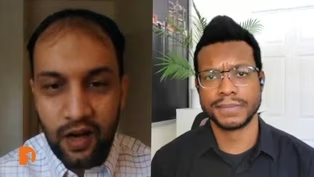
Afghan Journalist Jawad Sukhanyar On Fleeing Taliban Forces
Video has Closed Captions
Clip: S6 Ep4 | 6m 13s | Jawad Sukhanyar details his immigration journey, including escaping from the Taliban (6m 13s)
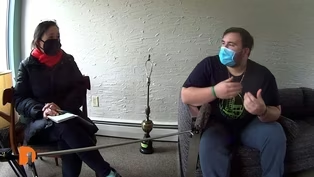
EMU Students Help Afghan Refugees Move Into New Homes
Video has Closed Captions
Clip: S6 Ep4 | 5m 52s | Eastern Michigan University welcomes new Afghan refugee families to campus (5m 52s)
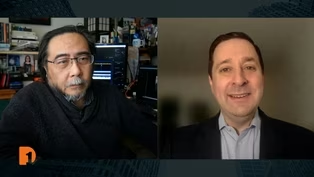
The Impacts of Refugee Resettlement in Michigan
Video has Closed Captions
Clip: S6 Ep4 | 10m 42s | One Detroit's Bill Kubota examines the state of immigration in Michigan and it's impacts (10m 42s)
Providing Support for PBS.org
Learn Moreabout PBS online sponsorship
- News and Public Affairs

Top journalists deliver compelling original analysis of the hour's headlines.

- News and Public Affairs

FRONTLINE is investigative journalism that questions, explains and changes our world.












Support for PBS provided by:
One Detroit is a local public television program presented by Detroit PBS