
The Story: CHANGE MAKERS
Season 1 Episode 6 | 24m 36sVideo has Closed Captions
Meet people who make a difference, through years of hard work or a strange turn of events.
This episode explores people who make a difference, whether through This episode explores people who make a difference, whether through years of hard-work or a strange turn of events. Featured stories years of hard-work or a strange turn of events.
Problems playing video? | Closed Captioning Feedback
Problems playing video? | Closed Captioning Feedback
Production Support Provided By: Riptide Waters LLC; Texas Parks & Wildlife Foundation; Texas Rural Funders, H-E-B”
The Story: CHANGE MAKERS
Season 1 Episode 6 | 24m 36sVideo has Closed Captions
This episode explores people who make a difference, whether through This episode explores people who make a difference, whether through years of hard-work or a strange turn of events. Featured stories years of hard-work or a strange turn of events.
Problems playing video? | Closed Captioning Feedback
Where to Watch Texas Monthly Presents: The Story
Texas Monthly Presents: The Story is available to stream on pbs.org and the PBS app.
Providing Support for PBS.org
Learn Moreabout PBS online sponsorship- There are people throughout history who have looked around, seen the way things are, decided that they aren't right and decided to do something about that.
- Once development comes on this island, the habitat's gone.
- It looks as if it were a scene from a world war.
Something needed to be done.
- [Isis] Whatever you do, stand up for your rights.
- I think that's what makes them an inspiration to all of us.
(bright music) (bright music) (computer keys clacking) (dramatic music) - I really love stories where an ordinary person sets in motion extraordinary things.
The hero, like, "I was just doing what anybody else would do."
What they're doing in some sense may be ordinary, yet the fact that they did it, they made the effort, they went the extra mile, that's what makes them extraordinary and can make them an inspiration to all of us.
(bright music) My name is Forrest Wilder.
I'm a staff writer for "Texas Monthly" and I wrote "Ghost Wolves of the Gulf Coast."
(dog barking) (wind chime clinking) It was 2008.
Ron Wooten, a long-time Galveston resident, let his dog Scruffy out.
Little rescue.
Scruffy went off and never came back.
- He ran across the ditch near our house and he was attacked and taken off into the field by a pack of coyotes.
I went over and chased them away from his body.
- A lot of people at that point might have reached for their gun.
Ron went and got his camera.
He just became really curious about these coyotes, and as he started documenting them, he noticed that there was something kind of different about them.
- They had longer ears, bigger heads, rounded eyes, and their coloration was much different than what I'd seen in previous coyotes.
- [Forrest] These animals had, like, reddish fur.
They were bigger.
Their features were very wolf-like.
A lot of people think, like, "Well, they're just weird coyotes."
But Ron thought, like, "No, these look like red wolves."
- I was a Bachelor of Wildlife and Fisheries at Texas A&M, so I thought, "Well, maybe we've got some red wolves stuck on the island."
- This would be a huge discovery.
The red wolf used to be abundant across much of Texas and much of the southeast, but through habitat loss and hunting, they were basically driven to the brink of extinction.
There's something like only 20 red wolves left in the wild.
Ron's trying to figure out whether, in fact, these coyotes on Galveston Island are red wolves or carrying a lot of the DNA.
If they have red wolf DNA, it would be a major breakthrough for conservation programs.
(bright music) Eventually he got the attention of two scientists, Kristin Brzeski and Bridgett vonHoldt, who are some of the top researchers in the country on canids.
- I responded saying, "Yeah, I agree.
These pictures do look interesting.
They look different.
But to really do something, I'd need some genetic samples."
- [Forrest] They were able to get samples from Ron and the results were astounding.
- The Gulf Coast canines on Galveston Island retain really distinct genetic information.
So they have what we would classify as red wolf genetic ancestry.
- It confirmed that Ron was correct.
Turns out Galveston Island is this genetic hotspot for animals carrying a lot of red wolf DNA.
- But on top of that, they have this really interesting, important component of ghost ancestry.
- These canids have a decent amount of DNA that I can't identify what it belongs to and I've tested everything.
Is it dog DNA?
Is it gray wolf DNA?
And it fits nothing.
This is actually ghost genetics, which is something we know exists.
They carry it, but we don't quite know what the identity is, and our hypothesis is that this is pre-extinction red wolf DNA.
- [Forrest] It's a ghost in the sense that, like, it comes from some point in the past where there was some intermixing.
- Stuff that was bred into whatever was down here in the red wolf time.
- Because they are carrying this powerful and ancient and rare DNA, they're referred to as ghost wolves.
The discovery of the ghost wolves opens up tantalizing possibilities for conservation.
- As we track these animals, we're looking at their movements, we're looking at relationships.
Came here and then they jumped over there.
And trying to correlate that with their genetic ancestry.
- That's a scat - That's poo.
It allows us to really understand the value of these animals and relay that to the local officials that there's denning sites and pathways, these corridors, that get them safely from one green patch to another.
- There's also different methods that could be utilized to try to capture that lost ghost ancestry, cloning or genome editing, to capture that variation to help both red wolves persist but then also understand how these animals are persisting.
- These coyotes are essentially carrying this repository of red wolf DNA that could revive the species to a healthy population with good genetic stock for the future.
- We can use these different new tools and then good old-fashioned breeding to restore the historic animal.
(bright music) - Galveston prides itself on being its kind of own world.
It's quirky, it's an island, and that's part of the charm of the place and so, like, what better than having some weird, you know, critter named the ghost wolf running around?
Ghost wolves of Galveston island, it just sounds like a cool animal.
(gentle music) The problem is that's in competition with this growth imperative.
Galveston has been just booming.
The real estate market has been very vigorous, very healthy, but a lot of that green space and just habitat in general is being replaced by condos or other types of development.
There's not that much left.
- This is another den habitat, or it was.
There was trees over here, there was more trees over there, there was high shrubbery in here, and it provided some protection for them.
- They don't have as many places necessarily to den.
It's forcing them out into traffic.
They're getting hit.
- One that got hit right across the street from one of these big developments on the seawall, that animal was looking for a place to cross over, but they had put a fence over there.
Once development comes on this island, the habitat's gone.
(gentle music) - [Forrest] The ghost wolves are part of this larger conversation that's happening, frankly, you know, all across Texas where you have a lot of population growth and urbanization.
Like, how much nature, how much wild spaces do we leave versus how much do we pave over and turn into homes and parking lots?
Those are the questions that I think people are asking as these last kind of green spaces are being enclosed upon.
What does this place want to be and what's it all about?
There's so many questions people want to answer about these animals, and so this is the beginning of this story, not the end of it.
I kind of wonder if not for Ron Wooten, would we even be talking about these ghost wolves?
- [Kristin] Ron was all in.
He showed us the different habitats and the denning locations.
- He's a co-author on our paper, the very first paper of discovery, 'cause he's such a pivotal, central person in all of this.
- [Forrest] He's a wonderful poster child for, like, the citizen scientist and I think he deserves a lot of credit for bringing this to light.
(camera shutter clicking) (pages rustling) - I always like to remind myself that just because something is the way it's always been doesn't mean that it's right and I think that there are people throughout history who have looked around, seen the way things are, decided that they aren't right and decided to do something about that.
(bright music) The way she speaks about black hair is with this really deep love.
She describes herself as someone who's challenged the ways that Texas thinks about black hair and Black culture.
(camera shutter clicking) Learning about her background, her getting arrested, how she'd helped change the laws in Texas, this is a part of my history that I didn't know until I heard her name.
(bright music) My name is Doyin Oyeniyi.
I am a senior fact checker and writer at "Texas Monthly" and I wrote "Her Crowning Glory."
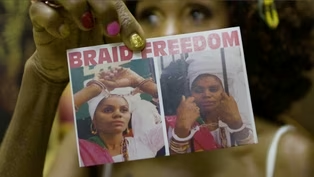
One of the key figures and advocates for natural hair rights in Texas is a woman named Isis Brantley.
(upbeat music) One of my editors at "Texas Monthly" came to me with the story idea and I'd never heard of Isis Brantley before.
- [Assistant] Yes, ma'am.
Okay, let's do a video.
- Peace and love, everyone, and welcome to Naturally Isis.
Peace and love to all my beauties out there.
- How to describe her?
Okay, yeah.
My first impressions is this person is so bubbly and, like, radiant and confident.
- Naturally Isis.
Y'all better come get these Isis locks.
- [Doyin] Growing up with a mother who braided hair, learning about Isis put a lot of my own experience into context and so I wanted to know more about her and to help get her story out there.
(gentle music) Isis Brantley was born in 1958 and she grew up in a historically Black neighborhood in Dallas and experiencing the richness and the support of that culture.
- Braiding on the porches in the community, it was beautiful, and that's really how we learned at a young age.
I loved it.
I absolutely love it, even though it wasn't a style that you could wear out if you wanted to get a good job.
- Isis was studying theater at what is now the University of North Texas.
She started to braid the hairs of her classmates and quickly realized that this was a way to build economic stability for herself.
(bright music) So in 1981, Isis Brantley opened up her own hair salon.
(bright music) In the '80s and '90s, she was someone that people would travel from all over the state to have her do their hair.
One of her well-known clients is Erykah Badu.
As part of her salon, she was also teaching people how to braid and using it as a way to help other women create economic stability for themselves.
However, the whole time Isis was braiding hair, she was unknowingly doing it illegally.
At the time in Texas, to braid hair, you needed a cosmetology license.
To have a cosmetology license, all of it would've been a lot of time and money spent to learn skills that she would not be using in her practice.
Texas cosmetology schools weren't even teaching hair braiding.
Being told that she could or couldn't practice it by people who didn't really even understand what it was she was doing, it felt like another form of enslavement to her.
(dramatic music) She continued braiding, thinking everything was good on her end.
Unfortunately that was not the case.
The police set up a sting operation at her salon, arrested her in front of her clients, took her to jail.
- It was scary.
All my community was saying, like, "It would be better just to go and get the license."
You know, "Don't fight this."
But my other peers and colleagues that were fighting injustice against braiders across the country said, "Whatever you do, stand up for your rights."
(bright music) We are in South Dallas parading for economic liberty and the freedom against the barriers that were put up against braiders and natural hair professionals.
I am not at war with the state of Texas.
I just want my civil rights to be respected and I want that to lead to the next generation.
I wanna pass this gift down.
(bright music) - [Doyin] As I was learning about Isis's story, I was thinking of my own mother.
My mother actually used to own a beauty supply store in Garland and she would also braid hair on the side, including mine and my sister's hair.
For customers, she would braid their hair in the back of the store or sometimes at her house, and it wasn't until I was learning about Isis that I started to understand why she might have not done it so openly before she got her license.
(bright music) In 2015, the court rules the regulations for hair braiding are essentially nonsensical and thereby unconstitutional.
And that same year, Isis partners with the Texas legislators to pass the House bill that deregulates hair braiding in Texas.
- [Isis] We are deregulated.
We are free to practice our cultural art.
People are opening up businesses catering to their people, their community.
- I feel really grateful to Isis.
Every time I talk to her, I feel a newfound, kind of deeper appreciation for my hair, my Blackness, my own cultural background.
- I don't think she gets the acknowledgement that she deserves because she really started this.
(bright music) She's like a superstar.
Like, "Isis does your hair?"
And I was like, "None other."
- As we continue to push piece by piece, piece by exhausting piece, for more progress and understanding and freedom, I don't want people like Isis to be forgotten.
(bright music) (pages rustling) (gentle music) (bright music) - The Big Thicket is unlike any other place in North America.
But having lived and grown up in that area and moved away, I find that most Texans that I encounter really don't know about the Big Thicket.
I don't think I truly appreciated the Big Thicket until I grew a little older and I wanted to revisit that story and the heroes who really saved that space for all of us.
My name is Tess Coody and I wrote "The Mild-Mannered Librarian Who Saved the Big Thicket" for "Texas Monthly."
On October 11th, 1974, Gerald Ford signed legislation that actually preserved the Big Thicket, the first national preserve, but getting there was a multi-decade journey.
So when I first started researching the history and the folklore of the Big Thicket in anticipation of its 50th anniversary, I came across a really fascinating individual, the last of a cast of characters who helped save the thicket, Maxine Johnston.
- You're gonna have to be tolerant with a 95-year-old- - Of course.
- Whose head leaks.
(Maxine chuckles) - A true Southern woman, she greeted me with a pot of coffee.
- I put out four cups for you guys.
Come on in.
- [Tess] She told me story after story of her experiences with congressmen and timber executives and naturalists that represent a lifetime of advocacy and experiences that most folks will never have for even a day in their life.
- [Maxine] I feel sad because I'm the last one.
(gentle music) - Maxine was born in Arkansas, but as a young girl who had lost her mother, she moved to Beaumont in 1942 to live with her sister.
She left behind creeks and woods on her family farm where she'd hide and read books and she landed in Beaumont and looked out over this really stark landscape and she felt adrift.
It's pretty stark and open and it was distinctly different from what she'd experienced as a young child.
So, soon after arriving, she went to school, South Park High School in Beaumont, and she had a really important encounter.
- My English teacher introduced me to Lance Rosier, who was the Mr.
Big Thicket (chuckles).
- [Tess] Mr.
Big Thicket, Lance Rosier, a self-taught naturalist who was regarded as the authority on the thicket.
And through his eyes, she began to develop a deep appreciation for not only its beauty, but its preciousness to humanity.
(bright music) - Went on several trips with him when he was taking groups and fell in love with the whole place.
It's a wonderful place with so much diversity.
- [Tess] In the Big Thicket, you're experiencing everything from arid sandy lands to deep baygalls and marshes.
There are more than 1,300 species of trees, shrubs, vines, over a thousand species of invertebrates, at least 300 species of birds.
Four out of five of all carnivorous plants are in the Big Thicket.
- [Ellen] I mean, if you can name it, it's probably out here.
- Everything is picturesque and lovely and it changes with every season.
(bright music) That's it.
- She felt like she was home again.
So the Big Thicket, before Western civilization kind of started having its way with it, was estimated to be around three million acres of all this biodiversity.
But as timber companies found these precious resources available in the Big Thicket, they practiced what was called clear cutting.
(chainsaw whirring) After experiencing almost a hundred years of intensive logging, the thicket had been whittled down from millions of acres to just a few hundred thousand acres.
Was upsetting the delicate balance of those woods.
(dramatic music) When we see pictures of it now, it looks as if it were a scene from a world war.
After she graduated from high school, Maxine went into work as a librarian at Lamar University's library in Beaumont.
She lived in Batson, which is a small community in the thicket, and would commute into Beaumont for her job at the university.
And, of course, along that commute, she would encounter logging trucks barreling past her.
Knowing that around 50 acres of that precious forest was disappearing every day created a real sense of urgency for her.
Something needed to be done or the flora and the fauna are gonna be gone.
So in 1964, a group of local leaders founded what would become the Big Thicket Association in an effort to get the state or the feds, somebody, to do something to save it.
And quickly, because of her particular skills, her professional skills and her personality, she became their chief clerk.
- That's the only reason that I got all of this damned attention, because I was the clerk (chuckles).
- [Ellen] She deflects that she did anything, but she was the ultimate organizer and diplomat.
- In her capacity at the library, she was the person who had access to scientists and biologists.
She was the place where journalists and elected officials, politicians, would go to get the facts.
And because she had the ability to move between all those worlds, folks began to trust her.
On the ground where clear cutting is happening and conservationists are active, you know, there was actual conflict.
As a librarian and as a person, Maxine had that right combination of humility and diplomacy that enabled her to build really important relationships with folks like timber executive Arthur Temple or Congressman Charlie Wilson and keep the conversation moving forward.
- He actually did say, "Maxine was stubborn and aggressive and a sweetheart."
(chuckles) I couldn't believe it.
(gentle music) - At some point, it became clear that something was going to get preserved, but how many acres and where raged for years.
Maxine assisted a gentleman named Billy Hallmon, who she calls the architect of the Big Thicket, to designate boundaries that would ensure the most important parts of its biological diversity were captured and preserved.
- We would send the maps to Charlie Wilson and then Charlie would in turn send them to all the timber companies and say, "Do not cut in these areas, please."
We saved a lot of acres.
- Eventually they landed on the 84,550 acres that were in the original legislation, which Gerald Ford signed to create the Big Thicket National Preserve.
But the work is not done, and while it's no longer the timber companies that are as present, the dangers are real.
There is considerable risk to the thicket by way of new development, TxDOT expanding highways and infrastructure.
- We picketed in front of TxDOT.
Maxine was there.
She spoke.
Yeah, they only give you three minutes and then the judge's buzzer goes off.
Well, Maxine doesn't hear well, so the buzzer went off and Maxine just kept talking and they weren't about to tell her that her time was up.
- I came to understand through this story it takes the loud voices who yell and it takes the quiet voices who compromise to get big things done.
It takes that person who's willing to give everything to achieving something bigger than themselves.
- They made the effort.
They want the extra mile.
I think that's what makes them extraordinary and can make them an inspiration to all of us.
- It gives us all a foundation for how we can be better as a state or a country or a world.
(bright music) - [Maxine] I don't know why we're doing this.
(Ellen chuckles)
Video has Closed Captions
Preview: S1 Ep6 | 30s | Meet people who make a difference, through years of hard work or a strange turn of events. (30s)
Providing Support for PBS.org
Learn Moreabout PBS online sponsorship











Support for PBS provided by:
Production Support Provided By: Riptide Waters LLC; Texas Parks & Wildlife Foundation; Texas Rural Funders, H-E-B”