
The Tallest Dwarf
Season 27 Episode 8 | 1h 25m 55sVideo has Audio Description
A filmmaker seeks belonging in the little people community and explores dwarfism within her family.
The Tallest Dwarf follows filmmaker Julie Forrest Wyman as she searches for her place in the little people community and unpacks rumors of dwarfism in her own family. Through intimate stories, creative collaborations, and archival history, the film delves into identity and medicine, asking whether society should change people or the structures that limit them.
See all videos with Audio DescriptionADProblems playing video? | Closed Captioning Feedback
Problems playing video? | Closed Captioning Feedback
The Tallest Dwarf
Season 27 Episode 8 | 1h 25m 55sVideo has Audio Description
The Tallest Dwarf follows filmmaker Julie Forrest Wyman as she searches for her place in the little people community and unpacks rumors of dwarfism in her own family. Through intimate stories, creative collaborations, and archival history, the film delves into identity and medicine, asking whether society should change people or the structures that limit them.
See all videos with Audio DescriptionADProblems playing video? | Closed Captioning Feedback
How to Watch Independent Lens
Independent Lens is available to stream on pbs.org and the free PBS App, available on iPhone, Apple TV, Android TV, Android smartphones, Amazon Fire TV, Amazon Fire Tablet, Roku, Samsung Smart TV, and Vizio.
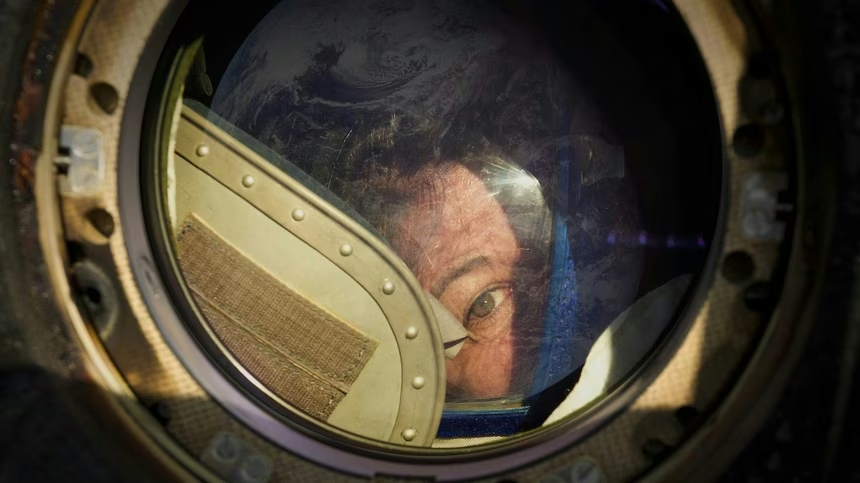
Sci-Fi's Take on Real Space Isolation
From 2001: A Space Odyssey to Moon, Project Hail Mary and Star Trek's holodeck, explore the psychological challenges of astronaut loneliness found in sci-fi, drawing parallels to real-life ISS experiences and proposing solutions like virtual reality companionship and induced hibernation.Providing Support for PBS.org
Learn Moreabout PBS online sponsorshipMore from This Collection
Films that shine a light on disability.
Video has Audio Description
When her eyesight begins to fade, a film editor reimagines belonging and what it truly means to see. (1h 24m 45s)
Video has Audio Description
A filmmaker investigates assisted dying through the lens of disabled voices missing from the debate. (1h 23m 41s)
Matter of Mind: My Alzheimer's
Video has Audio Description
Three families are transformed when a loved one is diagnosed with Alzheimer's disease. (54m 20s)
Video has Audio Description
The central mystery of this unconventional documentary is the nature of sound itself. (1h 25m 17s)

Matter of Mind: My Parkinson’s
Video has Audio Description
Three people navigate their lives with determination in the face of Parkinson’s disease. (54m 41s)
Video has Audio Description
Three people with ALS confront complex choices in this intimate exploration. (54m 42s)
Providing Support for PBS.org
Learn Moreabout PBS online sponsorship♪ ♪ [Gentle ambient music with bells] ♪ [Pounding beat playing] ♪ [Musical elements build] ♪ [Bright, poignant music playing] ♪ [Gentle electronic melody] ♪ [Music fades] Julie: So, um, maybe you guys can start by just telling me who you are.
Okay.
I'm Genevieve, Julie's mom.
Julie: You can say, like, "Your mom."
Hmm?
You can talk to me.
Oh, okay.
I'm your mom.
You know that.
[Julie laughs] Don't you?
I'm Forrest Paul Wyman, your father.
Julie: Thank you.
So, when did you notice that I had shorter arms and legs?
Like, that I had the proportions I have?
I would say maybe not until you were in high school.
Mm-hmm.
I agree.
Totally agree.
Julie: I remember when I was a little kid, you know, when we moved, every time I went to a new school, people would call me, like, "Oompa Loompa."
Genevieve: Wow.
Or... But didn't I talk to you about that?
You mentioned that... You mentioned that, yeah.
...you got that... that someone called you that.
Yeah.
I think you did mention that.
Or people would just stop me on the street and say, "What's wrong with you?"
Genevieve: What?
Yeah.
But don't act like I've never told you this, 'cause... Genevieve: No, I don't remember you telling us that.
And I was never with you when someone stopped you.
Like, "What are you?
What's wrong with you?"
Like, I got that a lot.
I just thought you had a great body.
I didn't-- I didn't think of your body as unusual.
Um, my memories are really different than what you're describing.
Genevieve: Huh.
But when I took you to the pediatrician for some other reason, he commented, right in front of you, he said, "Is there dwarfism in the family?"
And I just looked at him, and I said, "Not that I know of, but my husband has short arms and legs and a longer trunk, and I think Julie's body may be similar to his."
You know, he said, "If we had noticed this earlier, we might have tried giving her drugs."
Julie: Really?
Growth... growth... Paul: Mm-hmm.
...hormones or something.
Yeah.
When that pediatrician said that, I was shocked.
Paul: I mean, you were just a normal child.
Did you really think of me as normal?
Genevieve: Yes.
You looked... Absolutely proportioned.
...absolutely proportional.
Yes.
Julie: Huh.
[Bright rhythm playing] ♪ Julie: So what does it mean, "proportional"?
You've seen this Leonardo da Vinci drawing, right?
Paul: Oh, that does say Leonardo da Vinci.
'Cause this is the ideal man.
Yeah, it is.
I mean, look at him.
Oh, he looks very ideal.
Looks like such an ideal.
So I thought we could see how these proportions relate to our own.
We can do the first one here.
"For the human body, so designed by nature, the face from the chin to the top of the forehead and the lowest roots of the hair is a tenth part of the whole height."
Yeah, I'd say that's eight.
Does that look like eight?
Uh-huh.
[quirky up-tempo melody playing] Okay.
This is... Got you... [Measuring tape snaps] [Paul gasps] Oh!
Sorry.
From the wrist to the end of the middle finger should be just the same.
So I guess the idea is you should go like this.
Oh, yeah.
To see if your... if your proportion is right.
♪ Paul: Up?
Yeah.
Put your legs-- Spread your legs apart a little.
Yep.
A little more.
Hands up.
Get your hands up higher.
Up, up.
Paul: Okay, so, your arms are going to come out like this, flat.
Thumbs down.
Put your thumb down between your middle finger.
Touch your middle finger with your thumb.
That's it.
♪ Julie: So it's not really that different from, like, normal proportions.
Paul: It's off by about ten percent, and that's probably enough to make us look different.
[Gentle music playing] ♪ [Pulsing bass line begins] ♪ It seems like there are hundreds of kinds of dwarfism.
Paul: Yeah.
♪ I just want to know what we are and if there are other people like us out there.
♪ [Loud tone] [Crowd chatter] [Timid melody playing over tone] ♪ [Chatter] Mark: Everybody having a good time tonight?
[Applause, cheering] This week is all about the connections.
It's about all of us getting together and having those experiences that you can only have here, these once-in-a-lifetime, life-changing moments.
♪ [Music builds] ♪ Mr.
Kitchens, what do you do as little people in a group like this?
Well, naturally, our meetings are more of a social group, but the intent is to get little people together to help them solve their mutual problems, such as where to buy clothes, and how to rebuild a car so you can drive it, and the other day-to-day things that beset a person that is not designed to fit the rest of the world.
♪ [Music intensifies] ♪ Interviewer: How little do you have to be to be in the little people organization?
You must be under 4'10".
[Gentle music continues] [Laughter nearby and crowd chatter] [Music fades] [Crowd chatter fades out] "Balance leaves on your back and ignore the soreness spreading through your many legs.
Bring food to the hill.
You all rely on each other.
If you collapse or get stepped on, the others will place you on their backs and return you home."
[Applause, cheering] All right, so welcome to the open-mic night hosted by the DAC.
That's the Dwarf Artist Coalition.
[Whooping] Thank you.
And if you feel like it's time for you to come up here and share your story, it is.
Jack: "He asks me what I am, and I say nothing.
Lurching towards me, I glare down towards the linoleum.
He tells me that God wouldn't make something like me.
I do not suffer from dwarfism.
I suffer from the maltreatment imposed upon me because of my dwarfism."
Julie: Okay.
Okay, here we go.
I got it.
That good?
That's good, just that much.
Yeah?
Yep.
[Soft, poignant instrumentals] I'm not the same as you all.
I know that.
When I see you, I feel less alone.
I'm trying to, you know, enter and connect and be part of this place that I've really... you know, feel so much connection with.
Um, and this workshop is a chance for me to kind of share some of what I do with you, and invite you to make a portrait of yourself.
Physically say, "Oh, I need the angle up here"?
Julie: Mm-hmm.
Oh, so we ask your crew?
Julie: Yeah, so I want you to direct... Like, we direct.
...the camera.
[Playful bell rhythm plays] ♪ Julie: There we go.
Okay.
It might be easier for you if you put your hand up.
Okay.
And what you're gonna want to do is go get up close to... [Kate grunts] Julie: Are you okay?
Kate: Yeah.
Like that?
Yeah.
Do you know where... Yeah, I do.
Focus is in the front... Okay.
[Scattered clapping] [Gentle music continues] ♪ [Chatter, laughing] That looked really nice.
Woman: That was cool.
Woman 2: That was lovely.
We figured it out.
Sofiya: That was awesome.
[Music fades] Sofiya: I'm just so overwhelmed.
I feel like I was able to-- and through your workshop and mine, it just felt like we gave people a chance to be seen, you know?
And-and they wanted it.
[Laughs] Julie: Mm-hmm.
Mm-hmm.
Yeah.
So, it's like the need is there more.
The need to be accepted.
It's just so important.
Why do you think it's needed more and more?
Well, I think that we are a community that is invisible but always on display.
Julie: Hmm.
We're invisible in the sense of, like, sitting on a chair or trying to navigate a kitchen, the architecture of our spaces, the way the world works-- they're not thinking about people that are 5 feet and below.
You are not expected.
We are not-- However, we'll just stare all day.
It's always like... [Condescendingly] "Oh..." Yeah.
Yeah.
"Good for you."
It's so, like-- Wow!
Yeah, patronizing.
Yeah, and it's like-- Fetishizing, and... Yeah.
But I also really believe that images can also shake up those exact things, you know, and can, like, knock them down.
Right.
Like, I really... I really... think that.
I agree.
[Gentle, lilting melody playing] ♪ It's just so weird, like, the narrative that Mom and Dad gave.
They were totally like, "You were normal.
We were all normal.
There was nothing... We never thought there was anything wrong with your body.
We never..." [Laughs] What?
That's such a lie.
But, you know, it's interesting, because you guys would always kind of talk about how you needed the right chair for your feet to hit the ground, and... Yep.
I mean, I wasn't born with dwarfism in the same way that it would be like, "What does this kid need, and what adaptations and stuff?"
Right.
You were kind of-- I was just a little different.
It's a subtle difference.
Yeah.
It was a big deal in our-- It's not that subtle.
No.
[Pamela laughs] Like, with you standing next to other kids, I think that, visually, it was pretty obvious.
Yeah.
I definitely remember getting in fights with people about your body.
Really?
Yeah.
Whoa!
I remember people being like, "Why does your sister have such a big butt?
Why does your sister look like a dwarf or a midget, or...?"
Yeah, I definitely remember, and then I'd, you know, get really pissed.
But I remember maybe Mom almost, like, brushing over it.
This is the way she put it.
"We are not the kind of people-- Yes.
...that have those problems."
The message I was given, not just by our parents, but by the world, is, like, it doesn't matter what you look like.
That's the only antidote to feeling bad about the way you look, is to say, "It doesn't matter what you look like," which is really different from saying, "You have a big butt, and it is fantastic."
Yeah, I wonder how that would've been for you, growing up with a different attitude around that.
Yeah, I guess that's what I'm trying to figure out.
[Loud thrum of passing traffic] [Car horn blaring] Sofiya: Welcome to the How We Look Project.
We are so honored that you are part of this core group of LP performing artists, whom we are launching this creative process with.
Julie: The project is really about, how have we as little people been seen, and can we reinvent that?
Matthew: Here I am.
Aubrey: I see you.
Mark, Julie, and Sofiya: I see you.
♪ [Thrumming music playing] ♪ Sofiya: You know, we have very unique experiences with cameras, right?
We get our picture taken without our consent.
And so, we really want to make it clear that, like, this is our space where we have power to tell the stories we want to tell.
Sofiya: I like tracing your thumb.
[Laughter nearby] [Laughs] My thumb?
Yeah.
Just my thumb?
Just your thumb.
'Cause it does a little bend, like mine.
Hmm.
All of my other fingers can go -- themselves.
Ha!
Yeah.
The rest of them are-- You tell me how personal I can get.
Oh, yeah.
No, you're fine.
Okay.
Sarah: I wish this was permanent marker.
That's what I want to really do is just permanently mark your body.
Aubrey: Right?
Mark: Everybody's finished, and I haven't even gotten halfway done.
They're all having cigarettes-- They're all getting lunch.
Yeah, at the bar.
You know, that's what happens when you... when you hang out with a tall person.
Right.
[Laughs] [Laughs] Aubrey: I'm just gonna go halfway.
Sarah: You can go wherever you want.
I have no qualms about my vagine.
Julie: I'm gonna start here.
I'm curious about acting and what drew you to that.
Mark: I think I was always drawn to acting, being born so profoundly different.
Every time I'd go outside of my house, people would stare at me.
I felt like I was constantly on display.
Acting gave me an outlet to control, to some degree, what other people thought of me.
And I loved that.
I loved that power.
If you're gonna laugh, I'd rather it be something I said, a line I said, than that I was just walking down the street or grocery shopping, or whatever.
A star is born.
I want to wear you.
I kind of look like a sea creature, but I love that.
You look like a merman!
Totally merman vibes.
I feel that.
Aubrey: You can totally see the ass for days up here.
Sarah: Ass for days, baby.
You're a magical creature, I guess.
I'm a magical creature.
I put mine so high up.
Well, you have an aura.
It takes up space.
I don't know if that's it.
And I'm also, like, conveniently separated from everyone else.
What was I doing?
Mark: There's a lot going on there.
Yeah.
Julie: What do you guys think?
Does this feel like-- How do you feel with-- about looking at these and... Mark: I-I thought the tracing part was fun.
I found this to be extremely unenjoyable.
This reminded me of seeing x-rays of myself and having doctors analyze, like, the physics of my body.
It's something I have no control over.
And this is not me.
Like, I... This is flat and static and doesn't have a shape, really.
Aubrey: It's like when you see an unflattering photo of yourself... [Laughter] ...where it's, like, overexposed, so, it's like, you can see the beauty, but it's like, you can't... like, all washed out.
Julie: It doesn't see you.
Aubrey: Exactly.
[Pensive instrumentals playing] ♪ [Playful electronic beat layers in] ♪ Leslye: So are we gonna jump to the archive?
Julie: Yeah.
[Straining] I'm just gonna hand them down.
I mean, there's a lot.
Before Bruce and I even got together, he collected images of dwarfs and had the archive.
And then after Bruce passed away, it became, you know, really more important to me.
He wrote to every major gallery in Europe and said, "Do you have any images of dwarfs?"
and that's how he collected that part.
So there's dwarfs in art.
There's dwarfs in history.
There's dwarfs in entertainment.
There's medical-- Julie: Science?
Yeah.
Medical, science theme.
Um, sports.
I mean, he covered every category, basically.
Ellen: If you showed these pictures to the ten-year-old me, it would be like, "Wow, I have never seen any other little person that's Asian."
What happened to these people?
Are there great-grandchildren?
Do they have dwarfism?
And how are they living?
God.
I mean, all of it is about the gaze, right?
Leslye: Mm-hmm.
Exactly.
The gaze turned on us.
Exactly.
All these images have definitely influenced the way that we're perceived and the way that we're described and we're talked about.
This is part of our history.
Rachel: Our history.
Yeah.
Julie: We've shifted from... Rachel: This is a sample.
...carnival to medical.
Yeah, this is all medical now.
Julie: I think it's really kind of gawky.
Leslye: Shock value.
Shock value and gawky.
Ellen: Well, that is-- Julie: What I'm asking, "What makes the gawk--" Leslye: Inspiring versus gawking.
Yeah, and not inspiration porn, but just, like, appreciation.
Ellen: Appreciation versus gawking.
Julie: Yeah, what's the difference between those things?
Rachel: It's a felt thing.
Julie: Is it who looks at it?
Leslye: I think it's the viewer.
It's the framing of it, but there's a big piece that is your own emotional reaction to it.
But some of it is hard to quantify.
It's one of those, you know when you know.
Exactly.
I mean, here you go.
You know, and this is the early stuff.
That's why-- Is that Tom Thumb?
Yes.
So, these are performance troupes, it looks like.
[Unsettling notes resonating] ♪ Leslye: Those are pituitary dwarfs.
Rachel: Their bodies are usually described as "proportionate."
People like us, with achondroplasia, get described as "disproportionate," even though I think we have lovely proportions.
We do.
[Laughter] Ellen: We do.
Julie: Yeah.
[Solemn music playing] ♪ Leslye: That whole population has dwindled.
Ellen: Because scientists found a way to "fix" pituitary dwarfism.
Julie: Yeah.
I've been trying to figure out what drove those scientists, like, how they thought about their work.
[Music intensifies] Herbert McLean Evans: Eventually, it is hoped that humans who are undergrown will be made normal.
♪ Rachel: You're seen as an anomaly, as opposed to just existing.
♪ Eberle Kost Shelton: No one can appreciate the inferiorities with which many of these persons are afflicted.
Even a moderate amount of growth is eminently worthwhile... unless, of course, the individual wishes to commercialize his or her dwarfism on the stage or in the circus.
♪ Julie: It's like they were these prized spectacles for audiences, but, for doctors, they were specimens that needed to be fixed.
♪ Rachel: In some ways, to me, in terms of medical interventions, pituitary dwarfs represent our canary in the coal mine.
[Music intensifies] ♪ Theodore T. Zuck: I have never seen such growth in any child take place at this rate.
Man: We've made these children grow a combined total of 11 miles!
[Music tempo quickens] ♪ [Music falls off abruptly] [Gentle instrumentals, heels clicking] ♪ Julie: But what does it mean to just not have this type of body in the world anymore?
[Scuffing, heels clicking] ♪ [Escalators rumbling] ♪ [Gentle instrumentals playing] ♪ Chandler's mom: This looks like you, Chan.
I don't like the buttons.
Oh, okay.
Chandler: But I do like this.
I don't think that any of these fit me.
These are leather.
Ohh... Julie: I kind of want to hear about that sense of knowing there was a different way you wanted to be.
Chandler: I had always felt like I was just never in the body I was meant to be in.
Julie: What are some specific moments when you're like, "Now, I'm in this body that feels right"?
Chandler: After my lengthenings, I realized I was treated more my age because I looked my age.
I'm able to drive without adaptations in a car.
And, you know, I can walk a busy city street without worrying about being trampled over.
Every time I go into a changing room and I can put on a pair of pants that falls where it should fall, it's just one of those things where it's just like, "Wow."
Like, I just love looking in the mirror at it.
[Music fades] Julie: Where do you, like, adjust it?
Well, this one doesn't have struts like that I did.
And so, for the adjustments on this, it's probably, like, these things, but it's like the same concept.
So, like, I didn't have this part just similar to what this is.
Doctor: Do you have any pain with those screws up there?
Chandler: I don't think so.
It was kind of the underlying hip issues that were kind of being hidden by the rest of the deformity.
I think it'll get better and better.
So that's, uh, a lot of work.
It's 14 inches.
It should be.
A lot of work for you, yes, and some growth.
Do you want to walk the hall?
Let's see now you're walking.
Sure.
[Gentle music playing] ♪ Julie: Do you still identify as a little person?
Chandler: I guess before lengthenings, the fact that I had dwarfism was just never part of my identity.
I just had it.
So many people would always tell me, like, "Well, God made you this way because it's the beautiful body you're supposed to be in," whatever.
There are people who have had to work for the body that they've wanted.
They had a major weight loss or maybe even a weight gain.
And so, it's just when you finally have accomplished that, I mean, it's just a whole new world, and there's no other way to really describe that.
Julie: Wow.
My story was kind of different.
[Julie sighs] I always felt so pressured to change my body... and I didn't know what to do with that.
♪ [Bright, quirky electronic music playing] ♪ Girl's voice: "In Between: The Journal of a Girl Going through Adolescence," by Julie Wyman.
I'll tell you about me, myself, and my life at this point.
Looks.
Well, about looks, my hair's my favorite part of me.
It's honey brown and very thick.
My hands are probably my most prized possession.
They're probably the only part of me that's "normal."
If you cut off the bottom half of me, I'd be pretty good-looking.
♪ Perhaps I now realize the reason I'm greeted with such hatred at my school is that I am different.
Most everything about me.
So I'm planning to, next year, seventh grade, come to school as a brand-new person.
Outside, that is.
[gentle dramatic music playing] School just started, and I'm so different now.
[Julie reads along] How could I have ever wanted to be one of those gross, "popular people"?
Seriously.
[Julie alone] That Julie is gone.
Those Julies, gone.
First of all, I'm losing weight.
Period.
I'm not going to explain it anymore.
I believe it, so I don't need other approval.
Secondly, I'm finding me.
I'm independent, sophisticated, and confident.
Goals.
Lose 25 pounds.
Lose 21 pounds.
Raise self-esteem.
Learn to visualize self as a thin person.
♪ Changes.
Firmer all around, longer legs.
I, Julie Wyman, am a naturally thin person.
I do what thin people do.
[Echoing] What thin people do, what thin people do... [Echoing, overlapping lines] And I am 110 pounds.
[Echoing] Higher self-esteem, longer legs.
[Music intensifies] ♪ [Overlapping, dissonant musical melodies playing] ♪ [Music becomes cacophonous] [Music fades quickly] [Water lapping] Julie: I think there was one time when you were talking about this process of limb lengthening.
Right.
Uh-huh.
I guess I'm wondering, didn't you think about that for me?
No.
No.
Unh-uh.
I thought you talked to me about it one time.
I do remember us talking about it.
I think what I remember is you saying maybe it was too late for you to do it, but I could do it.
And it seemed like you kind of wanted me to think about it.
Paul: Uh... I think I remember that.
Yeah.
I had always wanted to have some kind of an easy surgery to get taller.
I thought it should be possible.
I definitely remember thinking, "It's too late for me, but if the technology improves, it might not be too late for you."
[Intense music plays] I just remember struggling to accept the body I have.
And you were telling me I was in need of correction.
Well, I think I just, uh, wanted it to be easier for you.
[Music softens] ♪ [Children chattering] ♪ Julie: I keep thinking about... the doctors telling Mom about growth hormone.
Paul: Yeah.
Yeah.
She was against it.
[Gentle, upbeat music playing] It's weird that back then they were researching it right near us, over at UC San Francisco.
Yeah.
That must have been in the '70s.
Julie: Yeah.
Growth hormone was scarce.
The government was rationing it.
And people would send all these letters to the lab.
Woman 1: My brothers and friends say that I am too short.
I can't bear this.
Please, help me increase my height.
Woman 2: She's a pretty sweet girl but hasn't a boyfriend for the simple reason she's 4 feet 7 inches tall.
Woman 3: He is withdrawing and beginning to give up.
Please help him.
Please.
Teen boy 1: I'm 5 feet 5 and desire 5 to 6 inches over my existing height.
Woman 4: If he remains at the present stature, his future will be very cruel for him.
We are ready to send him to your laboratory.
Woman 2: She's quite willing to be a guinea pig.
Woman 5: She is not a dwarf and is an "A" student.
Teen boy 2: Please, help me.
Send the hormone quickly.
♪ [Music fades] [Extended, poignant note playing] Julie: So, Dad, did you ever want me to take growth hormone?
Paul: Well, I'm glad you didn't, because I think it was risky.
Julie: Yeah.
Back then, they sourced growth hormone from cadaver pituitary glands.
Yeah.
I think I knew that.
And some of it from other labs around the country got contaminated, which caused this horrific disease, and people died.
Wow, I had no idea.
[Dissonant music playing] Julie: And that's why the FDA fast-tracked synthetic growth hormone, the drug that launched the biotech industry.
[Epic pulsating music playing] [Indistinct chatter] ♪ [Music softens] [Schoolyard chatter] ♪ [Measuring stick clicking] ♪ Mark: You know, there's a lot going on in the pharmaceutical technology laser-focused on our community, specifically our children.
How does this affect LPA, and how do we as LPA move forward on this journey?
♪ Making people taller.
Should we be doing that?
The trials that are going on... Female speaker: This is the most common short stature condition.
So the new drugs that are being developed for achondroplasia, the primary outcome that the trial is designed on is for height, because that's attainable... [Male speaker] We have to think about the level... Mark: The goals we want, I think, as a community are a relief from spinal stenosis, foramen magnum, bowed legs.
The focus on those mechanical issues, even with children, versus the focus on extra inches, their self-worth is still informed by who they are, not by their size.
[Applause] Whatever size they have... Woman: How do you safely involve your children in a clinical trial?
Female speaker: There are many, many, many risks because it's a drug that has not been used for a long period of time.
So, even thinking about fertility, we have no idea what the influence is down the road.
♪ [Children giggling, shrieking] ♪ Nic: These kids, who knows if they're going to end up with cancer or sterile.
I mean, they're literally guinea pigs in a trial study.
Everyone here has had surgery, so we have had things fixed, but that didn't change the genetic structure.
That didn't affect our community.
What's scary to me about it is they're gonna start targeting young parents, average-height parents like my parents, who don't know and are scared, and they're gonna get to them before we can get to them.
They care about their kids.
Sarah: Of course.
You know?
But they have a fear in them that they're not going to be able to do anything.
If they could have these extra 4 inches or 5 inches-- which I would argue is not going to change their life at all.
I don't wake up every day thinking, "Oh, my gosh, I'm short."
And, you know, I couldn't reach, uh, things.
You know?
Get a stool.
Like, if that's your biggest issue... I have no problem going to the pharmacy, asking the teenage stock boy, like, "Can you hand me those regular tampons?
No, not the lights, the regular.
Right th-- Thank you.
Blue box.
Thank you."
I feel like I'm on "The View" right now.
[Laughter] Yeah.
So we're gonna each share our poems through movement.
Matthew, do you want to go first?
Matthew: Yeah.
My liberation is a beautiful thing.
[Tender, building instrumentals playing] ♪ Sofiya: And what I'm hoping you can find in your own individual exploration is a repetitive movement that feels liberating.
♪ What does it mean to liberate your body?
♪ [Music fades] I danced for 12 years, and my feet were like, "Sorry, no more."
And worked with a doctor that said he could do surgery on me.
And he tried, but I was in bed for a year and a half.
I missed my senior year of high school 'cause he didn't really know about dwarfism.
He assumed dwarfism was all one thing.
Fractured my hip and had doctors just tell me, like, to get over it-- I don't know why, like-- or not know what to do.
And then I found my orthopedic surgeon.
For the last three years, I have no pain, and that was never something I thought would be possible in my life.
One thing we have been sort of talking about is, could we make a film about the power dynamics?
Well, we all have those stories of awkward scenarios, perhaps, um, with a doctor or two.
We're definitely interested in the hard stuff.
Aubrey: "Aubrey, nine, a young boy with dwarfism, stands in the middle of an empty, dark x-ray imaging room.
His bare skin is covered in imaging pads, like he's doing motion-capture work for James Cameron."
[Laughter] Sarah: "Doctor walks in."
"Look at you!
Remember before?
You could barely walk!"
"Hi, doctor.
How are you?"
"Get up and walk for me."
[Aubrey, hesitantly] "Okay..." "Gets up and walks down the hallway, concentrating very hard on not waddling at all."
We literally wrote the same scene.
I'm not even kidding, that same, like, pretending not to waddle.
"Aubrey looks down at his feet.
His attention is redirected to a hushed, intense conversation between two people happening outside the room."
Sarah: "Worried about... but will he be able to have children?"
"Can you come up to the table?"
"Sofiya cannot get on.
Doctor picks her up."
"Is it okay if the residents come in to learn?"
[Snorts] "Sure."
[Sofiya laughs] "But it wasn't okay.
I felt like a guinea pig being poked and prodded my entire childhood."
Julie: "I notice your physique.
Do you have a family history of dwarfism?"
"Not that I know of, but are you saying that I terminate a pregnancy because of this?"
Julie: "Well, [Clears throat] I'm not sure.
But one thing I can tell you for sure is that anyone with that condition..." "Yes?"
"...they all have excellent personalities."
[Laughter] Sofiya: Wow, a real fun... Sarah: That's their medical research.
Jokey!
Julie: I was like, "Thank you."
Aubrey: "You guys are so sweet.
And can I call you 'little man'?"
[Laughter] Julie: No.
Mark: At least they asked.
Sarah: Amen to that.
No.
Oh my God, true life.
Aubrey: All the time.
[Bright melody playing] Julie: Okay.
Arms out to measure distance.
Okay.
Fingertips touching.
Hands down.
Okay.
Okay.
Are we rolling?
Yep.
♪ Genevieve: What do I think of it?
Julie: What do you think?
Like, what's your take on it?
Do you get why I want to get tested?
Genevieve: Well, you know, I mean, that's your choice.
I just don't think giving it a name or putting it in a category such as "dwarfism" is something to be concerned about.
It's just not, to me.
It's just... Yeah.
I mean, what's-- You know, what's the problem?
Julie: I don't know.
Is there one?
It doesn't have to be a problem, though.
For me, a diagnosis wouldn't be about finding a problem.
Like, I'm not looking to be "fixed."
[Electricity buzzing] [Gentle, meditative instrumentals playing] ♪ [Cell phone chimes] Julie: Hello?
Woman: Hi, Julie.
I'm calling from the genetic counseling office.
Oh, wow.
Okay.
So, you did measure disproportionate.
You know, the upper part of your arm, the upper part of your leg.
Okay... But the results are still inconclusive.
Hmm... We don't have a diagnosis... yet.
Huh... But there's one more test you can take, a genetic test.
Hmm... Ellen: You're 5 feet tall, right?
Yeah, I'm 5 feet tall.
I, like, broke the threshold.
We know other LPs that are 5 feet.
You do?
Yeah.
Julie: Wow.
Ellen: But there are people that have dwarfism that are your size that want nothing to do with us.
Leslye: Yes.
Ellen: But you want to be part of us... Yeah.
...even though you can easily just blend in.
I can't easily.
I mean, I can.
But I can't.
More easily than we can, right?
More easily than we can just blend in.
You know, I think because I didn't quite know, like-- there's been a sense of loneliness with it, really.
That's what it is.
Yeah, so... Yeah.
Wow.
Yeah.
[Inhales deeply] Leslye: I can't believe your family never wanted to... to know.
Julie: Yeah.
Isn't that weird?
Like my dad, I've talked to him about it a lot, and he was like, "We're just kind of short."
Yeah.
But it didn't... Julie: It just wasn't the same kind of thing.
Whereas, for me, I was just like, "I really want to know."
And now I'm just waiting for the results of my genetic test.
But the whole idea that there's a gene for dwarfism, wasn't that kind of the root of these new therapies?
Leslye: I think it was.
[Gentle music playing] Julie: This is how I found you.
Leslye: Yeah.
Yeah.
That's me.
Julie: And Billy Barty was there?
Just doesn't seem like an ordinary scientific announcement.
I think he felt it was important for the general public to see that these are human beings who we're talking about.
It's not just this abstract gene kind of thing.
He didn't say anything about eugenics, but, you know, that was sort of always... kind of in the background.
They didn't ask us any questions.
They just took a lot of pictures, and there was a lot of applause.
Julie: Did you ever read, in the LA Times about the doubts he had?
Leslye: I don't think I did.
That's what really got me.
♪ Wasmuth: Once you find the mutation that causes the genetic disorder, and you put the information out there, people can use it in any way they want.
And I guess that's what bothers me.
You hope it will be used to the benefit of everyone, but you know that it's not always going to be the case.
We had no idea of the implications of splitting the atom.
What should be tested for?
And should we test everybody?
What disease do you eliminate through abortion, and what disease do you sort of just let alone and say, "Let natural evolution take its course"?
[Gentle, dramatic music playing] There is a good possibility that this gene is involved in something beneficial, something important that we haven't found out about yet.
It seems obvious at first, just get rid of this horrible, defective gene.
But I'm worried that we won't have the insight to manage such things wisely.
♪ [Music fades] [Rebecca speaks indistinctly nearby] There we go.
And... close this.
There we go.
There we go.
[Softly] Peanut butter first.
And then... Are you really gonna sit here and... [Giggling] You're a mess.
You're a mess.
I wanted to [Indistinct].
I like actual peanut butter on my sandwich.
Like, not just like... I put that... Did you know after I put that on, it wouldn't come off, so I had to eat it.
So you ate my peanut butter?
No, off the spoon.
Really?
Julie: I am really interested in how people relate to their bodies and what our bodies tell us, and how we think about them.
Rebecca: Yeah.
I mean, when I was a little girl, my mom would never say anything negative about her body in front of me.
Every now and then, she'd say things like, "Well, I want to be healthier," but it was never, "Oh, I don't like how my body's built."
There was never anything like that.
[Background chatter] Your hair, I love it, and it's amazing.
And it's so long and so beautiful and so thick.
But when you make a sandwich, you don't want it to get in what you're making either.
Rebecca: The thing is, for us as a community, we don't see our lives as conditions.
We see them as cultures.
Julie: Tell me about dwarf culture.
Rebecca: You know, dwarf culture is seeing the beauty in dwarf bodies.
Dwarf culture is knowing that we're the reason that 747s were able to fly in the air, because United specifically hired little people engineers, because we could literally stand up inside the engines and fix the planes to make them fly.
Dwarf culture is your other friends with dwarfism celebrating the fact that you're pregnant and actively saying, "Oh, I hope it's a little person!"
And then when you have your third child, and your third child's average height, they're like, "Well, I guess that's all right.
We'll figure out how to accept them."
Roughly 80% of kids with dwarfism are born to parents that don't have dwarfism.
And so, a lot of times, they've never been told their body's beautiful.
They've never been told that they're okay the way they are.
And then you start having these pharmaceutical companies come in and say, "Oh, but we can fix you.
We can make you normal.
We can make you better."
[Solitary chord resonates] [Traffic humming] [Dramatic piano music playing] ♪ Julie: So, people are protesting because LPA accepted sponsorship from pharma companies.
Can you tell me about that?
Mark: So, we had a relationship with these pharmaceutical companies for years.
Without endorsing them, we accepted sponsorship money from these companies.
And it created a huge controversy.
So, we decided that the best course of action was to have a town hall.
We have always held a neutral stance on what people do and choose to do with their bodies.
We do not regulate choice.
We can never fight pharma on fair footing, financially.
We're a nonprofit.
We'll never do it.
I would much rather use their money and get parents that are googling therapies or googling dwarfism in the middle of the night and bring them to conference.
And that's the best way, I think, that we can get our message across.
With that being said, it's our chance to listen now.
There's millions of other companies that we can get money from, that will not tie us to a pharmaceutical company that, in my view, is trying to tell my family, tell my son and my friends that they're not okay the way they are.
That is my opinion.
[Applause] Woman: But what about that family that has an infant that needs foramen magnum surgery?
I mean, it's on the horizon that that kid might need a shot instead of surgery.
And I'd-- I-I want that-- I'd want that shot for my kid.
So, the fact is they have more people signed up for their trials than they have spaces.
The future of this organization is going to have people of different heights.
It's just the reality.
I mean, they're already in the trials.
We can't stop them.
But if we can get access through them to those kids who didn't make the decision to be in these therapies, I want to make sure that those kids know that there is a support group out there that they can go to.
[Tearfully] I feel so passionately about... Sorry.
...this organization, and it was never our intention to... to divide it.
[Somber music playing] ♪ [Music fades] [Indistinct chatter] Let's go on the street.
Let's do it.
Yeah.
I think they closed down the road.
Woman: We're gonna rule the streets.
Sofiya: We're gonna rule the streets.
Let's cut the curbs out.
[Laughter] Cut the curbs out.
[Upbeat music playing nearby] ♪ [Scattered cheering] ♪ [Heavy, evocative melody layers in] ♪ ♪ ♪ Julie: What is the line for you, and how do you feel power or tension?
Aubrey: I grew up in a complete-- like in the circus world, but I started actually performing, you know, very young.
And I think when I was done with that, when I was, like, 17, 18, because it was just, yeah, you could do any skill and you'd show up to an event spinning two plates and, like, doing seven other things at once, an incredible skill, and they'll be like, "Oh, my God, it's a midget."
And I was just like-- could not keep doing that.
[Music continues] [No audible dialogue] Mark: Why on earth did I pick this profession?
Because it wants to pigeonhole you into exactly the stereotypes that I don't subscribe to.
♪ I notice in things I am in that average-height people get extreme close-ups, and then I get a wide.
They never want to have the audience forget that I have dwarfism.
I'm always like, "Well, who cares about our bodies?"
Like, really.
It doesn't matter.
And yet, that allure and that passion for being able to control my own narrative.
Because when I do play a role, whether I'm doing Shakespeare or a commercial, they become a little person because I'm playing it.
That little person might have a completely different perspective on being little than I do, and that's really fun to explore.
But all that gets missing by the-- when you're, like, doing a Dr.
Pepper commercial with one line, and you're dressed in an elf costume, none of that matters, you know?
[Bright, plinking melody playing] ♪ Sofiya: We don't have to be these oddities that come from nowhere.
I feel like when people see me on the street, it's like I'm a dwarf that came out of a tree.
Billy Barty was an actor, and he started Little People of America.
He used to say that we steal the stage, that we take up too much attention.
That's why people don't like us.
[Laughs] I agree with him.
But, you know, that's something-- that's not my problem.
That's everyone else's problem.
[Traffic humming] [Siren blaring in distance] ♪ Julie: What we're gonna do is we're gonna kind of embody our character.
What agency can we breathe into these bodies and these histories?
Sofiya: And when and if you're ready, I want you to start walking.
And I want us to think about how this person moves.
Where does their center of energy come from?
♪ And as you're moving, also remember, where are you?
[Music intensifies] ♪ I always think, like, it must have been hard to keep your own humanity within being told that you're just, like, an oddity.
Mark: As a society, we've lost all of these stories.
If we only-- if they only could speak the truth.
♪ Sofiya: What is that word or phrase that amplifies your character's essence?
Ready?
One, two, three.
Mark: I'm an imagineer.
Dead.
Mark: Connection.
Sarah: "Exploited, that's how I feel.
All day, every day, except with her.
With her, I feel alive.
With her, everything was safe and magical.
Not magical in the way others perceive us, like elf magic, but that internal love magic.
The next day came.
Shirley was gone.
They took her.
Praying I'd find her, but I never did.
I'm just an object.
I'm a doll, just like they want.
I have nothing left inside."
[Music intensifies suddenly] ♪ Sofiya: What does your character want?
One, two, three.
Aubrey: I want respect.
Sofiya: I want home.
Mark: I want to connect.
I want to move.
Sarah: Freedom.
Matthew: I want a cigarette.
♪ Matthew: "Me?
Don't like them.
They drool and eat their own-- and they smell.
Miguel's last gig was on a ranch, so he knows how to work with them.
Found the pup here dead this morning.
Don't know how.
Lucky the crows didn't get to him.
Boss says got to give it a proper burial, so that's what we do.
Most days, we're digging graves.
Listen, when you take my picture, I don't want to wear the mask.
Mama said I have beautiful eyes, so I want you to see them.
Miguel's eyes are [muted]-colored, so he can keep his mask on.
This picture is gonna be in the papers, right?
Victor and Greg don't know we're doing this, and if they find out, they'd break my legs to get in front of your lens.
But it's a dog-eat-dog world.
Can I bum a cigarette?"
[Applause] Aubrey: People love putting people of color in monkey outfits.
Add the dwarfism on top, like... I've literally had people ask to put their hand on my head, like, as a grown adult living in 2022.
Like a CEO coming up and being like... and then their girlfriend taking a photo, and them, like, drunkenly walking away.
Sofiya: What are the commonalities between these characters?
Matthew: They are at the direction of the artist.
Sofiya: Yeah.
Right?
They are not saying, like, "This is how I want to be portrayed," or, "This is how I want to look."
I'm excited to start making art that's for us.
Like, it's for us, from us, by us.
[Gentle ambient music playing] ♪ [Poignant instrumentals playing] ♪ Mark: You know how this works, right?
Don't you?
Not really looking at you, dear painter.
I see all of this as a transporter of sorts, a... a way to connect, even.
♪ [Pulsing, shimmering melody intensifies] ♪ [Music peaks, then slowly fades] [Upbeat instrumentals playing] Chandler's mom: Okay.
[Camera shutter snaps] Hang on.
Okay.
Yeah, there you go.
'Cause you got this.
♪ Good.
That was good.
Something there will work-- Oh, that's cute.
That's super cute.
So, Chandler was diagnosed at birth.
It was pretty overwhelming.
Julie: Do you remember what was going through your mind?
You know, when you're the new parent, you don't really know what achondroplasia is.
And you look things up in a medical article, trying to navigate what are all these things that can go wrong.
Or you start watching the shows, and you see, "Oh, this is what they're talking about when they say achondroplasia.
That's what my child is gonna look like."
That's really scary.
Chandler: Hi.
Good morning!
Do you like suckers?
There might be two in here.
And I also have an important job for you.
Do you want to know what's in the room?
We have coloring books.
[Gasps] What?
And there's, like, ten to choose from.
You can get both.
Thank you.
You're welcome.
Know what that is, Lu?
It turns into a backpack.
It does.
Here.
One arm in there.
And one arm in here.
We're keeping it just for you.
Matt: We are average-height parents, so we will never be able to walk a mile in her shoes.
That's one of the reasons that we have such a huge community of friends that are LPs that she can lean on.
Chandler: This weekend is all about the research and development going on, as well as surgical options.
And so, we'll get started.
[Applause] Speaker: If we can positively impact this condition medically, that might go on to improve their ability to interact successfully or more successfully in society.
[Solemn music playing] Julie: When you heard about the pharma trials, did it give you a sense of hope?
Maybe it would've been different if somebody came to us in that time when we felt so afraid, um, and said, "Hey, there's a drug that, you know..." It might be different.
But I think because we got over that initial fear, um, and sort of got to the place where we're like, "Okay.
This is just gonna be a little bit different.
It doesn't mean it's gonna be bad.
It doesn't mean that it has to be scary.
It's just gonna be a little bit different."
When you get to that place, um, a drug, for me, didn't seem like "hope."
It just is a way to avoid painful surgery.
Right.
If we go that route.
Speaker: We live in a society that's designed for people who are at least about 4'10".
Children have children's chairs in schools, but once you reach adulthood, uh, you're expected to sit in this chair, not in a small child's chair.
So, looking at the big picture, there's two options.
We can either change the environment, and in the United States, we have done that quite a bit.
But, uh, around the world, that doesn't necessarily exist.
So, another option is to change the individual.
The typical height for an achondroplastic dwarf for a male, 130 centimeters.
Your height is gonna be the height of a third grader.
Right?
Nine years old, average third grader.
Now, obviously, many, many, many people who have achondroplasia do not undergo extensive limb-lengthening surgery.
They live fine, happy, productive lives.
But this is the struggles that your child will face going through life as an adult the height of someone who's in third grade.
♪ [Somber music moves down through several pitches] ♪ Julie: Whoa.
[Music fades] Is that an antique?
Probably.
Hasn't been fired in 50 years, so... Wow.
Show me about the proportions of it, or, what were you saying about... The stock here has been cut down.
My aunt had this made for her short arms.
This is my Aunt Lila's.
See, I can wrap my elbow on this and go-- and walking like this very comfortably.
It's easy for me to hold this.
Julie: Is the safety on?
Uh, I don't know where-- I think this is the safety right here.
I'm scared.
[Clicking] Here, that's the safety.
Julie: Okay, good.
The trigger can't come back.
You should keep it with the safety on, Dad.
You shouldn't have it around the house without that.
Okay.
[Gentle music playing] ♪ Paul: When I had my army test to go to Vietnam, they measured my arms and said, uh, "Son, I'm sorry, you're not gonna serve," and I said, "Oh, that's too bad."
They told me that if I held my rifle with the bayonet out, I couldn't possibly kill somebody before they killed me.
♪ Julie: I guess I'm wondering, who in our family had short arms and legs?
Well, uh, my sister Charloa does.
Aunt Lila was like that.
Aunt Ruth.
Then there's my mother.
We never talked about difference in frame or anything there, I don't think, in the family very much.
♪ Julie: You think there have been people, like, in generations in the past in our family that have been actual dwarfs?
Paul: Not that I'm aware of.
But, um, we, uh, have a little tendency in that direction.
[Reflective ambient music playing] ♪ Julie: And since I didn't have kids, there won't be any more of our body in the world.
Paul: Yeah.
♪ Julie: It's a weird kind of way to be different, because it's not-- you know, it doesn't fit into a category.
♪ I just wonder if you experienced that at all.
Yeah.
I've experienced that in my life.
I was feeling like I'm on an island alone by myself.
Yes, I've had that feeling a lot.
Julie: Yeah.
[Waves crashing] ♪ [Music mellows, remains reflective] ♪ Katrina: I find it very interesting to tap into, like, a deeper and darker side that I feel is stereotyped about people with dwarfism, which is very much that we're insecure or we're sad.
And I feel like, for a long, long time growing up, I thought, "Oh, we should be silent about all of those things so that people don't really know."
But it's like, you can have soft moments, you can have compassion, and it's okay to receive that.
Julie: I wonder if that's, like, a disabled fragility, you know, like, to have a space to be vulnerable.
Katrina: Yeah.
Yeah.
Totally.
And it's, like, super fun to be a part of a group of people getting to explore that on a deeper level outside of an average-height person's voyeuristic view.
[Pensive instrumentals playing] [Indistinct chatter] ♪ Aubrey: Give an eight count.
And five, six, seven, eight.
One, two, three, four, five, six, seven, eight.
One, two, three, four, five, six, seven, eight.
One, two-- [A.D.]
One alpha two, take one.
[Marker snaps] [Loud thud] Doctor: Oh, you're here.
[Laughs] Yeah.
Oh, that is so cool.
♪ I feel like we're in, like, an off-brand version of, like, Chicago.
[Laughs] Or, like, Newsies.
[Laughs] Yeah.
[Laughter] ♪ Last year's rent!
♪ [Laughter] [A.D.]
Rolling.
Okay, settle down.
Action.
Doctor: I don't know if you remember what your hips were like before.
I... I do.
I remember it quite well, actually.
[Talking over patient] You wobbled back and forth, no range of motion.
Started to have knee pain... Had to see if your bones can take it.
And my God, look at you now!
One of my biggest accomplishments.
Right, yes.
Truly.
It's quite amazing.
So we just need you to walk on the trackpad.
Sound good?
[Solemn music builds] ♪ [Footsteps approaching] [Music intensifies] ♪ [Electrical buzzing] Doctor: Avery, just follow the path on the floor and wait for my instructions.
♪ Doctor: Slower.
[Unsettling instrumentals playing] Doctor: Hold.
Please stay as still as possible for me, okay?
[Electrical buzzing] Aubrey: Okay, people.
Let's just do something else.
Julie: Yeah.
[Music fades into upbeat rhythm] Imagine, like, you're a paparazzi, like, at the airport, and you're like... don't give a-- if you're about to trip on something.
Action.
[Upbeat, confident dance music playing] ♪ [Exclaims playfully] [Laughs] [Cheering] That's a wrap.
["Mendoza" continues] ♪ ["Mendoza" fades] Julie: So, I want to ask you about your parents' reaction.
[Chortles] Can you tell me about that?
Sure.
Um... So, you know, I go back to my parents, and I tell them, you know, "Everything's good.
The heart rate's great.
We're-- the ba-- I'm healthy.
The baby's healthy.
But it's looking like the limbs are smaller, and, probably-- it might be an LP."
And... the reaction was... not what I expected.
I mean, I-I wouldn't say that it was negative, but it was like, "Oh, if that's what you want, great."
I guess what I expected was them to be like, "Oh, my God, that would be great!"
Like, "That would be amazing if you had a little person, because you're a little person, and who better to parent that little guy than you?"
Um... And so, when the reactions are not that, my first emotion is anger about that, and then my second is deep, deep, deep sadness, because... I love my life.
I love my life so much.
And I want... my son to love his life.
Um... I don't want anyone to ever make him feel like his life is less than.
So... That's why if it-- if it's... if and when I've had to... constantly advocate or constantly answer questions about my pregnancy and what... what our situation is, it's like I'm constantly fighting for approval or for some recognition of my life, like, "Yes, my baby might have dwarfism, and I have dwarfism, and we're going to be a family of little people."
Whoa.
[Laughs] What a concept.
I have two, Mom.
Rebecca: You have one freckle.
I have two on my fa... my... my cheeks.
Right now.
You're going to get more.
[Indistinct] Jackson's got more on his cheeks now, and his nose.
'Cause if they're not gonna give me a redhead, they're at least gonna give y'all freckles.
One freckle?
No.
Lots of freckles?
No.
Yeah.
[Giggling] Julie: Let me come back to the pharma question.
I mean, do you think of it as, like, a kind of extinction or eradication?
Do those terms seem too extreme, or...?
Rebecca: It is eradication.
It is eugenics.
I mean, to sit and think that there are people that don't look like me or my family making a decision that people that look like me and my family should not exist anymore.
Julie: What do you say to the idea that each person should decide if they want treatment or if they want limb lengthening or whatever?
How do you respond to that?
Rebecca: It is hard having that conversation.
How do you support somebody in making a decision that fundamentally rejects you all the way down to the cellular level?
And at the same time, being a marginalized community, do you have an ethical and a moral responsibility to welcome them back?
And I don't think, as a community, we've reconciled it.
Julie: All right.
See if you can all fit yourself around your mom and dad somehow.
[Giggling] I am try-- Careful.
Ah-ah-ah-ah.
Careful.
Careful.
Careful.
There we go.
Julie: Oh.
Wait.
Okay.
There you go.
There we go.
[Bright ambient melody playing] ♪ Woman: Hi, Julie.
I'm calling from the genetic counseling office.
Julie: Oh.
Hi there.
I'm calling because we do have an answer.
Oh.
Okay.
So, the lab did find a mutation in the FGFR3 gene.
Wow.
Which is the gene that causes achondroplasia.
Wow.
I knew there was something.
But the mutation that you have has been recorded in individuals with hypochondroplasia.
Wow.
That makes so much sense.
And now, you know.
Hypochondroplasia.
Yeah.
[Bright, bubbly electronic music playing] ♪ [Music fades] Julie: Remember when you went to get that genetic test?
You got your blood drawn?
Paul: Yes.
Right.
I want to share with you what I found out.
Okay.
The kind of body that we have is called hypochondroplasia.
Mm-hmm.
We're like tall dwarfs.
[Laughs] Mm-hmm.
We are little people, Dad.
Yeah.
We are.
And, you know, I'm sad that I didn't get to have kids, and I didn't get to have... more of me.
You know?
Mm-hmm.
I sort of felt like if I had a kid that was like me, I would like to give them total love and acceptance.
Mm-hmm.
You know?
And I would like them to-- Feel good about themselves.
Yeah.
I want them to see their beauty.
[Sighs] You know?
Yeah.
I think it's really hard to, like, to feel like your body is wrong.
And that's how I felt, you know, when I was a kid.
Mm-hmm.
I'm so sorry.
But I understand how you feel, 'cause I felt that too.
You did?
Of course I did.
[Tearfully] Yeah.
I did.
[Sniffles] [Julie inhales deeply] [Children chattering nearby] Julie: Let's pretend we're walking into the future.
Paul: Okay.
[Paul hums] Yeah.
I do think about that.
You do?
Yes.
I-- Just think quietly now.
Well, I was-- Wait, just don't talk for a second.
Just think, okay?
And just walk a little bit.
Okay.
I think about all the people I used to know when I was a young boy here.
But just think about it in your head.
Okay.
[Gentle, ethereal note resonating] ♪ [Cheery guitar melody layers in] ♪ [Shimmering chord resonating] [Music intensifies] ♪ [Music fades] ♪ ♪
Video has Closed Captions
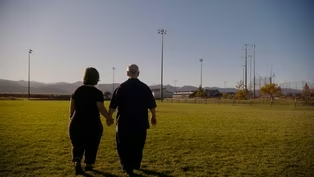
Preview: S27 Ep8 | 30s | Follow filmmaker Julie Forrest Wyman as she searches for her place in the little people community. (30s)
Providing Support for PBS.org
Learn Moreabout PBS online sponsorship









Support for PBS provided by: