On Stage at Curtis
The Transition: Mezzo-Soprano – Lucy Baker
Season 18 Episode 9 | 25m 13sVideo has Closed Captions
Lucy Baker takes viewers through her exciting time at Curtis and what lies ahead.
On this episode of On Stage at Curtis, Lucy Baker has been a key player in the film adaptations of Triple Sec and The Medium. As she prepares for her new role in Chicago, she rounds out her year with a few featured performances. Baker takes viewers through her exciting time at Curtis and what lies ahead.
Problems playing video? | Closed Captioning Feedback
Problems playing video? | Closed Captioning Feedback
On Stage at Curtis is a local public television program presented by WHYY
On Stage at Curtis
The Transition: Mezzo-Soprano – Lucy Baker
Season 18 Episode 9 | 25m 13sVideo has Closed Captions
On this episode of On Stage at Curtis, Lucy Baker has been a key player in the film adaptations of Triple Sec and The Medium. As she prepares for her new role in Chicago, she rounds out her year with a few featured performances. Baker takes viewers through her exciting time at Curtis and what lies ahead.
Problems playing video? | Closed Captioning Feedback
How to Watch On Stage at Curtis
On Stage at Curtis is available to stream on pbs.org and the free PBS App, available on iPhone, Apple TV, Android TV, Android smartphones, Amazon Fire TV, Amazon Fire Tablet, Roku, Samsung Smart TV, and Vizio.
Providing Support for PBS.org
Learn Moreabout PBS online sponsorship- [Presenter] In partnership with the Curtis Institute of Music, WHYY presents the following program.
(upbeat orchestral music) (audience applauding) (orchestra music continuing) - [Lucy] My name is Lucy Baker.
I'm a mezzo soprano.
I'm in my second year of my master's, studying voice and opera at Curtis.
(upbeat orchestral music) It's kind of a weird profession if you're not a musician yourself.
Sometimes I feel that it becomes sometimes the only part of my identity to those that aren't musicians.
You know, if I'm at a get together with a bunch of random strangers, that tends to be the only thing that we talk about, which, you know, I have, you know, a good script, a good set of things to talk about.
But you know, there are other things about me, but it's always a positive thing.
It's funny, it's a funny thing to do.
It's, to me, a weird thing to do as well, but I really enjoy it.
(opera singer singing in foreign language) (orchestra playing gently) I started out taking voice lessons when I was seven.
I honestly don't really remember a time when I wasn't singing, and the teacher that I was with from 7 to 18 started me off on folk songs, and then quickly we moved into some Italian art songs, and then we moved into like French and German art songs.
I feel like I didn't really, I wasn't really singing like as a singer until I got a little older.
I was learning more how to become a musician as a child more than learning how to become a singer, because a lot of people I know didn't even really start taking voice lessons or start learning how to sing until high school.
I started taking voice and actually piano when I was about six or seven, and so at that time it was really just learning how to, you know, how to be a musician, how to perform music.
It wasn't really about the voice at that time.
I did not practice a lot as a child, but again, I said I was like six or seven when I started.
I think it's hard to get a six-year-old to practice, you know?
The practice really started more when I was in high school and college as I started to get more serious about my profession.
But at the time, it was more about learning how to read music, when I was a kid, learning the songs, learning the words.
It wasn't so much practicing my technique, it was just more practicing getting the music under my belt.
My least favorite part and my favorite part is kind of the tradition of classical music, that in a way there is a set of rules that you need to follow that sometimes I feel like can keep you in a certain box, but at the same time, there is that great tradition to try to serve.
I'm really excited, seeing a lot of the more contemporary classical music that is being written these days.
I think it leaves a lot of room for personal interpretation.
(piano playing dramatically) (opera singer singing in foreign language) Before I went to college, I was actually planning on becoming a speech therapist because I was worried about being able to support myself financially as a musician.
(opera singer singing in foreign language) And then the summer before my senior year of high school, my aunt was teaching at the Loyola Rome campus, and I got to go visit her, and I went to a dinner party with some of her friends and they said, "Please sing for us, please sing for us!"
And you know, I was like, 17.
And I was like, "Oh, please don't make me do that."
But I did.
(opera singer singing in foreign language) I got up and sang and they said, "There's this woman that we want you to meet.
We're gonna set up a voice lesson and a lunch with you."
And so I got to have a wonderful lunch, voice lesson, and meeting with a teacher in Rome named Delia Serot.
And that lunch really did change my life because at that time she told me, you know, you were born to do this, you have to do this.
And at the time, the only people I'd heard telling me that were my teacher and my parents.
And I said, "Well, you have to do that.
You know, you're my parents."
But hearing it coming from somebody that was in a different continent in Italy, it just really was the push that I needed to get into music.
And so after that trip, I came home and I looked for music schools to apply to.
And if it weren't for that, I'd probably be a speech therapist.
(opera singer singing in foreign language) (dramatic classical music) (opera music continuing) (classical music continuing) (orchestra playing) (singer singing) (audience applauding) I was lucky to only do one audition this year, and I happen to have gotten a job on the first audition.
I'm so grateful for that.
After I graduate, I'm really excited, I get to move back to Chicago.
I'm so lucky to be a part of the Ryan Opera Center at the Lyric Opera of Chicago, their young artist program there.
This is a two year program.
I'm so excited to be there, working with them in concert settings, covers, small roles.
It really is a dream job for me.
Well, I think the goal for this program is that you leave hopefully with a manager and hopefully a year of work lined up.
So it would be really great once I leave that program to be able to start gigging around the country and around the world, preferably starting in some smaller regional houses and making some role debuts to prepare, to hopefully sing those roles one day in bigger houses.
So much of my time growing up as in like getting into the part of my life where I'm ready to audition was during the pandemic, so I missed out on a lot of audition opportunities.
All of my auditions for grad school were on Zoom.
I had never been to Philly, I had never been to Curtis until I stepped here with my suitcases to move here.
So I haven't really done a lot of auditions, weirdly enough.
♪ Oh say can you see ♪ ♪ By the dawn's early light ♪ Being from a kind of small town, there was really only small regional opera houses and productions for me to see.
But the Lyric was really the first place where I saw full scale productions and I was going regularly and I was seeing people that I knew up there on the stage.
So I really do have a soft spot for Lyric, and I would love to do that one day, yeah.
(classical music) I mean, there are so many great singers out there that we all look up to, but I actually find that sometimes the most fulfilling performances I have are those with my friends and my colleagues.
And so the people that I would love to collaborate with are the people I'm collaborating with now.
I can't wait to see where they go in their careers, and I hope one day to be on the Met stage with my best friends.
(gentle classical music) (opera singers singing in foreign language) (classical music continuing) (singer singing) (classical music continuing) (singer singing) (classical music continuing) (singers singing) (upbeat classical music) (classical music continuing) (singer singing) (upbeat classical music) (classical music continuing) (singer singing) (audience applauding) Well, why I chose to go to Curtis was just how many wonderful musicians have come out of there, including one of my past teachers.
I studied at DePaul University for my undergrad, and there I studied with Amanda Majeski, who is an alum of Curtis, and I had such a wonderful time working with her.
And her current teacher, Julia Faulkner, works here at Curtis.
And so I wanted to be able to continue the work that I did with her by being with her teacher.
And also the amount of opportunities that the students get here at Curtis is really unlike any other school.
There are so few students here that everybody has to be used in a certain way.
I also can't lie, the the price tag really did call me here.
I am so, so lucky to be able to get the free education here that you can't get at a lot of places.
The beauty and the curse of this profession is that you never know what's coming next.
(upbeat piano music) (opera singer singing in foreign language) (piano music continuing) (singer singing) I'm lucky to know what the next two years bring, but I have no idea what comes after that.
(opera singer singing in foreign language) I hope to continue gigging and singing, and I hope people will still wanna hear me in a couple years.
(opera singer singing in foreign language) It'd be great to be able to perform in other countries, other continents.
I'd love to just sing as many places and as much music as possible.
(gentle piano music) Trust yourself.
I think this profession comes with a lot of self-doubt, and I need to trust the work and the artistry that I have, that I've had, have, and will have.
You know, I think that when you don't trust yourself and you don't believe in yourself, that really can pull you down, whether or not you have the ability to, you know, make it.
So I think that's probably the best advice I would give myself.
And also, I wish that I had focused a little more on my languages when I was younger.
Every singer says that.
I really wish that I had spent more time learning to speak another language, not just be able to sing it, but really be able to be conversational and fluent in another language.
Just continue to be really grateful for the opportunities that I've been given.
I mean, you can only go so far with talent, but a lot of the opportunities we get are because of the wonderful people we have around us, and I hope that the wonderful people around me will continue to support me and help me in my future endeavors.
So I would say to my future self, continue to be grateful for the opportunities that you're given.
(opera singer singing in foreign language)
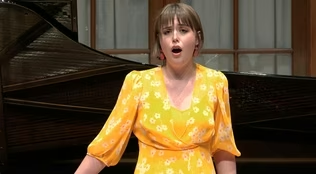
The Transition: Mezzo-Soprano – Lucy Baker
Preview: S18 Ep9 | 29s | Lucy Baker takes viewers through her exciting time at Curtis and what lies ahead. (29s)
Providing Support for PBS.org
Learn Moreabout PBS online sponsorship












Support for PBS provided by:
On Stage at Curtis is a local public television program presented by WHYY