Unspun
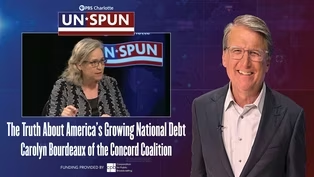
The Truth About America’s Growing National Debt | Unspun
Season 2 Episode 211 | 26m 59sVideo has Closed Captions
America’s debt crisis: how federal deficits could shape the next decade.
Tonight on Unspun, Pat McCrory speaks with Carolyn Bourdeaux of The Concord Coalition, a leading voice on fiscal responsibility. They tackle one of the biggest challenges facing the nation: rising federal budget deficits and the growing national debt—and what it could mean for America’s economic future.
Problems playing video? | Closed Captioning Feedback
Problems playing video? | Closed Captioning Feedback
Unspun is a local public television program presented by PBS Charlotte
Unspun
The Truth About America’s Growing National Debt | Unspun
Season 2 Episode 211 | 26m 59sVideo has Closed Captions
Tonight on Unspun, Pat McCrory speaks with Carolyn Bourdeaux of The Concord Coalition, a leading voice on fiscal responsibility. They tackle one of the biggest challenges facing the nation: rising federal budget deficits and the growing national debt—and what it could mean for America’s economic future.
Problems playing video? | Closed Captioning Feedback
How to Watch Unspun
Unspun is available to stream on pbs.org and the free PBS App, available on iPhone, Apple TV, Android TV, Android smartphones, Amazon Fire TV, Amazon Fire Tablet, Roku, Samsung Smart TV, LG TV, and Vizio.
Providing Support for PBS.org
Learn Moreabout PBS online sponsorship- [Announcer] This is a production of PBS Charlotte.
- Tonight on "Unspun," we're talking about a problem that could define the next decade of American government, the federal budget deficits, the national debt, and what it means for a economy.
I'll be joined by a leading voice in the national conversation on fiscal responsibility.
Plus we'll talk about the politics of the recent primary elections.
In today's America.
Welcome to the spin game.
Believe me, I know, I'm Pat McCrory.
When I was governor and mayor, I played the spin game.
I was played by the spin game.
But aren't we all done being spun?
Let's take the spin out of the world we're in here on "Unspun."
(dramatic music) Good evening.
I'm Pat McCrory.
With the national debt racing toward the 39 trillion mark, the Congressional Budget Office is warning that interest payments on that debt alone may consume a significant share of federal revenue, leaving less for defense, infrastructure, education, and other priorities.
Of course, every President and Congress has added to the national debt, but the question now is how long we can sustain it without undermining economic growth and shifting an even heavier burden onto future generations.
Dr.
Carolyn Bourdeaux is the Executive Director of the Concord Coalition, the political advocacy group Based in Arlington, Virginia supports balanced budgets, lower deficits in a more sustainable fiscal future.
Dr.
Bourdeaux is a former member of Congress who worked on bipartisan budget reform and fiscal responsibility.
Carolyn, it's great to have you right here in our studios in Charlotte.
- Good to be here, good to be here.
- You know, I remember as mayor many years ago, back in the '90s, that your coalition would come to downtown Charlotte and right in front of the bank, they'd put a clock, saying what the national debt is, and it was going up and up and up even as we spoke.
- Yes.
- I don't know if it was in the probably 20 billion, 30 billion, a hundred billion at that point in time.
- Right.
Well, a funny story about that, when I took over the Concord Coalition a year ago, I said, we need to get that clock back out.
And they had to regretfully inform me that they didn't have enough numbers on the clock anymore.
And it was one of those old school ones where you actually had the places for each- - Right, like Master score card at Augusta.
It's not electronic yet in a way.
- That's right.
That's right, it wasn't.
Now I suppose we could do an electronic billboard, but anyway.
Yeah, so the situation has gotten much, much worse.
- Well, absolutely.
In the '90s, we watched it go up and up and up, and yet we really did nothing about it and we just kept moving forward.
What's the difference now between now and the '90s when I first saw that clock?
- Well, I mean, actually in the '90s, we did get it balanced.
We did get it balanced.
- You had President Clinton and the Republican Congress working together.
- That's right.
Bipartisanship, you know?
Go figure.
- Newt Gingrich came in.
President Clinton needed some victories.
They came to the middle and made some tough decisions.
- They did, yeah.
So from like 1999 to 2001, we had a balanced budget.
We had a surplus, and then that just evaporated really for the past 25 years.
We've had this structural deficit, the revenue lines growing further and further apart from the expenditure lines.
- So the question is, what difference does it make?
Well, you know what I mean?
Because I hear people kind of just, ah, we've been hearing it for years.
The politicians aren't doing a thing about it.
We're as citizens are asking for more and more from the government.
- Right.
- Ah, we've survived.
- Right.
Well, this year we will approach, we'll probably pass 40 trillion in debt.
That's equivalent to well over a hundred thousand dollars per person.
Several hundred thousand per taxpayer.
And it does have a huge impact.
We are getting to the point where this is really gonna be something we're going to feel in our day-to-day lives.
It affects interest rates just on a really micro level.
So our ability to buy a home, afford a home, ability to start a small business, expand one.
Those are impacts that are really starting to affect us even today.
But the bigger problem is that we may face a very serious debt induced fiscal crisis, and nobody knows when exactly that would happen.
But it would be really catastrophic for our economy if something like that does.
- And yet as a former politician, I see governors and state legislators and federal congressmen and the president, we've had a war in the Middle East.
- Yep.
- A lot of missiles being dropped.
They cost a lot of money.
- Yep.
- We expanded Medicaid here in North Carolina, which increases the federal debt because they're taking 80 to 90% of that cost away from the state.
Infrastructure is in horrible shape at this point in time.
Every president promises new infrastructure.
We pass the infrastructure bill under Biden.
Is that the reason the debt is going up?
- Well, we have some structural problems.
And yes, one of them is that Congress keeps on taking on things and not paying for it.
It's really basic stuff.
At the state level, you pay for things, right?
If you wanna increase spending somewhere, you're gonna have to increase revenues somewhere.
- As long as we also get earmarks from the federal government.
Because governors and mayors are up to Washington all the time saying, can we get an earmark for our new road?
- Right.
- Can we get an earmark for Medicaid expansion?
- Right.
- So we're kind of guilty of that too, at the local and state level.
- Everybody is, right?
Everybody's in on this.
And we really need to change the dialogue to get closer to where states are, which is, it's not weather to balance, it's not whether we can do these things, but it's how to balance, how to get there.
But I just wanna say one thing that's very important for everybody to understand.
This structural deficit is not being driven so much by waste, fraud, and abuse.
That's all important pieces.
It's not being driven by earmarks, which, we'd like to pull those back to.
We wanna be efficient with our tax dollars, but it's really being driven by an aging population, by healthcare costs and by the rising interest payments that we are making on the debt.
So we have this huge debt, and now the interest payments are starting to really consume a lot of our expenditures.
It'll go from 14% of our expenditures to 19% of our expenditures over the next decade.
And that will just, it's crushing things, like you mentioned, infrastructure.
We're not able to make those investments in the future like we need to be doing.
- And you talk about demographics, it's my generation, the baby boomers.
All those babies born after World War II.
- Yep.
- Soldiers coming home.
Spiking up now, we're in our late 60s all the way into the 80s and 90s.
Amazing.
You know, the Vietnam War veteran now is old.
- Yeah.
- And their costs are incredible regarding healthcare.
- Yeah.
And we have not set aside enough money to make those payments.
And what you're starting to see, the Social Security Trust fund is gonna run out of money in 2032.
- Yeah.
Alright.
And that's within, we have a senate race here in North Carolina.
That is going to, the next senator is gonna have to figure out how to deal with that shortfall.
- But they're gonna avoid the topic altogether, I assume.
Senator Cassidy in Louisiana is one who's talking about it.
- That's right, you got a few.
- You got a few.
- But I encourage you and all of your viewers to go out and ask those important questions.
And everybody needs to understand, if Congress doesn't act, it will trigger, and across the board, 28% cut to everybody's social security benefits.
So Congress must act to deal with that.
That's not sustainable for many people, many families.
They can't take that kind of cut to Social Security.
So we have to address that issue.
The political implications are, you know, any politician who brings up social security, they have a commercial against them within 24 hours.
You know, so and so wants to cut your social security.
And you know that's a problem.
How do we overcome people only thinking about the short term politics, knowing there's a fiscal cliff?
- Right.
- Especially for the Gen Xers and other generations.
- Well, right now, it's kind of reversed in actuality.
Saying nothing means you're cutting social security benefits.
- Exactly.
- So everybody out there needs to be asking their federal elected officials, all of them, members of Congress, senators, candidates, how they're gonna deal with this shortfall?
- Well, do they believe it?
Do you think do the citizens believe this ever since Al Gore's lockbox?
We've been talking about this with Social Security.
- [Carolyn] That's right.
- Some politicians, including Vice President Gore did talk about it.
- [Carolyn] Yep.
- But now that it's been going on and on and on, I think the hardest part for people like you and me is to really go, no, we're not crying wolf.
This is the real thing.
- Right.
Well, everybody should know, eventually the wolf does come, right?
Eventually the wolf does come.
And in 2032, in statute, right, we will have to, the Social security program will have to make those cuts unless Congress intervenes to shore up our social security system.
- So what's the next big thing on the budget that's your biggest concern that we have to make some tough decisions on?
- Yes, so if you think about our budget, about 50% of our budget is interest payments, Social Security, and Medicare.
So to deal with this, we have to deal with three aspects of the budget.
We have to deal with Social Security.
That's about to run out of money.
We actually have a Medicare trust fund that's about to run out of money also.
- Yeah.
- And it's one year after Social Security.
So it's 2033, that will trigger across the board, 10% cuts to all of our healthcare providers.
So we're gonna have to get back in there and wrestle with healthcare and all of our challenges there.
We spend a lot of money on healthcare in this country.
We don't get the return on investment that other countries do.
So we're gonna have to go back and wrestle with that one.
And then last, we are gonna have to put revenues on the table.
We are gonna have to think about, you know, are we raising enough money to meet our obligations on the other side.
- Which is the other deadly sin of any politician running for office.
- It's hard.
- One is, I will cut your benefits, and the other one is I'll raise taxes to keep your benefit.
And, you know, both political parties, consultants will immediately put a commercial out on those.
And you rode on my toll lane coming in and it cost me my election.
- Yes.
- And yet we didn't have the money for the road.
We had to think of a revenue source to pay for it.
- Yep.
- So that who in Washington right now is talking about this and kind of sticking their neck out that's elected?
- Right.
So we have green shoots, shall we say, of people who are working together.
- Green shoots.
- Green shoots, little seedlings.
- Oh, I got you.
- They're picking their hands out of the soil there.
- Yeah.
- It's a group called the Bipartisan Fiscal Forum, the BFF, you know, they thought that was cute.
And it is Democrats and Republicans.
It's led by Scott Peters, who's a Democrat from California, and Bill Huizenga, who's a Republican from Michigan.
And they are pushing forward a fiscal commission act that will kind of reopen the dialogue and a resolution that would say, as a first step, we need to cut the deficit in half.
It's called a 3% resolution, which means we're dropping the deficit from 6% of our gross domestic product to 3%, but it cuts it in half.
- So do you think this is gonna go to some commission sooner or later to take the responsibility off the elected officials getting the details?
Erskine Bowles right here from Charlotte, North Carolina Was one of the ones with the Senator.
- [Carolyn] Alan Simpson.
- Alan Simpson, yeah.
Yeah, I've watched them give their presentation several times.
Simpson-Bowles Act.
- [Carolyn] Yep.
- But they never made it to the next step.
- [Carolyn] Yep.
- But now, do you think we'll get there the next step?
Maybe an independent commission with an up or down vote by Senate and House?
- This one's set up a bit different from Simpso-Bowles trying to learn from the problems that happen with Simpson-Bowles.
So it is composed of members of Congress, which I think is important because those are folks who really understand the politics.
It has a very large public education piece.
It doesn't require the super majority that Simpson-Bowles require to just get it out of the committee.
And then it requires a mandatory up or down vote in the House and the Senate.
So those are important pieces.
I think just getting this back on the national radar is very, very important.
So even if it doesn't get us all the way, just taking those steps to start laying out what needs to happen next is critically important.
- Now, you just got back from Raleigh.
You're driving on down to Atlanta from here, but you came through Charlotte to do this show, and I appreciate it.
- Yep.
- This is important for North Carolina, and that's why do you want to talk to the state representatives in Raleigh?
Why is this important for them?
- Well, the state government, about 40% of your state budget is federal funds.
And so everybody needs to be really aware.
- Yeah, in other words, my budget when I was governor was about 22 billion.
But you needed to add another probably 20 billion when you add healthcare especially.
- That's right, yeah.
- People don't realize that.
- That's right.
So state budgets are very heavily affected by the federal spending.
Of course, it's not great news that we're delivering to the legislature, right?
We need the legislature and local people to weigh in to get the budget under control.
But it is going to take some retrenchment at the federal level, which is going to affect the state finances.
So state legislators need to prepare for retrenchment.
And that's something we are trying to convey to people.
- Many 20 seconds.
If what people want to get involved in the Concord Coalition, which has got a great reputation for many decades.
How do they get involved?
- Go to our website.
The best place to go is called Concord Action, concordaction.org.
And we have ways that you can sign up to get involved, working with your members of Congress, sending letters, meeting with them, things like that.
So we're trying to reach out to everybody and start moving the needle here.
- It was an honor to have you "Unspun," and thanks for your work.
- It was a pleasure to be here.
Thank you.
- Thanks congressman.
(upbeat music) Alright, it's time for the "Unspun" Top 5.
And tonight's top five is the top five budget busters that cause the federal debt that politicians do not want to talk about.
You're not gonna be hearing any of these top five during the campaign between now and November from any politician.
We'll start out number five.
Medicare.
Why will you not hear about Medicare busting the federal debt?
Well, the average voter, the largest voting base is over 65 on Medicare.
You think any politician's gonna risk losing their vote?
The answer is no.
Number four, Medicaid.
Well, we just did Medicaid expansion in the state of North Carolina.
Everyone loves it, but there's no way to pay for it.
But no politician wants to remind the public that we do not have the money to pay for Medicaid expansion.
Number three, the federal pension for retired employees.
Oh my gosh.
It's in the billions of dollars unfunded.
And it's a big item of the federal debt.
However, that includes the military and public safety officers.
No one wants to lose their vote because they're risking their lives for us.
Number two, federal employee healthcare plan.
You think the healthcare costs for us is high?
Think about the healthcare costs for all retired federal employees and current federal employees.
It's astronomical.
It's out of this world.
No one wants to talk about it.
And number one, congressional earmarks for states and cities.
Congressional earmarks for states and cities that Congress people love to promise and announced to mayors and governors.
I got some money for this road, I got this money for this prison, I got this money for the hospital.
Where's the money coming from?
Debt.
(dramatic music) time now for "Unspun" one-on-one.
Andrew Dunn is back, a journalist and political editorial writer.
Great to have you back on "Unspun."
Thanks so much.
- Absolutely.
Well, I'm grateful you had me back.
- Oh, did a great job last time.
The audience demanded a return.
- That's right, that's right.
You had a great interview with Dr.
Bordeaux earlier.
Loved hearing that.
I wanted to ask you about this.
State treasurer, Brad Breiner has a interesting analogy to describe the trouble with the national debt.
He says to think of every $1 trillion in debt, like a person being one pound overweight.
- Wow.
- So with today's national debt, sitting at about, what, 39 trillion, that's like a person being 39 pounds overweight.
You know, a problem, but not a catastrophe.
You know, he goes on to say that the heavier a person is, the more debt that there is, the more likely they are to develop problems.
And you don't know when exactly those problems begin.
30 pounds, a hundred pounds.
Is that a good way to think about it in your view?
I think it's an excellent way.
In fact, it reminds me of what Bill Lee, the Chairman of Duke Energy told me one time when I got his advice on whether I should do light rail or not.
And he said, "Mayor, you can wait until the pain arrives and do it then.
But most likely if you wait until the pain arrives, it's too late.
But you can wait and anticipate the pain and do it now, but it's gonna be one hell of a sale."
- Yeah.
- And that's the dilemma in politics.
We usually don't move until the pain arrives.
And that's why we usually do pretty good in crisis, because in crisis, a tornado or hurricane or a homeland security effort, we all come together as a nation and work together because the pain got here so quickly.
We haven't got time to do power struggles and turf battles.
But with things like social security or Medicare or Medicaid or transportation, eh, we'll go, we'll wait for another generation or the next election.
We'll just hand it off, kick the can down the road.
So it'll be interesting if we wait until 2033 when social security runs out and we reduce benefits by 25 to 30%, as Dr.
Bordeaux said.
- Yeah, well, I have a feeling that it probably is gonna take a crisis to actually arrive the pain.
It's gonna take the pain.
But you certainly felt some pain connected with federal money when you were governor.
You know, I'm thinking, I was shocked to hear Dr.
Bordeaux say that 40% of the state budget ultimately comes from federal money.
You know, there was unemployment- - Actually, it's a little misleading to say that because the state budget maybe now is around 25 billion.
But if you add federal money, it probably almost doubles with the federal money.
Especially a lot of that money comes primarily in health and human services.
You gotta remember, Medicaid goes through the state government.
So a lot of these things funnel through the state government.
The state government distributes the money.
I allow the controversy in Minnesota right now.
- That's right.
- So that's federal money going through the state, the state didn't distribute it properly.
You've got a political and financial quagmire.
- Yeah, and you certainly had that in a couple different places with Medicaid when you were governor and with unemployment insurance.
- Yeah, we owed the federal government $2.5 billion that I inherited.
I didn't know it until after I got elected.
- No, and you didn't have the ability to just print money to inflate your way out of it.
Is there a need for North Carolina to start weaning itself off of federal money, do you think?
- I think there's a need for every state government and city government to wean themself off.
In fact, I always felt kind of bad as a mayor and a governor.
I'd go to testify in front of Congress and ask for earmarks for roads or other light rail line here, which is federally matched when they're the ones in debt.
So it's kind of ironic.
We as governors and mayors and both parties complain to the federal government, we need your money.
And yet then we brag that we have a balanced budget.
- Right.
- So there's a little hypocrisy there from both sides of the aisles when we go begging for federal money that doesn't exist.
- Yeah.
- Except in borrowing money from China.
- Oh my gosh, I hadn't thought about it that way.
That's a great point.
- Yeah.
- I wanna shift gears a little bit.
We're here just a couple days after the primary elections for the 2026 November elections.
And you know, there was one that's still not over.
And that is the big ticket one between Senate President Pro Tempore Phil Berger, Rockingham County Sheriff, Sam Page.
They ended election nights separated by just two votes.
- Two votes.
- Unbelievable.
You know, Senator Berger is widely considered to be the most powerful politician in the state of North Carolina.
- More than the governor, more than the speaker, more than anybody.
And he uses that power.
- Exactly.
And how does a person like that with that much power end up in this situation where he's fighting for his political life?
- Well, you know, I think this has happened in Washington.
When people get in leadership, they tend to spend more time in Washington or in Raleigh than they do back home.
And they spend all their time raising money throughout the nation.
Or in Berger's case, he came to Charlotte an awful lot to raise money for his reelection in Rockingham County.
He spent $10 million, maybe more in that congressional or state Senate seat with what, 20,000 voters.
I mean, that's unheard of in North Carolina policy.
And he's down two votes.
And now other votes will be, there's gonna be a recount.
We're going through that right now.
It's gonna be interesting how that comes out.
But it's a lesson learned.
You may be powerful in Raleigh with all the special interest groups and people are afraid of you, but back home, they're not afraid of you.
And you saw this happen to Daschle in Washington.
You've seen this happen to a couple leadership positions in Washington where they're very popular in DC with the lobbyists, but they're not popular back home.
In fact, you can see that with the Kentucky Senator now that's retiring who was the head of the Senate.
- Oh yes.
- You know, they're running against him, the successor that doesn't even bring up his name anymore.
- That's right.
Yeah, speaking of lessons learned, I wanted to ask you about one other primary race right here in Charlotte, the Democratic primary.
Mecklenburg County Sheriff, Gary McFadden.
- Wow.
- Looks like he pulled it out with about 34% of the vote.
- 34% of the vote, which means almost 60% of the people didn't vote for him.
- Yeah.
- And a low turnout primary.
And so now Republicans have no vote.
And many independents who tend to vote on, who might have picked the Republican primary won't have that chance.
I've known Gary now for probably 35 years, at least 35 years.
He was at a head of investigations when I was a city council member and chairman of the Public Safety Committee.
His group would investigate all the murders.
He's a very unique individual, kind of a big ego.
He loves to be in front of the cameras, he's tough.
But he's caused a lot of enemies as the sheriff here at Mecklenburg County, not only here in Charlotte Mecklenburg, but also in Raleigh.
And he still won.
So it's gonna be interesting how we adjust the next four years as the sheriff.
Will he change at all?
- Any advice you would give him?
- He probably needs to adapt a little more or Raleigh could cut his funds.
- Yeah.
- There could be payback and revenge going, yeah, you won, but where are you gonna your get your money?
And believe me, the county jail has got a lot of issues right now.
And the mental health issue in the county jail is probably one of the biggest problems we have in Charlotte, Mecklenburg.
You know, probably 80% of the people we arrest have mental health or addiction issues.
And that's a tough job.
- It is.
- Because those are things you can't deal with.
Hey, it's great having you on the air and back on "Unspun."
Thank you very much.
- Thank you.
- Thank you.
Well, the primaries in this off year election are now over in North Carolina and across much of the country.
So the real question is what results actually matter?
Well, in many ways, more than 90% of the elections for federal and state legislative seats are essentially already decided.
Why?
Gerrymandering.
In fact, in North Carolina, there may be only one or two slightly competitive congressional races left heading into the general election.
One of those races is in district one in the eastern part of the state.
Even after President Trump and the Republican led legislature redrew the state's congressional maps to help make that district a likely Republican pickup, incumbent Democrat Don Davis may still have a path to hold the seat because of President Trump's recent current poll numbers.
But before Democrats start celebrating too loudly, it is worth noting they've done their own version of gerrymandering, especially in big cities when it comes to county commission and school board districts.
Take Mecklenburg County, for example.
In many local races, the Republican party only offered up a few token candidates.
Those elections are effectively decided in the Democratic primary.
And look at the sheriff's race right here in Mecklenburg County.
Four democratic candidates competing in the primary and no Republican in the general election, which means half the voters in the county essentially have no say in the final outcome.
So what does this all mean?
In many races across North Carolina and across the country, roughly 12% of voters are actually deciding who wins.
The rest of the electric is left choosing between candidates and districts where the outcome is already baked in.
I doubt that's how the voters envisioned representative government working, but that's the system we've built on both sides of the aisle.
Well, that's the truth as I see it.
I'm Pat McCrory and I'll see you next time on "Unspun."
(upbeat music) - [Announcer] A production of PBS Charlotte.
The Truth About America’s Growing National Debt Preview | Unspun
Preview: S2 Ep211 | 30s | America’s debt crisis: how federal deficits could shape the next decade. (30s)
Providing Support for PBS.org
Learn Moreabout PBS online sponsorship
- News and Public Affairs

Top journalists deliver compelling original analysis of the hour's headlines.

- News and Public Affairs

FRONTLINE is investigative journalism that questions, explains and changes our world.












Support for PBS provided by:
Unspun is a local public television program presented by PBS Charlotte