
The Unlucky Rabbit
Clip: Season 27 Episode 3 | 9m 56sVideo has Closed Captions
A group of animators pitch “The Unlucky Rabbit” to Walt Disney.
A group of animators pitch “The Unlucky Rabbit” to Walt Disney, a documentary about how his earliest creation, Oswald The Lucky Rabbit, was forgotten to time. (Shane Hernandez/Loyola Marymount University)
Problems playing video? | Closed Captioning Feedback
Problems playing video? | Closed Captioning Feedback
Fine Cut is a local public television program presented by PBS SoCal
The Unlucky Rabbit
Clip: Season 27 Episode 3 | 9m 56sVideo has Closed Captions
A group of animators pitch “The Unlucky Rabbit” to Walt Disney, a documentary about how his earliest creation, Oswald The Lucky Rabbit, was forgotten to time. (Shane Hernandez/Loyola Marymount University)
Problems playing video? | Closed Captioning Feedback
Where to Watch Fine Cut
Fine Cut is available to stream on pbs.org and the PBS app.
Providing Support for PBS.org
Learn Moreabout PBS online sponsorship[music] These storyboards look splendid.
Do we have time for rehearsal before we pitch?
Never mind that.
He's here.
How do you do, Walt?
How do you do?
Thank you so much for being here today.
We're short on time, so you're going to need to get into it ASAP.
Time is money.
Of course, absolutely.
It's been over 30 years since you started this company, Walt, and what better way to celebrate than with a documentary?
Who's going to want to watch a documentary?
Well, what sets our documentary apart is, ours will be animated.
We always say it started with a mouse, but really, it started with a rabbit.
That's right.
This documentary is the comeback of your first cartoon star, Oswald.
Our story takes place at Universal Pictures in 1927, Oswald's first home.
Universal had been out of the cartoon game for a while, but the founder of Universal, Carl Laemmle, saw great potential for a new sensation to hit the scene.
I've always had this idea that maybe Laemmle was sitting at the head of a boardroom table, and he says, bring me a cartoon.
Once Laemmle gets the ball rolling, the series is delegated to a third party, Winkler Pictures, headed by Margaret J. Winkler and her husband, Charles Mintz.
Margaret seeks out the man for the job, you, Walt Disney.
Well, I came to Hollywood and arrived here in August 1923.
One half of my suitcase had my shirts and underwear and things.
The other half had my drawing materials.
[chuckles] Once Walt is in business with Winkler and Mintz, he collaborates with animator Ub Iwerks to design the character.
When Walt Disney and Ub Iwerks were creating Oswald, they were inspired by some of the actors of the time, like Harold Lloyd and Charlie Chaplin and Douglas Fairbanks.
Together, the two of them make Poor Papa, the first short starring Oswald.
They hated it.
It wasn't the kind of Oswald that they expected.
Instead, it was kind of a grumpier, older Oswald who ran around angry, trying to scare all these birds off his roof.
He just really wasn't a character that people were going to connect to or really love.
[music] The team takes the criticism to heart, and they create Trolley Troubles, Oswald's official debut.
Exhibitors actually really loved it, and there was a strong reaction that it was improving the whole program of Universal short films that got showed before the feature.
They really took into account light and shadow and camera angles, and he had a real personality.
It starts the success that Oswald has momentum, and it's a successful cartoon.
Walt, Ub, and their animation staff have a star in the making, and for a year, Oswald continues to shine brighter and brighter.
After a year of success, Walt travels to New York to discuss his Oswald contract renewal with Charles Mintz.
Needing a much-deserved vacation, Walt decides to invite his wife Lillian along so they can take a honeymoon that they never had.
Walt certainly thought he did a great enough job with Season 1 that when he took the train from LA to New York and arrives at Mintz's office, he thought he was going to be rewarded with an even better contract, making more money and having a bigger budget.
However, Mintz had other plans.
You said you wanted more money for your Oswald the Rabbit cartoons.
You said, your Rabbit, but he's our Rabbit, get it?
That's what's so funny.
[laughs] He wanted Disney to start working for less and provided him a contract and an offer that Walt just couldn't accept.
He was bitter, and he stormed out of the office.
He thought he could cut in and move in a little better, and I pulled away from him.
But instead, while Walt was on that train ride, Mintz did something far worse.
He signed on all of the other Oswald artists except for Disney and I think Iworks, who refused to sign, just so that he would have this leverage in negotiation.
From then on, I said there's no middleman.
He contributed nothing, we did everything, so I had to get a new character.
I feel like Oswald a bit is like the child of divorced parents, so I'm sure that he would have a bit of a sense of abandonment.
[music] It's interesting to think about the mindset of Walt Disney on that train ride.
Just going through all of these states, through the Midwest where he came from.
Not just losing a contract, but having his whole studio stripped out from under him.
Really, it shows a lot of grit and determination and a wonderful partnership with his wife, Lillian.
He apparently sketched Mickey Mouse on that train ride back to LA.
I decided it would be with a mouse.
I had a mortimer first and my wife shook her head and I tried Mickey and she nodded the other way and that was it.
Mickey appeared in Steamboat Willie, the first sound cartoon.
While Mickey in Steamboat Willie caused the trajectory of Hollywood to change, Oswald's career shifts too.
After the introduction of sound in cartoons, Oswald got a voice too.
He started to sing, lots of gags, but they lived in the shadow of Disney.
[music] I only hope that we never lose sight of one thing, that it was all started by a mouse.
[music] That's the end of our storyboard so far, but by utilizing public domain, we think that this is the best way to highlight your long forgotten star.
It was a terrific pitch, Kathy, truly.
He loves Oswald, but he's moved on to other things.
You did good, Kathy.
The pitch was swell.
Oswald.
You silly rascal, you scared me.
I'm sorry, Oswald.
They didn't take the pitch.
Don't cry.
They just don't understand.
Don't worry.
One day, they're going to want you.
I promise.
[music]
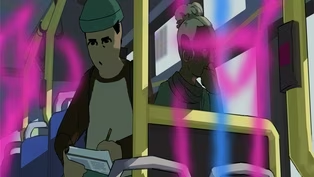 New
NewClip: S27 Ep3 | 5m 23s | Angelo decides to record a silly video at the beach for animation reasons. (5m 23s)
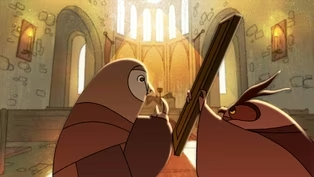 New
NewClip: S27 Ep3 | 2m 32s | A monk overcomplicates the simple task of hanging a painting. (Regis Iofis/San José State University (2m 32s)
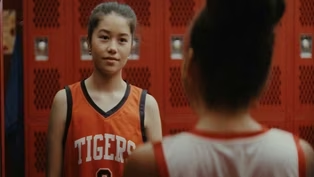 New
NewVideo has Closed Captions
Preview: S27 Ep3 | 1m 19s | A high school sophomore must overcome jealousy to maintain her friendship. (Anna O’Donnell/USC) (1m 19s)
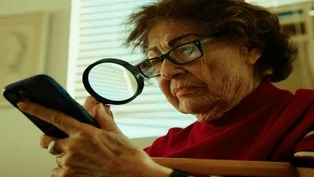 New
NewVideo has Closed Captions
Clip: S27 Ep3 | 17m 1s | Senior citizens are learning to use modern tech for the first time. (Angela Suh-Young Kim/UCLA) (17m 1s)
 New
NewVideo has Closed Captions
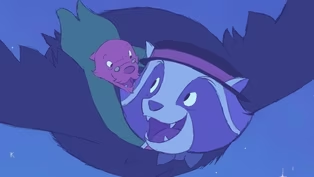
Clip: S27 Ep3 | 2m 44s | Wilbur and Harold attempt to discover what the stars taste like... (Giovanni Edwards/CalArts) (2m 44s)
Providing Support for PBS.org
Learn Moreabout PBS online sponsorship New Episode
- Arts and Music

Innovative musicians from every genre perform live in the longest-running music series.









 New Episode
 New Episode

Support for PBS provided by:
Fine Cut is a local public television program presented by PBS SoCal