
Hiseerie
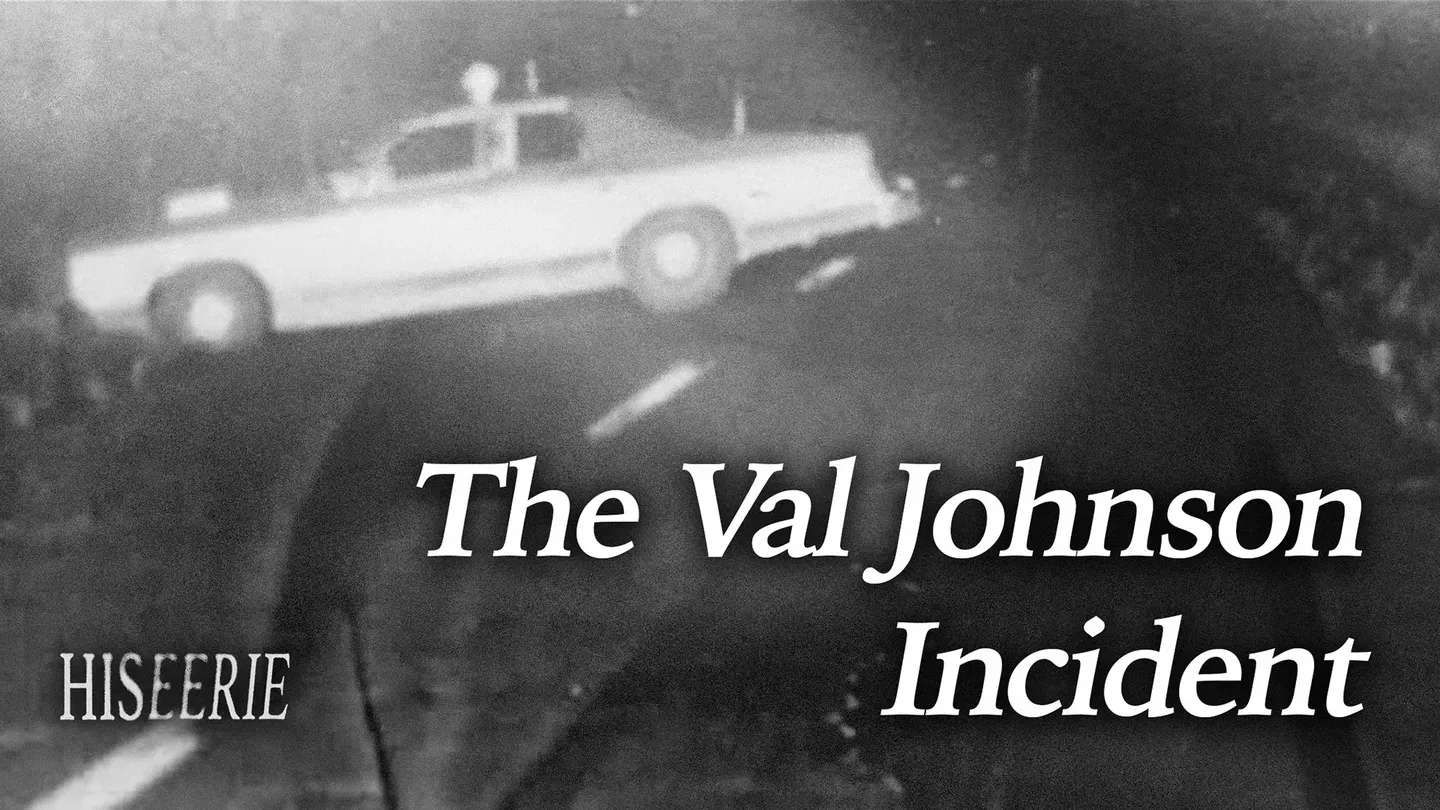
The Val Johnson Incident
Season 3 Episode 4 | 25m 44sVideo has Closed Captions
In 1979, Deputy Sheriff Val Johnson had an encounter with a UFO on a remote road near Stephen, MN.
In 1979, Deputy Sheriff Val Johnson would have an encounter with a UFO on a remote road near Stephen, Minnesota. This encounter remains one of the most notorious UFO sightings to this day.
Problems playing video? | Closed Captioning Feedback
Problems playing video? | Closed Captioning Feedback
Hiseerie is a local public television program presented by Pioneer PBS
This program is produced by Pioneer PBS and made possible by the Margaret A. Cargil Foundation and viewers like you.
Support provided by:

Hiseerie
The Val Johnson Incident
Season 3 Episode 4 | 25m 44sVideo has Closed Captions
In 1979, Deputy Sheriff Val Johnson would have an encounter with a UFO on a remote road near Stephen, Minnesota. This encounter remains one of the most notorious UFO sightings to this day.
Problems playing video? | Closed Captioning Feedback
Where to Watch Hiseerie
Hiseerie is available to stream on pbs.org and the PBS app.
Providing Support for PBS.org
Learn Moreabout PBS online sponsorship- I'm Mickey.
- And I'm Ryan.
- And this is "Hiseerie."
(mysterious music) We grew up watching paranormal investigators like Zak Bagans on "Ghost Adventures," Ryan and Shane on "Buzzfeed Unsolved" and "Ghost Files," and Sam and Colby on YouTube.
The semi-casual investigations, people just trying to connect with those who are no longer around, or something we just can't understand, and diving deep into true crime cases.
All throughout history, different cultures have believed in the paranormal.
Divine gods, spirits, aliens, shaman, and witchcraft, just to name a few.
Supernatural occurrences are reported all over the world and have become ingrained into pop culture.
Since the beginning of humanity, people have been questioning the bigger picture of existence.
What's really out there?
Aliens, ghosts, Bigfoot?
Well, we want to try it ourselves in our own backyard.
So come with us and explore the paranormal and macabre side of the great Midwest.
- It's considered by some as the most evidential UFO occurrence to ever occur in the history of the United States.
(spooky music) - We're from two different departments of Pioneer PBS and share a fascination with all things macabre and supernatural in history.
- If you like this episode, please like, comment, and subscribe down below.
If you wanna see more behind the scenes and extra full length investigations, check out our Patreon at Patreon.com/Hiseerie.
(mysterious music) - Russ Johnson, who had been a sheriff's deputy at that time for about three years from Marshall County signed on for duty on August 26th, 1979 at 5:00 PM.
(mysterious music continues) As a matter of standard protocol, he called into dispatch and coordinated the time on his wristwatch along with his dash clock to coincide with the sheriff's office official time standard.
(mysterious music continues) He went on a routine patrol and towards the end of his patrol, he began to patrol around the Stephen, Minnesota area at around 12:30.
(mysterious music continues) He radios in to dispatch to indicate that he's gonna head towards his hometown of Oslo, which was about 30 miles away, and end up with a short patrol around Oslo and complete his eight-hour duty shift.
He left Stephen, headed west on Marshall County number five.
And as he was approaching the intersection to Highway 220, which was about 10 miles distance, he noticed a very bright light hovering above the road about a mile and a half away.
Now, the terrain here is very flat and it's very easy to see for many, many miles at a time.
And his initial impression was that, well, maybe it's a semi-truck that has stopped and is having some trouble or it's an airplane landing light or something fishy going on.
So he makes a turn then to the left and he travels about a mile and a quarter and right in the vicinity of mile marker 68 on Highway 220.
Bang.
The car is enveloped with a searing bright light.
The last thing he could remember before him rendered unconscious is a sound of breaking glass and the car tires locking up and skidding to the hall.
(mysterious music continues) So he left Stephen at 1:30.
He got to the scene of the incident at about 1:40.
At 2:19, 39 minutes later, he wakes up.
He first starts to open his right eye and he notices that the engine indicator on the dash is red indicating the car's not running and his eyes are in excruciating pain.
He grasps then for the sheriff's department two-way radio microphone and he calls into dispatch and dispatch answers and he says "What do you need help with?"
"Officer in need of assistance."
So the dispatcher says, "Okay, I'll get somebody out there right away."
At 2:21, he dispatches the deputy from Steven to head out there, says, "There's something going on with Val, you better get out and see what's going on."
So the deputy then leaves Stephen following the same route that Val had taken 40 minutes earlier out to the scene.
Dispatch calls back to Johnson and says, "Well, what's happened?"
He said, "I don't know.
Something hit my car.
I can't explain it.
It's strange."
"Okay," he said "I'll call the chief deputy."
So dispatch calls the Chief Deputy Everett Doolittle and Warren, and Everett Doolittle calls Sheriff Dennis Brecke and says, "Val's got a problem.
I'll pick you up."
So then they're on the way out there.
Well, in the meantime when the Stephen deputy gets to the scene, he runs up to the car and he sees that the windshield is shattered.
And his alarmed impression is that there's been a shotgun blast at a car.
And he pops the door open hurridly and Val is in the driver's seat, his head resting against the steering wheel, his arm draped down by his side, and he's rambling.
He's incoherent, incoherent.
He's shivering, kind of shaking either from being in a state of shock or it was about 50 degrees, a little bit cool that night.
So the Stephen deputy then goes back to his car, radios dispatch and says, "Send an ambulance out."
So dispatch then sends out the Stephen volunteer ambulance and they hightail out there.
Now they're a little ahead of Brekke and Doolittle because Brekke and Doolittle are other 20 miles distant.
So everybody, those two groups are on the way to the scene.
The ambulance gets out there and one of the ambulance drivers says, "Well, what's happened here?"
And the deputy from Stephens says, "We don't know, Mike."
Well, it must have been a UFO.
One of the ambulance attendants says, "Well, it looks like this could have been a deer strike."
"No," Val says, "It was a bright light about the size of a coffee can."
So the ambulance, they put a backboard on Johnson, they load him up in the ambulance, and they hightail off for Warren.
And on the way there, Johnson is loudly complaining about eye pain, and am I going to get my sight back?
And all this commotion's going on in the back of the ambulance.
The ambulance driver's kind of annoyed with all that business, so he closes the window between the passenger compartment and driver's compartment, which just further illustrates the fact that Val was in intense pain and needing medical care.
Well, it was shortly after that, Sheriff Brekke and Chief Deputy Everett Doolittle show up on the scene.
And they spot the broken glass from the headlight on the middle of the Highway 220 roadway.
And as Deputy Winskowski explained this to me, these pieces of glass, and they found almost all of them, were laying on the roadway as if you had just dropped them from a waist high height, not like they'd been smashed on a vehicle that was traveling 65 miles an hour and scattered about.
They're all right there.
Then they noticed where the skid marks start 856 feet later.
The skid marks extended for 99 feet before he got to the vehicle, which was sitting sideways on the road with the front wheels off the shoulder of the road, the headlights peering into an unharvested green field.
So they take a picture in the dead night of the position of the car and look around for anything that might be obvious.
Of course, it's two o'clock in the morning, it's pitch dark.
The sheriff gets in the car, he starts it without difficulty, and he drives it back to Warren.
So I asked Sheriff Brekke, I said, "what were your thoughts of when you're on the way back to Warren?"
And he says, "I thought, 'What the **** has happened here?'"
And they get back to Warren with the car and they lock it in Sheriff's Department garage.
In the meantime, the ambulance has dropped off Val Johnson at the hospital in Warren, and they contact the local physician to, you know, "You better come in and check this guy out."
They take x-rays, they don't find anything wrong.
The doctor examines his eyes and he has what they call a conjunctivitis, which is a mild welder's burn.
And the doctor tries to, to get a look at the retinas, but the light is way too painful for the deputy.
So the doctor administers puts a salve on and bandages his eyes up.
When the doctor examined him at the hospital, there was no mention made of him examining a bump on the head, even though they'd taken x-rays.
And so if he had banged his head on the steering wheel hard enough to knock him out, it certainly would've left a bump larger than one that disappeared 45 minutes later.
And he had no discomfort from a knockout blow.
The only discomfort he had was, he says, "Only way he can describe it is like if I was struck with a 200 pound pillow."
And he had that facial discomfort for about several days.
(mysterious music) Val's at the hospital.
Sheriff's Deputy Doolittle picks him up at the hospital and they take him over to the sheriff's office for him to make a audio tape report of what has happened over the night.
He can't do a written report because his eyes are still bandaged.
So I visited with the dispatcher and he recalls that when they brought Val in, he was uncharacteristically agitated and confused and totally out of character.
During the process of the investigation, Val comments several times, "Something strange and unusual happened to me tonight.
Something strange and unusual happened."
(mysterious music continues) And after the interview is completed at 4:55 AM, they tell Val, "Well, we'll be taking you home soon."
And he says, "Well, you know, I should call my wife and tell her that I've been running late and you know what the deal is here."
And he stretches his arm out to ask the Deputy Doolittle, "What time is it?
I want to call my wife And the Deputy Doolittle notices that his watch is running 14 minutes slow.
They didn't think too much about that at the time, but they take Val home tuck him in, and they come back and they start to examine the car, still locked in the sheriff's garage and they note all of the specific damage, which includes, but it's not limited to a broken headlight, at least three noticeable impacts on the windshield, two dents on the hood, two bent antennas.
They later noted that there's a hole in the dash panel, plexiglass.
They note that the battery won't hold the charge.
They note that the CB radio doesn't function near as well either.
They're really confused at this point as what's happened and they're going to need some help on this.
So Sheriff Brekke calls the Center for UFO Studies in Evanston, Illinois, and he speaks with Alan Hendry, who is their chief investigator.
Hendry takes an immediate interest in the case and tells Sheriff Brekke, "I'll be there tomorrow morning to help you with this investigation."
(mysterious music continues) The next day, then Brecke and Doolittle and other deputies go back to the scene of the incident and they look for any clues relating to airplane tire marks, skid marks on the road, roadside disturbance, anything that looks out of the ordinary in their process of reading the scene, and they, they find nothing.
Brekke takes Val Johnson to an ophthalmologist in Grand Forks, and a ophthalmologist removes his bandages at 11:45 AM, and they notices no damage on the eyes.
But the ophthalmologist in Grand Forks concurs with the Warren physician that it was a proper procedure to follow and that that type of damage to the eye can actually heal within a four-hour time period, and here we are 10 hours later.
The investigation then starts to take a broader scope and the sheriff's office should be commended the fact that they pulled out all the stops to try and figure out what in the **** happened.
They had the investigator from the Center for UFO Studies, they made contact with Ford Motor Company who sent a glass division expert to examine the fracture patterns in the windshield.
He determined that there were four impact points, one from a hard object, one from a hard blow, one from an internally applied stress, and one from an externally applied stress.
And it was his professional opinion that all four of those events happened within milliseconds of each other.
The antennas, the broken glass, and the broken red reflector on the top were sent to Honeywell Laboratories for forensic examination.
They did silicate studies on them.
They looked for radiation on them.
They did hardness tests on the antenna to try and figure out if heat had been a factor in the bending.
And they noted that the only impact marks on the antennas were from bugs and that none of the bug residue had been scraped off at any point on the antennas.
So that spring antenna material can be bent by hand.
It's very difficult because it's a very, very tough material.
And if you tried to do that by hand, there's no way you could have done that without disturbing the bug residue on the antennas.
So that remains one of the most mysterious parts of the whole sequence of events.
All of the damage on the car is something that can be replicated by hand or by hammer or other methods, but in the context of a single event to occur within 39-minute time period doesn't make any sense.
And the case is basically unsolved.
It's still a mystery and it's puzzled.
Scientists, UFO experts, doctors.
(mysterious music continues) The most unexplainable piece of evidence in this encounter is the fact that the bug residue remained on the antennas throughout the whole length of the antenna and just partially removed in the vicinity of the bend, but honeywell determined that might have been that some of the bug residue flaked off from the bent bending stress applied to the antenna.
And the fact that the rear antenna, which was bent at 90 degrees, in order to accomplish a 90 degree bend on a piece of spring steel, it has to be deflected way beyond 90 degrees because it relaxed at 90 degrees, which precludes the possibility of a head-on impact to cause that damage.
And then the time delays on the two watches or the watch on the deputy, the patrol car dash clock, and I found a neighbor that lived a mile away that had a bedroom clock that was missing 14 minutes that night.
And remarkably, 45 years later, he still has that clock.
And I've got a picture of him with that clock in my book.
So you have three time pieces.
The car clock was run by 12 volt battery.
The deputy's wristwatched that as a manual line and the battery operated clock in the neighbor's house.
And to explain all that damage within the context of human involvement does not explain the welder's burns.
And in addition to that, he had been having some dental work done and he went to his local dentist three, three, four days after this event, and the dentist noticed that all his bridge workers busted up, but yet he had no pain or swelling.
And they reviewed the x-rays taken two weeks prior to the incident and they were fine.
In addition to that, in 1980, Deputy Winskowski, the deputy from Stephen, and the Deputy Everett Doolittle, the chief deputy from Warren, attended a conference on UFology in Winnipeg, Manitoba.
And at the end of that, Johnson was asked if he ever has had any, had any bad dreams or any emotional issues after that event.
And he says, "There's one thing that kind of bugs me.
Every once in a while something comes to mind and it sticks in my mind like a McDonald's commercial.
It's a three-word phrase, and that phrase is, I am committed and I have no idea why it lingers in my subconscious."
(mysterious music) Brekke called a press conference on Wednesday after the event.
And it went on the AP after that.
And I have a friend that was working in the Kwajalein Island, 8,000 miles away.
They got their news by shortwave radio and he about stopped dead in his tracks when he heard his hometown had been involved in this incredible UFO encounter.
Yeah, it was around the world.
Brekke, the day after this occurred, he was inundated with calls from national inquiry.
He got calls from London wanting to, you know, interviewed and try and clue them in on what some of the details and facts were concerning this encounter.
Most thought it was something made up or it was a joke or it was a hoax.
Even though Val's personality was very, very credible individual.
There was a person by the name of Philip Class who wrote a book about the fact that UFOs are just a big hoax.
And his reasoning was that while it couldn't have been done by malicious UFO nuts, it had to have been perpetrated as a hoax, but he fails to explain how that's possible, even though he interviewed some of Val Johnson's former coworkers and asked if Val ever tried to play tricks on anybody.
And one coworker admitted that, well, like hide your coffee cup once in a while or something.
Well, class makes no distinction on what the connection is between hiding a coffee cup and trying to you know, produce any elaborate hoax of this nature.
So Val, Val incurred a lot of stigma for this and basically poor guy, it's followed him through his life and he has not been able to rid himself of that stigma.
And so he still, he's living in Wisconsin and he declined an interview for the report.
It didn't surprise me because I knew that he wanted to, you know, kind of stay private.
(mysterious music continues) After the incident, the Marshall County Border Commissioners wanted directed Sheriff Brecke to put, get this car fixed, which had about $250 in damage and get it back on the road.
And wisely, Sheriff Brecke said, "Well, this investigation is, is still open, plus this car is probably going to be a valuable artifact someday."
And he convinced the commissioners to put it in storage.
So it remained in storage for 40 years until the 40th anniversary of this event and the border commissioners donated it to the Marshall County Historical Society.
And it's been on display here since then.
(mysterious music continues) I don't know what to think.
I'd like to think there's a rational explanation but you can't rule out UFOs.
J. Allen Hynek, who was the fellow that the Air Force hired to try and figure out what's going on with, he worked for 16 years on Project Blue Book for the Air Force.
And he was hired by the Air Force.
The Air Force intent was to try and immediately dispel any of this UFO stuff because they figured that if UFOs are real, the public is going to get alarmed and mass hysteria is gonna evolve.
So the Pentagon told the Air Force, "You gotta get this thing figured out and quell all, all of these reports."
So the Air Force hires J. Allen Hynek.
He's a World War II rocket scientist and astrophysics professor.
And initially, he was a skeptic of UFOs, but as he start to study the 19,300 reports that came into the Air Force in that 16-year period, you start to notice that about 20% of these don't make any sense.
And when the Air Force discontinued the study in 1969, Hynek left and he formed the office in Chicago, Center for UFO Studies, and he hired Alan Hendry as a chief investigator.
Hynek's book, Hynek, the UFO book is, that's the name of the title of the book, mentions in the prologue to his book that he had a conversation with U Vant, who was Secretary General of the United Nations for a while back then.
And Ufant said, "You know, if you consider the fact that an aliens day might be equivalent to one of our years, maybe some of that would make a little more sense to you."
So Hynek then rethought that proposition well, maybe interstellar travel isn't at all that impossible.
So the jury's still out on there.
Unfortunately, with all the technology and all of the investigations that have occurred since 1947, when this UFO craze began in the United States, there's really no hard evidence.
There's no good photographic evidence.
This is the only, only damage evidence that that you'll find anywhere in the world right here in this car.
So that's a little puzzling.
- If you like this episode, please like, comment and subscribe down below.
If you'd like to support us or our station, you can find full-length investigations and behind the scene content on our Patreon at patreon.com/Hisseerie.
(mysterious music) (mysterious music continues) (upbeat music)














Support for PBS provided by:
Hiseerie is a local public television program presented by Pioneer PBS
This program is produced by Pioneer PBS and made possible by the Margaret A. Cargil Foundation and viewers like you.