Roots, Race & Culture
The Value of a Vote
Season 5 Episode 1 | 26m 25sVideo has Closed Captions
Learn more about the fight for the vote with legendary Freedom Rider Joan Trumpauer.
Uncover the remarkable story of civil rights activist Joan Trumpauer, a legendary Freedom Rider who worked to help de-segregate America. Trumpauer and her son Loki Mullholland join this episode of Roots, Race, & Culture to discuss topics of voter suppression, gerrymandering, and the importance of every vote.
Problems playing video? | Closed Captioning Feedback
Problems playing video? | Closed Captioning Feedback
Roots, Race & Culture is a local public television program presented by PBS Utah
Roots, Race & Culture
The Value of a Vote
Season 5 Episode 1 | 26m 25sVideo has Closed Captions
Uncover the remarkable story of civil rights activist Joan Trumpauer, a legendary Freedom Rider who worked to help de-segregate America. Trumpauer and her son Loki Mullholland join this episode of Roots, Race, & Culture to discuss topics of voter suppression, gerrymandering, and the importance of every vote.
Problems playing video? | Closed Captioning Feedback
How to Watch Roots, Race & Culture
Roots, Race & Culture is available to stream on pbs.org and the free PBS App, available on iPhone, Apple TV, Android TV, Android smartphones, Amazon Fire TV, Amazon Fire Tablet, Roku, Samsung Smart TV, and Vizio.
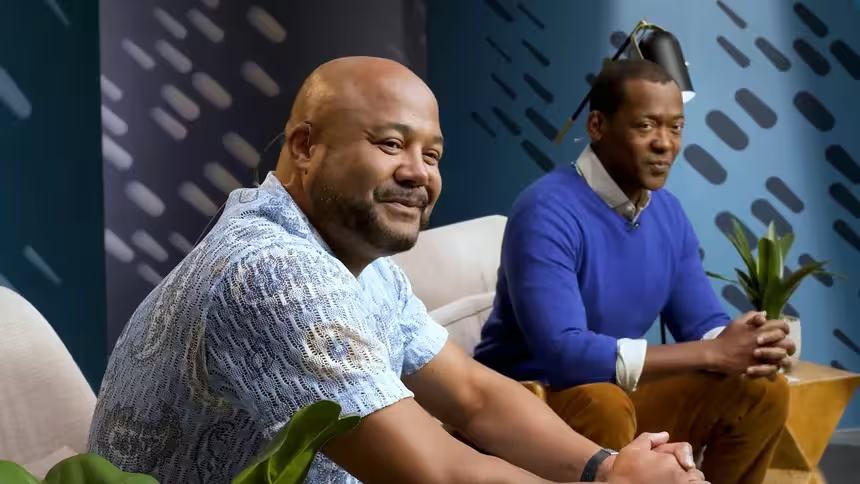
Welcome to Season 7
Bold and honest conversations tackled with humor, insight, and empathy.Providing Support for PBS.org
Learn Moreabout PBS online sponsorship(soft music) - [Announcer] Funding for "Roots, Race, and Culture" is provided in part by the Norman C and Barbara L. Tanner Charitable Support Trust, and by donations to PBS Utah from viewers like you.
Thank you.
(upbeat music) - Hello my friends, and welcome to "Roots, Race, and Culture," where we bring you into candid conversations about shared cultural experiences.
I'm Lonzo Liggins.
- And I'm Danor Gerald.
Well, it's election season, and regardless of which side of the political fence you prefer, no one can argue the fact that it's a controversial and historic presidential race.
In some ways, a vote never meant so much to the country.
- That's absolutely right.
And joining us today in the studio, we have two guests who have very intimate experiences and critical appreciation for what it means to have the right to vote.
First, we have Emmy Award-winning filmmaker Loki Mulholland.
He's the director of 10 films, including "Dying to Vote," "After Selma," one of my personal favorites, "The Uncomfortable Truth," and "The Evers."
Loki, would you please tell us about yourself?
- Thank you for having us.
Yeah, Loki Mulholland.
My simple introduction is I'm Joan's son, the civil rights icon sitting across from me at the moment.
And I've done documentary cinema for probably 20 years now, and majority of my films have actually been produced in Utah.
But they focus on issues ranging from civil rights to social justice to voter suppression and the like.
- Also, we have joining us a civil rights icon, as you said, a legendary person in our country's history.
Joan Trumpauer Mulholland, Loki's mother.
Thank you so much for joining us, Joan.
- Thanks for having me.
- Yes, it's a pleasure.
It's a pleasure.
And we have a clip that we have from Loki's movie, "An Ordinary Hero" where we can introduce you properly.
So let's take a look at that.
- [Speaker] There was one sit-in that almost duplicated the Jackson sit-in.
- [Joan] And this was not that long after World War II, so Nazi armbands and brown shirts and lunging police dogs, the whole thing was frightening.
- [Loki] Within a couple of weeks, the drug stores in Northern Virginia desegregated, and my mother and her companions began looking for their next target.
They settled on Glen Echo Park in Maryland with its segregated swimming pools and amusement rides.
My mother purchased the tickets as her fellow Black students rushed to get a seat on the merry-go-round, because as she would later say, there's a back of a bus and a back of a line, but there's not a back of a carousel.
In all, my mother would participate in nearly three dozen sit-ins and protests before a seemingly peaceful plan was hatched to confront interstate travel.
It would be called the Freedom Rides.
And so at 19 years old, my mother and her friends were sent to the most dreaded prison in America, Parchman.
- Probably one of the most violent and worst places a human being could be.
- Oh yeah, here's 14, home sweet home.
To see the cell was as small as I remembered it, not comparable to Nelson Mandela's experience, but a cell that was smaller than the one he was in for years, we had up to four people in.
And that that did put that part of it in perspective.
- Wow.
That's an introduction indeed.
(laughs) That is an incredible story.
What inspired you to want to go and get involved in some of these sit-ins and be involved in a movement where at that time, especially with the Klan and especially with the temperature of the country, the racial tension, you could get murdered.
People were getting murdered down in the South.
- I had friends who were murdered, yeah.
- You were almost murdered yourself.
- Yeah, I came close to dying in it a time or two.
I think it's my Sunday school lessons about loving your neighbor as yourself and treating people the way you wanna be treated, that really put me into it.
- Well I think one of the critical things to understand in regards to Chaney, Goodman, and Schwerner in particular is there were actually several Black people killed prior to them just weeks prior, never got any press.
It was only when whites would get attacked, when whites would be killed, that suddenly America was like, "Wait a second, this is something we gotta talk about."
1965 is the Voting Rights Act.
Vernon Dahmer was killed after that because he was trying to register African-Americans to vote.
So just because the Voting Rights Act happened and everyone could now vote, doesn't mean the Klan and others weren't still accepting of this idea.
Remember Brown Versus Board was '54.
Segregation still exists.
- Was that a primary part of what you were doing in the South, or with a lot of these sit-ins, was it primarily about voting or was it about civil rights?
- Other aspects or what?
- Well, we had focuses like on lunch counters, and the people who were sitting at the lunch counters kept the Freedom Rides going.
This had to do with interstate travel, which the Supreme Court had just ruled on that everything had to be open.
And so the sit-in students kept the Freedom Rides going when the buses were burned and things.
And then when some of those Freedom Riders got out of jail, the sit-in students, they got involved in the local communities and realized, if you're gonna make a difference, you gotta be able to vote for the people that make and enforce the laws.
And so that became the focus.
And some of the same guys, mostly guys, then moved from Mississippi over to Alabama.
And that led to the march on the Edmund Pettus Bridge, where the beatings were so bad that President Lyndon Johnson, himself a powerful southern Democrat, only chosen as Kennedy's running mate because he was a powerful southern Democrat, went on national TV before a joint session of Congress when that was almost a first and described in detail the beatings on the Edmund Pettus Bridge and said, "We must have a voting rights law, and we shall overcome."
And he repeated, "We shall overcome."
The Anthem of the Civil Rights Movement.
And those three words were the death knell of the Southern Democratic Party which had made him president.
And we got the Voting Rights Act.
- There are definitely issues around the country today when it comes to voting.
Can you speak a little bit about some of those issues?
- Yeah, so I mean the issues that we have today in particular is voter suppression.
So these are laws and things that are created to make it as hard as possible to allow the individuals to vote.
You can't keep them from voting per se, but we're gonna put so many barriers in front of them that we're gonna frustrate theem to the point where they don't even want to vote.
One of those great things is the voter ID, because there's this whole theory that there's all this massive voter fraud.
Statistically you have a better chance of being struck by lightning while being attacked by a shark then actually voter fraud taking place.
So for example, I'll give you a great example.
So in our film "After Selma," we talk about Alabama.
So in Alabama, they decided, well you need to have an ID, and to get that ID, you have to go to the DMV.
So then what they did was they restricted the hours that the DMV was open to just working hours.
Well the majority of the people, particularly African-Americans, were working hourly jobs.
So they cannot actually get to the DMV because if you work hourly, you need that money.
Well then what they decided to do was, because people were actually finding ways to do it, they then ended up closing all the DMVs in Black neighborhoods.
This is fact, this is what they did.
They closed that to further frustrate it.
Because now as a Black person, you had to go to the white neighborhood, which generationally you were told don't go there and you weren't wanted there to go to that DMV to get the voter ID.
- To get people as far out of their comfort zone as possible.
- As far as out of comfort zone, again, it's to create the barriers.
And in Georgia, what were they doing?
I mean, they're like, you can't give people water, you know, a line.
- And that's just recently.
- Well let's watch a clip from the movie because this is a great film and we have a clip from it, so let's check it out.
- [Loki] To millions of Americans, the long fought battle for voting rights culminated on Bloody Sunday when 600 courageous marchers were attacked by police on horseback as tear gas and screams filled the air.
Selma, the Edmund Pettus Bridge, forever ingrained in American history, monuments to a struggle.
Everyone can now vote.
So what happened?
Following the Civil War, the 15th Amendment prohibited the barring of anyone from the right to vote based on race, color, or previous condition of servitude.
To get around that, states use societally-imposed conditions instead of race as the litmus test to vote.
The poll tax and literacy test.
Newly freed African-Americans had no money, and only 3% could read or write.
And if that didn't work, then there was always the tools of terror.
But voter ID would only be one of many levers which a party could pull to suppress the vote and change the results.
Combined with voter purging, mass incarceration, gerrymandering, and the closing and moving of polling locations, this lethal cocktail would alter our democracy.
- Why do you think that a lot of the history of some of the struggles that whites have went through to help Black people isn't spoken about enough?
- Well, I think if it was spoken about more, more whites would be more engaged.
And we're at a point again in history where we have people that want to divide people.
And representation's important.
It goes both ways.
And that's the power of my mother's story, is this white southern woman who saw something was wrong and decided to do something about it and chose the courage of her convictions.
And that we all can do that.
- If you don't vote, you don't count.
- Was there a lot of hate directed towards you at the time when you were involved with some of those sit-ins and some of those registrations?
- I was considered a traitor to the race, going against the way things, you know, white folks should have things.
- Top 10.
She was on the Klan's most eanted list.
- Really?
- She was on the Klan's most wanted list.
- They had a poster just like the FBI had a poster, the 10 most wanted.
And if you got killed, they X'ed your face out.
Medgar Evers, all they got X'ed out.
I never got X'ed out, but I was close a time or two.
- Well, we have a clip of the film that was just discussing, "Dying to Vote," and it tells the story of the Dahmer family.
And they lost their father in the early '60s because he tried to exercise the right to vote.
So let's go ahead and take a look at that clip because this is a really great film.
(soft music) - About 2:00 in the morning on January the 10th, 1966, my family was attacked by two carloads of armed Klansmen because they wanted to send a message, a message of fear and intimidation to the Black community about what could happen to you if you decided you just wanted to try and register to vote, not vote, but just try and register.
- [Narrator] November 10th, 1898, Wilmington, North Carolina, and the only successful coup attempt to ever take place on American soil.
Three of the city's 10 aldermen are Black.
To end this Negro domination, former Confederate Colonel Alfred Waddell threatens to "Choke the Cape Fear River with carcasses."
On election day, red shirts patrol Black neighborhoods, but Blacks continue to vote and hold office.
Waddell with his mob of over 2,000 men convenes at the courthouse where he delivers the White Declaration of Independence.
"We, the undersigned citizens, do hereby declare that we will no longer be ruled and will never again be ruled by men of African origin."
The angry mob ran pages through the Black neighborhoods with rifles and a gatling gun.
Some 250 African-Americans are killed.
The aldermen are thrown out, and Waddell is declared the new mayor.
Black elected officials are jailed and marched to the train station.
Thousands more flee.
Two years later, the North Carolina legislature would enact strict Jim Crow laws.
- So wow.
- That's deep.
- That's deep.
- Choke the Cape River with carcasses.
- The fearmongering.
- It's fearmongering.
And this Dahmer family lives close to Hattiesburg.
I have roots there, right?
And so for me, there's something important about connecting that past, which for young people feels like ancient history, they're thinking this was forever ago, but there's these pictures, but here we are.
And so how do you connect that idea of sacrificing your life, which their father did to help register people to vote after the Voting Rights Act was passed?
How do you connect that past to the present?
- Well I think that's part of the challenge is we look at the past, we see these black and white photographs, and we're going, "Well that was then, this is now."
We don't see that taking place anymore in regards to the Klan riding around and doing that per se.
Unless you live in Tennessee where white supremacists were marching down the street just recently.
But we have to be able to bring them to the present and see the issues that exist today and what's taking place in regards of particularly voter suppression.
And the intimidation is still there, still real.
I mean, I believe it was the 2020 election where in Arizona you had folks out there with guns monitoring things.
So those sort of things still take place.
But really it's really about connecting the issues that impact them the most, and understanding that your vote matters.
That they're trying everything so hard to take away your vote or suppress that vote.
That's how important your vote is.
Every vote matters.
- Yeah, and January 6th, I mean, they were trying to essentially turn over the election, this attack on the capitol, and people died.
And they were essentially trying to protect the integrity of the process.
The police officers who died were trying to protect the integrity of the voting process.
- And my question is, there's a saying that we often hear that we learned from the past and we can take that into the present.
What was it that people were so afraid of Black people getting the vote back in the 1950s and '60s?
Why were people so afraid?
What did they feel was gonna happen if Black people had the vote?
- Well they felt that Blacks were inferior to them.
They weren't as intelligent, they weren't as moral.
And that chaos would come out of that.
And also they were sort of afraid of revenge that Blacks would do unto the white people as the white people had done unto the Black people.
- So that fear was something that they had inside of them, sort of like a fear of retributions so to speak.
- Do you think that fear carries over today?
- Well, yeah, I mean, so back then, and the same rhetoric is used today.
So back then in particular, like if we look at Brown Versus Board, we look at "Bloody Sunday," the book from judge Brady which led to the lynching, basically led to the lynching of Emmett Till, sorted that up was Misogynation, that we're gonna lose the white population.
So today we have the same theory of what's called the Great Replacement theory, which is whites are gonna disappear.
Now I hate to break it to whites, but whites are already a minority in the world.
Always have been a minority in the world.
- And we're all out of Africa.
- We're all out of Africa anyways.
But I don't know how we're gonna be replaced because it's weird to even talk about, but it's the fear, and fear works so well.
It's an effective tool that continues to be drawn back out year after year.
And we go, why do people keep believing it?
Well, because it keeps working.
- Well, speaking of fear, let's take a look at some of the fear tactics that were used back then when you were, and again, involved in some of these sit-ins at Woolworth.
If we could show that clip.
- When Salter joined, the crowd turned violent.
He was knocked in the back of his head with brass knuckles.
There was a student who put his cigarette out on the back of Salter's neck.
There were several cigarette, and you can still see it to this day, if you look on the back of his neck, he has scars in the shape of a cigarette.
They threw pepper and water mixture into his eyes.
- My guideline was don't let the sons see you suffer.
- Things were just going out of control.
And at that point, Joan had said that she believed that they were not gonna make it out alive.
None of them were gonna make it out alive.
- [Joan] I think I was beyond fear.
I think I was driven by determination to carry this through.
And by the time I sat at the counter a while, it was like an out body experience that the real me had left the body.
And it was just a shell there.
And the real me was sort of up above like a guardian angel letting me know what was happening and protecting me to some extent.
But the real essence of me, the important part was already.
- Those are iconic images, and to us, it's just a photo.
But to you, it's your life.
What do you feel when you go back and see those things?
- Ah, I got a little place in history.
- Yes, you do.
And do you feel that it was worth it?
Go ahead.
- But those kids were a product of their environment, that the schools were segregated, the churches, the law, everything said segregation was the way it should be.
And we were violating that.
- When you were a part of that whole situation, was there a big palpable fear that you had like that you were a part of something wrong?
Or did you question whether or not you were doing the right thing?
- I didn't question it one bit and I'd say never give way to fear.
It'll paralyze your brain and keep you from thinking what you should be doing in the situation.
Fear will get you killed.
I'm standing on the path that I walked down with Dr. King after he spoke here to take him over to the science building where he was speaking to a crowd.
- [Loki] Through the summer of 1963, my mother stayed in DC and focused her energies on helping plan and organize one of the largest human rights rallies in US history, the March on Washington.
- Up until the march actually took place, til that morning, we were not at all certain it was going to come off.
The newspapers had brought up the possibility of riots.
Store owners downtown boarded up storefronts a bit or anticipated problems.
The American Nazi Party was just over across the river in Arlington.
A lot of people were against the civil rights movement then.
And there was even thought that the federal government might bring out troops and prevent the march from happening, that the buses would be halted before they even got to the city.
It's not just one person that does it all.
It's not just Dr. King, it's not just Rosa Parks, it's not just Harriet Tubman the way it's taught in school, but that it's lots of people that you've never heard of doing what's right, going beyond themselves and out of their comfort zone, making hard choices that causes change.
I saw something was wrong and wanted to try to help make it right.
We have to pick our targets, and mine was the southern way of life.
- That's the most beautiful mugshot in the history of the world.
- That is a great mugshot actually.
What would you say to a person that was watching, let's say a white person who would say "I'm interested in getting involved in, A, learning the history of African-Americans, and A, learning our history of what we did in the Civil Rights movement," what would you say to a person like that about potentially being a better ally or getting involved?
- Well, what I always tell people is show up and shut up first and foremost.
The people, wherever they are, doing the work that they're doing, don't need you to come in and try to tell them how to solve their problems.
They already know what the problems are, they just need support.
And second is I used to beat myself up going, "Man, I'm not doing what my mother did or John or Hank Thomas or others."
It's like, "Well no, I don't have to."
My mother once said something that is really profound to me is I can't do everything, but I can do something because doing nothing is not an option.
And we just need to find, like my mother said, find what's important to us and do that.
Not everyone was on the front line.
Danor, your mother or your grandmother hosted folks from Freedom Summer.
That was what they could do.
Now that might sound trivial, just hosting someone in your house, but when you're hosting a white person in your house in Mississippi in 1964, that's a target.
So the bravery that takes place.
- The Klan burned crosses in front of that house because of it.
And you know it may seem like Joan and Loki's activism and the value of a vote are two very different topics.
- Now we're not ancient history.
- No, not at all.
You're right here.
But many people may feel like they'd never be able to do one thing in their life that's as meaningful as these two activists have done.
But my message and our message to you is that each and every time you register and you vote, you are being an activist.
Your vote says to America that you also matter, that you count, and you have the right to be seen and counted in guiding our democracy.
- Well said and well put ,my friend.
So from all of us at PBS Utah, we want to thank you all for joining the conversation.
And as always, other episodes and extended conversations can be found on our website, PBS utah.org/roots, or on the PBS Utah YouTube channel.
- And if you have any feedback or ideas for other episodes, be sure to give us a shout on social media.
So until next time, for "Roots, Race, and Culture," y'all.
- [Both] We are out.
(upbeat music) - [Announcer] Funding for "Roots, Race, and Culture" is provided in part by the Norman C and Barbara L. Tanner Charitable Support Trust, and by donations to PBS Utah from viewers like you.
Thank you.
(upbeat music continues)













Support for PBS provided by:
Roots, Race & Culture is a local public television program presented by PBS Utah