VPM News Focal Point
The Vote | November 03, 2022
Season 1 Episode 14 | 26m 46sVideo has Closed Captions
Election workers; voter rights for former felons; “Civic Influencers” getting out the vote
Election workers and election integrity; restoration of voting rights for former felons; college students are “Civic Influencers” passionate about getting out the vote across Virginia.
Problems playing video? | Closed Captioning Feedback
Problems playing video? | Closed Captioning Feedback
VPM News Focal Point is a local public television program presented by VPM
VPM News Focal Point
The Vote | November 03, 2022
Season 1 Episode 14 | 26m 46sVideo has Closed Captions
Election workers and election integrity; restoration of voting rights for former felons; college students are “Civic Influencers” passionate about getting out the vote across Virginia.
Problems playing video? | Closed Captioning Feedback
How to Watch VPM News Focal Point
VPM News Focal Point is available to stream on pbs.org and the free PBS App, available on iPhone, Apple TV, Android TV, Android smartphones, Amazon Fire TV, Amazon Fire Tablet, Roku, Samsung Smart TV, and Vizio.
Providing Support for PBS.org
Learn Moreabout PBS online sponsorshipANGIE MILES: The integrity of the vote starts with the integrity of those who oversee our elections.
We'll introduce you to some of the people who serve in this way.
Losing the right to vote is what happens when Virginians are convicted of felonies, but what happens after they serve their time?
Restoring the vote, that's ahead.
Plus our youngest voters, are they engaged or not when it comes to casting a ballot?
This is "VPM News Focal Point."
Production funding for VPM News Focal Point is provided by Dominion Energy, dedicated to reliably delivering clean and renewable energy throughout Virginia.
Dominion Energy, Actions Speak Louder.
The estate of Mrs. Ann Lee Saunders Brown.
And by... ♪ ♪ ANGIE MILES: Welcome to "VPM News Focal Point."
I'm Angie Miles.
Virginians are preparing for midterm elections, and today we'll explore various aspects of the vote, a bedrock of our democracy.
First, we look at a national issue through a Virginia lens.
Billionaire Elon Musk's Twitter buyout shook up the digital world a few days ago, leading to lots of questions about privacy and safety on the app.
Multimedia reporter Keyris Manzanares shares what you need to know.
KEYRIS MANZANARES: Tesla owner, Elon Musk, is now the new owner of Twitter, a social media company he bought for $44 billion.
Musk is beginning to clean house, firing the former Twitter CEO and other top executives.
Since Musk's takeover, there has been a surge in racist, homophobic and antisemitic tweets.
Twitter itself is rumored to be changing.
Users could soon see changes like content moderation and being charged a fee to be verified.
Danasia Pascual, a digital media strategist for Get Social RVA, says she's paying attention to Musk's approach.
DANASIA PASCUAL: It is going to be really, really interesting to just see how the platform changes and how people are showing up, either in a new way or on a different platform altogether.
KEYRIS MANZANARES: Pascual says paying for a verification can become dangerous.
DANASIA PASCUAL: Right now a lot of consumers of social media from ages 12 to 55, we use that verification to know that the information we're getting is from a reliable source, so if anyone can pay for that blue check mark, we have to question everything we see on social media.
We can't trust what we see.
KEYRIS MANZANARES: Virginia independent journalist, Brandon Jarvis, agrees.
BRANDON JARVIS: Now anyone can log into Twitter, pay $8 a month and imitate someone else.
They didn't have a blue check and appear to be a reliable source or person who they aren't actually.
KEYRIS MANZANARES: With over 10,000 followers on his Twitter account, Jarvis uses his platform to inform the public about Virginia politics and public policy.
BRANDON JARVIS: And it's really the most useful tool.
It's really where I believe news starts and then disseminates to other social media sites and onto newspapers and other publications.
KEYRIS MANZANARES: What worries Jarvis is that people are choosing to get off Twitter and take their conversations elsewhere.
BRANDON JARVIS: If these people are going to go somewhere, I need to see where they're going and possibly open an account there to supplement.
ANGIE MILES: If you're concerned about protecting your Twitter data, there are a number of things you can do now.
We have that information for you at vpm.org/focalpoint.
ANGIE MILES: As Virginians vote in the first national election since 2020, nearly a third of the country and more than half of Republicans, continue to question the results of that year's presidential contest.
We asked Virginians whether they have concerns about protecting the integrity of the vote.
MICHELLE WISE: I'm a voter so I to think that my vote counted and it wasn't tampered with, you know, in no way.
So the integrity of our votes is very important to the nation as a whole 'cause, you know, we did a lot to be able to vote.
CHRISTINA LEDUC: The mail-in ballots.
I mean, I'm kind of 50-50.
I understand that there's older people that can't get out but I think that's where some fraudulent stuff can start happening so.
CRAIG BOWLER:Me personally, I have no problem with the voting establishment because I did the early vote and you walk right on in there to the facility.
You give 'em your ID.
You go and vote and that's pretty good.
So I don't have any challenges with that.
MILLIE PIPER: I think identification is the biggest one.
I think we need ID.
JEAN JOHNSON: Letting one governor of that particular state be responsible for counting the vote and establishing how many voted and, you know, what the vote was.
ANGIE MILES: Whether it's the process or people overseeing it, trust in elections is an integral part of what keeps democracy alive.
We spoke with election administrators across the state about the challenges they face this election season.
Since 2016, nearly half of the state's registrars have left or are leaving their positions.
Multimedia journalist Adrienne McGibbon has more.
ELECTION WORKER: This is all for you.
VOTER: Alrighty.
ELECTION WORKER: And you have a great day.
Pick anywhere you desire to sit, okay?
VOTER: All right.
Thanks.
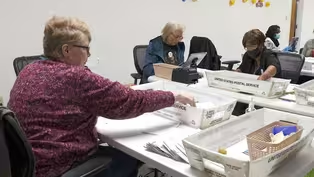
ADRIENNE MCGIBBON: Early October in Chesterfield County, election workers are going for training.
TANGELA KERSEY: So I just need you to sign in for me.
The ink pen for you.
ADRIENNE MCGIBBON: Tangela Kersey is the absentee voting manager for the county.
It's her job to make sure Chesterfield's voting locations are staffed and the workers know all the rules to ensure a smooth election process.
TANGELA KERSEY: I look at them just like family.
ADRIENNE MCGIBBON: Working elections runs in Tangela's family, dating back to her grandmother.
TANGELA KERSEY: It trickled down from family member to family member to family member.
And then too, with our ancestors, everyone's ancestors, we really fought hard to be where we are today to be able to vote.
ADRIENNE MCGIBBON: When the votes start coming in, her goal is to make sure every vote gets counted.
TANGELA KERSEY: When I walk into the door here at Chesterfield County, I leave all of my political views outside the door.
My main concern is to process the return ballot and make sure that the integrity of the election is uphold.
One thing that I believe in is that numbers don't lie.
However the outcome of the election, I know that Chesterfield County handled each ballot with integrity.
ADRIENNE MCGIBBON: Election integrity is come into question after the 2020 presidential election.
In Virginia, Attorney General Jason Miyares created an election integrity unit.
Those running Virginia's elections say they've faced questions too.
ROBERT STEPHENS: All we can do is try and explain to them how the system works, how the equipment works, what it can do, what it can't do.
We show them as much as we can, and I think just going through the process, they see it.
ADRIENNE MCGIBBON: Robert Stevens is the Assistant General Registrar in Charles City County.
He says observers from both parties can watch the process each day.
ROBERT STEPHENS: They see everything we're doing and without exception.
When they leave, they go, "This is really well run!"
We have faith in what you folks are doing.
ADRIENNE MCGIBBON: At the end of every day, someone tallies up the votes to make sure all the numbers match.
Despite the precautions, some voters still question the accuracy.
ROBERT STEPHENS: I think a lot of people listen to and read a lot of things that are exaggerated, and they come in and they have questions as to whether we are doing the things that they've heard about supposedly being done when they listen to various news sources.
ADRIENNE MCGIBBON: The pressures around elections are taking a toll on some state election administrators.
DIANNA MOORMAN: People are worn down and people are tired.
I think that with the amount of social media and the presence of social media, I think that's kind of escalated beliefs, and I'm not directing that to one side of the aisle or the other.
I've seen it on both sides.
ADRIENNE MCGIBBON: Dianna Moorman is the First Vice President of the Registrar Association of Virginia.
She's also the Charles City County registrar.
She's held that position for six years.
Dianna estimates since she started more than half of the state's registrars have left or are leaving after this year's midterms.
DIANNA MOORMAN: And that's a lot of institutional knowledge that we have lost through resigning, just retiring, various reasons.
ADRIENNE MCGIBBON: She says the rhetoric around elections tight budgets, staffing issues, and the pandemic have all strained election administrators.
DIANNA MOORMAN: I really do feel and am concerned about election officials across the country.
While Tangela in Chesterfield County, and Moorman in Charles City County acknowledge the challenges, Moorman says voters should still have faith in the system.
DIANNA MOORMAN: We ran three successful elections for the pandemic and we did it proudly.
If we can do that through a pandemic, we are capable of pretty much anything.
ELECTION WORKER: Just step in there and cast your vote.
VOTER: Thank you.
ANGIE MILES: In a "Washington Post" op-ed, Virginia Attorney General Jason Miyares defended the decision to create an Election Integrity Unit, saying, It will work more efficiently and collaboratively with the election community.
He also said he wants every Virginian to have confidence in our democracy.
VPM News Focal Point is interested in the points of view of Virginians.
To hear more from your Virginia neighbors, and to share your own thoughts and story ideas, find us online at vpm.org/focalpoint.
ANGIE MILES: Voting is a fundamental right that people sometimes take for granted, but it's a right that is usually taken away from those convicted of felonies.
Nearly 5 million Americans cannot vote because of felony convictions.
Virginia's constitution permanently strips those convicted of felonies of their right to vote.
Advocates have urged Virginia governors to use their executive authority to restore that right, and some governors have listened.
KEYRIS MANZANARES: For Melissa Trinidad, losing the right to vote meant she was voiceless.
Trinidad was convicted of prescription fraud and assorted charges that she says helped fuel her drug addiction.
Trinidad was in and out of city jails from Norfolk to Warsaw between 2013 and 2019.
MELISSA TRINIDAD: That's how I ended up incarcerated was for multiple prescription fraud charges.
Nothing violent or anything like that.
But, at the end of the day, pretty serious felonies.
KEYRIS MANZANARES: When you become a felon in Virginia you automatically lose your civil rights, the right to vote, serve on a jury, run for office, become a notary public, and carry a firearm.
Trinidad says she wasn't aware of everything she would lose once becoming a felon.
MELISSA TRINIDAD: Any crime that you commit, you're given your time, you serve your time, you get out.
But then there's so much stuff that comes afterwards that it makes it very difficult to reacclimate to society and feel like that you have served your time.
There's probation, there's voting rights, there's gun rights, there's driver's license, everything with the DMV.
There's so much stuff that comes after that, court fines.
So it's almost like even after you're done with your sentence, you still pay for that for years to come.
>>As governor of the Commonwealth of Virginia.
FMR.
GOVERNOR BOB MCDONNELL: My parents had grew up Irish Catholic.
My parents had always instilled in me the sense of justice, fairness, second chances.
All these things are just fundamental to America anyway.
According to the best of my ability.
Smart government is also making sure that when that person walks out of the state penitentiary that they've got the skills, and the attitude, and the ability to go back to work and have a second chance for those who really want to have a second chance, which I think are most of the people.
So I began to think about it a little bit during my time as a legislator, but it wasn't until I came Governor that I actually had the direct authority to do something significant because the Constitution of Virginia at that time and still today vests all the authority for rights restoration in the Governor.
KEYRIS MANZANARES: There are diverse laws in each state regarding which former felons can vote in under what circumstances.
Three states, Iowa, Kentucky, and Virginia have constitutions that permanently disenfranchise a person convicted of a felony.
Only the Governor has the full authority to restore a person's right to vote.
However, Iowa is under a standing order from its Governor to restore the vote and may be on the verge of amending its Constitution.
GOVERNOR KIM REYNOLDS: Quite simply, when someone serves their sentence and pays the price our justice system has set for their crimes, they should have their right to vote restored automatically, plain and simple.
TRAM NGUYEN: I remember 2013 very well when Governor Bob McDonnell streamlined the rights restoration process.
The restoration of voting rights for returning citizens has been an issue that our organization and our community members have cared deeply about for years.
FMR.
GOVERNOR BOB MCDONNELL: Especially with me being a former attorney general prosecutor, army guy, I have plenty of pro-law enforcement credentials, and maybe this was a time for somebody like me to step up and try to do it right.
So we came up with a program to restore, automatically restore essentially, through the Executive Branch.
I felt that because I've been in law enforcement most of my life, that I gave permission to Republicans that it was okay to be for restoration rights.
It wasn't soft on crime because we had plenty of things that our team did to toughen the penalties and hold people accountable for harm to society.
But it's completely different to instill a philosophy that it's smart government and it's the right thing to do in a nation of second chances to get people back on their feet.
MELISSA TRINIDAD: The very first time that I was able to vote after I was granted the rights back, it was very exciting.
I posted it on Facebook.
I had people take pictures of me there at the voting booth to be able to vote.
So it was just a really accomplished feeling to be able to do that again.
TRAM NGUYEN: Under Governor Bob McDonnell, in the first couple of years as we were working with community members, it was an onerous process.
If you were convicted of a violent crime, there was a longer waiting period before you could even apply.
And then at one point we were working with folks on, it was a 13 page application where you had to really, I mean, navigating it through a 13 page application, getting personal references to speak to your moral character, all of that, right, before you could even be considered to have your rights restored.
And then it was up to the Governor and his team to decide on an individual basis.
Between Governor McDonnell, Governor McAuliffe, and Governor Northam, I mean, hundreds of thousands of Virginians in a short period of time have had their rights restored.
FMR.
GOVERNOR BOB MCDONNELL: Terry McAuliffe just blew our records away right away 'cause he actually went overboard because he actually did it in such an automated way that he was restoring rights of people that were still in prison.
And of course you got a lot of blow back and there was lawsuits on that, but I think people have found the equilibrium now.
Governor Northam continued it.
From what I've seen so far Governor Youngkin's continuing that in a significant fashion.
MELISSA TRINIDAD: I actually got a letter in the mail that Governor Northam had restored the rights of multiple individuals, and I happened to be one of those individuals that had been a specific amount of time outside of receiving the felony charge and that I qualified to have my rights restored to vote.
And I remember being super excited about that and I couldn't wait to hurry up and register and figure out when the next session was to be able to vote.
TRAM NGUYEN: Our mission has been all along to change the Constitution of Virginia and we have worked with both Republicans and Democrats on a constitutional right to vote amendment.
It's going to take some more time.
It has to pass General Assembly twice and then go out to the voters of Virginia to approve.
So in the meantime, it's up to any Governor and their administration.
KEYRIS MANZANARES: Earlier this year a Republican-led House of Delegates Committee voted to kill a pending Constitutional amendment that would automatically restore voting rights to people convicted of a felony once they are free.
MELISSA TRINIDAD: If I had the power to determine whether or not somebody who committed a crime has the right to vote, I would definitely choose that they do not lose that right.
The act of voting symbolizes to me that I have done a good job acclimating myself back to society, that my voice, and my opinion matters.
FMR.
GOVERNOR BOB MCDONNELL: The great equalizer is the American franchise to vote.
Everybody's vote counts the same way.
Doesn't matter if you're a PhD, or you're an eighth grade dropout.
Doesn't matter if you're a CEO of the company or the new secretary at a startup business.
Doesn't matter.
Everybody's vote counts the same.
I'm a firm believer that anything we do to increase people's right to vote and their education about the democracy is really good for the lasting power of America.
ANGIE MILES: There has been bipartisan support to make automatic rights restoration the law in Virginia.
But for now it remains up to each governor to maintain.
Most recently, Democratic Senator Mamie Locke from Hampton is pushing lawmakers once again to consider changing the state constitution.
Under her proposed amendment, those who have served their time for felony convictions would have their rights restored once free.
A new poll finds that most Republican voters fear midterm elections won't be conducted fairly.
But experts and most democratic voters say they trust the process will be fair and accurate.
Delegate Marcia Price, who spearheaded the Virginia Voting Rights Act, joined us to discuss how myths about election fraud impact your rights as a ballot caster.
(gentle music) ANGIE MILES: Let's talk about the bill that you authored that became law.
It really is kind of a grandchild of the National Voting Rights Act of 1965.
Can you help our audience understand what that act was about, what that law was about?
DEL.
MARCIA PRICE: Yeah, so we s in 2018, 2019 and 2020 there were other states that were passing bills that would prevent people from going to the polls and exercising their right to vote.
We were hoping for federal action, but weren't able to get that, so we knew that we needed to do something on the state level.
Much like a lot of other issues, it's really coming down to the states.
And so we knew we wanted to protect those communities that have been targeted for voter suppression and make sure that that was illegal.
ANGIE MILES: Okay, so in 1965, when President Lyndon Johnson signed the law, it was necessary for what reason?
DEL.
MARCIA PRICE: Yeah, it was necessary because the history because the history of systemic racism found itself from our beginning of the country.
ANGIE MILES: Virginia is forming Election Integrity Unit and it's being questioned, looked at by the NAACP for example.
DEL.
MARCIA PRICE: An election integrity unit isn't needed.
We have a safe and fair election system today, evidenced by the data that there is no issue going on.
But then, you have those same people who aren't addressing some of the issues that are happening within elections, and so that's why we stepped in with the Voting Rights Act of Virginia.
ANGIE MILES: Everyone having the right to vote, having access to the vote, and everyone being sure that there really is not widespread cheating or fraud going on.
Should these be partisan issues?
DEL.
MARCIA PRICE: Unfortunately they have become partisan issues but we find ourselves at a moment in history right now where it has become so partisan where you have pro-democracy and anti-democracy and you can tell by the bills that are being put in, they're falling along a party line.
ANGIE MILES: You can watch the full interview on our website.
ANGIE MILES: A recent NPR Marist poll found that only 14% of young Americans ages 18 to 29, planned to vote in the upcoming election.
One reason, according to a Harvard study, is a sharp increase in young people believing their vote doesn't make a difference.
But one organization has a mission to engage this generation to get out the vote with a campaign for and by young people.
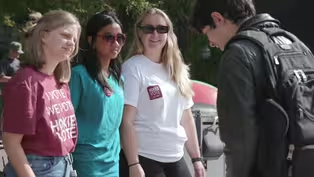
CHLOE VANDERHOOF: I found Civic Influencers when I was lookingfor a job over the summer.
And I really wanted to apply skills that I learned while studying political science.
that I learned while studying political science.
And when I read about it, I thought Civic Influencers just looked like an amazing opportunity to be able to apply my skills and to create a positive change within my community and make an impact in any way that I could.
and make an impact in any way that I could.
KATRINA COUSINS: Well, we found out through data-driven information that teenagers from the age of 18 to 29 have been able to make an impact on voting or an impact in their community.
What Civic Influencers is doing is giving them that avenue and that vehicle to be able to, you know, voice on issues.
CHLOE VANDERHOOF: I have a link directly to help you register to vote.
One to look at voting laws.
One of the bigger projects that I did was over the summer and online on my social media platforms, I introduced an area for people to ask anonymous questions about anything politically.
And I created a link tree and I called it Civic One-Stop.
So it is kind of a one-stop shop where you can look for any political information you need.
You can find how to register to vote.
You can find media sources that are as nonpartisan as possible.
You can take ideology quizzes to figure out what you believe and find candidates that match those beliefs.
And I put them all in one spot.
So I thought the easiest way possible for anybody who needed information could get to it.
STUDENT 1: Hey, are you registered to vote?
STUDENT 2: I didn't, I am not registered.
RAEGAN LAMKIN: I became a Civic Influencer because I knew that there was marginalized communities that did not show up to vote and youth was being one of them.
And I wanted to impact the vote as much as I can.
And so I became a Civic Influencer to get access to the resources that Civic Influencer provides and to be able to impact the elections as much as I can.
Here's the event that we're doing.
Make election day a holiday for Virginia Tech cuz we don't get off for election day.
AVA JASPERSE: I wanted to feel like I was, I was doing something, contributing to, you know, young voters and young people around us.
So I really just wanted that sense of being involved.
REAGAN LAMKIN: More women are getting mad and more women are getting angry and they're wanting to get more involved.
And I think we're seeing that in Civic Influencers.
Cause I plan on creating a new club through Virginia Tech called The Voters of Tomorrow.
It's actually a national organization and I hope to start a chapter here which focuses on youth priorities like climate change, economic justice, reproductive rights.
KATRINA COUSINS: So we're nationwide, we have students all over the United States.
We are looking to, you know, saturate our market with more Civic Influencers.
We also know that after the midterms there's issues we have to make sure we hold people accountable for, you know, what they said they were going to do.
So we still have a need for CI's to be out there and you know, we want those people.
We want those people advocating for their rights.
CHLOE VANDERHOOF: I think the right to vote is something that really does need to be protected.
And the way that we can do that is by showing we care which is showing up to the polls and encouraging people to vote and letting them know that it is really great to make your voice heard and to make sure that you are counted in every election.
ANGIE MILES: As the Civic Influencers drum up votes from our next generation of leaders, we encourage you to visit our website, vpm.org, for comprehensive coverage of the midterm races.
We'll also have special reports and analysis on election night here on air, on the radio, and online.
We hope you'll join us for that.
This concludes our program and we'll see you next time.
Production funding for VPM News Focal Point is provided by Dominion Energy, dedicated to reliably delivering clean and renewable energy throughout Virginia.
Dominion Energy, Actions Speak Louder.
The estate of Mrs. Ann Lee Saunders Brown.
And by... ♪ ♪
Civic Influencers hope to turbocharge student voters
Video has Closed Captions
Clip: S1 Ep14 | 3m 8s | Virginia college students work as Civic Influencers to mobilize the youth vote (3m 8s)
Election workers prioritize election integrity
Video has Closed Captions
Clip: S1 Ep14 | 4m 1s | Virginia election workers feel the strain amidst questions about election integrity. (4m 1s)
How Musk’s ownership of Twitter will impact Virginians
Video has Closed Captions
Clip: S1 Ep14 | 2m 4s | Virginians are preparing for potential changes to Twitter. This is what you need to know. (2m 4s)
Video has Closed Captions
Clip: S1 Ep14 | 10m 26s | Unfounded voter fraud concern can threaten voting rights, a bedrock of American democracy (10m 26s)
Video has Closed Captions
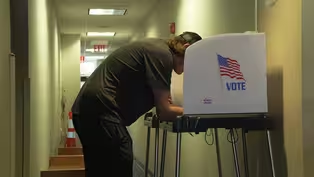
Clip: S1 Ep14 | 8m 1s | How restoring the vote to formerly incarcerated people is ‘smart government’ (8m 1s)
Video has Closed Captions
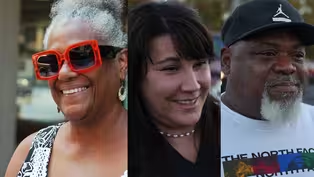
Clip: S1 Ep14 | 1m 4s | As mid-terms approach, we asked Virginians if they have concerns on protecting the vote. (1m 4s)
Providing Support for PBS.org
Learn Moreabout PBS online sponsorship
- News and Public Affairs

Top journalists deliver compelling original analysis of the hour's headlines.

- News and Public Affairs

FRONTLINE is investigative journalism that questions, explains and changes our world.












Support for PBS provided by:
VPM News Focal Point is a local public television program presented by VPM