
To The Point with Doni Miller
The Voting Rights Act
Special | 26m 25sVideo has Closed Captions
Rebecca Zeitlow discusses the current state of the Voting Rights Act with Doni.
What protections remain, and what has already been lost? Who decides how Americans vote--and how much access they have to the ballot? Rebecca Zeitlow discusses the current state of the Voting Rights Act with Doni.
Problems playing video? | Closed Captioning Feedback
Problems playing video? | Closed Captioning Feedback
To The Point with Doni Miller is a local public television program presented by WGTE
To The Point with Doni Miller
The Voting Rights Act
Special | 26m 25sVideo has Closed Captions
What protections remain, and what has already been lost? Who decides how Americans vote--and how much access they have to the ballot? Rebecca Zeitlow discusses the current state of the Voting Rights Act with Doni.
Problems playing video? | Closed Captioning Feedback
Where to Watch To The Point with Doni Miller
To The Point with Doni Miller is available to stream on pbs.org and the PBS app.
The views and opinions expressed into the points are those of the host of the program and its guests.
They do not necessarily reflect the views or opinions of public media.
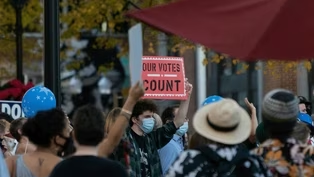
A foundational pillar of American democracy is under renewed pressure.
The Voting Rights Act, once hailed as one of the most powerful civil rights laws in U.S.
history, is facing a growing crisis fueled by court challenges, state level changes and deep political divisions.
What protections remain and what's already been lost?
Who decides how Americans vote and how much access they have to the ballot?
We cut right through the noise and get straight to what's at stake for our voters today.
Our guest is dean of the University of Toledo School of Law and distinguished Professor Rebecca Zeitlow.
This is to the point I'm Doni Miller.
You can connect with us on our social media pages, but you know that.
You can also email me at Doni underscore Miller at wgte .
org And for this episode and any others you might like to see go to wgte,org To the point, I am absolutely delighted to introduce you to our guests this morning, Rebecca Zeitlow, who's the Dean and distinguished professor, and the the Charles W Ford Professor of Law and Values.
That's a that's a mouthful at the University of Toledo College of Law is with us today.
She teaches constitutional law.
Federal courts and constitutional litigation and is widely recognized as one of the nation's foremost scholars on constitutional law and civil rights.
I am excited to have you here this morning.
Thank you for spending so much time with us today.
We are going to be talking about the Voting Rights Act.
It's on everybody's minds right now.
I am surprised, however, when I'm out and about at how little people actually understand exactly what that legislation is and why it's worthy of all of the attention that is getting right now.
Could you synthesize for folks what the Voting Rights Act actually is?
Certainly, the Voting Rights Act was enacted by Congress in 1965, signed into law by President Lyndon Johnson.
It was as the result of years and years of activism by civil rights activists, including those who were injured and even murdered because of their advocacy for voting rights in the South and in this country.
What the Voting Rights Act did was to enforce the 15th amendment, which is a reconstruction era constitutional amendment which prohibits race discrimination on the basis of the franchise.
And what the Voting Rights Did act did was to contain provisions prohibiting racial discrimination and also provisions trying to create some structural change to address the fact that throughout sort of since the Civil War and Reconstruction, notwithstanding the 15th amendment, black people throughout the South were denied the right to vote and they were denied the right to vote by laws.
They were denied the right to vote by the local electoral officials, and they were denied the right to vote by terrorism and violence, including the violence of the Ku Klux Klan.
So this was a huge victory for democracy.
And it's been it's been fairly safe.
Is that is that it has been it's been extremely successful.
So it just wrought a huge change as a result of the Voting Rights Act of 1965.
Black people and other people throughout the United States have been able to vote and have voted.
And what we're talking about today is, along with provisions that directly regulated the right to vote and regulations of voting, that's in section two of the Voting Rights Act and Section five of the Voting Rights Act.
The provision we're focusing on today also regulates voting district.
So part of what happened in the 1960s was not just the need for individual rights, but also the need to look at the structural problems with the district of both state legislatures and congressional legislatures, especially in southern states that were malapportionment and and basically left out black people.
African African-Americans throughout the south of the Supreme Court was involved in that in its its rulings establishing the right of one person, one vote.
And also the Voting Rights Act prohibits race discrimination in drawing district lines and also prohibits not only intentional race discrimination, but it prohibits practices that have a disparate impact, that is, that a disproportionately negatively affect racial minorities.
So it is it is considered one of the most important.
As we mentioned earlier, one of the most important pieces of legislation that our country has ever enacted.
Yes.
What should happen?
Pick the worst thing in your mind that could happen with this act, and let's have it gutted.
Well, yes.
Would be the Supreme Court destroying it, which is what they have done.
I was just a recent ruling, but I want to emphasize one more thing that I think you were you were asking about.
Not only was it enacted in 1965, but it was reenacted over and over again by broad margins in Congress.
And most recently, the provision we're talking about now was reenacted in 2006 by a Congress.
The vote in the Senate was 98 to nothing and only about 30 people.
Only about 30 members of the House of Representatives votes against it.
So this is a bipartisan consensus that this was a good thing through the democratic process.
And we're talking about democracy, right.
And the democratic process fixing itself, fixing democracy.
Right.
And then to have this unelected court to come in and disempower Congress in this and other rulings.
What do you think the impact, the long term impact of this, of this decision is going to be?
Well, we already see the impact right immediately after the decision came.
The Calais decision came down.
Several states have already moved to redistrict and get rid of majority minority districts.
So the the impact on the governing of this country is directly affected by folks who are voting.
Does this change the way our country will be moving forward?
Well, so part of what's happening here is again, the answer is yes.
But it's not all.
It doesn't have to be all gloom and doom, right?
So what we see happening here is that we have a confluence of partizan and race, right.
So we have the Republican Party drawing districts that favor Republicans, and they control all the legislatures in southern states and in some, some northern states as well.
They're doing this.
When they do this, they are also diluting the votes of Democrats in general, and in particular African Americans, because especially in southern states, African-Americans overwhelmingly, not entirely, of course, but overwhelmingly tend to vote Democratic.
So what you see happening, for example, in Tennessee, right after this decision came down, there was one blue district in the state of Tennessee that represented the city of Memphis, which is heavily African-American city.
The Tennessee state legislature redrew the districts to divide those votes.
Memphis votes up three ways to create three red districts.
Now, what impact does that have on the voters in Memphis?
It means the voters of Memphis had someone in in Congress that represented their interests, that represented their concerns, that would always be doing that, because only they only represented this area around Memphis right now.
They're going to be they're going to they're going to they will they will vote.
They can still vote, but they're never going to be electing the people that they want to represent them.
They won't be able to do that.
So we're almost out of time in this first segment.
But but I do want to ask you, is there some argument to be made that the constitutional rights of the African Americans affected by this action have been violated?
Yes.
The argument would be that they are being denied the right to vote on the basis of race.
And that's what the Voting Rights Act prohibited now.
And that's what Congress said the Constitution meant when they enacted the provision that said that districts that dilute minority votes violate the Voting Rights Act.
Now, that's not what the way the court interprets the 15th amendment.
And what they did was, they said to Congress, we don't think the 15th amendment prohibits this, and you can't decide that either.
And that's the problem.
But the vast majority of members of Congress thought, yes, we have, as I said, almost a unanimous members of Congress.
Yes, we believe this was what the 15th amendment means.
This is how we prohibit race discrimination that violates the 15th amendment.
But now that Congress has said now, the court has said, you can't do that Congress.
And that's the most upsetting thing about this.
So this was made by the Supreme Court.
This decision was made by the Supreme Court.
Is there any thing that everyday citizens can do to address this decision?
Yes.
And the impact of this decision, yes.
So most of the district, the gerrymandering that's going on right now is Partizan gerrymandering.
And as I mentioned before, there's really a confluence here.
It's not so much you know, I can't I can't read the minds of the members of the Republican legislatures in the South that are enacting this.
But I think it's I think they're more concerned about their own power than being racist.
Right.
That's not necessarily what it's about.
Go after Partizan gerrymandering and prohibit Partizan gerrymandering.
Studies show that prohibiting Partizan gerrymandering would have the same empowering effect for black voters and for all voters, as the section two of the Voting Rights Act was through its remedies.
Okay.
Hold on.
Thought I'd like to start there when we come back.
All right.
You stay with us.
We'll be right back.
To me, community means connecting to others.
I'm Doni Miller and welcome to the Point.
I love PBS kids.
We're a community committed to education.
Discover new ideas, dive into exciting subjects, and engage with the world around you.
I would send them personally a t shirt.
Crime doesn't pay in the old West End.
Pass it on.
That's how we cleaned up the neighborhood.
Vision loss for people is not the end.
It's the story.
It's the next chapter.
WGTE Public media invites you to get out and play day.
Monday through Friday.
It's the 419 powered by WGTE with Matt Killam, Gretchen DeBacker, I'm Kevin Mullen.
What can people expect on the show?
Give me an hour.
A reminder of why this is a great place to live, work and play.
Where you come to watch, listen and learn.
Welcome back.
You know that you can connect with us on our social media pages.
I'd like to remind you that you can email me at Doni underscore Miller at wgte .
org And for this episode in any other that you would like to see, remember to go to wgte org To the point.
If you missed her introduction in our first segment, we have with us the amazing Dean of the University of Telos, University of Toledo Law School, Rebecca Zietlow.
We are talking about the Voting Rights Act and the impact that the recent Supreme Court decision has had on that act.
Many, many states are arguing that this has nothing to do with race, that this has nothing to do with power, that it has to do with balance, that it has to do with protecting the integrity of the election process.
To them you would say what you mean opposing the Voting Rights Act has to do with that.
Well, that's the whole purpose of the Voting Rights Act was to restore balance, was to undo the harm that had been done to our democracy by suppressing the votes of a very large percentage of people in this country, and to ensure that people's right to participate in democracy is protected.
So.
I and I guess I just as I said, almost a unanimous bipartisan consensus of Congress the last time they viewed this.
Yeah.
So we went to break talking about what people can do to fight back.
And we talked about those those actions that would probably be most effective.
But what role does Congress play now, if any?
Well, that's a good question, right.
Because what we see happening here is, as I said before, my chief concern is the court disempowering Congress, right.
So after this decision, one thing Congress can't do is go back and say, no, we really meant it.
And you misunderstood what the section two of the Voting Rights Act means.
That would be the appropriate way for a court to to have addressed this would be to say we're interpreting a statute.
If a court interprets a statute, then Congress can come back and amend the statute.
But when the court is interpreting the Constitution, then Congress can't do anything to change that, because the court is the ultimate interpreter of the Constitution.
So they can't do that.
But what they can do, as I mentioned earlier, is to pass a law prohibiting Partizan gerrymandering.
That's something that people have tried to do through litigation.
They've challenged it at one.
At one point, the Supreme Court said they challenge it as violating the Equal Protection Clause of the 14th Amendment, which requires that people generally be treated equally.
And the court said at one point.
Yes, you could bring that case, but we can't figure out what would be unconstitutional Partizan gerrymandering.
But what actually one of the concerns about this case is they seem to say they did.
In fact, they did say, you can't draw these lines to remedy race discrimination unless there's enough, you can prove intentional discrimination, which, by the way, the court in an earlier case had made has now made it very, very hard to prove intentional discrimination.
But you can draw lines for Partizan reasons, and that would justify this, said Justice Alito.
In this case, which is one of the really disturbing things about it.
That being said, that doesn't mean there's a constitutional right to Partizan gerrymandering, and Congress could pass a law prohibiting Partizan gerrymandering.
And as I said before, that would actually remedy a lot of the race discrimination that's happening in the districts now.
So for those folks who are those those feet on the ground people who are protesting and saying that they have been disenfranchized, that black folks are going to lose their elected seats, which looks fairly likely when you take a look at at the map, the road to recovery from this seems pretty fraught with difficulty.
The road to recovery, it is fraught with difficulty, is fraught with struggle.
Right.
And that's always been the case, right?
That was the case.
It just feels backwards.
It feels like we're moving backwards pretty quickly.
It does feel that way.
And if if I may please.
You know, I'm a historian, legal historian of the reconstruction era, the Civil War, the resulting amendments, including the 15th amendment, which we've been talking about, the 14th amendment, 13th amendment, which abolished slavery, and that period of time after the Civil War, where in fact the rights of black people to vote were being enforced.
There were some amazing things that, governor that the governments did.
There were some amazing people, including former soldiers, Union soldiers, that black people that were elected to Congress from southern states.
And that was followed by a so-called redemption period, where the country pulled back from the from enforcing these rights, the Jim Crow South in most of the first half of the of the 20th century, and of course, race discrimination in northern states to I don't want to say all was talking about the South, but and then the civil rights movement and all that struggle and people being killed and fighting and crossing the, you know, Edmund Pettus Bridge and the great.
Oh, now, you know, member of Congress from from Georgia who was hit in the head and almost killed.
Yes.
Great.
John Lewis.
Yes.
To get us where we are now.
Now there's this is retrenchment again.
So there's really going to have to be a movement in favor of democracy again, in favor of rights representing Congress, of state legislatures, state supreme courts.
Really important.
We saw that in Virginia, where the where the people of the state of Virginia voted for a law to to gerrymander and from to create more Democratic districts and Republican elected Supreme Court struck that down.
So paying attention to your state and local races is really, really important.
Really important.
And I think I think you have to fight those folks who are feeling Disenfranchized have to fight the frustration of feeling as though they don't have any power.
Right.
And then not voting as a result of that.
That is the concern, right?
That people would be discouraged and say, my vote doesn't matter.
I'm just not going to vote.
And that's just tragic, especially when you think of, as I said before, all the struggle and sacrifice that people made in the past to ensure that we do have the right to vote.
Right.
We win.
And you, an African-American person, have right to vote because of the struggles of of rights movements over the years that.
Absolutely, absolutely.
And that is a critical fact that somehow isn't talked about right now.
And I'm so happy that you brought that up during this conversation, because that alone has to provide the encouragement and the energy to continue to fight, to continue to fight this fight.
So is it is it possible that through this recent decision that the impact of the black vote, in fact, is so diminished that it really can't change a race?
No, actually, that's not true.
Right.
So I think that's something that I think that's something we forget about sometimes does.
You aren't 50% right, but 20% of the electorate or whatever it might be in each district, right, can make a huge difference, right?
Most most electoral races are won by less than 5% or certainly less than 10%.
So you really can make a difference.
You know, even if you are, even if you yourself see, part of the idea behind the Voting Rights Act was that the was the right.
Have a representative that looks like you.
Right.
Right.
Because that's someone who you know or you think at least very strongly likely is really going to represent your community, right?
Right.
But people who don't look like you can also represent your community.
Sure.
Right.
So I think we I think we have to understand that.
And so the Supreme Court has this idea, this justification that there's no more racism.
So we don't need this anymore.
Well, we know that's not true.
Absolutely.
But what we also know is that all change has happened as a result of alliances right across racial alliances, cross religion, Reliance's, you know, cross class alliances.
Right.
And so you really can do a lot.
You can be the key, you know, you can be the margin of victory.
So if you were the consultant for elected officials who were wanting to rally against this, who want to change this, what would your first piece of advice be to them?
Where do they get started?
Well, my first that's my mother was involved in politics her whole life.
So in southern Indiana, by the way.
And.
So it is to talk about issues that people care about.
You know, that's the thing, you know, and so as I said before, what's what's what's really at stake is democracy.
Why does democracy matter?
Because democracy is supposed to mean that we have a government that represents us and is responsive to us, and does the best it can to meet our needs.
Right, right.
It's an excellent answer.
I think that with that conversation, it will keep people involved.
And I'm so afraid at this point that the people to whom it matters most will step away from the discussion and step away from the opportunity to make cha because they can't see the road toward change easily in this situation.
But we also see people getting mad and fired up.
We do see some of them.
So I mean, for example, in the Georgia election, which is happening today, increase in participation of people who are asking for Democratic ballots.
You know, I hear the same thing happened in Lucas County, by the way, during our during our primary.
Yes.
But anyway, so I actually think that people really care.
They I think we all I think we believe.
I think there's something unites us in the US that we care about democracy.
You know, we've grown up.
Yeah.
I hope you're right.
You know, and yeah, I'm not saying that all our leaders do.
I'm not going to be.
I don't want to be too Pollyanna.
But you and me, people you see on the street, whether they agree with you or me politically or not, do believe in democracy.
That's what our country is all about.
And we're thinking about.
Excuse me.
We're thinking about that now because, you know, the anniversary of the Declaration of Independence this year is here.
That's right.
But you know what?
I think we have to pay attention, Rebecca, all the time.
Not just when the big things happen.
There are lots of ways to to lessen and weaken the vote.
You can remove people from the voter rolls for you can change the requirements for identificat to vote.
We've seen all of those happen in Ohio.
And by the way, some of that was able to happen because of an earlier Supreme Court decision called Shelby County versus holder, where the court decimated another provision of the Voting Rights Act that prohibited states in places where there had been a history of low participation by people in racial minorities, from adopting those kinds of practices that that restrict the vote, the vote.
This is such an important and such a huge, huge topic.
We absolutely have more to talk about.
So I hope you'll come back.
Well, I would I would love that.
I would love that as well.
And thank you all for joining us.
We hope to see you next time.
On to the point.
The views and opinions expressed into the points are those of the host of the program and its guests.
They do not necessarily reflect the views or opinions of public media.
To the point is supported in part by viewers like you.
Thank you.
Airs Friday, May 22nd at 8:30 p.m. and repeats Sunday, May 24th at 11:00 a.m. (30s)
Providing Support for PBS.org
Learn Moreabout PBS online sponsorship New Episode
- News and Public Affairs

Top journalists deliver compelling original analysis of the hour's headlines.
 New Episode
- News and Public Affairs

FRONTLINE is investigative journalism that questions, explains and changes our world.

 New Episode
 New Episode
 New Episode
 New Episode
 New Episode
 New Episode
 New Episode
 New Episode
Support for PBS provided by:
To The Point with Doni Miller is a local public television program presented by WGTE