
The Wild West Bank Sound
The Wild West Bank Sound
Special | 56m 39sVideo has Closed Captions
Minneapolis' West Bank comes alive with stories of music and migration in this multi-sensory trip.
Minneapolis’ West Bank neighborhood was once an epicenter of the music world. From the early 1960s, this perennial immigrant landing strip proved an irresistible draw for artists from far and wide, an ever-evolving cauldron of creativity and cultures. This film is a funky flashback, bursting at the seams with memories, all visualized with rare and rich archival photography, footage, and ephemera.
Problems playing video? | Closed Captioning Feedback
Problems playing video? | Closed Captioning Feedback
The Wild West Bank Sound is a local public television program presented by Minnesota PBS
The Wild West Bank Sound
The Wild West Bank Sound
Special | 56m 39sVideo has Closed Captions
Minneapolis’ West Bank neighborhood was once an epicenter of the music world. From the early 1960s, this perennial immigrant landing strip proved an irresistible draw for artists from far and wide, an ever-evolving cauldron of creativity and cultures. This film is a funky flashback, bursting at the seams with memories, all visualized with rare and rich archival photography, footage, and ephemera.
Problems playing video? | Closed Captioning Feedback
Where to Watch The Wild West Bank Sound
The Wild West Bank Sound is available to stream on pbs.org and the PBS app.
(bright music) - Maurice Jacox:"There's something about the West Bank."
- John Munson: "So much music started there on the West Bank.
- The West Bank was a little world of its own.
- Bruce Rubenstein: Lennon and Bowie both said they owed a debt to them.
To my mind, true American folk heroes.
- "Spider" John is one of his tunes.
- Molly Maher: "This is where Bonnie Raitt stood."
That was everything for me.
(upbeat, funky music) - Jeff Garetz: "It was a rowdy wild party every night."
- Rena Haus: "It was a working person's neighborhood."
- Daniel Murphy: "Art, music, attitude and activism."
- Judy Larson: "The West Bank was a place of escape."
- Eve MacLeish: "It's always been an immigrant neighborhood."
- Rena: "And everybody brought their own music."
♪ Shango Shango Shango mama ♪ Shango Shango Mama Shangoya ♪ - Tony Paul: "You say you got a gig."
- Going to be on the West Bank, man.
- Warren Park: "Folk music."
- Joe Demko: "Blues."
- Warren: "Jazz."
- Demko: "R&B."
- Molly: "All of a sudden you're seeing these really amazing indie rock people."
- Jack Torrey: "It was really a beautiful thing to stumble into."
- Bruce: "When you talk about the West Bank music scene, that was a fantasy come true."
(high-pitched vocals) - Tony Paul: "Wild West Bank."
(audience applauding) (Blues music) - Bruce: "Dylan, well, he was around Dinkytown" when I was there, and he played at the 10 O'Clock Scholar.
(Gentle blues music) - Judy: "Walking down 14th Avenue in a hot summer day.
And his music coming out of the screen door of the Scholar was just like you're in heaven, you know?"
(harmonica) - Bruce: "But he was gone by the time the West Bank got started."
(guitar strings) - Bruce: "People started going over to the West Bank bars instead of the East Hennepin Bar, where everybody had hung out before.
And the immediate reason we left Dinkytown was because they wouldn't serve a Black friend of mine that was with us, his name was Wally Pettiford, a whole bunch of us just walked out.
We walked across the Washington Avenue Bridge, to Mixers, which was empty, and asked the owner if he would serve him, he said, yeah.
So that was it, that became the place to go."
(upbeat energetic music) - Bruce: "Mixers became mobbed after that.
It's like everybody who was in college just came across the Washington Avenue Bridge.
And those other West Bank bars remained what they always had been.
Snoose Boulevard bars."
(violin strings) - That neighborhood was called Snoose Boulevard because back in the late 1800s, huge migration from Scandinavian countries.
- You could feel the history in it, you know?
Because the West Bank had been a working class immigrant neighborhood for so long.
- Eve: "When I first moved to the West Bank some of the old Norwegian, Scandinavian, Swedish immigrants still lived in the neighborhood."
- They were still these old bars that were serving lunches, you know, lunch meets in the afternoon to these regular customers for the last hundred years.
- And they were open all day, and they didn't have much of a crowd at night.
And I think they were sort of languishing, if not dying, and then young people started moving to the West Bank.
(acoustic guitar strums) - Well, it was a poor neighborhood, but it was a place where you could choose who you wanted to be.
- Judy: "That and it was cheap rent.
And it just got easier.
Hey, look at all these places we can go, bars and everything."
(acoustic guitar strums) - Bruce: "By 1963, those bars were starting to cater to younger people.
They started having music, and the first one was the Triangle."
- Judy: "They didn't really have a stage.
They were using a pool table for a stage.
They just would put plywood on it, put a straight back chair up there."
(piano keys) - Judy: "It was a great music time at the Triangle, Lazy Bill Lucas played."
♪ You know, the Devil ♪ is gonna get you ♪ ♪ If you don't get down ♪ on your knees and pray ♪ - Lazy Bill was an amazing character, you know, he was so good and so, so real.
♪ You just the Devil's job ♪ ♪ You know, the Devil ♪ is gonna get you ♪ - Mark Trehus: "I was a big Dylan fan.
I discovered that Dylan's peers, when he came down from Hibbing and was hanging out at the U in 1960, were these guys, 'Spider' John Koerner, Snaker Dave Ray, Tony Little Sun Glover."
♪ Oh boys, can't you line 'em ♪ ♪ Oh boys, can't you line 'em ♪ ♪ Oh boys, can't you line 'em ♪ - Maurice: "The first white guys that actually played authentic blues, first white guys to ever do that.
1961, I believe."
- Rena: "They were playing old folk and blues music, stuff that was rooted in field hollers and work songs.
There's something about the blues that's universal.
It's like this tree, and it's got all these branches of American popular music, but it all comes from the source.
Africa."
(chanting musical vocals) There was a time when that music, the blues, wasn't played as much And so Koerner, Ray and Glover, they were keeping alive a very vital, and real heartbeat of American music They didn't forget, you know, where it came from, from the old ones, the ancestors.
- Bruce: They didn't say, 'We invented this.'
They said, 'We heard these Black guys playing, and we love their music and you should hear more of it.'
So that was their attitude."
♪ I'm born in north Kentucky ♪ ♪ And I'm raised in Tennessee ♪ (banjo strings) - We asked "Spider" John about how did he and other young guys get into the kind of music they did way back, when not as many, like, young white kids were into blues music and stuff.
And he just talked about being obsessed with it.
They cared a lot, I think, about what they're doing.
It was their whole life.
- They were incredible interpreters of that music.
- There's a fine line between faking it, and uh making it sound like blues 'cause it's going to get you a gig, and feeling it, and knowing it, and integrating it into your life and the lives of the people that you're sharing it with.
- Blues, Rags and Hollers is a classic and influenced all kinds of people from David Bowie and John Lennon.
- Bruce: "Turner, Ray, and Glover showed those English guys that you could sing like a Black person and get away with it.
They liked American rock, they liked Little Richard, but they didn't dare sing like him.
And then here's these white guys from Minnesota that sang like them, and weren't afraid to do it and had their own way of doing it.
And that was a big step for a lot of people.
White people."
(chuckling) - Bruce: "I'd say Dave Ray was the best at that."
He could sound just like Lead Belly.
♪ Anyone should ask you, ♪ Who made up this song ♪ ♪ Tell 'em Huddie Ledbetter, ♪ done been here and gone ♪ John had his own style.
♪ All right little mama ♪ ♪ Not the way you wanna do ♪ - Charlie Parr: "John for me was, the walking embodiment of the folk music process.
You know, he could take folk music songs and turn them into 'Spider' John Koerner songs, you know, idiosyncratic, he was a set of one.
He was a cipher in the guitar world to me."
(harmonica) - Bruce: "Tony wasn't much of a singer.
He was a good musician."
(blues music) (harmonica) - Maurice Jacox: "It started with the Triangle Bar and then people moved across the street to another bar that had been a straight ahead working class bar called the Viking.
And the hippies took over the Viking."
- I really wanted to play there 'cause it was a small room and it was a working person's bar.
There was always good music every night of the week.
(upbeat music) - Charlie: "The mixer was mounted on the wall on the stage, and you could just lean over and adjust it.
But if you touched the wrong part of it, you get electrocuted."
- Rena: "Very sketchy.
Rube Goldberg kind of PA system.
And it was all hodgepodged together, but it worked, you know?
And the shape of the room had great acoustics and no matter where you were in the room, you could hear, it was, you know, it was one of those magical little places."
- Mary Lundberg: "It was a very exciting time.
So much music every night.
There was a huge folk scene going on."
- Bruce: "There was a sort of second iteration of The Scholar on the West Bank too."
- Mary: "I loved Leo Kottke.
He was one of my favorite guitar players."
Kottke played at the second Scholar up near Seven Corners.
(acoustic guitar strums) - Bill and Judy were pretty amazing to me.
They were outrageously intelligent, creative, humorous, had so much history in music.
- Oh, Judy is the consummate storyteller.
And Bill was quiet, extremely intelligent.
They were around the West Bank forever.
- Judy: "He joined the Sorry Mothers band that I was in, and then of course, Hijinks ensued after that."
(chuckling) - Eve: "She had a voice, like old blues."
♪ River was whiskey, ♪ I was a doc ♪ ♪ What about it ♪ ♪ I dive to the ♪ bottom, never come up ♪ ♪ Tell me how long ♪ ♪ How long ♪ ♪ I must've had to wait ♪ ♪ Oh, can I give you now ♪ ♪ You certainly can ♪ ♪ I mustn't hesitate ♪ - Molly: "Judy Larson was the room, and the room was Judy Larson.
Funny, gritty, it showed me a lot that we as female performers get to be all of these things too."
- Mary: "Just a classic couple in the folk world."
- A guy asked me if I wanted to go out, and I thought, well, he was a long hair, so I figured he was cool, you know?
And he goes, "Where do you want to go?"
I said, "I wanna go to the West Bank."
Why do you wanna go there?
I said, "Because there's a guy named" Willie Murphy I want to see.
(laughing) (upbeat music) - Maurice: "I was going to West High, it was a high school dance.
There's this band with this scruffy looking guy.
Jeez.
Had bad skin, bad hair, singing their ass off, and a good bass player, and that's how we first met."
- He almost didn't really pay attention to people, You know?
He was kind of in his own, in his own realm.
He was very smart.
He was always recommending books and telling me what films I should see and music I should be checking out.
And if I didn't have it, he'd turn me onto it.
- And I didn't see him for a few years.
But then Murphy and I with some other people who became the core of Willie and The Bees, made a soundtrack of a movie called The Secret of Sleep, by a friend of ours, Bruce Rubenstein.
- It was an expression of Koerner's aesthetic in film.
He wanted to make a photo skit.
- Bruce: "And that's what it was."
- Movie: "How'd you know where to find me?"
- Mary: "Willie and John Koerner were collaborating on things."
♪ We're drinking and dancing ♪ ♪ All night long ♪ ♪ Early in the morning ♪ ♪ We're still going strong ♪ ♪ The Red Palace is ♪ the name of the place ♪ - Those insane parties that Red Nelson used to have.
(whooshing sound) The Red Palace is the name of the place.
- Bruce: "Second floor up, he called it 'Ground Zero,' but he'd have a party three, four times a week."
- Mary DuShane: "Red did consciously create an atmosphere for musicians, and encourage everybody to play in all different kinds of music at those crazy parties."
- I started going to those parties, and I met Papa John Kolstad, and John Koerner played there a lot and a lot of other folk musicians would hang out there.
- Mary DuShane: "Just sit up half the night and play, and drink, and sing, and just have the most wonderful time.
Get up in the morning, go to work, do it again the next night.
Ooh, youth.
(upbeat music) - A friend of mine had told me about this band, "Willie Murphy and the Bumblebees."
♪ Missing his connection ♪ ♪ Speed ball is his lifeline ♪ ♪ Cocaine is his confession ♪ - Maurice: "We were all drawn to Murphy's writing."
The band pretty much made real what he heard in his head.
Absolutely breathtaking songwriter.
Someone who could be so mean, and so mean, and so venal, and be such a jerk, and here this heart-wrenching beauty came out of his pen.
- Rena: "He suffered no fools, you know?"
No prisoners.
He just like, this is the way it's gonna be and if you don't like it, get off my stage.
(laughing) - Maurice: "Murphy and I almost came to blows a couple of times.
We had a verbal fight on stage, And I had walked off the stage."
And I was gonna pack up my horn and go home.
And I went, I'm not letting this churlish (beep) run me out of my own damn gig.
And I went and pulled my horn back out.
I went back up on stage and I stood next to him in my spot, and kept on playing.
And he leans over and says, "Come here, man.
You are a (beep) and I'm a (beep).
Can't we just get along?"
♪ We will find what love is ♪ - That was Murphy's way of saying, "Please, can you ever forgive me for being such a jerk?"
♪ You're mean and nasty too ♪ - Rena: "Going to see them, I was always," like I said, kind of awestruck, and um and a little bit intimidated like I'll never be able to hang with these guys.
- The stage at the Triangle was at the point of the Triangle.
And so you come in the door and there's this triangular stage and getting seven people in this corner, in this area here, getting seven people up there was absolutely ridiculous.
- Maurice: "It was one step from the stage onto the bar.
We walked on the bar and stand there playing horn parts, and swinging our horns."
- Jeff Garetz: "Drinks on the bar?
No problem.
Kick 'em out of the way, you know.
And then they would start doing high kicks.
It was a rowdy, wild, fun, smoke-filled, uh, somewhat drunken or drug-induced party every night."
- Mark Trehus: "He was the kind of guy that he did not come off on records nearly as well as he did live.
The first record was recorded on a shoestring budget up at Dave Ray's studio up in Cushing, Minnesota.
It was patched together from, you know, what they could afford to buy and and all kinds of technical problems.
Yet, it's, you know, I don't think there's anybody who would say that that isn't the best Bees record despite its technical liabilities."
(folk music) - Maurice: "First really big thing we did was Bonnie Raitt's record."
(groovy music) - Maurice: "John Koerner was on the folk circuit out east, and Bonnie was also on that circuit too.
Just starting out."
- I was out there with John, and that's where they met.
John told her about the West Bank and he specifically told her about this recording studio that Dave had.
- Maurice: "Warner Brothers signed her and gave her $40,000 to make a record."
So Bonnie flew out here.
We spent four or five days on the West Bank and by that time Bonnie had realized that I think these are the guys I wanna make this record with.
Dave Ray was the engineer for the record.
- Dave had this Crown 700 four-track machine on which he recorded Bonnie Raitt's first record.
- This is in four track, so that meant if one person made a significant mistake, had to redo it, the whole track.
And Willie was the producer, but there was one catch.
She only wanted the rhythm section.
Murphy wanted more.
And he said, "Listen, why don't I just write a part" for one song and we'll have the horns come out and play on that and then you decide.
And so she agreed to that.
And so we start playing the song called "Finest Lovin' Man" and Bonnie's singing and playing and it comes to the part where (horn sound imitation) Oh my god, oh god yes.
God yes.
Horns, yes, yes.
The horn, bring the horns.
(bright music) You could tell Murphy's influence then that Murphy was already getting in her brain.
- Mark: "Willie could have been a star.
He got offered a job as a staff producer for Electra Records."
- Rena Haus: "Well the guy had a chance to be big time out on the West Coast."
- Mark: "He's like, 'Nah, I'll stay here.'"
- Rena: "He came back here and he kept it real for all of us here.
And that was a great gift."
- Willie was a community character and when we went on the road, he wasn't really comfortable being out there 'cause he was sort of used to being on the West Bank in his own world where everybody knew him.
(upbeat music) - Rena: "We were kind of just coming out of the turbulence of the 60s and into the 70s.
It was like a carnival.
It was like a celebration."
- Mary Lundberg: "It was a very, very vibrant community.
It was just the heyday of the hippie times."
- Jeff Garetz: "The West Bank was a unique community sort of a hotbed of local self-reliance and political progressivism."
- Rena: "There was a social consciousness in the community that was very pervasive."
- We got some of those buildings that turned into coffee houses.
- Mary DuShane: "The Extempore and then next door at the Riverside Cafe."
(upbeat folk music) - John Munson: "The Coffeehouse Extempore was one of the earliest pockets of the folk scene on the West Bank."
- I remember walking into the Extempore for the first time and that was an impressive place.
It almost felt like a drop-in center because there were a lot of people there who were just kind of playing checkers and chess and reading and engaged in lively debate.
And it was church run.
It had a very family vibe to it, which I liked a lot.
There was a value on acoustic music and on folk music.
(harmonica) The contrast between the Coffeehouse Extempore and the Riverside Cafe on the corner.
They had very different perspectives.
- It had started as a Marxist-Leninist cooperative.
- Yeah, more like anarchist, I think we used to call it.
- Jeff Garetz: "The cafe was in some ways representative of the West Bank as a community."
- It was a center of action and meeting when the neighborhood resistance was formed to protect the neighborhood from destruction.
- Jeff: "Cedar Square West was the first building of proposed 10 high rises that would've gone all the way down Riverside past the hospitals and the neighborhood organized and stopped that.
- Eve: "We'd have benefits to raise money for this struggle that we were in to save the neighborhood."
- Rena: "It's community building at its finest level.
The arts, the musicians, they're always at the vanguard of all positive social change.
Little bit ahead of the curve."
- People actually call us that often on the West Bank.
Willie and The Benefits.
- Eve: "I drew posters for some of those benefits" and used my photographs too.
That whole Bohemian scene was such an inspiring backdrop for photography.
Music was such an essential part of the cafe and it was extremely varied.
Phil Haywood played there a lot.
- Dakota Dave Hall and Sean Blackburn.
- I played more than anybody else at the at the Riverside Cafe in the year 1972 'cause I just played with everybody.
- Eve: "But then we started booking more jazz.
Ed Berger, Milo Fine, John Penny and people like that."
And the way you book people, you just call 'em on the phone and said, "Hey, you wanna play?"
"When do you wanna play?"
And that was it.
You know?
And they knew they'd get paid.
- One of the rules of the politics of the West Bank was the band always got paid first.
- Mary: "The West Bank School of Music was very integral" to the workings of the West Bank.
- It's easily 20,000 students that came through the door from 1970 until early 2018.
All these great performers were there, probably as many as 600 different individual teachers.
Peter Ostroushko, Rich Thompson (piano keys) Bill Hinkley (string strums) Dave Ray Eddie Berger Mary DuShane ♪ I'm savin' up ♪ Pop Wagner ♪ She could rag a ♪ tune right through ♪ John Beach.
- Joe: "I was taking a lesson" at the West Bank School of Music and I saw this guy in a cape go by the window and then come floating into the room.
And it as John Beach wearing this flowing cape, totally freaked me out.
I thought, huh, what in the?
And the teacher said, don't worry, that's just John.
- Maurice: "He's harmless."
- Joe: "That's just John."
(piano keys) - Eve: "The richness of it was that it's always been an immigrant neighborhood."
- Reporter: "These days, the folk festivals are often in many around the country.
One of them is the Snoose Boulevard Festival.
Now in its third year, an internationally renowned festival of ethnic Americana."
- Maury Bernstein brought that into existence.
Such a devoted musicologist.
- Reporter: "How does a guy named Bernstein get involved in Danish folk music?"
- I've been interested in all kinds of ethnic music all my, uh, life.
- Maury was quite a character and you know, just a genius in his way.
He had been very, very involved in the history of the neighborhood.
- Eve: "He was really intense about carrying tradition forward in the West Bank with Snoose Boulevard."
- Tom Lieberman: "He brought in Ann-Charlotte Harvey who was sort of an expert on the Scandinavian folk tradition."
- Eve: "And we at the cafe used to celebrate Snoose Boulevard by making our one and only meat featuring menu Swedish meatballs during the year because we were vegetarian."
- Reporter: "The dance, music and humor recreated bring to mind the good old days when lower Cedar Avenue was a center for Scandinavian entertainment here in the Upper Midwest."
- Eve: "Immigrant neighborhoods are always undergoing constant evolution."
(funky music) - Lance: "The West Bank, that was the center for Caribbean music here in the Twin Cities.
Rich culture, man, and rich music.
You know what I mean?
With the blend of the African rhythms, the European influence, you know, and that's where Calypso and Reggae and all of that came out."
- Joe Demko: "And then you had the university community that would bring in more students that would learn about the cultures and then start to participate in that."
- Tony: "I was at Augsburg and Peter and Lloyd would hang out at the Whole Coffee House at the U and they kept saying, we should could start a group, man, we can start a group.
Peter said I can sing Lloyd, I played the bass and that was it.
Shangoya."
- Shangoya.
I think it was 1972.
- 72.
- When it started.
- I'm that young?
- Yeah you are.
(upbeat music) - I remember in our tiny cafe there a small stage booking Shangoya and The Bees.
And these were big bands with lots of equipment and instruments and a big sound.
Obviously, they felt very welcome there.
And their communities came out to hear the music.
The West Bank community came to appreciate it and learn about it.
Caribbean music) - I came to The Bee's through John Beach's dad, white kid from the suburbs coming to the West Bank.
Man, it was like.
Pbththth.
- When I got in the band, there was 250 tunes and you had to memorize them and there's no charts.
And I'm like, "Oh boy."
His dance tunes were always complex and the ballads were incredibly sweet.
And I thought, I wanna hang with this 'cause this guy can write.
- They were great additions to the band.
We were right in a groove that lasted until we played our last gigs in what, '84 I believe.
- He always surrounded himself with excellent supporting musicians.
You can't say enough about good side men.
- Joe: "The side men's role is how do I support.
Bob was playing guitar and bass, driving the truck, setting up gear."
- You also wrote the charts.
- You're not just one role.
You have to learn how to do other things.
(upbeat horns and guitar strings) (trumpet notes) ♪ Personal Meltdown ♪ - Joe: "You have to learn how to sing a harmony part, find it, sing it as well as you can on any given night.
We went from being what I would considered a medium loud bar band to a full on rocked out cheerleaders on cocaine supermarket loud."
- Maurice: "I never really thought of myself as a singer.
And over the years the band was together, my role as a singer got stronger."
And that would not have happened had it not been for The Bees, I mean, that's where I developed my singing style.
(high-pitched vocals) - Eve: "The West Bank itself was a very white neighborhood, but it was integrated in the sense that we had all these musicians and people that would not necessarily live in the neighborhood, but they were there all the time."
- Maurice: "When we first tried to get the gig at the Flame Cafe and I don't know, few Blacks in the band.
I don't know if people are ready for that.
And they didn't wanna hire us because there were Blacks in the band."
- One of the first gigs Shangoya did in the club was uh the Tempo.
- Lance Pollonais: "Tempo, that's right."
- And I think we might have been the first Black band to play that club.
- At that club.
- Yeah.
And a couple other clubs in town too, you know?
Yeah.
- When I first came up in high school, Black bands and white bands didn't play together.
Right.
So white guys could make more money and get more gigs because they were white.
So that to being, I've always felt like we were doing something good about trying to change that and having a band that was Black and tan, as we would say.
(laughing) - If you look at the old Danes, we were smart enough to put in that beautiful building.
- Dania Hall.
- Yeah, Dania Hall.
- Cedar Riverside area was a major settlement for Scandinavian immigrants.
Norwegian, Swedish, and Danes.
Danes being the smallest of the three groups, could never afford to keep that hall alive if they only used it for their own activities.
So they rented it out to other groups around town.
- There was a little ballroom up there with a stage and that was on the third floor.
- Loading in the Dania Hall was horrifying.
Horrifying - Brutal.
- Dangerous place to play.
- Ballroom was on the third floor.
- Carrying equipment.
(organ sound) - Maurice: "Building with no elevator.
And you walked all this gear up three floors."
- That was back breaking.
- Cheryl had this Leslie man, it was heavy.
I had to go up these stairs, you know what I mean?
It was crazy.
(laughing) - And somewhere there's pictures of Willie and The Bees pushing John Beach's organ up.
Fantastic picture, isn't it?
- And you get up in this auditorium and it's got a balcony and it's beautiful.
- Jeff Garetz: "A horseshoe shaped balcony."
- Maurice: "Yeah."
- Jeff: "With ornate carved turn spindles and railings."
It was gorgeous.
- I always thought that the balcony was a bit dangerous because you'd see people bouncing up and down on it and it would actually move.
- The flooring was dangerous.
The flooring.
- That floor, man.
(chuckling) - I was just getting ready to say I was scared after the floor would bump.
- It was bouncing.
- We're gonna end up in the basement here one of these nights, you know?
- That was crazy.
- Yeah that was.
- But fun, crazy fun.
Those were fun times, man.
- Eve: "It was a beautiful, beautiful space.
And the tragedy of it burning down was too much for me when it happened.
It was just so tragic, it's still an empty lot."
- Garrison Keillor: "You're listening to 'A Prairie Home Companion' coming to you live from the World Theater in downtown St.
Paul."
(audience applauding) Made a lot of friends on the West Bank in the folk music community.
We should start with Bill and Judy and um The Sorry Mothers.
I think they were playing it at the Cedar.
They were like playing in the lobby or something and Garrison was watching them and he invited them onto his nascent radio show.
What became "A Prairie Home Companion."
- And now singing for Powder Milk Biscuits, Mr.
Bill Hinkley and Ms.
Judy Larson.
(audience applauding) - The June Apple Musicians Co-op was a group of musicians like Dakota Dave and the late Sean Blackburn, Bob Bovee, (harmonica) Pop Wagner (violin) Bob Douglas (violin) Rich Thompson, these were folks that Garrison was listening to and aware of in the folk music community and he started bringing them into his show.
(violin) - I got involved in the Coffeehouse Extempore in 1980 and the music was incredible.
The people would appear on the "Prairie Home" show first and then they would come over for an eight o'clock or nine o'clock show.
There'd be an opening act and then they'd go on.
Tim Sparks and Prudence Johnson and Tommy Lieberman had Rio Nido and they were around a lot.
♪ Slink into the swimming pool ♪ ♪ Lstening to the cowboy sing ♪ Robin and Linda Williams were there a lot who were classics on the "Prairie Home" show.
♪ You were a train star ♪ - Mary Lundberg: "It was an amazing time and the place was packed.
It became an after hours scene.
It was very exciting."
- Garrison Keillor: "Well that's the news from Lake Rubicon, where all the women are strong, all the men are good looking and all the children are that happy."
- Let's keep in mind that this is the late 70s, early 80s.
- I remember that as my tequila gimlet phase.
(chuckling) Tequila gimlet and psilocybin phase.
- Mauric: "Pretty much everybody in the band had alcohol problems.
- Substance abuse got in the way.
So I came to a point where I just couldn't keep it going.
- Maurice: "Murphy's in and out of rehab and detox.
We had to go and scour the bars on the West Bank to find where Murphy was.
We finally found him at his home passed out.
When he got sober, he didn't turn into a wonderful person.
He was the same irascible guy that he had always been."
- Well there were a lot of drugs around too and off and on.
(bright music) - You got the weed 'cause everybody wanted the weed.
They wanted to smoke.
Your whole back room there, you open the door.
(grumbling) - That never stopped at the place we played.
- That was a requirement, that was in the rider.
- I remember getting shorted 25 bucks on a Shangoya gig one time.
I go up to Peter and says, this is 25 bucks short.
He said had to buy some weed.
(laughing) It was a little bit Wild West.
- It was.
- It was.
- Wild West Bank.
- Wild West Bank.
(cymbals) - Eve: "When harder drugs arrived on the scene, it was difficult.
I watched it in my neighborhood, I watched it on the West Bank."
- Bruce: "That's when things got nasty.
Viking Bar was kind headquarters for that."
- At the Viking, you'd go to the bathroom and there's somebody in there doing something, you know, pretty illegal and you just mind your business and get back out into the music.
- There was some pretty significant fights about who could deal it there.
Scott Nelson was murdered over that.
- Hey, we survived it.
- Yeah, we did.
Almost everyone came out the other side stronger and better and grateful for what had made us people that we were.
- Dan Wilson: "You guys ready?
All right, come on down."
(string instruments) - Charlie: "In the 80s the West Bank was a little world of its own.
You didn't really need to leave the neighborhood."
Everything I needed was right here.
- It really felt like a safe place to kind of like go for it.
And rents were really cheap.
- Charlie: "I didn't move to the West Bank I moved to the $60 room."
- But I had one of the few rooms that didn't have lots of roaches in it.
- No one was getting rich.
It was basically people that were there because they wanted to be a part of something.
They wanted to be involved with something and they felt that it was like righteous is almost the word, you know?
- John: "And I think that's a thing that kind of characterizes the West Bank for me is like people who created a scene who were really involved in what the music was that was happening and it was important to them."
- Daniel Murphy: "Art, music, attitude and activism you know?"
- Everything was happening all at once all the time.
And I found free food.
I found a bunch of friends and mostly I found music all over the place.
- So as a performing artist, why wouldn't you want to be a part of that?
(bright music) - Maurice: "In this little area, they're like eight or 10 bars.
And the nightlife was fantastic."
George and Anna had this place down on Fourth and Cedar called the 400 Bar.
- Eve: "The 400 was a wonderful place.
You know, that's where you just meet your friends."
- And we'd play at the Rev and then we'd run across, kitty cornered across to the 400 Bar.
Tossed down a couple doubles, come back and play the second set.
It was terrible.
Terrible I tell you, - 400 Bar for me was Willie Murphy.
- As I've often said, I built the 400 Bar as far as music goes.
- John: "Around happy hour, Willie often would kind of hold court with his piano that was like kind of shoved into the corner of the stage."
- I got this guy that I knew that did pianos, I had him beef it up 'cause I played really hard.
- And he'd like play his songs.
Which is kind of to me unbelievable when I think about it now.
- And I played there every Wednesday for a long time, it was jammed.
People would come in and sit in with me, you know, different people.
(harmonica) - John: "At the time, It was kind of just what happened at that place."
- Maurice: "And their bar went from a sleepy little bar with maybe one or two pool tables and nothing really going on to five nights a week being packed with people."
- Molly Maher: "The Gooneybirds had Sundays at the 400.
I think the Cedar Wax Wings were on Tuesday nights.
Farm Accident was Wednesday nights.
Willie Murphy was Monday nights, Bill and Judy Larson, Sundays.
Front Porch Swinging Liquor Pigs.
There's your Friday."
- The stage was about this wide and it was sideways.
Right?
So you remember when you come into the door and I was drummer so I had to, I couldn't set up facing the crowd because it was so narrow.
- Yeah.
- And people are walking in and I'm right there man.
- But then the 400 made a really concerted effort I think to be a rock club.
It served that function really well for a lot of emerging artists like Trip Shakespeare, The Jayhawks, Soul Asylum, (rock music) Run Westy Run, all those bands.
We all kind of happened at the same time.
(upbeat music) - And then all of a sudden you're seeing these really amazing indie rock people.
- For me, I mean it was like absolutely epic.
- That was kind of different than the original cast of West Bank characters.
(audience clapping) The Golden Smog was kind of born outta my friendship with Gary Lewis, who was in the Jayhawks and Mark Perlman and Craig Johnson who was Run Westy Run.
We'd play and there'd be, you know, 300 people piled into that place.
It was very fun.
- A lot of good musicians came there.
Even national acts.
- For Semisonic, that was home court for us for sure.
- Maurice: "It's a little nowhere bar and it actually got to be fairly well known.
And it was mentioned in records and things."
- I believe the first time we ever played that song was there at the 400, people really connected with that line and certainly in that place 'cause they heard it every night as they like stepped out.
♪ You don't have to go home ♪ but you can't stay here ♪ (folk music) (acoustic guitar strums) ♪ I met Jesus down at Palmer's ♪ ♪ And he said I'm ♪ going to heaven ♪ - Bruce: "Palmer's another one of those triangular configured bars and they just put a little stage up there.
That happened much later, probably getting on towards 1980 before they had music."
- Their slogan is, "Sorry we're open."
And we found out why pretty quick.
(laughing) - Bruce: "I think John kind of held it together."
Palmer's was his living room.
He got to know people there.
- John: "I saw a lot of really interesting music at Palmer's."
- And we were so blessed to have so much music.
Like Cornbread Harris.
- Can come down here and watch Cornbread Harris play piano.
He's in his 90s.
I think that's amazing.
- My hat's off to Cornbread.
I love it that he's doing that.
(bright music and crowd chatter) ♪ Shango Shango Shango mama ♪ Shango Shango Mama Shangoya ♪ - Shangoya was like the only band I would say in the five state area that was really doing Calypso, Soca and you know, obviously reggae, but So Peter definitely started that trend in this part of the country.
- Especially in the clubs.
♪ I feel like dancin' ♪ - Peter just had this ability to stoke the fire and he was like a bellows blowing.
- He was very charismatic, Peter man.
People were drawn to him.
- He was not afraid to dance on stage - Yep, yep - And do his thing.
And next thing you know, there were probably half a dozen reggae and ska bands in town.
(ska percussion) - Lance Pollonais: "Everyone that basically played any Caribbean music here in the Cities passed through Shangoya.
That was sort of the university man back in the day."
- Shangoya, back in the day.
- Rite of passage.
You have to go through Shanggoya.
(Caribbean music) Wain McFarlane, he used to play bass in Shangoya.
From then, he moved on and he created Ipso Facto with his brothers and that um - Tony Paul: "I was part of that for a while."
- Lance: "Yeah yeah, Tony played with them for some time."
The Maroons played mostly on the West Banks.
This Exodus, Socaholics.
- I'm glad there is the West Bank.
'cause so many people made their name, and and their fame.
- Yeah, I feel fortunate that I was part of that.
You know, when the West Bank was music.
(audience cheering) - Brian Coyle and I stood in front of the Riverside Cafe and said, wouldn't it be neat if we could have a street festival?
Lo and behold, Cedarfest happened.
(chill music) - Cedarfest.
- Oh yeah, Cedarfest.
- Every year, block out the streets.
Lots of dreadlocks.
- Yep.
- Tie dye.
- But during Cedarfest, they'd have performers at Palmer's outside and John was often one of them.
- I think John for a lot of years was just kind of taken for granted.
I used to go see him at the Viking all the time on Sunday nights.
♪ Everything is fine ♪ - I moved to the West Bank in the mid-80s, 84, 85.
I didn't know who John was and a lot of my friends said, you need to go down to the Viking and see "Spider" John play.
You would love him.
And sure enough, the next Sunday, I was completely changed forever.
You know?
- I'd find out later that there was somebody like Charlie Parr that was kind of like sitting back in the background, you know, taking notes.
- The first time I talked to John, I was just like, I need to say something because you know, here's a person that changed my perception of the guitar.
And I went up to him and I said something dumb like that, you know?
He's like, "Hm, thanks."
Then we stood there for a minute and then I realized that I was done.
This is all I had to say.
And I just turned around and went out the door.
Well, after that moment, umn, I didn't, I didn't try to talk to him again for about a year or two.
(laughing) (harmonica) - Mark Trehus: "Dave and Tony were doing an acoustic thing in the basement at St.
Anthony East.
The turnouts were woeful.
There'd be literally like five or six, maybe eight people in attendance.
And I was one of them.
And Tony tells me that the gig is coming to an end.
It's just not, you know, nobody's coming.
And I said, 'Boy, we should memorialize this.
Do a record.'
I'm thinking now there's no way that my heroes are gonna wanna do a record with my crummy low record label.
And Tony comes in the next day after I mentioned it to him, he says, well I talked to Dave and yeah, let's do it.
The record turned out fabulously and they started drawing more people.
That was kind of the beginning of my association with them and making records."
And then the Koerner, Ray and Glover reunion record I orchestrated, they hadn't done a record together in 31 years.
It was and is an honor to have worked with Dave Ray, Tony Glover and and later "Spider" John Koerner.
You know, true American folk heroes.
They're every bit as important as people who have been given more national and international due.
- I'm glad that "Spider" John hung around long enough to see a lot of younger people come and kind of worship at his feet a little bit.
(laughing) - I remember sitting there with him one Friday afternoon and it was especially busy and it was a Minnesota-Nebraska game being played the next day.
And we're sitting there at the bar and we could hear these people talking.
They're young people from the University of Nebraska and one of 'em said, "They say "Spider" John Koerner hangs out here."
(crowd chattering) - David: "The first time I came to Palmer's, I chatted with 'Spider' John Koerner."
We had this tremendous conversation about music.
- We walked out to the Palmer's patio and we sat at a table and we were hanging out and then John walked out back holding his little shot and just looked at us and we're like, "Come sit with us."
And he's like, "OK."
And we had got to hang out and talk for a couple hours.
- In the late 80s and into the 90s, I was playing like every week at the Viking and he was playing at the Viking still a lot then.
And so, you know, I'd see him more often and we'd talk more often.
And then we started doing shows together.
- Charlie took Koerner, Ray and Glover and has turned it into his own.
And I love him for that.
He is so wonderful.
♪ I packed my suitcase... ♪ What a gift.
I mean, he used to play for tips at Palmer's and the Viking and now, you have to get there two hours early to get a seat.
He's so popular.
(folk music) - It was the last time I got to see John play was at Tony Glover's memorial service, which I was extremely honored to be asked by Tony before he passed.
He wanted me there and wanted me to play some songs.
John and I played and I think that's the last time he actually played in public.
- John: "And told him I wanted to give him this guitar.
I gave it to him and he was thrilled.
And his fans thought it was a good thing too."
- You don't think of it as mine.
It's John's guitar.
I play it all the time.
It's an extremely important part of my life.
This is one of "Spider" John Koerner's guitars and uh I will play one of "Spider" John Koerner's songs on it.
♪ Well everybody's ♪ going for the money ♪ ♪ Thinking it makes ♪ the world go round ♪ ♪ Well the slow world ♪ keep turning on and on ♪ ♪ Even when you're lowered ♪ underneath the ground ♪ - One of my most favorite photographs I have is outside the Viking bar and my name is on the marquee with Willie Murphy, "Spider" John Koerner, Liquor Pigs, Green Haus.
I'm like, "Hey, I made it, man.
It doesn't get any better than that."
♪ In the world of money ♪ ♪ The rich man is ♪ king you ain't got ♪ - I said to Willie one day in 1984, I said, Look, was apparent that bands that were 11 pieces by then could not make enough money on the bar scene.
Let's quit this.
And he said, "Yeah, you're right.
It's time to go."
(guitar strings) - Joe Demko: "He was in the community, a cultural icon.
He never could hold down a day job.
He stayed as a musician."
- Rena Haus: "You can keep playing in bars your whole life.
You could keep playing in bars till you're 80, 90 years old."
(upbeat music) (cymbals) - John: "That guy who's like having a drink at the bar is now playing the piano.
What's going on?"
But then obviously, he's amazing as he's going on and doing his thing, he's blowing your mind.
- Rena: "He was such a lovable curmudgeon and the first time I pulled my acoustic out, he goes, what are you gonna do with that?"
I said, I'm gonna kick your ass with it.
And from then on, we were friends.
- We definitely hung around.
I remember being in a green room with him.
- Yeah, that was us and some other folks our age and then like Tony Glover's sitting on the couch, Willie Murphy, I'm playing some Beatles song that I don't really know the chords to and Willie's on a phone call.
He's like, well yeah, it goes to an E nine diminished there.
And stops talking to the person and just focuses on me and just keeps telling me what to do.
I'm like this and he's like, "Yeah, anyway, I need a ride."
(laughing) - Sometimes we'd just sit on the porch and he'd hand me his guitar and say, play me something.
You know?
And so we got to be really good friends toward the end.
- I love that Willie and The Bee's song "Fairytale."
(piano keys) - John: "I think that is a song that I come back to again and again."
- When we did the memorial, we did "Fairytale," which was sort of his signature tune about the West Bank.
- It was just it was this amazing song.
- Maurice: "I remember so dearly that he's gone by.
It's a dream I just can't let go.
We sit in the evening drinking wine, getting high and outside, hear the northern winds blow.
I want to live in a fairytale, fairytale, come back, this beautiful melody."
(piano keys) - The reunion at the Cabooze after Peter passed.
It was like a homecoming.
- And there were about 27 people on stage.
(electric guitar) - Lance: "This was all Shangoya alums, you know what I mean?
That came from all over the country, came from out of the country to be part of it."
(horns and percussion) - We may have missed the heyday, but we were lucky enough to fall into the West Bank and into this awesome community of a bunch of people that were there to start it.
- My world was pretty small, but it was bigger because of the West Bank.
- They're my favorite people in the world.
"Spider" John Koerner, this is one of his tunes.
(crowd cheering) This is where Bonnie Raitt stood.
She sat at these bars and met these players that made something and then to all of a sudden find myself standing on the stage, looking out when, so long I'd been looking up.
It made me proud.
- The West Bank, I love the West Bank.
I hate to see the West Bank just kind of evaporate, you know?
- John: "Viking closing, Triangle Bar closing, Five Corners."
It makes me sad now when I drive by the 400 and it's gone and there's not really that kind of like rock outpost there.
- You know, those were important places and we've seen other important places shutter as well.
(horns and crowd chattering) - David: "I heard beforehand that Palmer's was closing."
(horns) It's shaken me to my bones.
Lot of good memories here.
(harmonizing) - Jack Torrey: "By the time this airs it will kind of be over, which is pretty hard to wrap your head around."
It's like, where's that community now that we really need it?
A lot of people, I think are seeking that and I think we'll find it too.
You find ways back to it.
- The West Bank is still alive in many respects.
It's still thriving, the Hard Times, The Red Sea, Cabooze.
- Cedar is still here.
- The Cedar is still happening.
We love that.
And still bringing great music, so that's really cool.
- Charlie Parr: "It's not going away here either.
It's as vibrant as ever.
It's different.
It's just, it's an evolution.
All neighborhoods need to evolve."
(crowd chattering) - Performer: "Cedar Riverside Time Machine, Part One Plus."
(audience chattering, violin) In the 1990s, Civil War in Somalia broke out and refugees from East Africa made their way all the way to Cedar Riverside.
- Samira: "I really enjoy the community aspect."
This little like hub is kind of really cool to see the print that Somali people have left here and still have here in such a short amount of time.
Conversations I've had with people, history is something that really matters.
So a lot of the cultural cornerstones of this neighborhood mean a lot to people.
Learning from elders and hearing from the people who've come before us is helpful and important for those of us who are still navigating this world.
(piano keys) - Tom Lieberman: "For all it has changed, it's really still kind of the West Bank."
(piano keys) - It doesn't live here, it lives everywhere.
You know?
And you know, the West Bank happened to be a concentration of the kinds of people that were making music.
They were all here doing it.
If they were all named any other neighborhood, that would be the West Bank.
(piano keys) - You know, I don't really understand the whole history of the West Bank.
I know my little chunk of the timeline, but as I've looked into what it meant in terms of the development of music in the city, it was like a really central.
I had this sneaking suspicion that it will kind of recycle that past somehow into something new.
I trust that.
♪ The days were not hard ♪ ♪ And we slept ♪ through the nights ♪ ♪ A blanket of ♪ hope kept us warm ♪ ♪ We knew then that we ♪ would make the world right ♪ ♪ We had love to ♪ protect us from harm ♪ ♪ I want to live ♪ in a fairytale ♪ ♪ I want to feel ♪ ♪ Come back ♪ ♪ Come back ♪ (bright music)
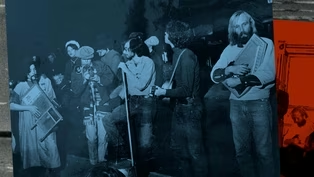
Video has Closed Captions
A thriving jug band scene persists to the present day on Minneapolis' West Bank. (48s)
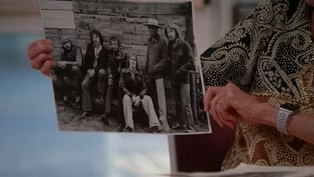
Video has Closed Captions
Eve MacLeish recounts fond memories photographing the West Bank. (1m 15s)
Preview: The Wild West Bank Sound
Video has Closed Captions
Minneapolis' West Bank comes alive with stories of music and migration in this multi-sensory trip. (30s)
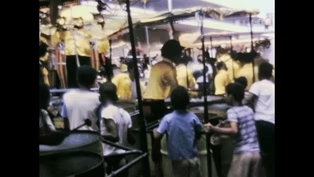
West Bank and the Birth of Steel Drums
Video has Closed Captions
Minnesota has an unusual role in the development of Trinidad's national instrument. (2m 3s)
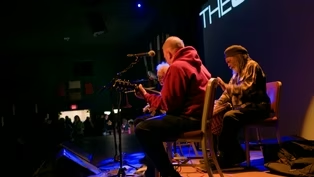
Video has Closed Captions
A public history event tells the fascinating history of the Cedar-Riverside neighborhood. (2m 30s)
Providing Support for PBS.org
Learn Moreabout PBS online sponsorship New Episode
- Arts and Music

Innovative musicians from every genre perform live in the longest-running music series.

- Arts and Music
The Best of the Joy of Painting with Bob Ross
A pop icon, Bob Ross offers soothing words of wisdom as he paints captivating landscapes.
 New Season






 New Episode
 New Episode
Support for PBS provided by:
The Wild West Bank Sound is a local public television program presented by Minnesota PBS