
There’s More to Tahoe
Season 5 Episode 6 | 26m 47sVideo has Closed Captions
Explore South Tahoe’s lakes, trails, and a trout spawning session with Nevada wildlife stewards.
Join Outdoor Nevada as host John Burke explores South Tahoe beyond the famous shores. Visit Spooner and Marlette Lakes, meet Nevada State Parks stewards, and discover pristine trails, forests, and wildlife. John also joins the Nevada Department of Wildlife during a rainbow trout spawning session, gaining an inside look at conservation efforts supporting Nevada’s fish populations.
Problems playing video? | Closed Captioning Feedback
Problems playing video? | Closed Captioning Feedback
Outdoor Nevada is a local public television program presented by Vegas PBS
There’s More to Tahoe
Season 5 Episode 6 | 26m 47sVideo has Closed Captions
Join Outdoor Nevada as host John Burke explores South Tahoe beyond the famous shores. Visit Spooner and Marlette Lakes, meet Nevada State Parks stewards, and discover pristine trails, forests, and wildlife. John also joins the Nevada Department of Wildlife during a rainbow trout spawning session, gaining an inside look at conservation efforts supporting Nevada’s fish populations.
Problems playing video? | Closed Captioning Feedback
How to Watch Outdoor Nevada
Outdoor Nevada is available to stream on pbs.org and the free PBS App, available on iPhone, Apple TV, Android TV, Android smartphones, Amazon Fire TV, Amazon Fire Tablet, Roku, Samsung Smart TV, and Vizio.
Providing Support for PBS.org
Learn Moreabout PBS online sponsorshipSupport for Outdoor Nevada comes from Jaguar Land Rover Las Vegas.
We're proud to help introduce a new generation of adventurers to the diverse experiences that our state has to offer.
Information at jlrlv.com.
Today on Outdoor Nevada, we visit the South Tahoe area.
I met up with some of my friends from Nevada State Parks to learn about everything happening at some of the other lakes and trails in Tahoe.
Plus, I put on my waders and got to work spawning rainbow trout.
All this today on Outdoor Nevada.
♪♪♪ (John Burke) When I say Lake Tahoe, you immediately think of world-class, unmatched, unparalleled beauty.
Well, this ain't half bad either, and it's only a stone's throw away.
Lots of recreational activities, and a lot of history.
Let's go explore Spooner Lake.
♪♪♪ This is a gorgeous area in the Lake Tahoe Basin.
The Spooner back country is a wide-open recreational and natural oasis.
It's full of aspens and more than 12,000 acres of forested open space.
The park features 50 miles of hiking, equestrian and mountain biking trails and primitive roads.
A few of the more popular trails are Marlette, Red House, Flume, and Tahoe Rim trails.
I started out with a leisurely hike around Spooner Lake, then met up with Steve from Nevada Parks.
Tell me about you and where you're from originally.
How'd you get into this?
(Steve Micklus) Well, I went to school for recreation and park administration and ended up applying for Nevada State Parks and got a job offer out of Las Vegas, and I've been with Parks ever since.
-And how's it working out for you?
-It's a great job.
I'm at Spooner Lake, and as you can see, it's one of the best jobs you can imagine.
-Yes, I can't believe this is your office.
I mean, I can't stop looking at it.
Let's start with the name.
Who was "Spooner?"
-So Michele Spooner was an entrepreneur that came to the area, and he started a shingle mill here at Spooner Lake and established this area.
-Wow!
He knew what he was doing.
So let's talk about the lake itself.
How deep is it?
-It's about 20 feet deep.
-Is it as cold as Lake Tahoe?
-No, it's not.
It's a lot shallower, so throughout the summer it'll warm up.
In the wintertime it freezes up but, you know, it's already thawed out here by the end of May and it'll just continue to warm up throughout the summer.
-What kind of activities happen, can you go camping?
-There is camping in the area.
Those campgrounds are in the back country, so the closest one is up North Canyon Road.
It's about a two-mile hike up North Canyon Road.
But in this immediate area, you can walk around Spooner Lake.
We have a two-mile trail that goes around the lake, and there's biking as well.
-You got fish in here?
-We do.
There's tiger trout, rainbow and cut-bow.
-And fishing is allowed?
-Fishing is allowed with a proper license.
Can you bring your pets?
Can you go for a walk with your dog out here?
-Absolutely.
A lot of people bring their dogs out.
It's a nice area to take the dog for a stroll around the lake.
There is a leash law that they're required to be on, but it's a nice area for it.
-I get the feeling that if you come to Lake Tahoe and it's kind of crowded, you could come here and have just as good an experience.
-Absolutely.
You won't have the crowds that you'll have at the lake, especially if you're at like a beach area.
Spooner is one of those areas where you can get away from the Lake Tahoe crowd but still enjoy the scenery.
-Yes, there's really nobody out here on a day that's absolutely perfect.
Man, it is incredible.
-It is.
The back country off Spooner Lake is such a great opportunity to be transported.
You'll find yourself deep in a forest surrounded by aspen and pines.
Here you can hike or bike, and you'll very rarely see a vehicle back here and if you do, it will be for official park business.
I made my way through the back country to meet up with my old friend Jay Howard.
Jay has a wealth of information and loves this Spooner Lake area.
We made our way back to Marlette Lake on the way to the Flume Trail.
(Jay Howard) This is Marlette Lake.
-Who was Marlette?
-Named after a guy named Seneca Marlette.
He was the first surveyor general for the state of Nevada, and he had been a surveyor general for California.
He was the guy, and his crew, who first surveyed this whole area back in the mid 1800s.
-So this is a little off the beaten path but there's a lot doing here, isn't there?
I mean, there's a lot to do.
-There's a lot going on.
There's a lot of people that come up here.
This is a non-motorized back country with a lot of hikers, equestrians, people on horseback and mountain bikers.
-Can you go fishing out here?
-Oh, yes.
This lake is open to fishing.
It's got a very short season because it's also used as a fishery where they collect eggs, but you can fish here.
So we do get a lot of people on mountain bikes, you know, with their fly poles in their packs.
-Oh, interesting.
-Pristine, a little bit remote.
What kind of animals you got up here, Jay?
-You know, I saw black bear not too long ago.
There's a lot of black bears up here.
Bird life like all the raptors, osprey, and we have bald eagles up here.
Mule deer, of course.
-What's feeding the lake?
What keeps it at its level?
-You know, this lake is kind of hemmed in with this watershed that we see around us, and there's about six kind of smaller creeks that bring water in.
But it's really just the snowshed that puts all the water into this lake.
-Roughly what elevation are we at right now?
-About 7,200.
-What is this structure that's right here?
What is that all about?
-This was a cabin, and this chimney that you see is actually the back of the cabin.
And back in the 1930s when this cabin was built by the owner of the water system, the Virginia Goldhill Water System that operated here back then, that person just built a family cabin, like a summer cabin and it was back when the lake was lower.
So the cabin would have been kind of out over what is now water.
-Can you imagine that?
Can you imagine having a cabin right here and it's yours?
-Yes.
-When you come to a place like this, does it still hit you like it does me?
What do you feel when you come out here?
-Just the solitude, and I mean, we were kind of talking a little bit before about there can be a lot of people out here, but it's still a dispersed use, right?
So we get visitors up here in the back country, but they're all kind of going their own way on bike or on foot, and it's still-- it's this feeling of solitude up here that is just, you know, phenomenal especially on a quiet day midweek, not the weekend, right?
It's just a quiet place to be.
-You know, you mentioned bikes.
I've been around Nevada a lot, and lately I'm seeing these e-bikes.
Do you know anything about those?
-Electric bikes?
Yes, back here you see a lot of mountain bikes because we're in this sort of territory, and we've got mountain bikes that are e-bikes now.
They've got a battery, they've got a small motor.
They're a pedal-assist, so they help you pedal.
Small motor.
-I sense you have one.
-I do have one.
-Can we take a look?
-We can take a look if you'd like.
-Let's go.
(whistling) Nice wheels, Jay.
-This is an e-bike.
-Let's talk about e-bikes right now, because I'm seeing them everywhere.
They're just catching fire.
What's the etiquette?
What are the rules or regulations out here for an e-bike?
-In the last couple years, e-bikes have really hit the back country, and this is a little bit more of a cruiser.
It's not a high-end mountain bike like they have.
How the State of Nevada defines an e-bike is less than 750 watts, and it can't go over 20 miles per hour.
And that's it.
I mean, there's no classes.
Like in California there's a class one, a class two, a class three.
In Nevada it's either an e-bike or not, and if it's anything more than that, like they have versions of this with throttles where you just throttle and you go, this bike you have to pedal before it starts to assist, right?
So this is a pedal-assist bike.
It's got a big battery in here, got a motor right here.
You've got to treat it just like any other bike that you'd be on.
They can be dangerous.
You can go down and hurt yourself, injuries are not uncommon, but they're really not any different than a regular mountain bike.
So if somebody out there is thinking, oh my gosh, e-bikes, they're going to be harder on the trail, they're going to be loud, it's really just not the case.
I mean, like you said they're pretty quiet, and in my opinion the impact these wheels have on the trail are not any different than a regular mountain bike.
-Well, you know what I'm about to ask you right now.
You know what I'm about to ask.
-You got to ride this thing.
-Can I try it out?
-You can try it out.
-So it's as simple as riding a bike?
-It's pretty simple like I said.
But there's an on and off button so you just turn on the power.
-That's it?
-And with a pedal-assist bike, all you're going to do is start to pedal.
You've got pedals, brakes, just like everything else.
As soon as you start to pedal, it will assist you and you'll feel it kind of kick in a little bit.
-You know, you're the leader in all the craziest trends.
The newest thing on your block, go talk to Jay.
-E-bikes.
-I'm going to go take a ride.
-Okay.
Have fun.
♪♪♪ Awesome!
Catch you later, Jay!
See ya!
Now, I'm all for hitting the trails on a mountain bike and putting in the effort, but this e-bike has really changed my perspective.
Pedal-assist is a game changer.
You're still putting in the work but with a little help, and the help, well, it allows you to enjoy the sights and appreciate the ride.
I did break a sweat, but I wasn't gasping for air.
It was really enjoyable.
A local rider in his 60s who's still pretty hardcore told me he recently bought an e-bike and he looks at it like playing the guitar.
He loves playing the acoustic, but he also likes making some noise with the electric.
-Woohoo!
Oh, man, epic!
I mean, how do you describe perfection?
Speechless.
Look, the next time you come to Lake Tahoe, check it out.
Breathe in the fresh air, take the sights, but make sure you take time to go to Spooner and Marlette lakes.
When you do, you'll go home and your friends and loved ones will say well, how was it?
And you'll say-- speechless.
I wasn't done in the Tahoe area.
Jay mentioned Marlette Lake is used as an area to spawn fish.
Well, I was curious so I reached out to my friends at the Nevada Department of Wildlife and sure enough, there was a spawning happening right at Lake Tahoe in Incline Village.
I met up with Travis from the Nevada Department of Wildlife to learn more about trout spawning and hopefully lend a hand.
Travis was happy to accommodate, so I suited up and joined the crew and we started the day.
How does this work?
What are we doing?
(Travis Hawks) So this is an electro-fishing backpack.
What it's doing is it's basically like a stun gun for fish.
It doesn't injure them, it just temporarily demobilizes them and it enables us to capture them without having to run like nets or actual fishing or anything that would be more intrusive for the fish.
-So in layman's terms, you're going to zap the water and it kind of stuns the fish, it doesn't hurt them, and then we scoop them up.
-Exactly.
That's an ideal situation.
-How far up does this electricity go?
-It's only running about five feet in front of us.
-Shouldn't we be able to see them?
Because I don't see any.
-Yes, you would think, but it's amazing how well they can hide and how camouflaged they are when they're in the water.
As we get more into kind of the shadowy areas, if there's any fish, that's where they're going to be.
-You're not going to zap us?
-I'm going to try not to.
When rainbow trout spawn, they need the flowing water of a stream.
The moving water keeps the trouts' eggs clean from fungus.
Travis and his team identified this stream as an ideal spawning location.
This is where we started our day.
We're good to go, so are you ready?
-This is crazy.
How big of a fish am I looking for?
-Anywhere from 12 to about 30 inches.
-Wow!
There's got to be an element to what you do that's very satisfying when it comes to helping the environment.
-Oh, yes, absolutely.
I mean, that's number one.
Like this project in particular, seeing the increase in the population that we've seen over the last six years and knowing that it's a direct impact of the work we've done.
You know, to put more animals on the landscape and allow them to thrive is incredible, and a lot of people don't realize the work that goes into maintaining animals on the landscape and how much effort is put into it.
So one, I personally like it, and two, it's fun to explain to people because a lot of people don't understand this.
-Oh, you got-- lift up, lift up, lift up.
Lift your net, lift your net.
-You got one!
You got one!
Wow, that's a big one too.
Nice job.
-How did you see that?
He didn't see it.
How big would you say that one is?
-Seems like an 18, 19-inch female.
-Would you say the trout here are incredibly healthy because-- look at that.
-Yes.
So these are some of the healthiest rainbow trout you're going to find anywhere, really.
-And why is that?
-Clean water, you know, an abundant source of forage and-- -Can you hold that up for the camera so we can take a good look at that.
Look how beautiful that is.
Are you seeing what I'm seeing?
-Yes.
Very healthy, super clean.
She's a female.
She's not-- she doesn't have a lot of eggs, but we're going to hold her and wind up tagging her.
We may not spawn her though.
I'm going to give it to you and then just dump her in that upstream.
Thank you.
-Wow, that was awesome!
We continued our march up the stream and secured a couple more trout.
It's amazing how camouflaged these fish are.
I couldn't see them right in front of me.
How did you do that?
Two in a row!
Amazing.
Rainbow trout will travel several miles up a stream in search of the perfect place to spawn.
But before that happens, the Nevada Department of Wildlife has a series of holds and pens set up to secure the trout.
It's here we get personal with the fish.
I'm still shocked at how I can't see them.
-Yes.
It's incredible how well they can hide.
-All right.
So I'm just going to a dark corner, but I really don't know... -Yes, that's really the only way to do it.
Yup, got it.
Nice.
-Wow!
Okay, now what do I do?
-So we're going to bring him up and over, don't let him out, and we're going to put him in this net pen over here.
-Jeez, he's huge.
Tell me what you think the size and the weight of this one is.
-He's 24-ish and probably about four or five pounds.
So if you just grab the bag with your free hand and just kind of dumped him out.
-Oh, really?
-Yes.
-Okay.
There you go, buddy.
Perfect.
-Wow, that's satisfying.
-Yes, right?
-I want to be you when I grow up.
-Yes, that's a healthy fish there.
-Okay.
Let's go to stage two.
First we gathered up all the trout into one pen.
Once they're all secure, they're prepped for extraction.
-In this one here?
The males and females are separated, and each trout is naturally sedated for their safety.
From there, the egg extraction begins.
♪♪♪ The snout towards the front.
-Snout towards the front, okay.
Sorry about that, sweetie.
Sorry.
That is...440.
♪♪♪ So she is tagged twice, basically; is that right?
-Oh, she will be, yes.
-So it's 990.
-All right.
-And then I'll take this from you and give her a tag.
These fish are also tagged with a radio chip and contact tag.
This is done to keep track of the fish as part of the overall study.
The contact tag actually has Travis' phone number on it so if someone catches the fish, they'll contact Travis and he'll ask a series of questions.
-So we go right in front of the dorsal fin.
-Okay, and there's a child watching right now that says does it hurt the fish?
-So that's why we sedate them.
I'm sure they're sore afterwards.
-So then this is the visible Floy tag.
And then we'll put him back in the water.
We continued to measure, weigh and tag.
This data is very important to the study of these fish.
-540.
-470.
But once this is completed, we can start the egg extraction.
Unbelievable!
So that's 1930.
-Perfect.
So now all these fish are tagged and we're going to go ahead and spawn.
So basically pull her out.
I'm going to clean off that anaesthesia and then hold her like this, and then just very little pressure.
That's actually a beautiful color.
-Yes.
It's the same as the health of the fish.
The health of the eggs that come out of these fish is impressive.
-As a novice, I'd say it's very healthy, right?
-You're right.
Your assessment is correct, and I mean, basically anyone who grew up fishing knows what a salmon egg looks like, and that's exactly what we have here.
-How many again?
-So they can range-- I mean, 500 would be a low number of eggs, 3,000 is high.
These fish in Tahoe, when they're really ready to lay their eggs typically are about 2,000 eggs per female.
-When they release them in the wild, the eggs, do they release them in one spot?
-Yes.
They all go in usually like Sand Harbor which is just down the way, Cave Rock.
Grab another one.
-I mean, in the same spot in the stream?
-Oh, yes, they do.
They build what's called a redd, so it's like a nest for fish in the rocks, and they'll lay their eggs in those rocks.
So this girl's not ready to land.
So if you feel, you can feel how she's bulging but she's kind of hard.
-Yeah, right there.
-That means she's not ready to lay her eggs.
She'd be really soft and loose if she was ready.
-So you're going to let her be.
-Yes.
We'll just let her go, let her lay her eggs when she's ready.
I get the impression we're going to have a few of those.
-So the eggs go in here, then what happens?
-So once we handle these last couple females, I'll grab a male and we will do the exact same process to fertilize the eggs.
-So you're having about a-- what did you say, about a 95% success rate with these eggs?
-Yes, sir.
So I mean, figure we did a thousand eggs, and that's 950 fish.
-And they get released back here and in other-- -And in other places around Nevada and, you know, as you can see, they're all big healthy fish and good genetics in these fish, so we want them in other places where people, you know, where they may be easier to catch than Lake Tahoe.
So anyway, you can get out and catch some fish and enjoy the outdoors.
This one's not ready either.
All right.
So now we go with a male.
-Now it's time to fertilize.
-Exactly.
Once the eggs are ready, a male trout is brought in to begin the fertilization.
It's the same process.
How long does it take for them to fertilize?
-They're fertilized now.
It's pretty instantaneous.
With the eggs fertilized, they're carefully cleaned and rinsed with the water from the stream.
This removes any harmful materials to the eggs.
Not only do these eggs go on to help stock lakes, streams and ponds throughout Nevada, this study is also part of a bigger picture.
This will hopefully bring back Nevada's cutthroat trout population, which is on the verge of extinction.
The rainbow and cutthroat are very similar species, so the data collected here will be used to spawn cutthroat and build back its population in Nevada.
So roughly speaking, how many fish get released a year?
-I'd say total across the state of Nevada, we're pushing 800,000 to a million, just knowing how many eggs that we produce.
Once all the eggs were collected, fertilized and cleaned, it was time to get them counted and prepped for transport to the hatchery.
Again, this was very time sensitive, so it was right to work counting and packing.
-27 ounces, yes.
So Taylor will fold them up.
So that's how they get transported, and they'll go in the next cooler down here.
The work is very time sensitive, and it's like a well-oiled machine.
I was really glad I could be part of the team and help.
Finally, with the eggs on the way to the hatchery, it was time to return the rainbow trout back to the lake.
So this is it, the final part of their involvement in this process, right?
-Yes.
This is the last part of their long day.
Taking them back home and let them head back out to the lake and hope we see them again next year.
-How do you know they don't just go back up the stream?
-Some do, the males specifically.
That drive for them to spawn is so strong, a lot of them turn and head right back up the stream.
The females for the most part are sick and tired of what we're doing, and they-- let them go right here-- and they just go ahead and swim out to the lake.
There they go.
How satisfying is that to you to see this part of it?
-Awesome.
Yes, I mean, after what we just put them through and everything and then to watch them swim off healthy is about as good as it can get.
-It's about as good as it can get.
I got to tell you something.
You have taught me so much today: In part, nature doesn't happen by accident.
Sometimes it needs a little help if man's going to be involved, and I don't think people realize the work that you're doing here affects the entire state.
-Yes, and I mean, I'm glad you took that from what we talked about because there's guys-- I mean, I'm not the only one.
There's guys like me all over the country and Nevada specifically, a group of guys and girls, good groups of them, out doing this exact stuff all over just so we can have, you know, the wildlife that a lot of people take for granted.
-I got to say on behalf of the state, on behalf of the fish, thank you, man, for everything that you do.
-Thanks for the help.
-This has been an absolutely great day for me-- I got to spend it out here with you and learn a lot.
Thanks a lot.
-Yes, thank you.
The help is much appreciated.
-Good stuff.
♪♪♪ The Tahoe area of Nevada is beautiful.
You turn a corner or hike further into the back country, and it just gets more stunning.
But it's so much more so because you can breathe.
There's an openness, an ability to reset.
Look, we all lead busy lives with lots going on, and sometimes we just need a moment, a day, or even a week to reset, a chance to take a breath, hear nothing but the water, trees and air.
The Lake Tahoe area can accommodate, and the people that you'll run into here, well, they're either looking for the same thing or helping to provide it to you.
Take it from me: Take the time.
Find your spot here and take that moment to reset.
♪♪♪ Support for Outdoor Nevada comes from Jaguar Land Rover Las Vegas, inspiring the spirit of adventure with confidence in any terrain or condition.
Information at jlrlv.com.
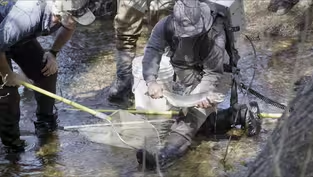
Behind the Scenes at Lake Tahoe's Trout Conservation
Video has Closed Captions
Clip: S5 Ep6 | 13m 26s | See how Nevada spawns trout at Lake Tahoe, from electro-fishing to native species restoration. (13m 26s)
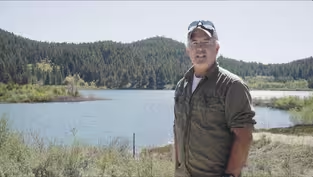
Hiking, Fishing & E-Bikes at Spooner Lake, Near Lake Tahoe
Video has Closed Captions
Clip: S5 Ep6 | 10m 29s | Hike and explore Spooner and Marlette Lakes, peaceful gems tucked above Lake Tahoe’s bustle. (10m 29s)
Providing Support for PBS.org
Learn Moreabout PBS online sponsorship













Support for PBS provided by:
Outdoor Nevada is a local public television program presented by Vegas PBS