
Things That Aren't Here Anymore (1 of 3)
Episode 1 | 19m 21sVideo has Closed Captions
A nostalgic look at Southern California's past, things and places which no longer exist.
Ralph Story takes viewers on a nostalgic journey through Southern California landmarks that aren't as they used to be. The first part includes the Red Car, Clifton's, Pasadena ostrich farm, Mt Lowe, seaside amusements, Beverly Park and Ocean Park. Produced in 1995.
Problems playing video? | Closed Captioning Feedback
Problems playing video? | Closed Captioning Feedback
Things That Aren't Here Anymore is a local public television program presented by PBS SoCal
Things That Aren't Here Anymore (1 of 3)
Episode 1 | 19m 21sVideo has Closed Captions
Ralph Story takes viewers on a nostalgic journey through Southern California landmarks that aren't as they used to be. The first part includes the Red Car, Clifton's, Pasadena ostrich farm, Mt Lowe, seaside amusements, Beverly Park and Ocean Park. Produced in 1995.
Problems playing video? | Closed Captioning Feedback
How to Watch Things That Aren't Here Anymore
Things That Aren't Here Anymore is available to stream on pbs.org and the free PBS App, available on iPhone, Apple TV, Android TV, Android smartphones, Amazon Fire TV, Amazon Fire Tablet, Roku, Samsung Smart TV, and Vizio.
Providing Support for PBS.org
Learn Moreabout PBS online sponsorshipAnnouncer: Major funding for "Life and Times" was provided by The James Irvine Foundation, which is dedicated to the development of an informed California citizenry, with additional support from GTE, building better communities through communication.
[Ballroom music playing] Man: I wish somebody would have tapped me on the shoulder and said, "Well, these are the good old days."
Woman: People were very, very careful about their manners then.
Second man: This was a tremendously romantic time.
Second woman: Would you like me to blow it?
[Toot toot toot] [Ballroom music playing] Ralph: People are always saying, "Those were the good old days."
Did you ever wonder if they really were?
And if they were so wonderful, why did they disappear?
Let me ask you a couple of questions.
You ever wonder what the "Hollywood" sign said before it said "Hollywood"?
And were those wonderful old red cars blue or green before they were red?
How long has it been since you had lunch at Clifton's Pacific Seas or a Cobb salad at the Derby?
Tell you what.
I'll put five gallons of flying-A in the Studebaker.
You get a couple of jelly donuts from the Helmsman.
We'll stop by Currie's for a couple of mile-high cones, and we'll take in the Hollywood stars at Gilmore Field.
If they're not playing tonight, we'll go on to Pacific Ocean Park, and we'll meet some wonderful people who remember all of these things that aren't here anymore.
[Ballroom music playing] Now you see it.
Now you don't.
And they call that history.
It happens all the time, only maybe oftener in Los Angeles.
My name is Ralph Story, and on January 7, 1948, I parked my Studebaker right there, and I walked into this building to begin 40 years of talking, first on radio and then on television.
My first job was to sign on KNX at 6:00 in the morning.
I had to learn to say... [Speaking Spanish] Well, KNX is still transmitting, and I see Mark C. Bloome is still wheeling and dealing across the street, and the Palladium is still dancing next door.
And surprise, I'm still talking.
I remember I bought an old Spanish fixer-upper house up Beechwood Drive under the "Hollywood" sign, only it didn't say "Hollywood" then.
It said "Ollywood Land."
The "H" had fallen down, and it was actually just a real-estate tract, another nice old Los Angeles custom.
Just about everything else I remember about Los Angeles isn't here anymore.
So, where to begin?
Well, in the beginning, there was the car, not your car or my car, everybody's car, the big, red car.
It's the way we got to all of the places that aren't here anymore, and it's the sure winner of our nostalgia trophy.
[Music playing] For decades, we've had this love affair with Pacific Electric, the old inter-urban electric trolley that ran everywhere on the slogan "Live in the country.
Work in the city."
We Angelenos invented that way of life, and we idolized the big, red cars as modern rapid transit, and we're still reminiscing about those good old days.
Mae: I was working in downtown Los Angeles, and my husband was working on the red cars.
He would always tip his hat and say, "Well, that was nice to see you ride again today."
So, this went on for several weeks, and one day he wrote a little note to me on one of the little white tickets, and he said, "Do you think it would be OK for me to ask you for a date?"
Well, this went on for a couple weeks, and I never answered.
Then he said, "You didn't answer my note."
So, finally I said, "Well, perhaps."
Woman: ♪ Gonna take A sentimental journey Gonna set my heart at ease ♪ Mae: Then we dated in April to August, and we were married, and we were married for 49 years.
[Jazz music playing] Ralph: Don't look for villains like the car companies or the bus companies or the tire companies.
You and I killed the big red cars.
We took the trolley to the end of the line.
We bought the lot and built the house, and then we betrayed our true love.
We bought a car.
We bought a hundred thousand cars.
And in the Fifties and Sixties, Pacific Electric choked to death on them, a tragic affair because we broke the first rule of true love-- we didn't go home with the one who brought us.
[Jazz music playing] And now I wonder if you remember the tropical island we used to have right here on Olive Street in the middle of Los Angeles.
It was only a cafeteria, but, my, my, what a cafeteria.
Clifford Clinton and his family transplanted everything from Hawaii-- waterfalls, palm trees, coconuts, pineapples, hula skirts, ukuleles, the whole luau.
But what they served was meatloaf and coleslaw, and they called this Pacific Seas.
However, what made Clifton's really special was their pricing policy.
As a residual of the Depression years and their Christian faith, Clifton's never turned away anyone who couldn't pay for dinner.
Think of that.
Esther: And everybody said to him, "You're gonna go bankrupt doing this," but he didn't.
Shortly after I graduated from UCLA, which was in 1937, another lady, a friend of mine, and I started a little gift shop right inside the door of the Pacific Seas Cafeteria.
We not only sold mementos from the islands, but we also made leis from fresh flowers.
The inside was just beautiful.
They had neon palms coming up in several parts of the dining room.
[Music playing] Facing the front of the cafeteria was a platform where they had singing waiters, and every so often, one of the waiters whose turn it was, would go up and sing with a microphone for the whole dining room to hear.
Ralph: And Esther should know.
She's worked for Clifton's for 51 years.
She still writes their monthly newsletter called "Food for Thot."
And on her 40th anniversary, the owner, Don Clinton, gave her this plaque.
Esther: And what thrilled me most was that he put on here this original brass plaque, which was fastened to the outer door of Clifton's Pacific Seas because Clifton's Pacific Seas is no longer there.
And, um, this is a little verse I wrote about that.
"Step from the street, "with its dust and cries, "into an island paradise.
"Amid these tropic trees "and flowers, find rest "and peace and happy hours, "where rainbow waters "cool the air, "where girls with blossoms "in their hair offer you "tempting foods to eat, "where the atmosphere is gay "and sweet with friendliness, "where music sings to lift "your spirit on its wings.
"From here, you'll seek "the streets again, refreshed to meet your fellow man."
Ralph: Well, Clifton's is still serving meatloaf at a number of locations in Los Angeles, but it's their Pacific Seas that people still talk about.
Esther: It was a chance to feel that you had traveled elsewhere into a wonderful realm, and you were right in your own city.
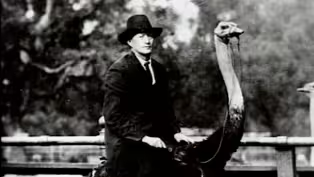
[Music playing] Ralph: Weird bird, the ostrich, so weird people used to drive out to the ostrich farms, like Cawston's in Pasadena, just to take pictures or maybe to take a ride.
[Music playing] The product, of course, was feathers, feathers for women's hats and clothes.
Ah, but fashions change.
During the Depression, the feathers and the birds and the farms all disappeared.
But wait.
They're coming back.
Out in the agricultural areas, the ostrich farms are bigger than ever now, only this time, it's not the feathers or the leather.
It's the meat, rich, red beef-like meat low in cholesterol, high in price, and they say it will be the meat of the Nineties.
Ah, yes, times do change.
It's no wonder those birds stick their heads in the sand.
[Music playing] And don't look now, but I think one is trying to get away.
[Music playing] Now, here's something that hasn't been here for a long time.
It's a different kind of railway, the vertical kind.
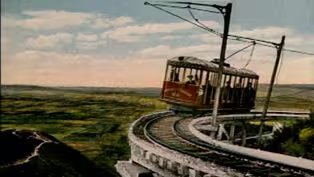
When inventor and professor Thaddeus S.C. Lowe retired to Pasadena, he got a crazy idea.
He built a little mile-long electric trolley line from here to there.
Well, actually from down here to up there.
[Trolley rumbling] Then he built an observatory, a tavern, and a hotel at the top, and he had a winner on his hands.
They even renamed that little mountain, and it's knowns as Mount Lowe to this day.
He said he did it just for the point of view, but when the roads and the cars could also snake up the mountain even higher, the thrill was gone.
The hotel burned in the Thirties, and now it's just one of those things that lives on in our memories, but if you ask me, the old professor really had a point of view.
Are you having a good time?
You know, back then, having a good time was called amusement, and we had amusement parks.
Venice was an amusement park.
You could ride the trolley along the boardwalk, take a gondola ride in the quaint Venice canals.
And come clean now.
Anybody here remember taking a bath in the local bath house?
More than just an amusement, though, was the awesome, thrilling, legendary roller coaster in Long Beach called The Pipe.
And a different kind of thrill was having your picture taken with the king of the jungle at Gay's Lion Farm in El Monte.
It only cost a dollar.
And down by the sea, we had a great, big fish farm.
Everybody fondly remembers Marine Land.
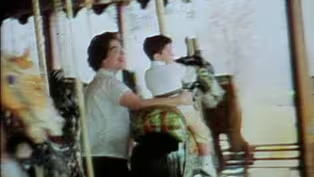
OK. Do you remember what used to be right here where the Beverly Center is now?
It was called Beverly Park.
In the world of amusement parks, Beverly Park would surely be voted least likely to succeed, but it succeeded anyway for reasons that are hazy.
[Carnival music playing] It was really just a patch of green at the corner of Beverly and La Cienega, a few ponies going round and round, a little merry-go-round barely going around, and a hot dog stand.
Did I miss something?
But it ran all the time, and it ran for a long time.
And they say all the divorced Beverly Hills fathers could take their kids there and unload a little guilt.
Jeffrey: What I remember more than anything else was they had a pony ride, and it was a track.
So, my sister and I used to race around the track.
But when you get off your ponies, in the middle of the track, they had swans and geese who would just virtually attack you.
[Geese honking] So, you'll see lots of geese running up and biting kids on the butt, and that's what Beverly Park was like.
I mean, it was a thrill park.
[Geese honking] Martin: When my son was born, I would take him over there for his birthday parties.
They had wonderful birthday parties over there, all the rides.
And, of course, you'd bring all of his friends over, and you bought a string of tickets.
You'd give all the kids tickets.
They'd go on the rides.
And it was a delightful park.
It wasn't so many years ago that they tore it down, and why get rid of something like this?
Now there's really no place for a child to go for his birthday.
Ralph: This was all great for kiddie rides, but if you wanted the big-time thrills, you had to head to the beach.
Chorus: ♪ By the sea, by the sea By the beautiful sea You and I, you and I Oh, how happy we'll be When each wave Comes a-rolling in We will duck or swim... ♪ Ralph: Once upon a time, everybody in Los Angeles wanted to go to the beach, and they did.
So, big wooden piers were built out into the Pacific, and little fun zones developed at the base of each one.
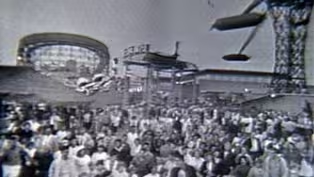
Chorus: ♪ I love to be beside Beside, beside the sea Beside the seaside... ♪ Ralph: Probably the most successful was Ocean Park between the Venice Pier and the Santa Monica Pier.
Chorus: ♪ You and I You and I... ♪ Barbara: Pacific Ocean Park began to be terribly popular about the late turn of the century, about... you know, 1918, 1917.
It was built before then, but that's when it hit its heyday.
Chorus: ♪ By the sea By the beautiful sea You and I, you and I Oh, how happy we'll be When each wave Comes a-rolling in We will duck or swim And we'll float and fool around The water over and under And then up for air... ♪ Barbara: It has theaters.
It had roller-skate rinks.
It had dance halls.
It had restaurants.
It had rides and slides and something for everybody.
Chorus: ♪ By the beautiful sea ♪ Ralph: But then, in 1958, a tidal wave of money rolled in, and it became Pacific Ocean Park, 28 acres of nautical nonsense which really rivaled Disneyland, and the all-day admission, just 90 cents.
J. Stanton: They took the old Highboy roller coaster and renamed it the Sea Serpent.
They took the old Stratoliner, which was this huge tower with rockets twirling around it, and renamed it Mr. Dolphin.
They rebuilt the entire end of the pier and turned it into a banana-boat train ride, where you went out into the jungle and then circled a volcano that was erupting and then crossed a rickety trestle to cross the tracks overlooking the ocean.
Jeffrey: They had a very scary ride that were, like, these little bubbles that actually went out over the ocean.
I remember, probably in 1964, '65, one of them fell into the ocean with a couple of people in there, and every time I'd ever ride on it, I'd go... "Is it gonna be me next?"
Colleen: I call it The Centrifuge.
I guess they call it The Whirlpool.
They got them in that-- It looks like a barrel with a bottom in it, and they started spinning, and pretty soon, you're glued to the back.
But my husband didn't realize that the floor dropped away also, and our kids, oh, they did get even with him.
He about died on that one.
[Music playing] Emcee: Another outstanding thrill at Pacific Oceans Park is when you ride over the Pacific Ocean in a bubble.
[Music playing] Ralph: They called it P.O.P.
for short, but not for long.
Nine years after it opened, business fell off, and the whole fantastic, fabulous foolishness just plain disappeared.
But we can still hear the squeals of the Sea Serpent and feel the salt spray of Mr. Dolphin and Mrs. Squid, and we'll be back with more "Things That Aren't Here Anymore."
[Music plays]
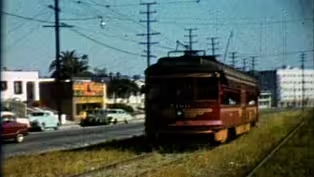
Before the Freeways, Los Angeles had The Red Car
Video has Closed Captions
Clip: Ep1 | 2m 22s | Before Los Angeles was known for cars, it was an innovator in rapid mass transit. (2m 22s)
Video has Closed Captions
Clip: Ep1 | 2m 3s | Before Beverly & La Cienega had the Beverly Center, it was home to Beverly Park. (2m 3s)
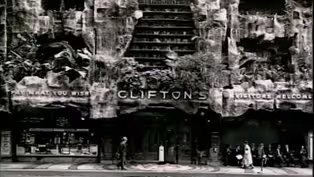
Early History of Clifton's Pacific Seas
Video has Closed Captions
Clip: Ep1 | 3m 28s | Clifton's, known for its generosity toward those who could not pay, was founded in 1930. (3m 28s)
Video has Closed Captions
Clip: Ep1 | 15m 15s | The Mount Lowe Railway opened on July 4, 1893. (15m 15s)
Ostrich Farms of Early Los Angeles
Video has Closed Captions
Clip: Ep1 | 1m 23s | Before the Great Depression, women's hats and ostrich feathers were in-fashion. (1m 23s)
Video has Closed Captions
Clip: Ep1 | 4m 29s | Ocean Park was a popular L.A. amusement park in the early 1900s. (4m 29s)
Providing Support for PBS.org
Learn Moreabout PBS online sponsorship











Support for PBS provided by:
Things That Aren't Here Anymore is a local public television program presented by PBS SoCal