
Things That Aren't Here Anymore (2 of 3)
Episode 2 | 22m 24sVideo has Closed Captions
A nostalgic look at Southern California's past, things and places which no longer exist.
Ralph Story takes viewers on a nostalgic journey through Southern California landmarks that aren't as they used to be. The second part includes Angel's Flight, the "Honeymoon Elevator," drive-ins and other SoCal architecture, Central Ave, Helms Bakery, and Bullocks Wilshire. Produced in 1995.
Problems playing video? | Closed Captioning Feedback
Problems playing video? | Closed Captioning Feedback
Things That Aren't Here Anymore is a local public television program presented by PBS SoCal
Things That Aren't Here Anymore (2 of 3)
Episode 2 | 22m 24sVideo has Closed Captions
Ralph Story takes viewers on a nostalgic journey through Southern California landmarks that aren't as they used to be. The second part includes Angel's Flight, the "Honeymoon Elevator," drive-ins and other SoCal architecture, Central Ave, Helms Bakery, and Bullocks Wilshire. Produced in 1995.
Problems playing video? | Closed Captioning Feedback
How to Watch Things That Aren't Here Anymore
Things That Aren't Here Anymore is available to stream on pbs.org and the free PBS App, available on iPhone, Apple TV, Android TV, Android smartphones, Amazon Fire TV, Amazon Fire Tablet, Roku, Samsung Smart TV, and Vizio.
Providing Support for PBS.org
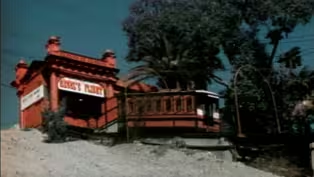
Learn Moreabout PBS online sponsorship[Music playing] Ralph: I'm not just making a pun when I say that Los Angeles has had its ups and downs literally and figuratively, but probably the most successful and famous is this little trolley car behind me.
Its name is Olivet, and it has an identical twin named Sinai.
Those are Biblical names chosen by the churchgoing ladies who lived up on Bunker Hill.
And by now, of course, you know I'm talking about the incredible "Angels Flight," just a hundred yards of railroad, but it ran for over 60 years, traveled over a million miles, made over a million dollars, and made over a million friends, every one of whom remembers it well.
[Music playing] Man: ♪ You are my lucky star Oh, I saw you from afar... ♪ Ralph: We've had all kinds of rides in the history of Los Angeles, but the shortest one is the most famous one.
So, let's climb aboard for the ride up to Bunker Hill.
Man: ♪ I was star struck You are my lucky star I'm lucky in your arms You've opened heaven's portal Here on Earth For this poor mortal You are my lucky star ♪ [Music playing] Esther: That was fun.
My mother and father took me there when I was still a child.
Rode up on it.
It was quite a thrill.
So, when my little daughter was about three or four, we took her on Angels Flight, and she loved it, too, and that was shortly before they stopped running it.
[Music playing] Sammy: Well, as a young kid, it was exciting to be going up, and you felt like going flying.
You're going up almost perpendicular, and you look back and looked over the city.
Ralph: Right here in downtown Los Angeles, at the corner of Hill and Third Street, is the original location of Angels Flight.
Throughout its history, Angels Flight inspired many Angelenos.
Local artist Ben Abril remembers Angels Flight like this.
[Music playing] Woman: ♪ Clang, clang, clang Went the trolley Ding, ding, ding went the bell Zing, zing, zing Went my heartstrings For the moment I saw him I fell ♪ Ralph: And in this early silent movie, the words "Angels Flight" are a source of great confusion for two young lovers.
[Lively music playing] Ralph: After 68 years of lifting our spirits, Angels Flight was dismantled in 1969 to make way for a new development.
Instantly, it became one of our most beloved things that aren't here anymore.
But wait.
Plans are to reunite us with our old love.
Groundbreaking for the return of Angels Flight just one block south of its original location is planned for 1995.
And the moral of this story is, if we remember hard enough, we can bring things back.
I'm happy to report that love and romance are two things that have not disappeared from Los Angeles, but a funny old romantic symbol is gone.
It was just an elevator, but it ran to the third floor of the Los Angeles courthouse, and that's where the marriage license bureau was.
It was known as "The Honeymoon Elevator," maybe because some of the honeymoons began before it reached the third floor.
But don't snicker.
Some of those marriages lasted longer than the elevator and longer than the courthouse.
Mean streets are not something new for Los Angeles.
Right after the Civil War, all the desperadoes drifted to our southwest corner, and this was the most dangerous town in the West, and there was no 911.
So, this sign was posted on Main Street in 1865.
It's gone, but I mention it because there seems to be a strong feeling we should find the sign and put it up again.
[Lively music playing] Was Los Angeles invented for the automobile, or was the automobile invented for Los Angeles?
And was it a marriage made in heaven or in hell?
We'll see.
But we have the wide-open spaces, the year-round sunshine, no snow, seldom mud, lots of nearby fuel, and the restless urge to see and do.
So, away we went in our merry motorcars to make the first real driving city.
Everything we see and do and say and are begins and ends with our cars.
We were going to reminisce about some of the wonderful old drive-ins which aren't here anymore, but historian Alan Hess says they are more than nostalgia.
They are culture.
Alan: Over the decades, through trial and error, through experiment, Los Angeles got to know how to design for the car.
Buildings would be shaped for the automobile, the drive-in restaurants particularly, which came along in Los Angeles in the late 1920's, really had their heyday in the 1930's.
These were service stations on the roadsides for people who were living in their automobiles.
Ralph: The drive-in menu was burgers, fries, and a shake, but the delivery system was a beautiful, sexy Los Angeles invention, the carhop.
[Music playing] Carhops aren't here anymore, but all of us guys miss them.
Don't be offended if I say Los Angeles has the best and the worst architecture in the world and a lot of funny buildings in between.
We like edible architecture, hot dog stands that look like hot dogs.
But if we miss all of those funny old buildings, maybe somebody ate them.
[Music playing] I don't need to tell you that Los Angeles is not a real city.
It's just a whole bunch of neighborhoods sharing the same name.
One of our neighborhoods was called Central Avenue, and I know the avenue is still there, but what's central is missing.
[Ballroom music playing] People stayed up late, but they also got up early because their community was the entertainment center of town, certainly thriving if not prosperous.
Everybody knew everybody else.
[Ballroom music playing] Mildred: That was the place to go to see your friends.
You walked up and down Central to see your friends and to see what other people were doing.
And you wanted to be with them, and you wanted to celebrate with them.
And there they were.
[Big-band music playing] Buddy: It was like the people from the avenue had their own world going.
It was wonderful.
Nobody seemed to mention it much outside of the area.
And now it was probably better than we all knew.
[Big-band music playing] Roy: Down in the middle of the block was the Club Alabam.
It had Johnny Otis' big band in there with a stage show, chorus girls and everything, T-Bone Walker, blues singer, as the star.
Across the street was The Last Word.
I think you've got the pictures of them with jam sessions going on.
All the jam sessions at that time were bebop-oriented.
And what made bebop so important, they would have after-hours jam sessions.
When you'd leave The Downbeat or the Alabam or one of them clubs there, you could go down to Jack's Basket Room on 33rd and Central, where you'd have Dexter Gordon, Miles Davis, Wardell Gray, all these people that would be down there.
Everybody would be jamming.
Mildred: Central was the place that we went to to take care of business.
We could shop.
We could get hardware.
Newspapers were put out on Central.
Central was almost like the main street in a small village.
You could do anything there.
During the time when Joe Louis was in his heyday, when he would have a fight, Central was quiet as... You couldn't find anybody.
Everybody is in their house, listening to the fight.
Radio announcer: A left to the head, a left to the jaw, a right to the head, and Donovan is watching carefully.
Louis measures him.
Right to the body, a left hook to the jaw.
And Schmeling is down.
Mildred: And whenever he would win, Central came alive.
People would rush, walk, drive, get to Central to talk about, to celebrate and drive up and down Central blowing horns and yelling at each other.
"Ooh, he won," and "Oh, wow."
That was a big deal.
[Horns honking] Ralph: So, there you have it.
Some things on Central Avenue are gone, but the music and the memories live on.
[Lively music playing] It may come as a shock in this age of supermarkets and super malls, but the groceries used to come to us.
The milkman and the iceman and the vegetable man and the meat man all came to the door, and the grocery man delivered the rest.
The Good Humor man may still be around, but just about the last to go was everybody's favorite, the guy who blew the whistle, the Helmsman.
Mae: This was a whistle that comes off of the Helms Bakery.
Would you like me to blow it?
[Toot toot toot] Can you hear it?
[Music playing] Ralph: Paul Helms started Helms Bakeries in 1930, and he got a contract to supply the Olympic training tables then took on the Olympic job of baking for all of Los Angeles.
Pretty soon, 300 trucks fanned out over the city every day.
Thousands of kids chased after the Helmsman for their share of sugared donuts.
And Karen Bunde was one of them, and she's still a fan today.
[Music playing] [Whistle toots] Karen: The Helms coach would come about the same time every day with all the fresh baked goods you could possibly want, whether it was jelly donuts or cream puffs or chocolate-chip cookies or Olympic bread or wheat bread or donuts of any shape and variety.
Mae: And you would just put up a card in your window, a Helms card, that would state that you wanted bread or pastry or for him to stop.
And he would blow his whistle, and, um... then you would go out and purchase whatever pastries or whatever you wanted.
Barbara: You got a lot of service in those days.
If you didn't have a car, it didn't make any difference because people brought things to you.
That was their business.
[Music playing] Karen: This particular coach, owned by Hillcrest Motors, is a 1948 Helms square coach.
[Music playing] Mr. Helms said, "Don't call them trucks, "because garbage comes in trucks."
So, they are Helms coaches.
And he started with 11 coaches, and at the height of the business, there were over 500 coaches on the road any given day, delivering to more than 3.5 million households.
Sammy: Most people don't realize, but I was the first non-white ever to win a national championship in diving and the first American-born Asian to win a gold medal for my country, the United States.
But while we were there in London, Helms Bakery used to fly in the Helms bread every day for our consumption.
And I remember all the Europeans, the Asians said, "That bread "that is like cake, "it is so white.
"How can they make bread so white?"
So, we ate like kings.
The French brought in their own wine.
But we brought in Helms Bakery.
Ralph: In 1969, a loaf of Helms bread sailed up in the Apollo 11 space capsule to become the first bread on the moon.
But a sad postscript-- five months later, they turned off the ovens because those Earthbound little delivery coaches were just too expensive.
[Music playing] Karen: It was a wonderful time, and Helms Bakeries, I think elicits a very warm, personal feeling about the essence of Los Angeles at that time.
[Music plays] Ralph: Even so, how much something costs is not a good measure of how long it's going to last.
Another missing Los Angeles landmark was very proud of its high prices and its high quality and its high service.
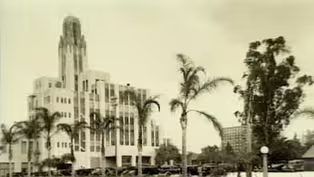
Of course, I'm talking about Bullocks Wilshire.
[Ballroom music playing] Barbara: You walked in to buy a dress or something, and a very elegant, dignified saleswoman would come out to greet you.
And you might see one or two things hanging on a model.
But you told the lady what you wanted and what you were looking for, and you sat down on a couch, a beautiful beige affair with a coffee table in front, and the saleslady went out to find what you wanted.
She would go out and bring two or three things for your approval.
A model would be sent out to show you how it looked when it was worn on.
And so, that's the way you bought your clothes.
Mary: Bullocks Wilshire was the most gracious.
You didn't even park your own car.
You drove your car in, and it was parked by a valet, and you got out to look on the ceiling and see a magnificent mural, and you would go in, and you would do all your shopping.
And when you were done, you would go out, and your packages would be loaded in the car, and you would drive away.
[Music playing] The store was magnificent... and it is still magnificent.
It was built in 1929, and it has a very unique history.
It was the second store in the Bullocks chain.
The man who conceived the store was P.G.
Winnett, the vice-president of Bullocks, and he went to the Paris Exposition of 1925, and the style that grew out of that exposition was art deco.
And he saw all these art deco designs, and he decided, "That's what I want for the new store."
So, the exterior, with its magnificent 10 stories of copper and terra cotta and its art deco style, and the interior was unlike any department store in Los Angeles.
Ralph: It's where anybody who was anybody could buy anything, as everybody remembers.
Barbara: One day, my mother and I were having lunch.
The world stood still.
What's happening?
Our eyes were directed to the entrance, and there stood Marlene Dietrich.
She was just at the height of her publicity career and good looks.
She was wearing a man's black gaberdine double-breasted suit, unbuttoned, a white silk shirt unbuttoned about except to here.
Remember, these are the days that ladies did not go out without hat, without gloves, the proper clothes.
And there she stood in all her glory in this entrance.
She had on a pair of high-heeled satin opera slippers.
No hat, no gloves, nothing.
She just stood there like a goddess.
Everybody just...
The world just stopped.
Unheard of.
Women did not wear pants.
Things like slacks were never seen.
Everybody began to buzz, and it was like a herd of locusts, you know.
They were just, you know...
The chatter just didn't stop.
I think that whole town was thrust into a state.
Anyway, getting back to Bullocks Wilshire, ladies went to lunch there.
Mary: The tea room was kind of blue-blood American cuisine.
You would go and have coconut cream pie or a Bombay salad with crab and shrimp, and their employee handbook said they had to use a certain vocabulary.
They had to say "we" and not "I," and they had to say "approve" and not "OK," and they never said "customer;" they always said "patron."
Ralph: Bullocks Wilshire opened one month before the stock market crashed in 1929, as old money began moving west from downtown along Wilshire Boulevard, and they shopped for more than 60 years.
Bullocks Wilshire closed its doors in 1992, but the real reason it isn't here anymore is because the old movie stars all died, and the old money kept right on moving west.
So, let's go west with it.
We'll meet you sports fans for a hot time at Gilmore Field when "Things That Aren't Here Anymore" continues.
[Music playing]
Video has Closed Captions
Clip: Ep2 | 5m 6s | Bullocks Wilshire was a high-end department store at 3050 Wilshire Blvd from 1929 to 1993. (5m 6s)
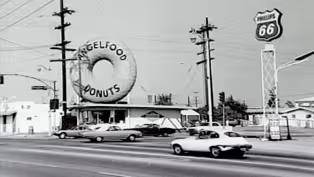
Drive-ins, Car Hops and Weird Architecture
Video has Closed Captions
Clip: Ep2 | 2m 27s | Los Angeles has long been tied to the automobile. (2m 27s)
Video has Closed Captions
Clip: Ep2 | 3m 52s | The original ran just north of today's for over 60 years. (3m 52s)
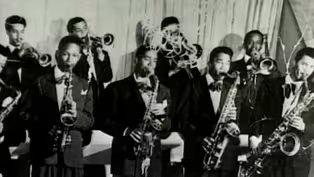
When Central Avenue Was L.A.'s Jazz Capital
Video has Closed Captions
Clip: Ep2 | 3m 57s | Central Ave. was L.A.'s center of jazz music and African American cultural life. (3m 57s)
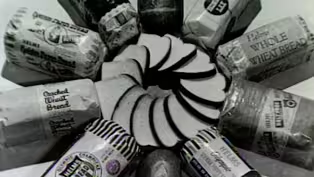
Helms: The First Bread on the Moon
Video has Closed Captions
Clip: Ep2 | 4m 25s | Helms Bakery operated from 1931 to 1969, at the site of Culver City's "Bakery District." (4m 25s)
Providing Support for PBS.org
Learn Moreabout PBS online sponsorship











Support for PBS provided by:
Things That Aren't Here Anymore is a local public television program presented by PBS SoCal