
TvFilm
"This Land"
Season 18 Episode 2 | 25m 9sVideo has Closed Captions
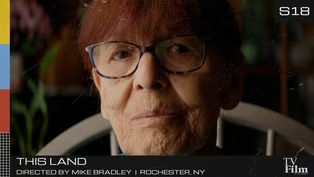
Join our host Jermaine Wells to watch "This Land" on TVFilm!
Join our host Jermaine Wells to watch a powerful short by Rochester-based filmmaker Mike Bradley. "This Land" is a short documentary that chronicles the untold story of Ganienkeh, a Mohawk community fighting to regain its traditional culture. Watch on TVFilm, Upstate New York's independent short film showcase!
Problems playing video? | Closed Captioning Feedback
Problems playing video? | Closed Captioning Feedback
TvFilm is a local public television program presented by WMHT
TVFilm is made possible by the New York State Council on the Arts with the support of the Office of the Governor and the New York State Legislature.
TvFilm
"This Land"
Season 18 Episode 2 | 25m 9sVideo has Closed Captions
Join our host Jermaine Wells to watch a powerful short by Rochester-based filmmaker Mike Bradley. "This Land" is a short documentary that chronicles the untold story of Ganienkeh, a Mohawk community fighting to regain its traditional culture. Watch on TVFilm, Upstate New York's independent short film showcase!
Problems playing video? | Closed Captioning Feedback
Where to Watch TvFilm
TvFilm is available to stream on pbs.org and the PBS app.
Providing Support for PBS.org
Learn Moreabout PBS online sponsorship(gentle music) (upbeat music) - Welcome back to "TVFilm," WMHT's showcase of short films made by Upstate media makers.
It's Friday night, and you're in the right place to kick off your weekend.
Tonight's film is called "This Land."
This is a powerful documentary by Rochester based filmmaker, Mike Bradley, which chronicles the untold story of Ganienkeh, a Mohawk community fighting to regain its traditional culture.
Let's enjoy.
(gentle wind blowing) (gentle music) - [Kanentiio] It was an extremely volatile, dangerous place.
- The combustion that occurred is almost predictable, because the state of New York would make deals with the Native Americans and then wouldn't keep them.
- This is Mohawk territory.
(camera shutter) People kept shooting at the gate, but they never looked into it until somebody got shot.
(suspenseful music) - And so, there was a standoff there.
(suspenseful music ending) (car engines humming) (birds chirping) These are our ancestral lands, but we always felt that we had been cheated out of that territory.
So it was inevitable that something had to be done.
That's our duty.
(crickets chirping) My Mohawk name is Kanentiio, which is from the Bear Clan at the Mohawk community of Akwesasne.
Governance has always been important to the Mohawk people.
We had traditional government.
Leadership was appointed through the three clans.
They were balanced, so you had an equal number of male leaders and equal number of female leaders.
(gentle background singing) But the Indian Reorganization Act in the US and the Indian Act in Canada forcibly imposed what they call a band council system.
And what they do is they oversee elections in accordance with Canadian or American procedures, and it sets up this competitive system that was alien to Mohawk governance.
(gentle background singing) There was a great deal of internal hostility between the Longhouse people who supported traditional governance and the band council.
(gentle music) (gentle wind blowing) Either you were for traditional governments and the revival of Longhouse, or else you were part of the elected system, which was a dirty phrase, people would call those of my generation who actually voted as sellouts.
You know, that even casting a ballot was an act of betrayal.
(gentle background singing) By the 1970's, at Kahnawake, across from Montreal, people were concerned that there was encroachment into the community by people who were not native and were not Mohawks.
They thought that the band council was not doing anything about these people settling on the territory.
Something had to be done.
(gentle music) - We were all from Kahnawake and we had our families there, and we lived on the farm.
It was a normal place.
We had our ceremonies, but in 1973 and all our young people were getting married, starting families, and they had no place to live because there was all non-Indians staying there.
(gentle drum beat) - That area, north of the east branch of Delaware River, all the way to Montreal, and from Lake Champlain corridor into an area north of Utica.
It was in that region, that's Mohawk territory.
(gentle music) - On May 13th, '74, that was the night we left.
It was nice on the farm and hated to leave it, but that was our decision.
That's all we had with us is what we could fit in our van.
We left everything behind.
Yeah.
- I was 12.
It was like an adventure.
(adventurous music) - We all lived like in a caravan following each other, and we drove for hours.
- It was really exciting.
- I was on winding roads.
- Are we there yet?
- We got there, it was like three o'clock in the morning, pouring rain.
That was Moss Lake.
(birds chirping) - [Jackie] This program was produced by Ganienkeh Communications and Radio Akwesasne of the Mohawk Nation.
I'm Jackie Sharp.
A group of Native Americans left their homes on reservations and traveled to Eagle Bay, in the heart of the Adirondacks.
There, they made shelter, planted gardens and established the new nation of Ganienkeh.
- [Narrator] Where we were was previously a girl's camp.
We renamed it Ganienkeh, land of the Flint.
(insects chirping) - [Louis] This was a summer camp for people of wealth, and it was just physically a very beautiful place.
Enchanting, you know, a nice lake with that house in the middle of the lake on a small island.
That's how I saw it, you know, and I had been able to come and meet with my brother and sister who actually resided there.
(insects chirping) In May of 1974, the camp is vacant, it is actually state land.
(insects chirping) - [Katsi'tsenhawe] It was more like a nice camp for vacationing, (laughs) but we weren't on vacation.
(birds chirping) - A lot of the other territories, there's drinking and drugs and we wanted to get away from that stuff, because through all these years, we see what it does to our people.
It causes a lot of damage.
- And different nations that were helping us.
- At Moss Lake, we just investigate everywhere, because we used to play in the mountains all the time, go fishing, swimming, there was always work too.
The women took turns cooking.
There was always somebody chopping wood, but the work didn't always seem like work.
I guess there was so many of us it just made it fun, but it didn't stay that way.
(distant chanting) (insects chirping) (birds' wings flapping) (birds chirping) (car engines humming) (gentle music) - I'm Lou Grumet and I spent most of my life in public policy, actually all of my life in public policy.
I grew up in West Virginia.
My father was a terrible alcoholic.
It would've been better if I hated him.
I'd say I didn't really hate him.
I didn't care about him.
My sister, who I was very close to when we were in high school, she was a senior and I was a freshman.
We would sit and talk and he would come stumbling up the stairs and fall into a soup and we wouldn't care.
When I went away to school, I never went home again.
(gloomy music) In spring of '76, I was the director of Intergovernmental relations to the Secretary of State of New York, Mario Cuomo.
And in that capacity, he would have me do various things.
And one of those things was the negotiation with the Moss Lake Indians.
He wasn't going to be sitting up in the north country.
And he referred to it as continual lent.
They had been sitting on the land for two years.
The governor didn't wanna do anything about that because the Second Wounded Knee massacre was two years earlier and Attica was four years earlier, and nobody wanted a shootout.
Get these people off the land.
That was my order.
(gentle music) But I had a tremendous sympathy for the drug and alcohol issues at Kahnawake.
Those kids were all being raised the way I was, and I wanted to make life better.
Their goal, was near as I can tell, was just to be alone.
But the local folks who were all irritated, they wanted these people out.
They thought they'd broken all the laws.
- If I ever tried anything like that, I'd get like, I'd get thrown right in jail.
I wouldn't get away with it.
- If this is allowed to continue, who will be the next group to come along and seize another piece of state land?
(birds chirping) - The communications between the local populace and the Mohawks was not working, and some of them decided that they would shoot at the Indians and the way their ancestors did.
(insects chirping) - In October of '74, a car that had to been a frequent harasser was driving up and down, yelling things out the window, throwing things out the window, and the Mohawk claim, was shooting at them.
And a couple hours later, a similar car was coming down the road and the Mohawk shot at the car and they hit a 9-year-old girl and they hurt her.
And now we have blood on the streets.
And now people were demanding that something happen.
- Remember, this is only three short years after Attica.
We watched that and we knew then if so ordered, the troopers were going to, they would enter Ganienkah.
We were told that once the troopers came in, and if we were given orders, then we were to open fire.
And fortunately, that never happened.
- Everybody was foot dragging.
The DA was foot dragging and we were foot dragging.
The state police were foot dragging and the Mohawks were more than foot dragging.
We were not looking for a fight.
That case has never been in court.
(gentle wind blowing) They understood that it had gotten too hot to handle in Moss Lake.
My orders were, get a deal.
And the easiest deal was to give them land.
And we were looking for land that the state of New York might be willing to part with.
- It had to have water and land to grow food on and to have the animals, anything less wasn't gonna happen.
It's our own, so we shouldn't have to even ask.
It is ours.
- We kept producing piece of land, after piece of land, after piece of land.
Every time I'd say, "We can't do this, we can't do that."
We had land that was too close to civilization.
We had land that didn't have hunting and fishing.
This is serious, what are we doing?
- And they wanted us to take all this land that was just swamp and forest and that, but some places weren't livable, so why are they gonna agree to that?
- We kept looking for eight or nine months.
Eventually, there were several pieces of state land up in Clinton County, and there were huge pieces of land for sale next to it, which were actually quite decent pieces of land with very good agricultural and good fishing.
And it was a great piece of property, but it wasn't our property.
I said, "Well, I can't give you the land."
(water flowing) They just casually said to me, "We have friends."
♪ Maytag ♪ - Thanks.
♪ For dishes that sparkle and turn ours clean ♪ - [Louis] They had Maytag and they had Maytag appliances.
♪ Dish washing machine, Maytag ♪ - [Announcer] The dependability people.
- Loved indigenous folk and she bought the land for them.
And they weren't looking for a deed, as long as we let them have the land.
They said, "We didn't want you to give us the land anyhow.
It's our land that you're sitting on."
The Turtle Island Trust.
In order to make it clear that it was not the natives who were owning their own land, was set up for them, in trust for them.
And the Mohawks leased the land from the Turtle Island Trust.
That was the deal.
(TV buzzing) - A group of Mohawk Indians three years ago moved into a former girl's camp, and they've stayed there ever since.
Today, that dispute with the state of New York was settled.
Gary Shepherd reports from Eagle Bay, New York.
- [Gary] The Indians said they wanted to live according to their traditions, which was not possible on reservations where there was crime and drug abuse.
The idea was to become self-sufficient and live off the land.
They finally agreed today to move from their current 600 acre site in Eagle Bay to 5,700 acres of state forest in Clinton County.
Officials called it the beginning of a new era of relations with the Indians.
- We live constantly in fear.
If it's different, it's wrong and dangerous.
That's always the first instinct, but a civilized society can learn to overcome that first instinct.
(bird chirping) (birds chirping continues) (peaceful music) (peaceful music continues) - We have a lot of children here, they have Mohawk immersion now, so they learn the language.
It's a lot different from before.
- My mother wasn't a speaker of the language.
It's kind of the main thing is why we're here, to learn what is ours and start over and to actually have a place where we can take care of ourselves.
Everything that is here belongs to the people.
It's important for us to continue as a people.
(gentle music) (children giggling) (children speaking indistinct) - When you consider that Mohawk people have been living in close physical proximity to this very powerful imperialistic entities from the time of contact, yet we still retain the core of our identity, still retain language, still retain culture, still retain spirituality.
I think that's miraculous.
(maracas shaking) You can reassert your traditional beliefs and customs without having to go through the courts or federal or state legislation.
Just simply going there saying, we are here.
Repatriation of that land is something that's not only possible, it's necessary.
And that's the way, I think the only way the Mohawk people have seriously as a way of surviving as truly sovereign people.
So, I expect there'll be other Ganienkehs.
(distant chanting) (crickets chirping) (crickets chirping continues) (clap board clacking) (gentle music) - My name is Mike Bradley and my film is called "This Land."
"This Land" is a documentary that tells the story of Ganienkah, which is a Mohawk Indian community.
It's currently located near Plattsburgh, but when it was founded in the 1970's, they started on some disused state land in the Adirondacks.
I grew up in Rochester, but I've vacationed in the Adirondacks many times throughout my life, including Moss Lake, which is where they initially set up the community in the '70s.
And today, you'd never know that this had happened there.
There's a historic marker at the parking lot that mentions this girl's camp that was on the property for many years in the first part of the 20th century.
And it has one sentence about, oh, also these Mohawks occupied this land for three years in the '70s.
It actually has the dates wrong on the historic marker.
And I had never heard anything about that.
And my wife and I went camping there.
And I read that sentence and that was the part that was most compelling to me.
I started doing research after that and it took about two years to make the film from that point.
I'm not a native person myself, so it was very important to build trust with the community, and I wanted them to want me to be there.
I didn't want to feel like I was parachuting in and taking the story for my own purposes and disappearing.
I wanted them to be really invested in the process.
At the time I reached out, it was approaching the 50th anniversary of the founding of Ganienkeh, and I think they had decided it was time to share their story.
And they eventually welcomed me there several times.
And I was very grateful to be, you know, trusted with their story.
As I started to learn more about the story of Ganienkeh in the early stages of making this film, one of the things that I was most struck by was the courage of the people.
One of the families that I interviewed in the film, it's a mother and daughter.
The mother, Katsi'tsenhawe.
She and her husband at the time were in their early 30's.
They had two young children.
And you know, when I started this film, I was in my early 30's.
My first child was born as I worked on the film.
The prospect of leaving a comfortable, if you know, imperfect home to go live in the woods and start something new, I just found that so inspiring.
And it tells you that they really believed in what they were doing because they could have stayed.
It would've been easier to stay on the reserve in Canada, but they chose to do something really kind of radical and go start this new community because it's what they believed in.
And I just find that really beautiful.
In my personal life, I'm very much an introvert.
I'm not approaching people and asking them deep probing questions in my day-to-day life.
But one of the things I really enjoyed about journalism and that I really enjoy about documentary film now, is that having the camera next to you kind of gives you license to ask these questions that might almost be a little inappropriate if it wasn't being done in the context of a documentary film.
You hear people in documentaries sometimes say, you know, I wanna be like a fly on the wall, pretend the camera's not there.
And I think that's impossible, obviously, especially the way I shot this film.
I use a, you know, a device that makes it so the character's looking directly into the camera, but they can still see my face.
So it's, they're speaking directly to the audience.
So there's this big contraption between me and the character that it's really not possible for them to pretend the camera's not there.
One of my favorite things about directing a documentary is seeing someone think about a question I've asked on camera and it appears that it's the first time that they've thought about it.
I'm really making them think deeply about something that they haven't considered before.
And seeing that thought process happening live on camera, I just love that feeling.
I love being a filmmaker in Upstate New York because there's no shortage of stories.
And so I hope that people watch the film and are driven to just be curious about what exists around them and what came before us in this place and the cultures that existed here, you know, long before New York State existed.
(gentle music) - We hope you liked tonight's episode.
And if you wanna learn more about this season's films and filmmakers, visit wmht.org/tvfilm.
And don't forget to connect with WMHT on social media and subscribe to our YouTube channel.
Thanks for tuning in.
I'm Jermaine Wells and I'll see you next week.
(upbeat music) - [Announcer] "TVFilm" is made possible by the New York State Council on the Arts, with the support of the office of the governor and the New York State legislature.
Video has Closed Captions
Preview: S18 Ep2 | 30s | Join our host Jermaine Wells to watch "This Land" this Friday on TVFilm! (30s)
Providing Support for PBS.org
Learn Moreabout PBS online sponsorship








Support for PBS provided by:
TvFilm is a local public television program presented by WMHT
TVFilm is made possible by the New York State Council on the Arts with the support of the Office of the Governor and the New York State Legislature.