
This Year Marks the 100th Anniversary of Black History Month
Clip: 2/11/2026 | 10m 53sVideo has Closed Captions
A look at its Chicago roots as well as the past, present and future of teaching Black history.
A century ago Negro History Week was established to commemorate the contributions Black people made to American society. It’s since expanded into Black History Month.
Problems playing video? | Closed Captioning Feedback
Problems playing video? | Closed Captioning Feedback
Chicago Tonight is a local public television program presented by WTTW
WTTW video streaming support provided by members and sponsors.
This Year Marks the 100th Anniversary of Black History Month
Clip: 2/11/2026 | 10m 53sVideo has Closed Captions
A century ago Negro History Week was established to commemorate the contributions Black people made to American society. It’s since expanded into Black History Month.
Problems playing video? | Closed Captioning Feedback
How to Watch Chicago Tonight
Chicago Tonight is available to stream on pbs.org and the free PBS App, available on iPhone, Apple TV, Android TV, Android smartphones, Amazon Fire TV, Amazon Fire Tablet, Roku, Samsung Smart TV, and Vizio.

WTTW News Explains
In this Emmy Award-winning series, WTTW News tackles your questions — big and small — about life in the Chicago area. Our video animations guide you through local government, city history, public utilities and everything in between.Providing Support for PBS.org
Learn Moreabout PBS online sponsorship>> A century ago, History Week was established to commemorate the contributions.
Black people need to American society.
It has since expanded into what we now know as Black History Month.
But on this one 100th anniversary, federal efforts to diminish black history include dismantling a slavery exhibit in Philadelphia.
Removing portions of the home monument in Mississippi for civil rights icon Medgar Evers.
And taking down a 19 th-century photo of a formerly enslaved man scarred by with things from his enslave are.
Joining us to discuss all of that and more are Robert Hansard and associate professor of African-American studies and historian at Columbia College, Chicago.
Crush on David, an AP African American Studies teacher Gwendolyn Brooks High School in Roseland and Sherman.
Dylan Thomas, the brand ambassador and social media chief at the Dusable Black History Museum and Education Center.
Thanks to all Happy Black History Month lecture here professor, want to start with you.
Remind us how Black History Month at the time Black History Week how it started or History Week, how it started 100 years ago.
It's a Burkhart, I Carter G Woodson.
It's his effort to celebrate and draw attention to value of >> African-American and African contributions to the broader history uses.
The boys sort of idea of contributing to the great sort of cultural narrative of our experience.
think that's critically important on just a moment to reflect just for for black people, but also put put a wider gold for the wider nation.
House observance of Black History Month changed over the years.
>> For me as a as a someone who's teaches at Columbia College and works with creative students.
I think it's just more and more emphasis trying on the expertise some of experiences local folks.
I talk about winds about Turner and the Gullah language in that connection to Africa.
Talk about practicing Nesbitt and all the work that he did in terms of bringing attention to anti apartheid movement.
So for me, it's about localized it to Savile really get into a story people understand his African origins through Haiti developing those kinds of complications conversations next.
>> Chris, on this is your 4th year teaching African American studies and at a predominantly black high school on what does it mean for students to have that kind of access to their own history and especially level of advanced placement level.
>> I can only tell you that I've seen magical things happening with students.
They feel empowered.
They have new established voices.
They feel like their presence is wanted and needed.
And I think that just the understanding history has now giving them more purpose in how they're going to move into their future.
So I mean, obviously the black students are giving us access to because it is a predominantly black school, not a lack, of >> But what are we what we know about the kind of black history learning and lessons that students throughout Chicago and Chicago public schools are getting?
Well, I think at my school it's predominantly black, but I actually work with multiple teachers who teach this course.
>> Chicago, public schools and the demographics are very different.
They offer the course that Walter Payton, they offer the course at Kenwood.
They offer the course at Westinghouse.
So there are a multitude of demographic populations that have access to this course.
And I think the one thing that we know is that black history cannot be a course only black students in.
So all are welcome to engage in this ridge and rigorous American history, Absolutely.
Thank you.
So De Welcome You often tell us that everything dope comes from Chicago.
>> Tell us about Chicago's place in in shaping black American identity.
>> Manahan brand.
good see you again.
And yes to everything that about America, including black history comes from Chicago.
As of the professors what we now today call asylum.
>> You're responsible for a team and we can start off as the association for the Study of Life and History.
>> They come from Chicago.
But most of our great minds, I can say most, but a lot of them spend time learning here.
Chicago, Dr Benjamin Mays, who goes on to be the longest serving president at Morehouse was educated here in Chicago.
Hardy was an educated here in Chicago so many others part here in Chicago.
John Hope Franklin and I was there when the most important books to African-American history is up before the main power by Robin in Julian.
And he had officers right here and Johnson, Johnson building right there on Michigan Avenue.
>> Professor, of course, black history or a black culture predates, you know, we know about the great migration with course.
We know about chattel slavery.
You've mentioned a little bit of, you know, Chicago's connections to Africa.
Tell us a little bit more about that.
>> You know, looking at history of Dusable looking his starting with thought the groups of folks who come from Haiti and coming to Illinois country up through Louisiana territory.
I've done a lot of research on some of those very ships where folks have arrived in common number.
Do ships come from places?
Congo in West Central Africa, the sum of the year of the caught region.
So it's important to draw on those sort of cultural history, culture and history.
I think too often we look at slavery in captivity as the origin point to start to investigate African-American history and culture.
But we need to start at Africa.
We need to start with these early stretch of experiences.
These early cultures.
I call kind of a look at cars mileage because you're trying to get into the world view and a perception and a perspective of these cultures.
>> All of that said we are seeing the dismantling of of all of this history for African-Americans across the country.
As we mentioned in the open professor Han what's your reaction to what's happening?
>> Just fortunate.
I mean, I it's it's it's an easy shot quit.
Okay.
to focus on black culture and black heritage with on patriotism or an American is in.
But think about something Gordon Parks trying to go and take pictures of the Tuskegee Airman and, you know, him being prohibited to do so.
At the same moment.
if you know, FDR Green to have executive order at a to to you know, discrimination because he doesn't a Philip Randolph to march in Washington, right?
So it's just the sort getting a feel for dynamic understand how how valuable all this is What we need to know about America.
This is our story.
This is an American story.
So we do what we do.
Want to miss it, right?
Right.
We often hear that, you know, black history is American history and American history black history as well.
>> Still a same question to you.
What is the reaction?
We see instances alterations at at the home of Medgar Evers and the like.
>> My reaction is one of sadness, right?
I think you can fix anything that not willing to acknowledge.
Meantime, we're trying to erase what happened to my folks here in America.
pushes us backwards in our ability to rectify it and move forward.
also encourages me, though.
It makes me realize that my work in the work of the panel is is so so important and also makes me want to challenge all of us because we don't right now.
The history making today.
We know right now the family has 3.
If we don't try to disseminate that history and eventually that history can be erased.
And so, you know, on the one hand, I'm Sam.
On the other hand, it empowers me to continue to work hard and I can make sure that I'm preserving black history for future generations.
>> Christiane, how do you talk to your students about administration's efforts to?
Rewrite history to change history, to erase it?
>> Well, I have to be honest, I have to be very careful.
I mean, I am in a school right.
One thing that I do is I encourage them to use their voices and to share their insights about what is happening.
And it's quite surprising to see the students are well aware of some of the injustices and inequitable practices that are happening now.
Many of them are impacted by some of the current policies personally.
And oftentimes those stories will come up in discussions in the class.
Okay.
>> The founder of Black History Week, as you mentioned, Carter G Woodson.
He intended for black history to still be a year-round pursuit to not just a week, not just a month.
Professor, how can we continue?
That happened keep that up.
>> Just kind of what we're doing here, panel from diverse backgrounds coming and speaking different elements and different approaches and different perspectives to understand this history and just carrying that discussion the on Feb.
I mean, for great, you know, there was short month, but the reason is because of, you know, I've Lincoln's birthday, but also Frederick Douglass has backed is the reason why the month was chosen.
But there's so many other contributors to a black experience you know, born in other So, So it's just important to get, you know, as much as we can.
a year-long process.
It's it's about bringing in these diverse perspectives continuing to contribute and adding develop this conversation for John, what can we be doing the rest of the year to acknowledge or or history not just in February?
Well, I think what educators could be doing is you know, incorporating more.
>> Diverse perspectives.
More of those stories that are.
>> You know, related to people who look like they're students into their curriculum.
I think that we also can take opportunities to celebrate by going outside of our buildings into the communities where our students live travel every day.
I also think that we can continue to encourage, you know, ethnic studies courses that promote educating students our rich culture and history globally.
>> Dilemma, give you the last word.
Got about 40 seconds left, you know, same question.
How can we do this year-round?
But also, you know, to someone who's looking for an interesting way to Mark Black History Month.
What do you recommend?
>> Well, I'm not going in trouble with my boss and not say come to the dusable.
concern have an education center.
We have a beautiful exhibit, Paris and black that teaches you about the black experience overseas and then real quickly when I think we ought to do is take the Spike Lee, do the right thing approach.
We approached one that is not African-American act in their favor.
Musician favors for favorite athlete and one of those answers going to be an African-American.
You can take that point to further educate them on the impact we've had on this nation.
>> All right.
I love that sparked a conversation.
Professor Robert Hansard crash on Davis 're back to wrap things up right after this.
>> Reflecting the people and
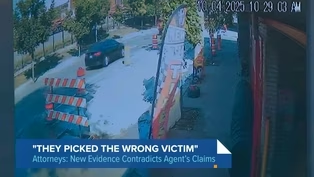
Attorneys Say New Evidence Contradicts Federal Agent’s Claims in Shooting of Chicago Woman
Video has Closed Captions
Marimar Martinez was shot five times by a Border Patrol agent in Brighton Park in October. (3m 47s)
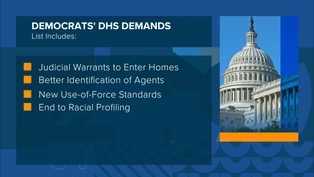
Congress at Odds Over How to Reform Department of Homeland Security
Video has Closed Captions
A partial government shutdown could be coming if lawmakers don't reach a deal. (8m 54s)
Providing Support for PBS.org
Learn Moreabout PBS online sponsorship
- News and Public Affairs

Top journalists deliver compelling original analysis of the hour's headlines.

- News and Public Affairs

FRONTLINE is investigative journalism that questions, explains and changes our world.












Support for PBS provided by:
Chicago Tonight is a local public television program presented by WTTW
WTTW video streaming support provided by members and sponsors.