One-on-One
Thomas Healy; Ilene Isaacs; Carlos Rodriguez
Season 2021 Episode 2468 | 27m 31sVideo has Closed Captions
Thomas Healy; Ilene Isaacs; Carlos Rodriguez
Professor Thomas Healy discusses the history of Soul City, a failed attempt by civil rights activist Floyd McKissick to build a predominantly black city in rural North Carolina devoted to racial equality in North Carolina in the 1970s; Ilene Isaacs shares the current state of food insecurity in New Jersey; Carlos Rodriguez talks about the impact of Hurricane Ida & COVID on the hunger population.
Problems playing video? | Closed Captioning Feedback
Problems playing video? | Closed Captioning Feedback
One-on-One is a local public television program presented by NJ PBS
One-on-One
Thomas Healy; Ilene Isaacs; Carlos Rodriguez
Season 2021 Episode 2468 | 27m 31sVideo has Closed Captions
Professor Thomas Healy discusses the history of Soul City, a failed attempt by civil rights activist Floyd McKissick to build a predominantly black city in rural North Carolina devoted to racial equality in North Carolina in the 1970s; Ilene Isaacs shares the current state of food insecurity in New Jersey; Carlos Rodriguez talks about the impact of Hurricane Ida & COVID on the hunger population.
Problems playing video? | Closed Captioning Feedback
How to Watch One-on-One
One-on-One is available to stream on pbs.org and the free PBS App, available on iPhone, Apple TV, Android TV, Android smartphones, Amazon Fire TV, Amazon Fire Tablet, Roku, Samsung Smart TV, and Vizio.
Providing Support for PBS.org
Learn Moreabout PBS online sponsorship- [Narrator] Funding for this edition of One-On-One with Steve Adubato has been provided by Bank of America.
Atlantic Health System.
Building healthier Communities.
The Russell Berrie Foundation.
Making a difference.
PSE&G, committed to providing safe, reliable energy now and in the future.
The New Jersey Education Association.
The North Ward Center.
The Healthcare Foundation of New Jersey.
Delta Dental of New Jersey.
Everyone deserves a healthy smile.
And by NJ Best, New Jersey'’s five-two-nine college savings plan.
Promotional support provided by Meadowlands Chamber.
Building connections, driving business growth.
And by NJBIZ, providing business news for New Jersey for more than 30 years, online, in print, and in person.
- This is One-On-One.
- I'm an equal American just like you are.
- The jobs of tomorrow are not the jobs of yesterday.
- Look at this.
You get this?
- Life without dance is boring.
- I don't care how good you are or how good you think you are, there is always something to learn.
- I did do the finale, and guess where my trailer was?
A block away from my apartment, it couldn'’t have been better!
- People call me 'cause they feel nobody's paying attention.
- (slowly) Start talking right now.
- That's a good question, high five.
(upbeat music) - Hi, I'm Steve Adubato, welcome to a very compelling conversation we're about to have with professor Thomas Healy.
He's a Professor of Law at Seton Hall University Law School, and the author of this book.
The book is called Race, Equality, and the Lost Dream of an American Utopia.
Good to see you Tom.
- Good to see you.
- Set this up, Soul City.
Soul City was set up in what year in North Carolina?
- It was launched in 1969 on a former slave plantation in rural North Carolina, about an hour north of Raleigh-Durham.
- And the whole idea was to create a community that was disproportionately there to support the African-American Community to be run by those who are African-American to support economic opportunity for those who are Hispanic and got funding from a federal government during the Nixon Administration, if I'm not mistaken, right?
- Absolutely, and your description is accurate and it was designed to be a model of black economic empowerment.
The idea was that African-Americans could only have political equality and political independence if they had economic equality and economic independence.
So the idea was to create a community where the levers of power would be in the hands of black people and capital would be in the hands of black people.
And yes, you're right.
It was supported by the Nixon Administration, which was a kind of odd alliance.
- Sure.
Why did it fail?
- It failed for a number of reasons, I mean, they were attempting to build a city from scratch in the middle of rural North Carolina out of really nothing but red dirt.
They had to bring in everything they needed.
They had to bring in the infrastructure.
They had to build homes in the community.
- There was no running water.
There are a whole range of people that do not have functioning toilets, if you will.
Why that location though?
- Well, the location had some real advantages.
First of all, land was very cheap and the developer of Soul City, a man named Floyd McKissick, he needed about 5,000 acres of land and he knew he could get it relatively cheaply there.
Labor was also cheap, which would be an enticement for industry to come in and build factories there.
It was halfway between Raleigh-Durham and Richmond.
It was a part of what's known as the Piedmont industrial corridor.
It was adjacent to a major highway, interstate I-85.
It wasn't far from interstate 95.
And there was a railroad that ran right by the property that they could use for shipping goods to and from the community.
So there were some real obstacles, but there were some real advantages to this site.
- It's so interesting, people often say, you know, you write about this extensively in Soul City, that it 'quote' failed.
Okay, we could say it failed, but there were lessons to be learned from this because economic empowerment in the Black community remains a critically important theme and challenge.
So it failed, yes, but we learned what?
- Well, I mean, one thing we learned is just what you said, that this is the unfinished business, of the struggle for Black Freedom and the civil rights movement.
Economic equality, you know, the racial wealth gap is about the same today as it was in 1969 when Floyd McKissick launched this effort.
And that the- - And by the Floyd McKissick led this effort, a lawyer by training.
- A lawyer by training.
He was one of the major figures of the civil rights movement.
He had the--.
- Tied to Dr. King.
- He was very close that they, they worked together on lots of initiatives and projects.
They led the 1966 March against fear together.
- Okay.
- And Floyd McKissick, this was his vision, his brainchild.
And what he recognized was that the civil rights movement had made a lot of progress.
Lots of important legislation was passed and lots of important cases were won.
But the one thing that was not completed was giving African-Americans economic independence and economic equality.
And that's really the unfinished business today, and that's why the inability of Soul City to reach its goals, I think it's so disappointing and so frustrating.
And I think one of the lessons that we can draw from it is that that's something that we need to invest in and we need to...
When people like Floyd McKissick explain what it is that black people need and what they're trying to accomplish.
I think we need to do a better job of listening to that.
- Real quick.
Why did and why do you care so much about this?
- Well, I care about it in part, because I'm from North Carolina, there was a newspaper that played a big role in essentially killing Soul City that I worked for as a young journalist out of college.
So I have a kind of personal connection to it, but also as a law professor, as I teach constitutional law, I think a lot about equality.
You know, this is a part of our larger history and trying to understand the forces that have thwarted racial equality is really important as for anyone who cares about our democracy.
- Two things, one, this book is being turned into a documentary, two, let us not forget that Senator Jesse Helms, Google Senator Jesse Helms folks.
He's extensively written about in this book, North Carolina, United States Senator, segregationist by most reasonable standards, a racist in the United States Senate.
Absolutely dead set against Soul City and wanted it to fail and worked actively for its failure.
Correct?
- Yes, absolutely.
And made clear from the very beginning that he was gonna try to kill Soul City.
In fact, when Floyd McKissick reached out to Jesse Helms in 1972, after Helms was elected to the Senate, Jesse Helms responded and said, "Essentially, I'm gonna do everything I can in my power to kill Soul City."
And he did.
And that's an important part of the story.
However, another part of the story is that it wasn't just racists like Jesse Helms that opposed Soul City, a lot of white integrationists opposed Soul City, because they didn't understand what he was trying to do.
- They were saying, "Let's be together."
Why, what are you doing creating.
I'm sorry for... Again, the book fascinated me so much.
It's not my job to describe this, but they didn't like the idea of separating.
It was like, let's push for integration.
That's what all these civil rights of laws are about.
But this was about economic opportunity and not just integrating schools and communities, right?
- Absolutely, and it was not going to be separatist.
It was a multi-racial project.
A quarter of his staff was white, his closest friend and advisor.
- McKissick - (indistinct) who lived... Yeah McKissick's closest friend and advisor.
And the project was why he made clear from the beginning that this community was gonna be open to all.
But that the primary goal was to benefit black people, especially the poor and the unemployed.
- The book is Soul City: Race, Equality, and the Lost Dream of an American Utopia.
Thomas Healy from Seton Hall University Law School is the author.
Professor, thank you so much for joining us.
I encourage everyone to check this book out.
It's important part.
We've been part of an ongoing series called Confronting Racism.
This book is a piece of a much larger complex mosaic.
Thank you, Tom.
- Thank you so much for having me.
- Stay with us, we'll be right back.
- [Narrator] To watch more One on One with Steve Adubato find us online and follow us on Social media.
- We're honored to be joined by Ilene Isaacs, who's Executive Director of an organization called Table to Table.
Ilene, good to see you.
- It's really good to see you, Steve.
- Tell everyone what Table to Table is, because, 'quote' rescuing food is a huge issue in our state and our nation, please.
- Yeah.
So what we do, Steve, we make sure that those pallets of beautiful, fresh produce, fruits, and vegetables are available for Emma every Thursday, when she comes to the market we established seven years ago in Newark.
She takes two buses to get there, and then brings it back to her family.
And we make sure that is a bag of oranges for Emma, who is a senior adult living in a subsidized housing building.
She loves oranges, but she can only afford half an orange on her fixed-income, so she relies on Table to Table to be the access to this beautiful fruit that she loves.
How do we do it?
Through food rescue.
We have seven refrigerated trucks that travel through Bergen, Essex, Hudson, and Passaic County.
We go to supermarkets and food distributors and other professional kitchens, and we pick up beautiful, fresh food.
Not dented cans without labels- - Right, right.
- but the good stuff.
Produce, dairy.
And we deliver it to the same counties, about 250 organizations.
And we just make sure that we're there, and people can rely on us, and know they can get good quality food.
- Why don't we do this?
Why don't we put up the website for a Table to Table?
Let people understand, again, by logging on that site, more about the organization and how they can be helpful.
Because one of the reasons we even do this by featuring other, we're a not-for-profit production company.
We've said that a million times.
No money, no mission, right?
And about to talk to Ilene about fundraising in a second.
But one of the reasons we feature organizations is so that not only can they tell their story, but you can be helpful as part of our public television audience, if you choose to.
That being said, what has been the impact of the pandemic on the people you serve everyday?
And then, I'm going to double down and talk about hurricane Ida.
Please, Ilene.
- Yeah.
The pandemic just, you know, in a day, turned our worlds around, and agencies started to close, because they were worried about their staff and volunteers.
The food sources started to dry up because of supply chain issues.
And the fact that people were shopping like crazy, and supermarkets paying for food.
So certainly, getting food donated was, you know, was not a top priority for some.
Yet the need exploded overnight.
People who never, ever believed they would be looking for a meal lost jobs, lost businesses.
So the need grew exponentially, and the ability to bring it into the community, and the sources for that food really dwindled.
So, because food, in food rescue you need to be nimble, and be able to shift on a dime.
We did.
We forged new relationships with municipal governments and community organizers.
We went to the food distributors and meal kit companies who were doing well and were able to procure pallets and pallets of food.
And of course we were concerned about our own drivers and their safety, but, you know, we built in some precautions as best as we could for them.
And we were out there just serving more people, 50% more food than in 2019, went out in 2020.
- Ilene, let me do this and put things in perspective.
You're talking about the number of people you serve, estimated that 2 million people are food insecure in New Jersey.
New Jersey ranks second in the entire country, in the United States, for the most significant increase.
This is an important piece in childhood food insecurity, increasing 85% from 3% to 21%.
Ilene, put that in perspective.
Children, food insecure, going to bed hungry.
- Yeah, I mean, just extraordinary that in one of the richest states, in one of the richest areas of a state in the country, that we could have children going to sleep hungry.
That happens in normal times, but because of the pandemic, that so exploded.
And for us, much of the food that we distribute goes to schools.
We use schools as distribution hubs that then provide food to other schools in their district.
So the schools closed and the ability to bring this food to kids really was impacted.
But again, quickly working with the community, seeing that maybe families weren't able to come to the schools, but would be able to come to a neighborhood church that served the same area.
- Right.
- We're able to ensure that people were relying on this food.
Particularly kids, particularly, in some cases, people who never had to wonder about where they would be getting this food.
There was the means for them to receive it.
- Yeah.
Before I let you go, Hurricane Ida's had an impact as well, correct?
- Uh-huh.
Hurricane Ida, really, of hurricanes, of storms, pandemics, et cetera, nothing affected us like Hurricane Ida.
All seven of our distribution trucks, our refrigerated vehicles were flooded out.
The impact of that is going to be long standing, because we still don't even have insurance settlements on the trucks.
And the ability to get new trucks to replace them is compromised.
So, significant issue, but we're managing.
We've got trucks out there.
People know they can rely on us.
The work we're doing is that important.
- Ilene, I'm so sorry that time is tight here, but real quick, A, how can people help if they go on the website?
And also, your funding comes from where?
Because I did say "No money, no mission," which is the same thing for those of us who do what we do as a nonprofit and television production affiliated with public broadcasting.
Your funding comes from corporations, foundations, individuals, correct?
- Correct.
We're completely philanthropy funded.
We write brands, individuals, "Send donations," corporate sponsorships.
Every year we raise the money to keep ourselves on the road.
- And if someone goes onto the website, they can contribute, they can be helpful, they can volunteer.
Correct?
- Absolutely.
This really is a community food rescue, and every member of the community can participate.
- That's Ilene Isaacs, Executive Director of an organization called Table to Table.
Ilene, thank you so much.
Not only for being with us, but for the work that you and your colleagues do everyday.
Thank you, Ilene.
- Thank you.
It was my pleasure, Steve.
- You got it.
Stay with us, we'll be right back.
- [Narrator] To watch more One on One with Steve Adubato find us online and follow us on Social media.
- Welcome back, folks, we're joined by Carlos Rodriguez, President and CEO, Community FoodBank of New Jersey.
Carlos, how are you doing, my friend?
- I'm doing well, Steve, and you?
- I'm doing great.
Doing great, not everyone's doing great though.
Let's talk about it.
We're taping this show as we move into the Thanksgiving, Christmas holiday season, and we'll be seeing before, during, after.
Let everyone know as we put the website up of the Community FoodBank of New Jersey, what way too many people are facing, and they're just not doing as well as the rest of us.
- That's exactly right.
As we move into this Thanksgiving season and the holidays altogether, many families are still working hard to put their lives back together after 20 months of living through this pandemic, and the economic hardship that it's brought for so many.
And so we here at the Community FoodBank of New Jersey, and our partners, and so many supporters, are working as we do every day and have been for so many years tirelessly to make sure that during this holiday, there's a little bit more, there's at least an opportunity to have food on the table, and maybe celebrate with food as it is so important this time of year, as opposed to many families having the alternative, having without anything at all.
- Carlos, it's one thing to talk about the impact of COVID.
As we speak right now, we're 19, 20 months in, it will be seen again after.
Because, unfortunately, the reality isn't going away, the problem isn't going away.
But Hurricane Ida has also had a devastating impact on the community you serve.
Talk about it.
- So Ida was, you know, a storm and a disaster within a disaster.
Here, we are trying to provide record amounts of food.
We were impacted directly with flooding in our main facility in Hillside, New Jersey.
Miraculous team that we have figured out how to keep the food moving literally the next day to not only areas that obviously continue to need it, but to areas that were impacted, and to families that were sheltered in hotels, and in temporary shelters in those early days.
So we had to use double-down efforts and make sure that families that found themselves in need maybe for the first time, or in more acute need, were able to get prepared meals, hot meals.
And then for pantries, some pantries were actually washed away, and had severe damage, so making sure that we can restock them, help them with any temporary assistance that they might need, and eventually really help them rebuild so they can get back to the important work and partnership of feeding their communities.
- Carlos, let people understand exactly how the Community FoodBank of New Jersey does what it does.
It's one thing to work as you and I often do as heads of nonprofits raising money.
Okay, that's part of it.
But you raised money from corporations, foundations, and individuals, fair?
- Fair.
- To do what?
Let's make it clear, because there are food pantries, there are other organizations involved in the hunger challenge that our community faces, but the Community FoodBank of New Jersey plays a very unique role in helping those organizations help those who are struggling and are food insecure.
Talk about that.
- So the way it works is the Community FoodBank of New Jersey is the primary provider of food and other important resources to a network of well over 800 partners in 15 counties that we work with.
And so we provide food assistance on how to handle the food, and manage the food, and make sure that they have what they need, including in times of disaster, resources, cash resources, to be able to expand their capacity or maintain their operations.
And so that's our role that we've played, a central that we play in the fight to end hunger.
- Talk about hunger and college students.
- So hunger is found in every corner of our society, and across so many demographics, including college students, many of whom, especially who find themselves hungry, are in school for the first time, or the first-generation students, I should say.
And they're really putting everything that they have in the education as a path to success, and a path to kind of a better life for themselves, and for their families.
And so many of them find themselves in need, and not able to manage being in school, having the right work, or enough work to be able to pay for school and for food.
And so we've partnered with up to 16 different campuses throughout the state to help them establish pantries so that students in need can actually go and avail themselves of food.
- So hold on, so if a student goes on the website right now, or a family member of a student, or a friend who wants to be helpful to that student, they go on the website, and we often say, go on the website, but what would they do to navigate the website, and get to the specific areas where the FoodBank could be helpful to those students?
Or is it about identifying someone closer to them, and then one of your 'quote' partners, how does that work?
- So it works two ways.
I think you touched on both ways, right?
Anyone that needs food, or immediate assistance, or wants to help someone who's in immediate need, you can go to our website and find out where the nearest food provider is, a local pantry.
For college students, again, there are about 16 different campus pantries that are going an extra step to make sure that they can take care of that need within their pantry, their campuses, I should say.
But I think that's the point.
We have partners of all different types that are providing food for that immediate need throughout the state.
And whether you're a student, a working family member, someone who's disabled, retired, there are programs in the community that are getting food from us that can help you make ends meet.
- Carlos, why is it that the problem of hunger, that food insecurity, that straight up hunger, and again, by the way, the difference between food insecurity and hunger, what is it?
'Cause I'm about to ask you about the disproportionate impact on women.
How would you define the difference between hunger and being food insecure?
What's the difference?
Or is there one?
- There is a difference.
I mean, when you have no food right now, and you haven't had a meal, you're hungry, you're just hungry in this moment, in this state.
When you're food insecure, you don't know whether you're going to have a meal, whether that quality of the meal is going to meet your needs, and you're very, I guess, to use the word in the term, insecure in your ability to feed yourself and your family.
Our goal, and in this society, in particular, is to make sure that everyone has the access to the nutritious food that they need to live a healthy and active lifestyle.
It's our goal in New Jersey.
- Now, talk about women.
I'm sorry to interrupt, Carlos.
Why are women being hurt more, frankly, disproportionately?
- Disproportionately, what we see is a lot of women, especially single moms, are disproportionately impacted with food insecurity, but we find that their food insecurity is also at a very low level, which means they have very disparate access to food and quality of food.
And it's a disproportionate amount, almost 48% of all of the food insecure households with children are headed as a single mom.
And it's hard.
It's hard to live on any single income, especially if it requires a share of that going to childcare and then paying for costs to actually get to and from work.
- Yeah, so as we wrap up, I want to clarify something.
You may have seen us doing a whole range of programming around hunger and issues regarding, as Carlos so aptly described, food insecurity.
It's because we have a long-term commitment to dealing with these issues.
We're working with Community FoodBank, a range of other not-for-profits that are funded by corporations and foundations that happen to, in fact, underwrite us.
But we feel that our responsibility is to feature the not-for-profit organizations that are more directly, I mean, we're a media organization.
Carlos, and his colleagues, and their partners, how many partners, again, Carlos?
- We have over 800 partners across the state.
- That means food pantries, food banks that are really close to communities, our job is to provide that information to people.
Your job is to either help yourself or someone around you by accessing those websites and those organizations.
Carlos, thank you so much for continuing to be a partner, a friend, and more importantly, doing the work that you and your colleagues are doing.
Thank you, Carlos.
- Thank you, Steve, for being a voice on this issue.
- I'm Steve Adubato, that's Carlos Rodriguez.
We thank you so much for watching, and we'll see you next time.
- [Narrator] One-On-One with Steve Adubato has been a production of the Caucus Educational Corporation.
Funding has been provided by Bank of America.
Atlantic Health System.
The Russell Berrie Foundation.
PSE&G.
The New Jersey Education Association.
The North Ward Center.
The Healthcare Foundation of New Jersey.
Delta Dental of New Jersey.
And by NJ Best, New Jersey'’s five-two-nine college savings plan.
Promotional support provided by Meadowlands Chamber.
And by NJBIZ.
How do you create change?
By cultivating hope.
And we see that every day, in the eyes of our preschoolers, in the souls of the seniors in our adult day program, in the minds of the students at Robert Treat Academy, a national blue ribbon school of excellence, in the passion of children in our youth leadership development program, in our commitment to connections at the Center for Autism, and in the heart of our community, the North Ward Center, creating opportunities for equity, education, and growth.
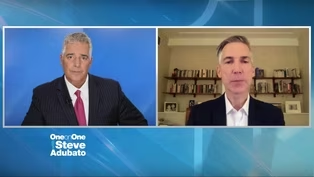
The History of Soul City, a Failed Racailly Equitable City
Video has Closed Captions
Clip: S2021 Ep2468 | 8m 46s | The History of Soul City, a Failed Racailly Equitable City (8m 46s)
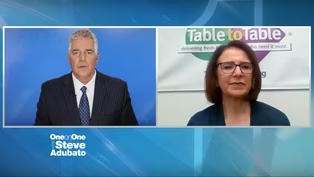
How Table to Table Addressed Hunger After Hurricane Ida
Video has Closed Captions
Clip: S2021 Ep2468 | 9m 5s | How Table to Table Addressed Hunger After Hurricane Ida (9m 5s)
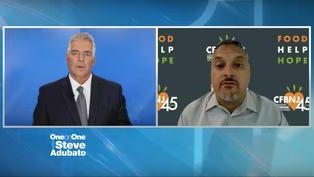
Impact of Hurricane Ida and COVID on the Hunger Population
Video has Closed Captions
Clip: S2021 Ep2468 | 10m 20s | Impact of Hurricane Ida and COVID on the Hunger Population (10m 20s)
Providing Support for PBS.org
Learn Moreabout PBS online sponsorship
- News and Public Affairs

Top journalists deliver compelling original analysis of the hour's headlines.

- News and Public Affairs

FRONTLINE is investigative journalism that questions, explains and changes our world.












Support for PBS provided by:
One-on-One is a local public television program presented by NJ PBS