
Thompson Center Sale, Democrat and Republican Battles
7/29/2022 | 26m 46sVideo has Closed Captions
Thompson Center Sale, Democrat and Republican Battles
The finalized sale of the James R. Thompson Center in Chicago, and a look at battles within both the Democratic Party of Illinois and the Illinois Republican Party.
Problems playing video? | Closed Captioning Feedback
Problems playing video? | Closed Captioning Feedback
CapitolView is a local public television program presented by WSIU
CapitolView is a production of WSIU Public Broadcasting.
Thompson Center Sale, Democrat and Republican Battles
7/29/2022 | 26m 46sVideo has Closed Captions
The finalized sale of the James R. Thompson Center in Chicago, and a look at battles within both the Democratic Party of Illinois and the Illinois Republican Party.
Problems playing video? | Closed Captioning Feedback
How to Watch CapitolView
CapitolView is available to stream on pbs.org and the free PBS App, available on iPhone, Apple TV, Android TV, Android smartphones, Amazon Fire TV, Amazon Fire Tablet, Roku, Samsung Smart TV, and Vizio.
CapitolView
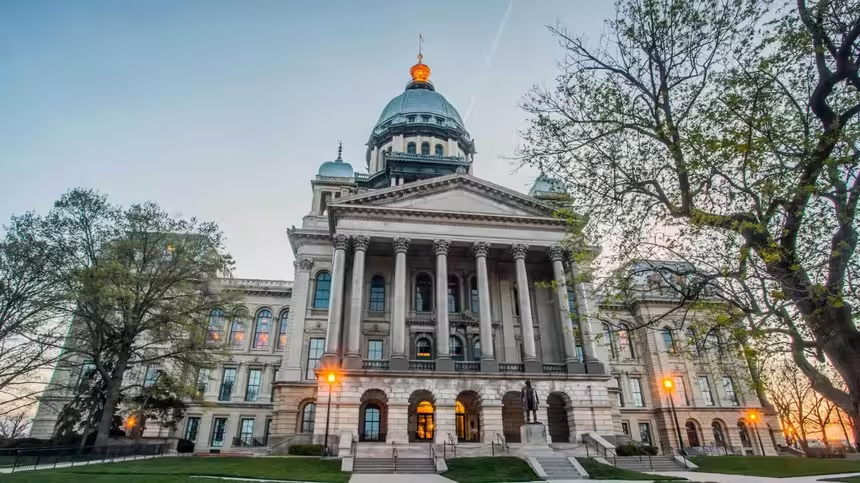
CapitolView is a weekly discussion of politics and government inside the Capitol, and around the state, with the Statehouse press corps. CapitolView is a production of WSIU Public Broadcasting.Providing Support for PBS.org
Learn Moreabout PBS online sponsorship(dramatic music) - Welcome to "Capital View" our weekly look at the happenings inside and outside the Illinois State Capital.
I'm Jennifer Fuller.
Our guests this week are Jason Piscia, the director of the public affairs reporting program at the University of Illinois Springfield, and Kent Redfield emeritus political science professor also at UIS.
Gentlemen, thanks so much for joining us.
- Good to be here.
- Glad to be here.
- Let's start with, you know, one of the big announcements from this week.
Governor J.B Pritzker joined Chicago city leaders and other state leaders, to announce the formal sale of the James R. Thompson Center in the city of Chicago.
This building is a landmark in what's known as the loop, and a lot of people have been talking about the fact that it's kind of an Albatros for the state over the last several years.
It's in need of a lot of repair and was costing the state more than it needed to.
Jason, who is this a win for in terms of the sale?
- Yeah, this is an issue that has, you know, selling, getting the Thompson Center off the state's books has been something that, you know, even Rob Blagojevich, one of the first governors to talk about it.
And every governor since has sort of made it his goal to divest itself of the Thompson Center.
J.B Pritzker finally got the deal done on his watch.
Google is gonna move into that building eventually.
It's sort of an interesting deal to get this, you know, historic building off the state's investment roles.
It's the Thompson Center, if you've ever been to downtown Chicago, very interesting building, interesting design, you know, sort of groundbreaking for its time.
It's shown its age, however.
It's hard to heat and it's hard to cool.
And there's a lot of maintenance issues that have been deferred over the years.
And just by the design of the building, it's been harder to take care of than a regular building.
But Google has decided to move in, in this interesting land deal.
The state will get 30 million in cash.
And in addition, the state will get title to another office building about two or three blocks away from the Thompson Center, and the former BEMO Bank headquarters, and the state will move some of its offices in there.
But yeah, I think this is a win for the state, at least how the initial numbers sound.
You know, Governor Pritzker this week was talking about how estimating, it'll save the state nearly a billion dollars over 30 years by, you know, consolidating office space, and cutting down on operating costs.
We'll see, you know, those are always pie in the sky estimates at this point, but we'll see how that plays out over time.
But this is also a big win for, you know, the city of Chicago as well.
Getting a big name like Google into downtown is a big plus, getting these well known names, you know, strong in the tech industry.
This is a good holding for the city of Chicago to have these, you know, tech workers, you know, right in the heart of downtown.
- Kent, Jason gets to an interesting point, while the seat of government in Illinois is in Springfield.
There are quite a few jobs, state jobs, in the city of Chicago.
Quite a lot of business goes on there.
And then you talk about bringing in these tech sector jobs as well.
Is this a win overall for the state in terms of moving out of this dilapidated building?
- Oh, most definitely.
And I mean, it is, you know, there's been a trend, certainly since the early days of Blagojevich, to move jobs out of the Springfield and into Chicago, into the suburbs.
I mean, yeah, if this means that we're not gonna transfer jobs from Chicago to Springfield, and it certainly isn't a win for the city of Springfield.
It has its own issues in terms of downtown redevelopment.
But in the bigger picture, you know, economically it makes sense.
It's a pretty dysfunctional building in terms of what it was purposed for, which was, you know, office space in terms of housing, you know, state government, which is a large scale bureaucracy.
And so, you know, this makes sense for Google, certainly, you know, you're getting a prime location in downtown Chicago.
If you were just to go out and start pricing real estate, you know, obviously they're getting a good deal.
And so, and it helps, as Jason said with trying to, you know, burnish Chicago's reputation as being, you know, tech, finance, you know, that kind of economy in terms of Northeastern, Illinois.
And so, and then just in terms of the checklist sort of thing as you know.
It's the season where you might be putting together a list of things that you wanted to tout on a campaign commercial or a direct mail piece.
And, you know, finally selling the Thompson Center while not, you know, at the top of the list, you know, it's one more bullet point you can put on there.
So I think generally, all of the stakeholders are pretty happy.
- Certainly not all sunshine and roses when it comes to party politics and things happening.
Even in the city of Chicago, we saw this week, as leaders from the city of Chicago, and the state of Illinois, the democratic party, got together to pitch the city of Chicago for the next Democratic National Convention.
There were a lot of questions about leadership, who will be the democratic party of Illinois's leader going forward?
And it still remains to be seen, as I understand it, a vote is coming this weekend, and we might have some clarity there.
But Jason, what's happening with Illinois Democrats, and do you think they'll finally coalesce around one leader?
- Yeah, I think, you know, it behooves them to sort of develop the one big happy family environment before all this happens.
And, you know, even at that news conference this week, you know, J.B Pritzker who is backing a different candidate for state party chair, was standing right next to, you know, Congresswoman Robin Kelly.
Who's the current party chair who he would not, he would like to see her, you know, not hold that position anymore.
With the main reason being, according to Pritzker and his supporters, that due to the way campaign laws work, because Robin Kelly is a Congress person.
She is unable to fundraise for state candidates, which sort of puts a crimp in the Democrat style, so to speak, in trying to raise money.
So there's a separate organization that raises money for state candidates, people say it could be, you know, more efficient to do with the other candidates.
So we'll see where this hashes out.
It'll be interesting, but I do think, you know, they'll come together in some way, and, you know, if they don't fully do it before the vote happens, you'll be sure they'll be at news conference afterwards, where they'll be all standing together once again, sort of, you know, kumbaya moment for the Democrat party saying, you know, "We're ready to move forward with this.
And our main goal is just to, you know, win the governor's office, win statewide offices, and hold on to super majorities in both the Illinois House and Senate."
- Kent, how much of this is still kind of a vacuum at the top with former house speaker, Michael Madigan, no longer being in control of the democratic party?
- Oh, I think that's a major factor here.
This is still part of working out what the post-Madigan era looks like.
And so as the speaker built his power, he took over the chairmanship of the DPI, the democratic party of Illinois.
And, you know, after it had been in shambles with the fiasco with trying to, the second Stevenson campaign, where we ended up with a couple of disciples of Lyndon Larouche winning the primary.
And so downstate Senator Vince Demuzio, rebuilt the party at that point, Madigan, who was looking to kind of, how do I build a power base outside the city of Chicago?
Seized upon that as a way to enhance his power, and eventually had a surrogate when, you know, run and take over the chairmanship, and then eventually took it over himself.
And so the democratic party became the third bucket that you put money in.
When you gave money to speaker Madigan, you gave it to friends of Michael J Madigan.
You gave money to the democratic house caucus committee, which is a political party under state law.
And then if you were maxed out as an interest group, or a candidate or, you know, an individual citizen, or a company on those other two options to give money, then you could give money to the democratic party of Illinois.
And so, you know, that allowed him to consolidate power and you know, people are reluctant, you know, to go that route.
This is also a fight between the governor and to a certain extent, the general assembly.
Between those groups, and the senior Senator from Illinois, Dick Durbin.
And so he was the one that was pushing Congressman Kelly's chairmanship.
And so there's kind of, you know, who's gonna be, you know, who's gonna be the chair of the party.
Money is in fact, an issue with all of this.
In 2018, the 2018 cycle, the DPI raised over $5,000,000 in new money.
Less than $300,000 with the Republican party in Illinois.
During the 20 cycle when Madigan's power was slipping away.
And they still raised $3.7 million in new money.
Currently, both the DPI and the Illinois Republican party have only raised, you know, three, $400,000 in new money.
Most of the money that goes through these committees are passed through, they're big transfers of money from, you know, the caucus committees, or the individual legislative leaders, where the governor is given $1,500,000 to the democratic party of Illinois.
And so, you know, there is a question about, you know, Madigan with his contacts, with his power, attracted lots of money.
And so, you know, you want somebody who is raising money at the state level to have those kind of contacts and experience, and be the familiar person that you're giving money to, that you have confidence in.
So, you know, there are lots of ways to get there, and they haven't figured out how to get there yet.
It's unfortunate that they're having a public fight when they're trying to present a unified front.
Not only for winning the democratic nominating convention before the next presidential election, but also they'd like to move up the Illinois primary to be more prominent, in terms of the presidential primary schedule in 2024.
So it would behoove them to solve this, you know, work this out in private and then have an announcement about a consensus way of moving forward, rather than coming down to a public roll call next Saturday.
Well, we'll see how well they do.
- Certainly and the Democrats are not the only ones with some issues within their party, as they head into the November election.
We saw this week that the Illinois Freedom Caucus, which is made up of several lawmakers who have for the most part, been supporters of former President, Donald Trump.
Calling for the censure of representative Adam Kinzinger.
Who of course, is on the house January 6th, investigating committee.
Still at the same time when asked, Senator Darren Bailey, the GOP nominee for governor in Illinois, side stepped the issue and said, "This is a federal issue, I'm not going to comment on that."
And then also saying that he supported President Trump.
Where does this end with the Republicans, Jason?
Is this something that they can come together on or do you see Senator Bailey making a more definitive statement?
- Yeah, it's interesting.
You know, when we talk about, you know, the freedom caucus also known as, the Eastern block of Republican state legislators, who are sort of known for their far right positions on things.
This is the same group that, you know, made the sort of ceremonial suggestion that Chicago should be excised from Illinois had made into a 51st state.
They'll tell you that wasn't really a serious proposal, but more of a, you know, something to get the peoples in Illinois's attention, that, you know, Chicago needs to, you know, be a part of Illinois and sort of represent what all of Illinois does.
But back to the Republicans, you know, this group has sort of, as you mentioned, going on against the Congressman for his role on the January 6th committee.
It's not the first time Adam Kinzinger would be censured.
It's happened in an individual county up in Northern Illinois.
So in some ways, this is just sort of, in some ways, beating a dead horse.
Kinzinger already announced that he's not gonna run for reelection.
So he's done.
This is sort of his swan song, his role on the January 6th commission.
But it is interesting, you know, Bailey has been right along with the Eastern block on all the other things they've done.
But I see this as a way of Bailey, perhaps in his own way, sort of moderating his views a little bit.
Realizing that he's gonna need some support of more moderate Republicans, in order to have any sort of a chance against J.B Pritzker in November.
The numbers are still not in Bailey's favor in terms of polling numbers or financial numbers at this point.
But, you know, I do see this as a way of Bailey to, you know, not really jump into the fray of this bashing of Kinzinger in hopes that, you know, he can get more Republicans on his side.
- Kent, typically those Republicans that he would need to be courting, are in the suburbs of Chicago.
And we've seen those suburbs run a little bit more democratic, in terms of vote totals over the last several years.
How important is it for him to moderate and to court those voters who perhaps don't always vote with one particular party or another?
- No, I think it's vitally important.
And, you know, Senator Bailey is, you know, trying to control the message.
He was at a press conference, wanted to talk about the problems within the Illinois department of family services, child and family services, DCFS.
And instead reporters wanted to talk about, you know, the moves to censure Congressman Kinzinger.
And so, you know, you can try to control the message, but as another candidate Richard Irvin found out, you know, sometimes it's very difficult for a candidate to control the message.
And if people wanna talk about extremism and you wanna talk about policy, sometimes the, you know, the extremism and the party fights, you know, seem to make better stories than the policy stories.
And so, yeah, absolutely.
I mean, he needs moderates and independents.
Kinzinger plays very well with moderate and independent voters.
And so, you know, he doesn't wanna talk about this issue at, you know, Senator Bailey doesn't want talk about this issue at all.
And whereas, you know, we know that the governor's campaign, in addition to talking about the great and wonderful things he's done in getting Illinois out of the hole it was in, when he became governor, is gonna wanna talk about all those Republican extremists, who, you know, whatever your problems are, you know, these people can't solve them and lump them all together.
So it will be a fight from here until election day as to who's gonna control the message.
- That message is something that, in some cases, doesn't always resonate with voters though.
Kent, when you talk about voters who are worried about inflation, gas prices, being able to pay for groceries and things like that.
What are the candidates going to have to do to kind of shift their messaging away from these extremes, and really talk about the issues that are impacting real people?
- Oh, you know, you have to run a two front.
And so you're gonna see, you know, in central Illinois, we've been seeing ads about various things that the governor has done for downstate Illinois.
And so you want to show your you're concerned and you're empathetic, At the same time, either the governor, or some independent expenditure committee, or, you know, federal dark money committee, is gonna be talking about abortion, and talking about same sex marriage, and talking about contraception, and how, you know, these extremists are out to take away all of your rights.
And, you know, you really can't trust these people to run government.
And so, you know, you want to say, "Here's the experienced leader that is, you know, dealing with the problems.
And then, you know, your option is to either stick with the person that you know and trust, or, you know, to take a gamble on all of these people who seem to be very extreme, and you can't trust them."
So, and you know, Darren Bailey's gonna run the mirror opposite campaign.
And so, and both Governor Pritzker had a lot more money, but Darren Bailey's campaign will have enough money to get the message out.
So it will be an interesting contest again, to see who can kind of frame it in a way that advantages their campaign.
- Jason, what's an undecided voter to do in terms of literacy on who's really telling the truth, and where the actual policy and effective information is?
- Yeah, I'll just go back to the lessons I given my, you know, intro to mass media courses here at UIS, when my students are sort of getting bombarded from both sides, and even more than both sides, on social media and news media, on what's true and what's not.
I think just, you know, be open minded, you know, in sort of our siloed media environment that we're in, where everyone sort of picks their favorite news organization or news channel that caters to a, you know, a political bent that we like, or that we support.
You know, we only get one side of the story.
You know, I always encourage my students to, you know, let's watch both CNN and Fox News and see what they both have to say, and that can happen, you know, on the state level as well.
You know, let's read as many local news sources as you can.
You know, be wary of the news sources that you do read, sort of where their funding comes from, and what points of view that they espouse support.
And just sort of fill yourself up with as much information as you can, that's good and solid.
And if you're not sure about it, you know, do a Google search about the fact that you read that you're not sure about.
If it's true, there'll be others writing about it as well.
Either, you know, confirming that it's true, or throwing it out as a lie.
So that's my advice that I give to everyone who's sort of figuring out how to wade through all this as we try to make a good decision on election day.
- Sure, we spend a lot of time each week right now, talking about campaign finance and elections, and what's coming before the November election.
But we also see this week, that house speaker Emmanuel Chris Welch created some committees, some advisory committees, that appears to be setting the chambers agenda for next session.
We're talking about things like reproductive health, firearms safety and reform, mental health and social media, with a focus on extremism online.
Kent, what do you think in terms of how those issues will go, is this the agenda that the Democrats are hoping to push next session?
- Well, it's part of the agenda.
And, you know, we're in the middle of the general campaign for the general elections.
So, you know, they need to keep their core, particularly the progressive core, energized.
And, you know, certainly we've seen in terms of abortion, and same sex marriage, contraception, you know, there are things out there to keep them energized.
But you're not gonna do anything with these groups between now and, you know, election day.
This is, you know, this is the setup for, you know, this is how we're gonna focus once we get back into office.
And so, you know, yeah, that's gonna be part of the agenda, it's important to give that message to the progressives, that these are the things we're gonna deal with.
You know, in addition to, we've got to balance the state budget.
We've gotta deal with the economy.
We've gotta fix the problems with, you know, the DCFS, Children and Family Services.
I mean, this is one part of it.
But you're always trying to, you know, how do we keep the base happy and how do we grow the base in terms of moderates and independents?
And so this is just one piece in the election, but it is also clearly, you know, what they expect to be working on as part of their effort, if they remain in power after, you know, and come back in January.
- Jason, does this put Republicans on the defensive at all?
Do they have to come up with their own answer to this?
- Yeah, there's been criticism from Republicans about how these working groups really exclude Republicans at this point.
And Democrats in response will say, "Well, you know, we're gonna figure out what direction we're gonna go with this, then we'll bring in the Republicans to talk about it."
And you know, this past week, when these groups were announced, Tim Butler, a state representative from Springfield, was among those saying, you know, "These are hot button issues, and yes, we should probably do something about them."
But really, as we talked about earlier in this show, voters are interested in those kitchen table issues.
What are we gonna do about inflation, our high tax burden, the property tax reform that's been elusive for so long in Illinois, what are we doing about those issues?
So I think, you know, it's interesting about the timing of all this as well.
There was some talk of trying to get a special session put together this summer, or even before the election, to try to, you know, have some of these working groups come up with some legislation they can slam through, and look good to voters as they lead into the November election.
We're not hearing any exact dates at this point on when a special session may happen.
So absent that, the next time the legislature is scheduled to be in town is for the fall veto session, the first week of which occurs the week after the November election.
So at that point, you know, we theoretically have some lame duck legislators, you know, who are, you know, at that point would develop some ability to vote first, maybe some things that might hurt them at the ballot box.
They wouldn't need to worry about that anymore.
And they'd also, the leaders would also have a better view on, you know, did both the House and Senate retain their super majorities and able to, you know, get things through, and enact those laws right away?
Since you'd need a super majority vote to get that to happen.
- Certainly, we've got the Illinois state fair starting later in the month of August as well.
We'll keep track of the political announcements and things from that as well.
Our guests, Jason Piscia, Kent Redfield, thanks so much.
- Good to be here, thank you.
- Thank you.
- And we'll catch you next time on "Capital View".
I'm Jennifer Fuller.
(dramatic music)

- News and Public Affairs

Top journalists deliver compelling original analysis of the hour's headlines.

- News and Public Affairs

FRONTLINE is investigative journalism that questions, explains and changes our world.












Support for PBS provided by:
CapitolView is a local public television program presented by WSIU
CapitolView is a production of WSIU Public Broadcasting.