
Thoreau Begins to Work with the Underground Railroad
Clip: Episode 3 | 5m 3sVideo has Closed Captions
Thoreau participates in the Underground Railroad and gives a speech on what it means to be free.
In 1850, the U.S. Congress passes the Fugitive Slave Act, makes it legal for slave owners to reclaim any runaways, even those who had escaped to free states. The women of the Thoreau household had already been active in the Underground Railroad, but this new law spurs Thoreau into action, too. Thoreau gives an impassioned speech about the freedoms that all human beings deserve titled "Walking."
From
Problems playing video? | Closed Captioning Feedback
Problems playing video? | Closed Captioning Feedback
Episodes presented in 4K UHD on supported devices. Major funding for HENRY DAVID THOREAU was provided by The Better Angels Society and its members: The Keith Campbell Foundation for the...
Thoreau Begins to Work with the Underground Railroad
Clip: Episode 3 | 5m 3sVideo has Closed Captions
In 1850, the U.S. Congress passes the Fugitive Slave Act, makes it legal for slave owners to reclaim any runaways, even those who had escaped to free states. The women of the Thoreau household had already been active in the Underground Railroad, but this new law spurs Thoreau into action, too. Thoreau gives an impassioned speech about the freedoms that all human beings deserve titled "Walking."
From
Problems playing video? | Closed Captioning Feedback
How to Watch Henry David Thoreau
Henry David Thoreau is available to stream on pbs.org and the free PBS App, available on iPhone, Apple TV, Android TV, Android smartphones, Amazon Fire TV, Amazon Fire Tablet, Roku, Samsung Smart TV, and Vizio.
Narrator: On September 18, 1850, the U.S.
Congress passed the Fugitive Slave Act.
The new law made it legal for slave owners to reclaim any runaway-- man, woman, or child--even those who had managed to escape to the free states in the North.
In April 1851, Thomas Sims, who had escaped from a Georgia rice plantation, was arrested in Boston and sent south to be reenslaved.
Henry David Thoreau: The authorities of Boston sent back a perfectly innocent man into slavery.
I wish my townsmen to consider that, whatever the human law may be, a government which deliberately enacts injustice, and persists in it, will become the laughing-stock of the world.
Cristie Ellis: The average white American, north and south, knew slavery was wrong, but it was really inconvenient to have to get rid of it.
Laura Dassow Walls: Where does the sugar to sweeten your coffee come from?
Where does the rice that you eat come from?
Narrator: The new law also mandated that helping an escaped slave was now a crime.
Lois Brown: At the time of the 1850s, the fine was up to a thousand dollars, which in our day and time is about $40,000.
40,000, and then up to six months in jail.
So, you begin to understand the incredible high stakes of continuing to assist.
Henry David Thoreau: I say break the law.
Let your life be a counter friction to stop the machine.
Narrator: The women of the Thoreau household had already been active in the Underground Railroad-- a secret network of safe houses, which abolitionists used to help slaves escape to freedom.
Henry began to work alongside them.
He escorted a fugitive named Henry Williams from the Thoreau home to the train station in Concord.
But after seeing a policeman, he put Williams on a later train to Burlington, Vermont.
Williams went on to freedom in Canada-- one of several human beings that Henry helped escape.
On April 23rd, Henry arrived at the Concord Lyceum to give a lecture called "Walking, or The Wild."
♪ Henry David Thoreau: I wish to speak a word for Nature, for absolute Freedom and Wildness, as contrasted with a freedom and culture merely civil, to regard man as an inhabitant, or a part and parcel of Nature, rather than a member of society.
I wish to make an extreme statement, if so I may make an emphatic one.
In Wildness is the preservation of the World.
♪ Clay Jenkinson: It's not really about walking.
I think that he's talking about what it is to be completely free.
He's a white, privileged writer who can walk anywhere he wants.
A fugitive slave doesn't have time to think about nature.
Rochelle L. Johnson: So when Thoreau writes in "Walking" that the freedom to walk is essential, he's certainly pointing to-- to the freedom that all human beings deserved.
In a natural world that is flourishing, regenerative, inexhaustible, the freedom that the natural world allows can teach us ideas, hopes, thoughts we didn't know we had.
J. Drew Lanham: Wildness, it's freedom.
Sometimes it's the breeze blowing through the trees or the call of a bird.
And so wildness is--I mean, it's over my shoulder, it's underfoot, it's always in my heart in a way that allows me to access it, even when I can't get to it.
Narrator: Thoreau called his lecture "Walking" "an introduction to all I may write hereafter."
Douglas Brinkley: "Walking," I think, is the birth of the modern environmental thinking.
It's one of those things that has grown over time.
It's the idea of wild and wilderness can be loved and protected and cared about.
It becomes a part of us.
[Activists chanting]
 New
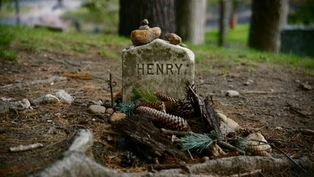
NewHenry David Thoreau Asks Us to Live in the Present
Video has Closed Captions
Clip: Ep3 | 8m 19s | Henry David Thoreau dies at 44, but his message lives on and encourages us to read. (8m 19s)
 New
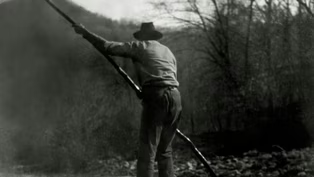
NewJoe Polis Teaches Thoreau the Penobscot View of Nature
Video has Closed Captions
Clip: Ep3 | 9m 45s | On an excursion, a Penobscot leader teaches Thoreau about the Penobscot culture and language. (9m 45s)
Providing Support for PBS.org
Learn Moreabout PBS online sponsorship











Support for PBS provided by:
Episodes presented in 4K UHD on supported devices. Major funding for HENRY DAVID THOREAU was provided by The Better Angels Society and its members: The Keith Campbell Foundation for the...