
Thoreau Challenges Justice with His Essay "Civil Disobedience"
Clip: Episode 2 | 7m 14sVideo has Closed Captions
Thoreau's refusal to support what he saw as injustice culminates in his essay "Civil Disobedience."
After refusing to pay four years of poll taxes, Thoreau is briefly imprisoned. Thoreau is adamantly opposed to supporting a state that is involved in enslavement and wars of aggression. Thoreau begins to write in earnest about society's obligations to freedom and justice culminating in the essay "Civil Disobedience," which influences the later work of Martin Luther King, Jr., Malcolm X, and Gandhi
From
Problems playing video? | Closed Captioning Feedback
Problems playing video? | Closed Captioning Feedback
Episodes presented in 4K UHD on supported devices. Major funding for HENRY DAVID THOREAU was provided by The Better Angels Society and its members: The Keith Campbell Foundation for the...
Thoreau Challenges Justice with His Essay "Civil Disobedience"
Clip: Episode 2 | 7m 14sVideo has Closed Captions
After refusing to pay four years of poll taxes, Thoreau is briefly imprisoned. Thoreau is adamantly opposed to supporting a state that is involved in enslavement and wars of aggression. Thoreau begins to write in earnest about society's obligations to freedom and justice culminating in the essay "Civil Disobedience," which influences the later work of Martin Luther King, Jr., Malcolm X, and Gandhi
From
Problems playing video? | Closed Captioning Feedback
How to Watch Henry David Thoreau
Henry David Thoreau is available to stream on pbs.org and the free PBS App, available on iPhone, Apple TV, Android TV, Android smartphones, Amazon Fire TV, Amazon Fire Tablet, Roku, Samsung Smart TV, and Vizio.
Narrator: One day in the summer of 1846-- after a year in his cabin-- he went to town to pick up a mended shoe.
There, he ran into the constable and tax collector, Sam Staples, who pointed out that Henry owed four years of state poll taxes-- an annual fee that every adult male citizen was required to pay in order to vote.
Sam offered to pay it for him, but Thoreau adamantly refused.
[Cell door shuts, key turns in lock] Henry David Thoreau: I was seized and put into jail, because...I did not pay a tax to, or recognize the authority of, the state which buys and sells men, women, and children like cattle at the door of its senate-house.
Lois Brown: The economy of Massachusetts had depended on trade with the South, and they were still constrained by the times that actually permitted enslavement to exist in the first place.
Clay Jenkinson: So by paying Massachusetts taxes, he continued to sustain this appalling, immoral, anti-American economic system.
[Rifles firing] Lois Brown: And then there's the Mexican-American War, which is not just a war between two nations, it's actually an American provocation and campaign to expand enslavement.
It's a territory grab.
Henry David sees this and decides, "Well, how is my name actually attached to these enterprises?"
Through taxes.
The dollar can now have a different kind of currency.
Narrator: Henry was placed in an upstairs cell.
He spent the night there, viewing his hometown from the fresh perspective of a prison window, seeing more clearly, he said, "the State in which I lived."
Someone--probably his Aunt Maria--bailed him out.
He was "mad as the devil," Staples remembered, that someone had "interfered and paid that tax."
Within 30 minutes of his release, Henry found himself picking berries on Fairhaven Hill, surrounded by children.
"I joined a huckleberry party on one of our highest hills," he mused, "and then the State was nowhere to be seen."
Cristie Ellis: The question of how to live a life of conscience is a major question for him.
How do you go on living at a time when simply living your life seems complicit with something you find morally intolerable?
[Indistinct chatter] Narrator: Just a week after his night in jail, Thoreau invited the Concord Female Anti-Slavery Society to host their annual event at his cabin, commemorating the end of slavery throughout the British Empire.
From Henry's open doorway, a slate of speakers addressed the small crowd, including William Henry Channing, a Unitarian minister, who called for a new U.S.
Constitution that excluded slaveholding, and Lewis Hayden, a rising abolitionist who had escaped from the plantation of the powerful Kentucky Senator Henry Clay.
Hayden told the audience the tragic story of his wife and child being sold away from him.
Laura Dassow Walls: And Thoreau starts to realize that he had a social and ethical responsibility to speak out.
He needed to give this his time and attention in a deep way as well.
Narrator: Thoreau began to write in earnest on society's obligation to uphold the principles of freedom and justice, culminating in an extensive essay that would be published three years later.
It would eventually be called "Civil Disobedience."
Henry David Thoreau: Under a government which imprisons any unjustly, the true place for a just man is also a prison.
It is there that the fugitive slave, and the Mexican prisoner on parole and the Indian come to plead the wrongs of his race, should find them; on that separate but more free and honorable ground, where the State places those who are not with her but against her-- the only house in a slave-state in which a free man can abide with honor.
In order to challenge the status quo, in order to recreate a new sort of society, there needs to be what Thoreau calls "counter-friction."
Slavery is a machine that is moving forward constantly.
Friction creates heat, and the machine itself breaks down.
Clinton Bembry: The human revolution in a single person can change the course of history.
♪ My Uncle Johnny went to prison.
He encountered a young man by the name of Malcolm Little.
And Uncle Johnny introduced Thoreau to Malcolm.
"The only place that a free man can abide with dignity in a slave state is in a jail cell."
That resonated with Malcolm-- that Thoreau would choose as a matter of honor a jail cell.
Malcolm Little would later be known as Malcolm X. During his prison years, he was often found reading the works of Thoreau.
Martin Luther King Jr.
: I have a dream... Kerri Greenidge: People just don't have brilliant ideas about justice and redemption from an empty, blank slate.
[King's speech continues, indistinct] Kerri Greenidge: Martin Luther King was reading Thoreau.
"Civil Disobedience," the words of Henry David Thoreau, could be used to disobey laws because they were unjust.
So a person like a King or a Malcom X found solace in what Thoreau was talking about.
[People shouting, whistle blows, cell door shuts] Arun Gandhi: The first time Gandhi was imprisoned, somebody gave him a copy of Thoreau's "Civil Disobedience" for him to read.
Thoreau was thinking on the same lines as he was.
That's how Gandhi began his civil disobedience campaign.
You need some adrenaline once in a while, you need a booster shot, and his essay provides that, even this late in the 21st century.
Cristie Ellis: How do we talk about problems of conscience when you're in the minority and you feel like your country is moving in the wrong direction?
He said, "I feel called upon to right the wrongs of my country."
 New
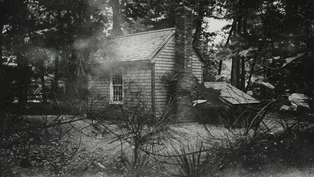
NewHenry David Thoreau Moves to Walden Pond
Video has Closed Captions
Clip: Ep2 | 11m 14s | On July 4th, 1845, Henry David Thoreau moves into a 10x15-foot house on Walden Pond. (11m 14s)
 New
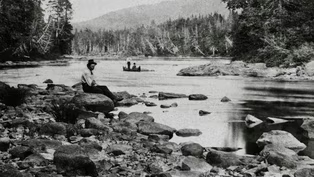
NewJourney to Mount Katahdin and Untamable Nature
Video has Closed Captions
Clip: Ep2 | 9m 22s | Leaving Walden Pond, Thoreau joins his cousin on an excursion to Mount Katahdin in Maine. (9m 22s)
 New
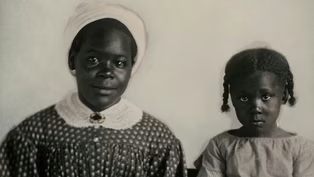
NewThoreau Tells the Stories of the Black Community in Concord
Video has Closed Captions
Clip: Ep2 | 5m 50s | While slavery is illegal in Massachusetts, Black communities are forced to the margins of society. (5m 50s)
Providing Support for PBS.org
Learn Moreabout PBS online sponsorship










Support for PBS provided by:
Episodes presented in 4K UHD on supported devices. Major funding for HENRY DAVID THOREAU was provided by The Better Angels Society and its members: The Keith Campbell Foundation for the...