
Thoreau Tells the Stories of the Black Community in Concord
Clip: Episode 2 | 5m 50sVideo has Closed Captions
While slavery is illegal in Massachusetts, Black communities are forced to the margins of society.
While slavery is illegal in Massachusetts, Black communities are forced to the margins of society. While living at Walden Pond, Thoreau explores their stories of hardship and resilience, which have been left out of the public record. His experiences pave the way towards his increasing involvement in anti-slavery work.
From
Problems playing video? | Closed Captioning Feedback
Problems playing video? | Closed Captioning Feedback
Episodes presented in 4K UHD on supported devices. Major funding for HENRY DAVID THOREAU was provided by The Better Angels Society and its members: The Keith Campbell Foundation for the...
Thoreau Tells the Stories of the Black Community in Concord
Clip: Episode 2 | 5m 50sVideo has Closed Captions
While slavery is illegal in Massachusetts, Black communities are forced to the margins of society. While living at Walden Pond, Thoreau explores their stories of hardship and resilience, which have been left out of the public record. His experiences pave the way towards his increasing involvement in anti-slavery work.
From
Problems playing video? | Closed Captioning Feedback
How to Watch Henry David Thoreau
Henry David Thoreau is available to stream on pbs.org and the free PBS App, available on iPhone, Apple TV, Android TV, Android smartphones, Amazon Fire TV, Amazon Fire Tablet, Roku, Samsung Smart TV, and Vizio.
John J. Kucich: In his beanfield, as he's hoeing his beans, he came across these arrowheads and stone implements of Native peoples, and he gets a sense that people have lived here for thousands of years, whose lives are very much written on the land.
Elise Lemire: He notices other signs in the landscape.
He saw bricks; he saw cellar holes; he saw trees and bushes that are not native to Walden Woods.
This meant someone had been there before.
Who were they?
Where had they gone?
What was their story?
Henry David Thoreau: For human society, I was obliged to conjure up the former occupants of these woods.
The woods which border it were notched and dotted here and there with their little gardens and dwellings.
John J. Kucich: In this 19th-century American New England town, you think of this kind of thriving, very close-knit community, which Concord really was to a large degree.
And then on the outskirts, there are other people.
And Thoreau is fascinated by these people who are living on the edge, living very close to the land.
Elise Lemire: These were people who had been enslaved in his hometown.
Narrator: In the 1780s, Massachusetts became the first state to make slavery illegal.
But most Black people in Concord had to choose between working as servants or scratching out a living on poor-quality land that no white person wanted to farm.
Lois Brown: Sentiments don't change just because a law is enacted.
The conditions of enslavement of labor, those may change in the law, but in practice, it's really servitude for life.
Narrator: Using local lore and his own observations, Thoreau pieced together the stories of what he called "these former inhabitants," which otherwise would have been all but lost from the historic record.
As he's writing a biography of the green space that we know of as Walden Woods or Walden Pond, he's also writing the biography of a Black space.
Henry David Thoreau: Down the road lived Brister Freeman, slave of Squire Cummings once, there, where grow still the apple-trees which Brister planted and tended; large old trees now... Elise Lemire: We're learning about a man who decided to claim for himself his new status as a free man.
But he couldn't plant a larger crop, something more in line with what other Concord farmers were planting because it's not fertile soil, so he's barely able to make his way.
Henry David Thoreau: Here, by the very corner of my field, still nearer to town, Zilpha, a colored woman, had her little house, where she spun linen for the townsfolk... Lois Brown: He describes the life of Zilpha White, who is eking out an existence.
She spins, threads, and silks for the Concord women.
Henry David Thoreau: She led a hard life, and somewhat inhumane.
One old frequenter of these woods remembers her muttering to herself over her gurgling pot, "Ye are all bones, bones!"
Lois Brown: And he describes her as living a life that is cruel and witch-like, this woman in the woods who's overheard stirring a pot and saying, "Bones, all ye are are bones."
And later he comes to a place where he says, "You know what?
She wasn't witch-like.
She's hungry."
Henry David Thoreau: East of my bean-field, across the road, lived Cato Ingraham, slave of Duncan Ingraham of Concord village, who gave him permission to live in Walden Woods.
Lois Brown: And the man to whom Cato is enslaved says, "You have freedom," but "You will receive nothing from me," So Cato begins to try to make a life for himself.
Elise Lemire: Cato has tried to secure a future by planting walnut trees, but he's preparing for a future that he never gets to enjoy.
Lois Brown: What remains in the earth is central to African-American history.
So planting walnut trees is a way of understanding that they were there, and also, they have ownership.
Ultimately, it is enslavement that kills him, because the terms of his freedom are so qualified, they're so mean-spirited.
Elise Lemire: And this is the story Henry tells us.
Narrator: Why did this small village fail, Thoreau asked, "while Concord kept its ground?"
Elise Lemire: Thoreau is asking the question at the heart of American history, at the heart of America itself: the question of why, after slavery, a community of formerly enslaved people could not be included, could not make themselves into a town that could survive and blossom.
The gentlemen of Concord abandon them to their freedom.
Lois Brown: He's trying to negotiate how there can be different histories alongside his at Walden because he gets to move wherever he wants to, because he's a person of privilege.
And all of that paves the way towards his increasing involvement in anti-slavery work and his outrage about injustice.
 New
NewHenry David Thoreau Moves to Walden Pond
Video has Closed Captions
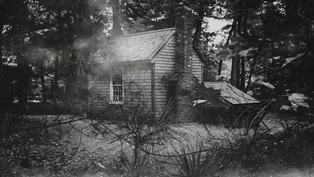
Clip: Ep2 | 11m 14s | On July 4th, 1845, Henry David Thoreau moves into a 10x15-foot house on Walden Pond. (11m 14s)
 New
NewJourney to Mount Katahdin and Untamable Nature
Video has Closed Captions
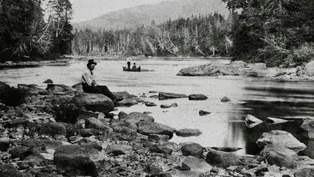
Clip: Ep2 | 9m 22s | Leaving Walden Pond, Thoreau joins his cousin on an excursion to Mount Katahdin in Maine. (9m 22s)
 New
NewThoreau Challenges Justice with His Essay "Civil Disobedience"
Video has Closed Captions
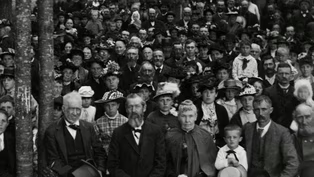
Clip: Ep2 | 7m 14s | Thoreau's refusal to support what he saw as injustice culminates in his essay "Civil Disobedience." (7m 14s)
Providing Support for PBS.org
Learn Moreabout PBS online sponsorship













Support for PBS provided by:
Episodes presented in 4K UHD on supported devices. Major funding for HENRY DAVID THOREAU was provided by The Better Angels Society and its members: The Keith Campbell Foundation for the...