
Threads of Expression: Embroidery, Dance & Punk Rock
Season 9 Episode 19 | 26m 46sVideo has Closed Captions
Discover redwork embroidery with Tisha Dolton, dance with Nadine Medina & rock with The Sugar Hold.
Discover the fascinating world of redwork embroidery with Tisha Dolton, delve into the dance journey of Nadine Medina, and rock out with The Sugar Hold in this eclectic episode of AHA! A House for Arts.
Problems playing video? | Closed Captioning Feedback
Problems playing video? | Closed Captioning Feedback
AHA! A House for Arts is a local public television program presented by WMHT
Support provided by the New York State Council on the Arts (NYSCA), M&T Bank, the Leo Cox Beach Philanthropic Foundation, and is also provided by contributors to the WMHT Venture...
Threads of Expression: Embroidery, Dance & Punk Rock
Season 9 Episode 19 | 26m 46sVideo has Closed Captions
Discover the fascinating world of redwork embroidery with Tisha Dolton, delve into the dance journey of Nadine Medina, and rock out with The Sugar Hold in this eclectic episode of AHA! A House for Arts.
Problems playing video? | Closed Captioning Feedback
How to Watch AHA! A House for Arts
AHA! A House for Arts is available to stream on pbs.org and the free PBS App, available on iPhone, Apple TV, Android TV, Android smartphones, Amazon Fire TV, Amazon Fire Tablet, Roku, Samsung Smart TV, and Vizio.
Providing Support for PBS.org
Learn Moreabout PBS online sponsorship(uplifting orchestra music) (exciting hip-hop music) - [Narrator 1] Explore the redwork of artist Tisha Dolton, learn about Troy Dance Factory with Nadine Medina, and catch a performance from The Sugar Hold.
(upbeat rock music) It's all ahead on this episode of AHA!
A House for Arts.
- [Narrator 2] Funding for AHA has been provided by your contribution and by contributions to the WMHT Venture Fund.
Contributors include The Leo Cox Beach Philanthropic Foundation, Chad and Karen Opalka, Robert and Doris Fischer Malesardi, and the Robison Family Foundation.
- At M & T Bank, we understand that the vitality of our communities is crucial to our continued success.
That's why we take an active role in our community.
M & T Bank is pleased to support WMHT programming that highlights the arts, and we invite you to do the same.
(upbeat hip-hop music) - Hi, I'm Matt Rogowicz and this is AHA!
A House for Arts, a place for all things creative.
Tisha Dolton began embroidering in 1998 during her spare time at her summer job at the Saratoga Battlefield.
Since then, she's gone on to create countless redwork portraits of extraordinary and often overlooked women from history.
Let's head over to her studio in Glens Falls to learn more.
(pensive orchestra music) - I am a historian, librarian, singer, embroidery artist.
I work for a local public library.
I was a public historian for the town of Greenwich for almost 17 years, and I embroider as much as I possibly can.
(laughs) My first job after I graduated from college was at Saratoga Battlefield in Stillwater, New York, and I was a seasonal interpretive ranger and I needed an 18th century craft that I could do.
I decided that I would teach myself how to embroider.
It actually helped because the women who got dragged there by their husbands who wanted to talk about war would always be like, "Oh, my mother quilts," or, you know, some things along those lines.
So it was a nice way for me to interact with people.
My interest in history probably goes back to my eighth grade history teacher.
I did basically a book report for her on Elizabeth Blackwell, who was the first woman to receive a medical degree in the United States.
And I was just kind of fascinated by the women who aren't really mentioned in the history books after that, which is pretty much all the women, but... (laughs) My embroidery is very portrait based.
The type of embroidery I do is redwork embroidery.
It's a fairly simple style of embroidery, it uses only three stitches.
It doesn't have to be done in red, but red was the traditional color.
The Yellow Wallpaper pieces are done in kind of like a charcoal color.
I read a book by Charlotte Perkins Gilman called The Yellow Wallpaper, which is a short story.
It's about women's mental health and postpartum depression.
So I'm kind of exploring that with a lot of those portraits.
A lot of the paper is ripped, the raw edge of fabric starts to unravel a little bit so I've left some of the raw edges there so that over time they'll unravel more.
And then I started slicing into the portraits and... (laughs) People who were kind of used to embroidery as like, you know, this pretty little decorative thing that's, you know, on your grandmother's dresser are like, (gasps) "You just destroyed your beautiful embroidery!"
I'm like, "Well, it's the point of the art."
Like... (laughs) I'm trying to, you know, to show that, you know, you're becoming unraveled, you're frayed, you're in pieces, you know, trying to play with that idea.
But then I also do a lot of historic figures, mostly suffragists.
(pensive orchestra music) In US history it's typically called the suffrage movement.
It's the Women's suffrage movement.
So it's a social movement in which women are trying to gain the right to vote in all elections.
So I decided that I would do a series of suffragists and then have them be tea cozies.
- [Interviewer] What's a tea cozy?
- I don't- (laughs) - [Offscreen Speaker] Trying to figure that out myself.
- So a tea cozy is two pieces of fabric, usually with some sort of like batting in between, but you put them over your teapot to keep your tea warm and they work really well.
(laughs) And the reason I was doing suffragists on tea cozies was because there were a few ties with tea in the suffrage movement.
One, they kind of akin themselves to the Boston Tea Party, taxation without representation.
There was the connection that the 1848 Seneca Falls Convention was planned over tea.
Then later on, ladies would create different blends and then sell those teas as fundraisers.
There's a surviving example of a club in California and their tea was called Equality Tea.
And that's how I get the name of my eventual exhibit.
The suffrage movement is important to me because one, it doesn't get talked about.
Social movements in general tend to get played down in history textbooks, in the general public.
Instead they talk about, you know, economic history, political history, the history of war.
And I'm not saying those aren't important, but the social movements are just as important.
Social movements are what forces change.
And once women got the right to vote, then the push comes for the other minorities that are getting left out.
The black men and women who were trying to fight poll taxes and literacy tests that most white people didn't have to pass in order to vote.
The Chinese Exclusion Act that didn't get repealed until 1942.
So Chinese Americans, most of them could not vote until 1942.
The restrictions on indigenous people in which in order for them to vote, they had to give up their tribal representation and declare themselves US citizens.
So there was a big push for that.
So all of these things, you know, and I mean, we're still fighting voter suppression to this day.
So voting rights is still something that always needs to be regarded and looked after and nurtured and fought for.
- Choreographer Nadine Medina is the owner of Troy Dance Factory, which offers classes and connections to beginners, advanced dancers, and everyone in between.
I'd definitely be in the beginner category.
- Welcome Nadine to House for Arts today.
- Thanks for having me.
- I wanna know, how did you create a dance factory?
Like, how did you create this business?
What was your creative journey?
- Much longer story than what we have time for, but I'll boil it down to when I was like seven years old, my mom enrolled in dance classes in Gloversville, that's where I primarily grew up.
And as I was thinking about this, 'cause I think about it a lot, I think we had just moved back to New York from another state.
So I think after moving a lot, I think it was like, let's find something to do every week that's consistent.
And so I was doing that and fast forward, you know, six or so years later, we were having difficulties paying for those classes due to some personal home life deterioration.
And so my dance teacher let me work to pay for those classes.
So I was babysitting her daughter, assistant teaching, house sitting when she'd go on vacations, like watching her dogs, doing all that stuff, and that was how I was able to stay in dance, which was pretty cool but it was a lot of work.
But it definitely showed me how much dance meant to me.
And you know, fast forward after college when I ended up moving back home after graduating and moving around a bit, I went back to work for her again and as a 20 something at that point, I took on a lot more responsibility with her, with like helping to run the show, picking costumes out, and I got to learn a lot more about the business.
But at that point I also had an engineering degree and needed to pay my bills.
So... (laughs) - You went to school for engineering but became a dancer.
- Yeah, I went to school for engineering, came back, and started dancing.
So I found a job in Albany and that meant that I was driving to Gloversville like three nights a week to teach and that wasn't sustainable anymore.
So I started kind of finding my own freelance jobs in the area.
And then when I decided like, you know, I think I wanna teach more out here, I should start training again and I couldn't find anything that worked for me, that's when I decided, well maybe it's time to create the thing that I wish I could find as an adult dancer.
- And that's kind of crazy.
A lot of artists on this show and in general, they're always like, "Oh, I wanted the space, I wanted the space, but I couldn't find something that kind of fit what I needed, so therefore I'm gonna create it."
- That's cool.
- So I just love this like trend of just like, especially within upstate in New York of like, if we wanna see it, let's just create that space.
- [Nadine] Create it.
- And you did.
- Yeah.
- It's one of like the major dance studios in Troy, New York.
So with that, what's your goal with this space?
- So there's the goals that are like, I want this number of students and this income or whatever, but really, like, I always envisioned having a studio with multiple dance studios in it.
And that's 'cause I went to Broadway Dance Center, that's where I do my training is down in the city and there's like seven studios or six rooms and I'm like, "Oh, that's what I want!"
You know?
- Yeah.
- Obviously didn't start that way, but I'm actually, this fall I'm gonna be up to three rooms.
Hundreds of dancers at this point, which is amazing.
So the studio itself is doing really great and we're seeing a lot of people.
As far as the dancers coming into the space, I want a space where everyone feels like they have a safe, like, place to be in the studio.
So that's from the people who- I literally had this conversation with some of my newer students last night who feel like they're not dancers and they don't deserve to call themselves dancers, which is a lot of conversations that we have.
What constitutes a dancer?
At what point do you become one?
And do we need permission?
And so we work with people who aren't even sure where they're at on that journey to people who grew up dancing competitively and still come to the studio and feel challenged by the work they get.
So really like, all levels, all different people who get to find a safe space and feel really comfortable becoming a new version of themselves as they learn more about themselves through the confidence they build at the studio.
- Yeah!
- [Nadine] Like that's- - You already do have to build confidence in dancing.
That's a lot of confidence.
(laughs) - Yeah, but it's also like, sometimes that desire is really there.
Like, you know you wanna be a confident person and you know what it looks like, but you need the right environment.
- [Interviewer] Yeah.
To kind of foster it.
- To help foster that.
- So how do you foster that environment for dancers to feel connected, to feel safe, to feel supported?
It's a very communal environment, it feels like everyone has to work together to kind of meet a common goal.
So how do you personally achieve that?
- When dancers come into the space, we do our warmup, and then instead of me answering all their questions, I have them answer each other's questions.
So I put the music on low and I say, "You've got like five, seven minutes," whatever it kind of takes until I see that the work is done, "For you to ask each other if you have questions from last week's material."
So now instead of me spending half an hour answering everyone's questions, in about five minutes, everyone's getting their questions answered by their classmates.
- That's cool.
- Which is awesome.
And I'm there, I'm present and listening in case anyone gets misdirected or gets stuck to like jump in and make that correction or help them out.
But it's really fostered the sense of community.
Classes don't feel competitive.
Like, dancers are not competing with each other in this space, they're there supporting each other.
They're being held accountable because they know they might have to help their classmates, but they also know that someone's got their back.
So it's super cool.
- [Interviewer] And that's important too.
- So important.
And I have an app, too, for the studio where dancers who are at the studio actually can be part of the app and literally they'll post in the app, "Hey, I'm missing class this week.
Does anyone wanna come have dinner with me, hang out in my living room and teach me?"
And so they're actually communicating.
- Oh, that's amazing.
So it's like multi-layered of how you like, keep the connection and the spirit going.
Awesome.
And that kind of relates to your mentorship program that I wanna make sure we talk about a little bit.
How do you... Choral Ball?
So it's actually Choreo Ball.
- Choreo Ball, okay.
- [Nadine] Yeah.
Yeah.
- Choreo ball, okay.
So like, give us some like information, give us some background on that and why it's important.
- Yeah, so it's loosely modeled off an event called Carnival, colon, A Choreographer's Ball, which happens in cities all across the world and it's where choreographers get to present like, experimental works of art.
Choreographers who are working in the field and oftentimes are creating for a client who wanna just like, create a piece that feels authentic.
And I really liked that and I wanted to marry an idea like that with an event for charity.
So domestic violence is something that's very like, near and dear to my personal experience and my heart, and so I wanted to create an event similar to the Carnival, so I call it Choreo Ball.
And we do it for charity, so proceeds for tickets go to the Unity House Domestic Violence Program.
- [Interviewer] That's great.
- But the program itself is that our dancers, which are actually 95% adult, 5% or less in my studio is children.
So our adult dancers get to apply to create and present choreography in April under mentorship.
And so they basically are committing to presenting a piece, working with other students, other adult students in the studio 'cause I don't allow solos because community building is really important to me.
- Yeah.
Can't be solo in that.
- Yeah, exactly.
(both laugh) And then they are assigned a mentor and so the mentor is one of the staff.
So it's either myself or one of my employees.
And that mentor meets with them at the beginning of the process and throughout the process to help guide them on anything that they need as they're creating their choreography for the first time ever.
- [Interviewer] Wow.
- So we have, you know, we'll help them with everything from personal issues, like, oh, we have someone who's just showing up late all the time or whatever, to picking out costumes that work for them to reworking parts of the choreography that from our own experience we know might need reworking, to getting them through, like, getting stuck, you know, like getting writer's block, but dancer's block.
- Oh, okay.
So it's a full mentorship.
- [Narrator] It's a full mentorship.
You're really giving them a lot, okay.
- Yeah, helping them learn how to edit, we talk to them about lighting, staging, I tell them at different parts of the stage, like, how an audience might perceive the emotion.
So we really talk through a lot and by the end of it, they have a piece to present.
- Oh, that's amazing.
So it's important.
So I would say this is really important for emerging dancers because they are learning all those pieces.
They're learning from step one all the way to the end, to how to choreograph a full set.
- Yeah.
Yeah.
It's super cool because I actually have- Two of my current staff members, actually, started working for me as a result of what I saw from them at Choreo Ball, as well as during that five to seven minutes of class time where they get to teach each other.
So it helps me see like, my dancers grow into teachers and choreographers and then present to them opportunities if they want to work at the studio as I see their growth and interest.
So that's been really cool.
And then I think it's important for dancers who really wanna learn more about their own voice in dance to take classes from different instructors.
- If you were to have a dancer leave your studio, what is one thing you want them to take with them, carry them?
What do you want them to carry out of that space?
- Curiosity.
- Curiosity.
Now why curiosity?
What's that about?
- Because my hope is that if they are leaving the studio for something, if it's not like moving or injury or something, that it's because they're just, they just are hungry to learn more, that they maybe didn't feel like they were getting, or in a space that they didn't feel like they were getting it in.
And so to me, that's just curiosity.
Like, literally, "What else is out there for me to learn?"
- Yeah, that's amazing.
Well, thank you.
Thank you for talking to us about the Troy Dance Factory.
- Thank you.
- Do a little shout out, I know you do Full Out Fest.
You wanna mention how you're doing Full Out Fest, give you a little promo for that before we end this interview.
- Full Out Fest is August 11th this year, it's going to be at Riverfront Park in Troy as it has been.
And the rain day's August 18th, we've got probably about 15 vendors, I don't know how many dances, but maybe like 25 or so dances that we'll have.
And then, you know, food and drink vendors, the artists, I've got a lot of artists that I'm reviewing to, you know, hopefully offer that platform to as well.
So, you know, rappers, singers, songwriters, bands.
So it's gonna be another really, hopefully, beautiful time.
- [Interviewer] Awesome.
- But August 11th.
- There you go.
Troy Dance Factory, doing a lot for the community.
Thank you so much, Nadine, for stopping by today.
- Thank you.
I appreciate this very much.
- [Interviewer] Of course.
- Thank you.
- Please welcome The Sugar Hold.
(energetic rock music) ♪ You'll never see me on a TV screen ♪ ♪ You'll never see me on a TV ♪ ♪ Oh, I mean it, I really mean it ♪ ♪ I mean mean it, I really, really mean it ♪ ♪ You'll never see me in a magazine ♪ ♪ On the cover of a magazine ♪ ♪ I mean it, I really mean it ♪ ♪ I mean it, I really, really mean it ♪ ♪ And I got just what I want ♪ ♪ I got just what I need ♪ ♪ I'm gonna sit out front ♪ ♪ Yeah, I'm gonna smoke some weed ♪ ♪ I'm gonna take my time ♪ ♪ Yeah, I'm gonna write a song ♪ ♪ I'm gonna make it mine ♪ ♪ It shouldn't take too long ♪ ♪ You'll never see me on a TV screen ♪ ♪ You'll never see me on a TV ♪ ♪ Oh, I mean it, I really mean it ♪ ♪ I mean it, I really, really mean it ♪ ♪ You'll never see me on a magazine ♪ ♪ On the cover of a magazine ♪ ♪ I mean it, I really mean it ♪ ♪ I mean it, I really really mean it ♪ ♪ I'm gonna change it up ♪ ♪ I'm gonna hit record ♪ ♪ I'm gonna light it up ♪ ♪ I'm gonna take one more ♪ ♪ I'm gonna get real drunk ♪ ♪ I'm gonna play two chords ♪ ♪ I'm gonna light it up ♪ ♪ I've done it all before ♪ ♪ You'll never see me on TV screen ♪ ♪ You'll never see me on a TV ♪ ♪ Oh, I mean it, I really mean it ♪ ♪ I mean it, I really, really mean it ♪ ♪ You'll never see me in a magazine ♪ ♪ On the cover of a magazine ♪ ♪ I mean it, I really mean it ♪ ♪ I mean it, I really, really mean it ♪ (energetic rock music continues) ♪ You'll never see me on a TV screen ♪ ♪ You'll never see me on a TV ♪ ♪ Oh, I mean it, I really mean it ♪ ♪ I mean it, I really, really mean it ♪ ♪ You'll never see me in a magazine ♪ ♪ On the cover of a magazine ♪ ♪ I mean it, I really mean it ♪ ♪ I mean it, I really, really mean it, let's go ♪ (energetic rock music continues) (upbeat rock music) ♪ I can hear the roar of people ♪ ♪ I hear the portrait of sounds ♪ ♪ I can see the city lights ♪ ♪ They are sparkling downtown ♪ ♪ I can hear the explosions ♪ ♪ Burstin' in the air ♪ ♪ The city streets are streamin' ♪ ♪ Everybody's there ♪ ♪ Oh, those city summer nights ♪ ♪ Oh, we're wasting the days ♪ ♪ 'Til the city streets start callin', callin' my name ♪ ♪ Oh, it's over ♪ ♪ It's over again ♪ ♪ The streets are callin' out my name ♪ ♪ And it sounds like a dear old friend ♪ (upbeat rock music continues) (singer vocalizes) (singers vocalizing) (upbeat rock music continues) ♪ I can hear it all so clearly although it's been so long ♪ ♪ I can hear the people singing that same old song ♪ ♪ And I don't know how but I know it's all still there ♪ ♪ So I'm callin' out one more time if anybody's there ♪ (pensive hip-hop music) - Thanks for joining us.
For more arts, visit wmht.org/aha and be sure to connect with us on social.
I'm Matt Rogowicz, thanks for watching.
(pensive hip-hop music continues) - Funding for AHA has been provided by your contribution and by contributions to the WMHT Venture Fund.
Contributors include The Leo Cox Beach Philanthropic Foundation, Chad and Karen Opalka, Robert and Doris Fischer Malesardi, and the Robison Family Foundation.
- At M & T Bank, we understand that the vitality of our communities is crucial to our continued success.
That's why we take an active role in our community.
M & T Bank is pleased to support WMHT programming that highlights the arts and we invite you to do the same.
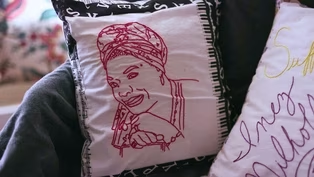
Art in Activism: Redwork Embroidery Suffragist Tea Cozies
Video has Closed Captions
Clip: S9 Ep19 | 6m 33s | Discover the unique art of suffragist tea cozies through redwork embroidery. (6m 33s)

How Nadine Medina Built Troy Dance Factory
Video has Closed Captions
Clip: S9 Ep19 | 9m 58s | Discover the inspiring story behind Troy Dance Factory with owner Nadine Medina. (9m 58s)

The Sugar Hold "City Summer Nights"
Video has Closed Captions
Clip: S9 Ep19 | 3m 20s | See punk rock n' roll band The Sugar Hold perform "City Summer Nights". (3m 20s)

Video has Closed Captions
Clip: S9 Ep19 | 3m 31s | See punk rock n' roll band The Sugar Hold perform "TV Screen" on a TV screen. (3m 31s)

Threads of Expression: Embroidery, Dance & Punk Rock | Preview
Video has Closed Captions
Preview: S9 Ep19 | 30s | Discover redwork embroidery with Tisha Dolton, dance with Nadine Medina & rock with The Sugar Hold. (30s)
Providing Support for PBS.org
Learn Moreabout PBS online sponsorship













Support for PBS provided by:
AHA! A House for Arts is a local public television program presented by WMHT
Support provided by the New York State Council on the Arts (NYSCA), M&T Bank, the Leo Cox Beach Philanthropic Foundation, and is also provided by contributors to the WMHT Venture...