Through His Eyes: WWII Photographer Dick Kent
Through His Eyes: WWII Photographer Dick Kent
Special | 28m 48sVideo has Closed Captions
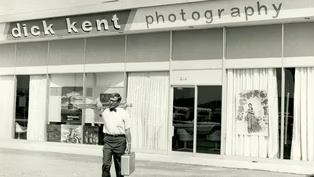
Photographer Dick Kent captured some of the most dramatic moments of WWII.
From the beaches of D-Day to the liberation of Dachau, photographer Dick Kent captured some of the most dramatic moments of WWII before dedicating his career to documenting Albuquerque’s rapid post-war transformation. A COLORES special.
Problems playing video? | Closed Captioning Feedback
Problems playing video? | Closed Captioning Feedback
Through His Eyes: WWII Photographer Dick Kent is a local public television program presented by NMPBS
Through His Eyes: WWII Photographer Dick Kent
Through His Eyes: WWII Photographer Dick Kent
Special | 28m 48sVideo has Closed Captions
From the beaches of D-Day to the liberation of Dachau, photographer Dick Kent captured some of the most dramatic moments of WWII before dedicating his career to documenting Albuquerque’s rapid post-war transformation. A COLORES special.
Problems playing video? | Closed Captioning Feedback
Where to Watch Through His Eyes: WWII Photographer Dick Kent
Through His Eyes: WWII Photographer Dick Kent is available to stream on pbs.org and the PBS app.
>> :The following program contains graphic images of war.
Viewer discretion is advised.
>> :Funding for class was provided in part by New Mexico PBS, Great Southwestern Arts and Education and the Nellita E. Walker Fund for KNME-TV at the Albuquerque Community Foundation McCune Charitable Foundation, New Mexico Arts, a division of the Department of Cultural Affairs, and by the National Endowment for the Arts.
And viewers like you.
>> Jason: There were some very, very ugly things that happened that my father witnessed, heard about, even filmed, but that he never really talked about.
I don't think Dick was ever the same as what he saw there.
How could you be?
>> Faith: Before the war, who was your father and what were his aspirations?
And goals?
>> Guy: He was a young man with some ideals that came from his upbringing in Ohio.
Middle America.
He thought he was probably going to go into the ministry.
He went to Oberlin College, which is a small college in Ohio, and enjoyed learning how big the world was.
He was patriotic in the sense that when the war started, he felt like he needed to join the army.
And so he did enlist.
In his resume, applying to the army.
He indicated some interest in photography, and Colonel Stevens came through looking for photographers to join a special unit that he was forming.
>> Brain: It was called the Stevens Irregulars.
It was a group of 30 men with cameramen, journalists and drivers.
>> Guy: So Dick was called over to interview with Stevens, and Stevens said, what kind of photography do you want to do?
And my dad said, combat.
And so Stevens said, that's just what we're looking for.
>> Faith: Was he aware of the dangers that he was entering into, even just as a photographer?
>> Jason: Probably not fully.
Like many soldiers, he probably had some illusions about what the war would be like.
He wanted to support the effort, and I think he probably believed in the idea of documenting the horror of war and what it meant.
>> Faith: Can you tell me about D-Day?
What happened when Dick crossed over to Normandy?
>> Guy: Our understanding is that George Stevens unit was assigned to a Canadian destroyer called the Algonquin.
They were up all night waiting for the invasion.
In some of the notes.
“Sunrise at 6:53 a.m.” “Landing craft sent at 7 a.m.” They were given flak jackets and things to protect them from the flash of the guns.
Dick, he apparently was on shore making footage, and he was in a hospital on the beach.
And there were German prisoners who were acting or who had volunteered to be orderlies.
And Dick was filming the Germans, and one of them was interested in Dick█s cameras It happened to be a German camera called a contacts.
So Dicken and this German, through an interpreter, were sharing interest in photography, and Dick asked the German soldier to take his picture.
>> Faith: What do you think that this says about how he maybe viewed?
The Germans in the beginning of the war, >> Jason: In these first encounters, I think that he saw some humanity in German prisoners and was sympathetic, maybe because there were a lot of casualties on both sides as the invasion progressed into France, and they were at the front most of the time, and they became more and more familiar with German tactics and so forth.
His outlook hardened a great deal.
>> Brain: As they moved through France.
He was always taking pictures of the citizenry, you know, the people standing on the side of the street.
He had, I think, an affection for the children of the war.
Many of the images that he has were of children and how they survived.
>> Faith: Can you tell me a little bit about the story behind what's going on here?
>> Jason: This is in a bunker that was formerly held by the Germans right in the front line.
And someone mentioned on the way.
Hey, there's a real American Red cross girl in there passing out donuts.
And Dick wrote in his letter that Nancy had had to walk that same path they did in view of the enemy to get into the bunker.
The probably most poignant event that I remember from both letters and notes that I read about this occasion is that one of the GIS said “listen, I understand from people who have made it home that the newsreels are not really showing the worst part of combat that we've been through.
What's wrong with you correspondence that you're not depicting war like it really is at home?” And Dick mentioned feeling somewhat uncomfortable, but he knew that their film footage was being censored.
>> Guy: This is from a letter that Dick wrote home.
“I also told them that we photographers have exposed a lot of film of their end of the war, showing death and pain and GI guts spread across the road, gaping wounds, sacrifice and the price of war.
But it all gets censored out.
The public can't take it.” >> Faith: He and the Irregulars then went on to photograph the liberation of Paris.
What did he experience there?
>> Brain: Everybody was in the streets.
Women were throwing flowers at them.
There was a lot of kissing and hugging and, you know, just a lot of celebration.
Cameramen are filming the street scenes, and then you see people duck behind jeeps.
You see people pull out their rifles, you see people aiming up in the windows.
So you know that there are snipers going on.
>> Jason: I specifically recall Dick mentioning that they had to duck, and that he personally had to duck and take cover from sniper fire.
There were still plenty of Germans in Paris, and it took a while for things to settle down.
>> Guy: When they were proceeding into Paris and then staying in Paris, listening to some of the atrocities that happened.
Dick started to understand just how bad it had been with the German occupation.
>> Jason: This is from a letter October 28th, 1944, that Dick sent to his parents.
“As we crossed France, atrocity stories piled up in my notebook, and as we got closer to Germany, they got worse.
I argued with people that these horrible, inhuman acts were acts of a few poisoned ones, not the German people as a whole.
But they explained to me that the people were responsible, that they cheered to do these things, and that they wanted to be misled by a Kaiser or a Hitler, and mixing with the boys at the front.
The Joes who were really fighting and winning this war taught me many more things.
The Nazis aren't even human beings.
They admit that themselves.” >> Faith: He did a lot of filmin of combat zones.
What did he capture >> Jason: in combat, It included dead Germans.
Dead American soldiers, piles of corpses.
There is a picture of my father running with his camera across a street in Aachen, Germany, where they are actually under fire.
>> Brain: And there was the aftermath of battle.
Of destruction.
>> Jason: And at some point, a lot of movement of refugees.
People who had been displaced before or were displaced by the battles and who had to evacuate and perhaps didn't even have a home or a hometown to go to.
Dachau.
It was a camp that had gas chambers and crematoria, and they were executing thousands and thousands of prisoners.
And Dick and George Stevens and Ken, Martha and their crew were ordered to go there to film what had been found, because it was confirmation of other atrocities that had been rumored.
They found trainloads of dead, largely Jewish people, moved from other camps, with several thousand people in train cars that had been left to die in bitter cold.
They found piles.
Four feet high of dead bodies waiting to be cremated.
Emaciated prisoners.
He did take quite a bit of still photography photos that we were not permitted to look at when we were children.
He also talked generally about the fact that there were Germans who were killed by American soldiers who had surrendered and were no longer a threat to the Americans, but who were executed by Americans because of the atrocities that they had seen.
In addition, there were prisoners who were enabled by some of the Americans to kill some of the German troops that were still there by beating them to death.
I have no doubt that he was horrified by the dehumanization that they had seen there.
>> Guy: In his writings about the the link up at the Elbe River.
Dick wrote, he felt like this link up at the Elbe River finally had cut off the German demon.
There was quite a bit of excitement meeting the Russians.
Dick told a story about being told to cross the Elbe river and do some reconnaissance, looking for some photo opportunities.
And the Russian lieutenant that had charge of the canoes to cross the river insisted that Dick and Ivan Moffatt have a drink before they went across.
And then there was a comment about meeting some Russians on the other side.
And then it was great hugs and and kisses and handshakes and exchange of information.
So it was it was quite a celebration when the Russians met the Americans.
>> Faith: Then they moved on to Berlin.
Can you talk a little bit about what your father photographed there?
>> Jason: A lot of destroyed buildings.
He did make a lot of notes on the reactions of German people as they were going from village to village.
There's one description in his notebooks that I recall of his saying that there was approximately a 24 hour period when it was truck after truck, tank after tank going through the center of this town with Germans looking out of their houses at these nonstop convoys of Americans headed toward Berlin.
And he wrote something like, “what are they thinking?
They must be in shock.” I don't think that he felt sympathy for them at that point.
I think that he was a journalist.
He was observing and wondering.
He did write something to the effect that “we don't acknowledge them.
They don't acknowledge us.” >> Faith: And how did he see the differently afterwards?
And did he still want to be a minister?
>> Guy: He did not want to be a minister.
He realize that a minister is a more passive job.
People come to you versus he needed to go out and tell the stories.
So he was definitely a changed person, but still hopeful for mankind.
He just wanted to help people in a different way.
>> Faith: What brought your father to Albuquerque after the war and what made him want to stay?
>> Guy: Ken Marthy was one of hi in the army in World War Two, and Ken had connections in New Mexico after the war.
Ken invited Dick to come out to New Mexico and check things out.
He was married and so he talked to his wife, our mother, and they decided to come out and set up shop.
He cameout and found a job at KOB-TV initially, and then he started his own business.
He was just always an entrepreneur and liked working for himself and not having to answer to anyone.
And so he struck out on his own and he was a commercial photographer.
He would joke no portraits, weddings or babies.
Those were maybe some of the more difficult side of photography.
And then he just saw it as a way to document New Mexico and what it had to offer.
So I think he had a deep connection with the land and trying to encourage people to come and spend their money here, if you will.
>> Faith: So he would take these aerial photographs to show the transformation of Albuquerque over the years.
Why do you think he chose to photograph the growth of Albuquerque?
>> Jason: I believe that Dick saw photography as a way of recording Albuquerque history.
He was enough of a visionary to be able to realize that time passes and in a dynamic city like Albuquerque was at that time, there are things that will never look the same unless they're recorded photographically.
So, for example, beginning in the late 50s, early 60s, he would take photographs of undeveloped parts of Albuquerque from an airplane.
Sometimes entirely on his own.
>> Faith: I mean, this takes a lot of dedication to go back to some of the same spots to write, because he didn't just take one and then that was it.
He would go back after multiple years.
>> Jason: Absolutely.
>> Faith: Shoot the same spot to show that growth.
Right?
>> Jason: Yes.
>> Brain: He would fly in a plane and and take systemized photographs all the way from east to west, west to east.
And he did this yearly for 15, 20 years.
>> Jason: When the tram and the upper terminal at the tram on the Sandia mountain was being built.
He took photos throughout that construction progress for the people who were developing the tram.
Lots of other things that are no longer able to be seen, but for which there's an historical photographic record that hopefully will be valuable to other people in the future.
That's the long term objective that Dick's work will live on in some fashion and be useful to people.
That's probably the legacy that he would appreciate most if he had to speak about it.
Although he was a humble person and he probably didn't even think about it in personal terms.
>> Faith: So ballooning, he did take a lot of photos of the first balloons that went up here.
Can you talk a little bit about that?
>> Guy: Well, a little bit of a visionary in that he he saw some value in promoting ballooning in New Mexico.
This was a picture over the Atlantic Ocean of Double Eagle two.
After it had launched the night before, it's got Larry Newman's hang glider hanging underneath it.
Dick flew out on an airplane to find the balloon and got some dramatic pictures.
This was an example of Dick's dedication to the hobby and helping Maxie and Ben and Larry have some record.
>> Brain: The Kitty Hawk launched from San Francisco and was flying over the Sierra Nevadas, and he and several other photographers rented a plane to to get pictures of the balloon as it flew over the Sierra Nevada's.
And my dad said that here, these other photographers had these cameras that were taking 75 pictures a second, and Dickie Bird was here with his four by five camera, pulling out the side and taking a picture.
And and National Geographic selected his photographs out of all the other photographers in the plane.
>> Faith: What do you think he loved most about photography?
>> Jason: In his own words, he said, “I like to create an emotional feeling in a person.
I sometimes think of myself as a kind of an artist.” He really did get satisfaction out of feeling that a photo that he had taken had some impact on a person, emotionally, or in terms of their knowledge or understanding and appreciation of things like nature or history.
>> Guy: He kind of had the best of both worlds.
He was employed and got to participate in something that he enjoyed.
And that's how you end up over a career with over 100,000 images.
>> Faith: When you look at his Albuquerque photographs.
Do you believe any of his wartime experience as a photographer colored those photographs?
>> Jason: This is a guess because I don't know.
But Dick was always very sympathetic to what he considered other people's difficulties and the human condition.
Some of it was natural just who he was, but some of it had to have been related to what he saw in World War Two.
In my opinion, there was something empathetic about him that was natural, but it was influenced by the war in which also impacted the way that he viewed what he saw in New Mexico and maybe what captured his own personal interest more.
There was a time when he was hospitalized and almost died, and we didn't see him for almost 30 days because he was in intensive care.
I got to see him for the first time, and they allowed family other than my mother to go in and see him, and he was able to talk, and I said, “what's the meaning of it, dad?
What what's the meaning of all this life” knowing that he'd been through so much?
And he said, these were his words, and he was kind of struggling and a little bit.
And he said, “to learn, to be happy and to do something for the common good.” That's the natural Dick Kent.
And he was consistent his whole life during the time we knew him that way.
Through His Eyes: WWII Photographer Dick Kent Preview
Photographer Dick Kent captured some of the most dramatic moments of WWII. (30s)
Providing Support for PBS.org
Learn Moreabout PBS online sponsorship
- Arts and Music

Innovative musicians from every genre perform live in the longest-running music series.
 New Episode
- Arts and Music

Intimate portraits of six of the most influential and celebrated classical music artists.
 New Episode








 New Episode
 New Episode
Support for PBS provided by:
Through His Eyes: WWII Photographer Dick Kent is a local public television program presented by NMPBS