
Through New Eyes
Season 10 Episode 7 | 26m 47sVideo has Closed Captions
Art, history and culture come to life through a Pittsboro mural and Raleigh street photography.
Fresh perspectives bring new life to art, history and culture in North Carolina’s downtowns. In Pittsboro, artist Thomas Begley lovingly restores an iconic mural by visionary folk artist Clyde Jones. Plus, on Raleigh’s Capital Boulevard, photographer Ben Harris documents everyday life, finding beauty in unexpected places.
Problems playing video? | Closed Captioning Feedback
Problems playing video? | Closed Captioning Feedback
My Home, NC is a local public television program presented by PBS NC
Through New Eyes
Season 10 Episode 7 | 26m 47sVideo has Closed Captions
Fresh perspectives bring new life to art, history and culture in North Carolina’s downtowns. In Pittsboro, artist Thomas Begley lovingly restores an iconic mural by visionary folk artist Clyde Jones. Plus, on Raleigh’s Capital Boulevard, photographer Ben Harris documents everyday life, finding beauty in unexpected places.
Problems playing video? | Closed Captioning Feedback
How to Watch My Home, NC
My Home, NC is available to stream on pbs.org and the free PBS App, available on iPhone, Apple TV, Android TV, Android smartphones, Amazon Fire TV, Amazon Fire Tablet, Roku, Samsung Smart TV, and Vizio.
Watch My Home, NC on YouTube
Enjoy a unique look at the food, music, people and culture that make North Carolina our home on the My Home, NC YouTube channel.Providing Support for PBS.org
Learn Moreabout PBS online sponsorship[bright guitar music] - [Heather] I'm Heather Burgiss, and for 10 years "My Home NC" has traveled the state, sharing the stories that make North Carolina home.
What keeps you coming back out here after really bad days?
- The feeling that I get when I accomplish.
That feeling is absolutely so rewarding.
- [Interviewee] Each one of my pieces have a certain narrative.
There's some sort of story.
But I'm not so specific as like, "This is what this means."
- [Heather] So join us as we honor the past, celebrate the present, and turn the page on the next chapter of "My Home NC."
[light upbeat music] [bright music] Legacies aren't just remembered, they're carried forward.
From restoring a Clyde Jones mural.
- Thomas has been able to go in and actually find the original brush strokes on that penguin and bring the thing back to life.
- [Heather] To preserving generational craftsmanship.
We explore how art, history, and culture live on through keeping them alive.
It's all on "My Home."
Coming up next.
[lively bright music] [bright music] All across the state, we are uncovering the unique stories that make North Carolina my home.
♪ Come home ♪ ♪ Come home ♪ [gentle lively music] - I think there are some people for whom art is this oceanic force that you can't resist, that kind of exuberant excess of just making things all day, every day.
It's a beautiful impulse.
- Okay, go.
- [Interviewer] What's it like to be Clyde Jones?
- Well, it's not being yourself, there's no you can put smiles on little youngins' minds.
- The more that I learned about Clyde, it seems like that's very true for him.
It seems like he just had to make stuff.
He just had to make stuff, and he made so much stuff.
The Clyde Jones mural is a huge field of sky blue and there are creatures all over it.
The mural and I are the same age.
We came into the world in 1996.
It's exciting to think about like what Pittsburgh was like then and what was I doing at that particular time.
This is my first restoration project.
I'm trying to make decisions in the restoration that honor the choices he made originally.
It feels like a real privilege.
It feels like an honor to be able to work on this project that's part of a legacy and part of a heritage.
My name is Thomas.
I've been really lucky to get to know the legacy of people like Clyde Jones who have made Pittsburgh a place of creativity.
I grew up in Vermont.
I moved on here about five years ago.
And I was on Google Maps all the time and I saw that there was something called the Clyde Jones' Critter Crossing in Bynum, North Carolina.
A month or so later, I happened to be in the area and I said I should drive by.
It's Clyde's house, and he has painted the whole thing with his critters, and the whole front yard is filled with these animals, these beautiful animals made out of found objects and wood that he's painted.
[bright music] [dog barking] - If you were to go around the neighborhood here, you know you'll see that pretty much every yard has a critter in it.
As I understand it, it was after a logging accident that crushed his leg.
- I have a broken leg with cast on it.
Seeing nature and woods, walking through the woods, seeing nature and trees, and [indistinct] says, "I'm freeing from the wood to nature."
- So using his chainsaw and hammers and nails, he started making the critter.
He wanted to bring them to life.
My name is Stephan Meyers.
I am an artist, musician, and handyman and longtime friend of Clyde Jones.
Many know him simply for the wooden critters, but he's been painting for just as long.
- Stephan has worked in plaster restoration.
And so he really understands the kind of care you have to take when you are trying to restore something that was a work of art in its own right.
- I have an understanding of substrates and consolidation and just, you know, different processes.
So I made recommendations like that to say, "Hey, you know, from my experience, these are some things that you can try or these are some things you can consider."
- I've been working on the restoration project for about four months.
The first thing I did was I put like an isolation layer on the wall.
So it's a clear coat of polyacrylic just to protect the original artwork.
- We had no idea that it would lead to this.
We had no idea that we'd be doing a restoration 30 years later.
My name's Lyle, and I am one of the co-owners of the plant and I am a distiller over at the Fair Game Beverage Company.
- Lyle and Tammy Estill were running a company in a building Downtown Pittsboro.
They had a big blank wall and they wanted Clyde to decorate it.
- Tammy and I commissioned Clyde to do a mural on the side of our software business in Downtown Pittsboro.
Clyde was a buddy of mine.
He would come down.
He said, "Look at this big ugly wall.
Like, it's just a big brick wall.
Why don't you do a mural on it?"
I was like, "We could do that."
I didn't know what I was doing.
I got it primed and ready to go.
And then, whammo, Clyde is up on a ladder painting penguins on the wall.
And there's news crews from all over the state coming to cover it, and Clyde Jones, famous outsider artist, does mural in Pittsburgh.
- It is the largest such public work that Clyde has been involved with that still exists.
- It faded in the elements and the sun and it was vandalized, and they painted over it.
I thought, let's restore that mural.
And Thomas has been able to go in and actually find the original brush strokes on that penguin and bring the thing back to life.
- [Thomas] This is one of the film photos.
Clyde's Paint was so, like, thick, I was able to follow the lines of his paintbrush through these like layers of graffiti and whitewash to sort of pull the original design back into focus, which is really exciting.
It's like these creatures were lying dormant for a while, and now they get to kind of be out and about again, which is really exciting.
- I've got a lot to learn myself.
- [Interviewer] And what's it like having all these people coming in and tramping through your yard all the time?
- That makes me want to do it better.
- I think what Clyde finds important about art is how it brings folks together.
- A lot of the things that we're down on ground level we're painted by community members.
And so you can see a lot of different hands at work.
He was focused on making it clear that art was something for everybody that everybody should be doing.
There's a kind of like improvisatory freedom to it that I think is really alive.
What I'm working on today is a group scene from a photograph that was taken the day the mural was painted.
There's a really wonderful photograph of everybody at the end of the day in front of their work holding up their paintbrushes, and then a portrait of Clyde on the end.
Today I'm moving on to adding some more dimension and details and giving them a little life.
- Thomas is smart and clear and talented, and he impressed me.
Hey, Thomas.
- Nice to see you, Lyle.
- How you doing, man?
- Doing all right.
And you?
- Good.
- Should we go... - The plant was my biodiesel plant.
It was built in '86.
It closed in '96.
We've transformed this place into a food and beverage destination.
You know, you come here on a Saturday, it's bands and dancing.
And Thomas walked into the Fair Game Beverage Company one day.
"Hi, my name's Thomas.
I wanna do a mural at the plant."
And I literally am like, "Do you now, like, some kid from Vermont?"
It's like, "Wow."
I guess I admired his spunk.
- This mural behind me is one that I did.
It's here at the plant, which is just a little bit outside of Downtown Pittsboro.
The design was a collaboration with Lyle.
I've been coming to the plant since I moved here.
There's live music, there's a lot of dancing, there's good food, there's good drinks.
I wanted whatever I painted to be sort of an extension of that feeling of like people having fun and dancing together.
I love to dance, so I knew I wanted to paint these big dancing figures.
Lyle suggested bugs.
I did a lot of research to figure out what insects would be good dancers, and I painted this little music and dance scene.
[bright music] The way contra works is you have the band who's providing the music, and then you have a caller who's someone on the mic instructing you through the dance.
I have a tendency to be a little shy sometimes, but having this very prescribed way of engaging with other people in this way that allowed me to feel really close to them was really exciting for me, and I made a lot of wonderful friends.
- We've got a guest caller coming up to the stage.
[crowd cheering] Yeah.
- That's great.
How long do you run the dances for?
- Eight or nine minutes.
Yeah.
- All right, find yourself a partner.
Folks, can we get a round of applause for this amazing band, Playing with Fire?
Can you believe this music?
[crowd cheering] And while you're at it, Terry Doyle, what a caller, I don't know if y'all can see it, but while you folks are dancing, Terry is up here clogging like you would not believe.
I've never seen somebody make noises like that with their feet.
Unbelievable.
I'm very new to calling contra dances.
I was just hooked.
[bright music] Balance the ring and California toro.
Balance the ring and California toro.
Neighbor, balance and swing.
Watching a good caller respond to a mistake, address it, take responsibility, and then move on sort of peacefully and joyfully, it brings an energy that encourages a kind of playfulness and experimentation that's, I think, really important.
[crowd cheering] Thank you so much.
Thank you very much.
Because so much of making anything, especially making visual art is you're addressing problems.
You're encountering these roadblocks.
Oh, I just remember something amazing, which is that I'm really struggling with these, with a particular pair of legs, but I remembered that the reason that they don't look that good is because there's gonna be somebody in front of those legs, which is kind of ideal.
Okay, that's huge.
That's huge for me.
You have to kind of move with a kind of lightness that makes it possible to reach the end of a project and enjoy it while you're doing it.
'Cause if you're not enjoying it, like, why are you doing it, you know?
Particularly with the work this big, it's easy to get caught up in little details.
When I was retouching certain areas and I was trying to follow lines very precisely, they didn't look as alive as the mural looked in the original photographs.
There wasn't that kind of exuberance, that explosion of color and all of these creatures against this beautiful blue sky that kind of goes out into infinity.
Instead, what I have been trying to do is mimic the process as much as possible.
It feels a lot like handwriting to be able to see like the way people move a brush.
And it helped a lot in trying to maintain the character.
It looked more like the original painting when I was just like letting the spirit move me as it were.
From what I know of Clyde, I think he would approve.
- Clyde is, you know, essentially in hospice, and I know that Clyde knows that it's underway and I would love to do a ribbon cutting that Clyde could at tend, so that he could see his masterpiece living on.
- [Interviewer] What do you decide to paint or... - Just whatever this head says.
That's all I can tell you.
- [Host] We wanted to celebrate today our iconic legend, the man.
It's his birthday.
- Let's all give a hand for Clyde.
[crowd cheering and applauding] - It really meant a lot to me that we were able to get this project done and that Clyde was able to be here for its unveiling.
It's exciting in some way to be sort of like collaborating with him across this time span.
- Let's do it.
- When we were about to cut the ribbon, someone said, "One of the kids is here."
- Wait, a kid from 30 years ago?
[gasps] No way.
- Oh.
[crowd applauding] - Do you wanna say a word?
- Say something please.
- My name is Rivers Caraganis, and I grew up in Pittsboro, and Clyde has always been one of my heroes and inspired me- We were a bunch of kids with all the time in the world just roaming around a small town, maybe back to a generation where things were a little bit simpler and, you know, a can of paint was a big deal.
It still gets me excited right now to think about it.
I painted these beautiful tropical fish.
Ta-da!
- [Thomas] And then Elaine was here.
She had brought her daughter.
- I painted that funny little eagle that's attacking the dinosaur.
I think it's fabulous to have this in Pittsboro for people to see, hopefully, generations to come.
- There you go.
- All right.
[crowd cheering and applauding] - It felt like a real legacy.
Like, there was this real unity.
I had a part in this process, but Stephan was orchestrating this.
Both Lyle and Tammy were really driving this project forward.
I worked really hard, but also I was really welcomed by people who gave me an opportunity to be part of this.
I love having friends who are in different generations.
Folk traditions are ways of kind of bridging social gaps, allowing us to address our loneliness in a really powerful way.
[gentle bright music] [gentle contemplative music] - Every city has a Capital Boulevard.
It's a street where capitalism has just gone amuck.
There's no regulations as far as what kind of signs you can have, how many billboards you can have half.
For a photographer, that's great because it makes things very interesting and there's a lot to see.
But I think a lot of people in Raleigh see it as a very ugly place.
They see it through the car window.
They don't see it walking around like I do.
I'm Ben.
I'm a father of two girls and professional graphic designer by day.
So the One Street City project is kind of my effort to try and find beauty in unexpected places.
Everyone's had that experience of going on a trip somewhere and then coming home and seeing your home with fresh eyes.
That's the feeling that I want people to get from these photos.
But by extension, make people realize that their life is full of those things that can be new if they just kinda like stop and look around.
My interest in photography started pretty young.
I was always interested in art, but I never really took it seriously as like a profession or something that I could do to kind of express myself in any kinda way or express an idea, really, until this project.
This was the first time, really, that I kind of took it seriously.
I grew up in Buffalo, New York, which is a very kind of industrial town.
It also has like a beautiful patina to it.
You know, all those beautiful Victorian houses and everything have like this ivy growing up, and it's just like there's a growth and there's like this mix of beautiful manmade structures and sort of nature of trying to take them back.
And I think that helped shape the way I look at the world in a lot of ways.
That's maybe one of the reasons why we settled on this area of Raleigh, Capital Boulevard, because I think that it feels a little bit like home.
I think what's interesting is, if you look at old photos, we notice things about details about them that like the people that lived then did not notice.
Old pictures of cars or old pictures of houses or telephones or anything.
You look at a movie from 10 years ago, and the cell phones look weird.
So that's also the kind of thing I'm trying to capture with Capitol Boulevard, is like a moment in time.
I'm not looking for landmarks or things that normally draw people's attention.
Usually, I'm looking for like everyday objects like dumpsters and telephone poles and billboards and things that people anywhere can relate to.
If you ask right now what the project's about, I think it's about like humanity overcoming sort of like commercialism and this idea that's kind of permeating our society, that everything's about making a profit.
Which on the surface of level, that's what Capital Boulevard is.
It's all commercial businesses selling the wares, right?
But I think that there's a human story to tell and there's the story of people.
And even though I don't have people in my photos, their fingerprints are there on the photos.
This tree is like, I love it.
I've shot it a bunch of times, and I just think it's so symbolic of like persistence and refusing to quit.
And I think that that there's so much going against it, it's just going directly out of pavement.
It's kinda like this like symbol of victory.
It won against all odds, and I just think that's such a beautiful thing and a little bit representative.
So maybe perhaps the people that work and live on Capitol Boulevard as well, because a lot of these people, they're dealing with things, and I think that this tree is kind of a beautiful symbol of that.
So... [gentle solemn music] This project came out of a really dark period for me.
In 2019, I was laid off from a job that I had for a long time, and it kind of just like turned my world upside down a little bit.
Then a year later after I was laid off, I was diagnosed with lymphoma.
It was actually a relapse.
I had had it previously in 2016.
Thought it was gone.
Came back in 2020 even worse.
Tumors through my abdomen and my armpits and my neck and everything.
And it was devastating.
And, you know, at that point, a relapse is more serious than an initial diagnosis because you've already tried to treat it.
And so now you're thinking like, this is a persistent cancer.
The genesis of this project came from that.
I was in this dark place.
I was very introspective.
I was thinking about my life.
I was thinking about what kind of legacy I'm gonna leave for my kids.
I didn't want 'em to remember me as a guy who just designs a bunch of logos.
I wanted them to think of me as a guy who tells a story.
And I...
But I had to pick one project just to focus on, and that was this project.
[birds chirping] I read somewhere that, you know, going for walks after you get chemo was good for you because it would help kind of spread the chemotherapy throughout your lymphatic system.
And so I would deliberately go for like four mile walks after my chemo and I'd bring my camera with me.
And so it was actually, it was almost like a curative, as well as mentally, as well as physically.
So when I'd go for these walks, I'd be tired and I'd be exhausted.
In fact, I have one self portrait I took on Capitol Boulevard where it was the day I got chemo and I looked tired and sweaty.
But I love the picture because it shows resilience too, you know?
These two are two of the first photos I took for this project.
This was before the project was called One Street City.
This was at like six in the morning.
I was going down the street and I was just trying to clear my head after a stressful night's sleep.
I couldn't sleep, so I went down here and took my camera with me and just decided to just try and take some photos.
Because there was so much going through my head at this moment.
This felt very relaxing to me.
And I think it comes through in the photo.
It feels like you can almost hear the birds chirping, you know?
I think it's a very relaxed photo.
And yeah, so this was the start of my therapy.
[birds chirping] [dog barking] I'm currently in remission.
I've completed treatment in 2023.
It was a six months of chemo and then two years of immunotherapy.
And I'm getting my port removed this summer.
I like to think I'm better than ever right now.
You know, I'm healthier than I've ever been and I think that mentally, I'm in a really great place.
I don't think when I set out to do this project, I really thought I would find an audience, but it did, to my surprise.
And I think most artists will tell you like, when you start making a piece of art, artwork of art, you don't have a complete picture in your mind of what it's gonna be.
I don't think I have a full understanding of why I do it, so I'm here trying to explain it to you.
But I think even myself, I don't have a full understanding.
I'm learning from other people's interpretations of it.
My wife, Sarah, will say things about it and I'm like, "That's a really great point.
I never thought of that."
Maybe part of this project is a self-portrait in a way.
Maybe the reason I resonate with these subjects is because I've been through some things, and I'm still here.
[bright music] - Join us as we celebrate 10 years of "My Home."
As we look back at some of our most iconic stories and where they are now.
Probably one of the most unique stories we've ever told is "The Land of Oz."
It is really a cult favorite.
It is almost like a abandoned amusement park.
And it's one of those things where you are just kind of captivated by what was, and there's still the yellow brick road, there's still the trees from the forest.
They invite folks to come in and dress up and be able to be transported back to those 1970s, '80s when the park was open.
Well, good morning and welcome to Oz.
Are you ready to follow the Yellow Brick Road?
And so we went into the story of Grover Robbins who created the park.
He was also one of the creators of Tweetsie Railroad.
So Grover really had a vision for what he wanted to do up there and to bring folks to the mountain and to have an experience that was really once in a lifetime.
They would have folks play Dorothy, folks play the Wicked Witch.
So really kind of immersing folks in what was back in that day.
I think what was really surprising was just watching the characters, you know, that were dressed up, that were taking everyone on tours.
They were so passionate and they were really in their character, and they would not break.
As mayor of the Munchkin City, I wish to welcome you most really.
- I think "The Land of Oz" story is one of those great examples of why we love to tell the hidden stories and the hidden history across North Carolina.
It's like a little gem that not everyone knows about or maybe they've heard about it, but seeing it present day and just bringing out that nook and cranny to a wider audience is always something that we relish doing in our storytelling.
We love to tell stories of legends and culture and these hidden jewels that not everyone gets to see every day.
So if you ever get the chance to go see this little bit of hidden North Carolina history, you really should.
Just follow the yellow brick road.
Yeah, I went there, I did.
[bright music] [bright music continues] [bright music continues] [bright music continues] [bright music continues] [bright music continues]
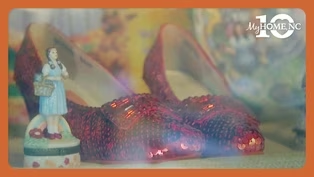
Land of Oz | 10 Years of My Home, NC
Video has Closed Captions
Preview: S10 Ep7 | 1m 57s | We revisit our story on the Land of Oz, a hidden piece of NC history tucked away on Beech Mountain. (1m 57s)
Video has Closed Captions
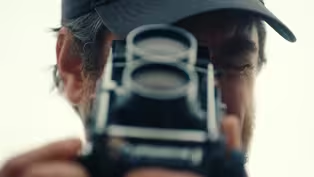
Preview: S10 Ep7 | 30s | Art, history and culture come to life through a Pittsboro mural and Raleigh street photography. (30s)
Providing Support for PBS.org
Learn Moreabout PBS online sponsorship












Support for PBS provided by:
My Home, NC is a local public television program presented by PBS NC