
Thurgood in New Center Park/Cranbrook Academy of Art
Season 5 Episode 27 | 26m 46sVideo has Closed Captions
Thurgood in New Center Park/Cranbrook Academy of Art | Episode 527
Detroit Public Theatre pays homage to the first African-American justice to serve on the Supreme Court of the United States, Thurgood Marshall. Gabriel Duran’s smooth R&B/Pop music is inspired by the culture and people of Southwest Detroit. And a closer look at the impact Cranbrook Academy of Art has on the world of design, art and architecture. Episode 527
Problems playing video? | Closed Captioning Feedback
Problems playing video? | Closed Captioning Feedback
One Detroit is a local public television program presented by Detroit PBS
Thurgood in New Center Park/Cranbrook Academy of Art
Season 5 Episode 27 | 26m 46sVideo has Closed Captions
Detroit Public Theatre pays homage to the first African-American justice to serve on the Supreme Court of the United States, Thurgood Marshall. Gabriel Duran’s smooth R&B/Pop music is inspired by the culture and people of Southwest Detroit. And a closer look at the impact Cranbrook Academy of Art has on the world of design, art and architecture. Episode 527
Problems playing video? | Closed Captioning Feedback
How to Watch One Detroit
One Detroit is available to stream on pbs.org and the free PBS App, available on iPhone, Apple TV, Android TV, Android smartphones, Amazon Fire TV, Amazon Fire Tablet, Roku, Samsung Smart TV, and Vizio.
Providing Support for PBS.org
Learn Moreabout PBS online sponsorship- Hi, I'm Christy McDonald, and here's what's coming up this week on One Detroit Arts and Culture.
Detroit Public Theater pays homage to the first African-American justice to serve on the Supreme court.
Plus explore the new music from Detroit's own Gabriel Duran.
Then head to Cranbrook for an exhibit celebrating art alumni from around the world.
It's all just ahead on One Detroit Arts and Culture.
- [Narrator] From Delta faucets to Behr paint, Masco corporation is proud to deliver products that enhance the way consumers all over the world experience and enjoy their living spaces.
Masco, serving Michigan communities since 1929.
- [Narrator] Support for this program is provided by the Cynthia & Edsel Ford Fund for Journalism at Detroit Public TV.
The Kresge Foundation; Community Foundation for Southeast Michigan.
- [Narrator] The DTE Foundation is a proud sponsor of Detroit Public TV; among the state's largest foundations, committed to Michigan focused giving.
We support organizations that are doing exceptional work in our state; visit: DTEFoundation.com to learn more.
- [Narrator] Business Leaders for Michigan dedicate to making Michigan a top 10 state for jobs, personal income, and a healthy economy.
Also brought to you by the Fred A. and Barbara M. Erb Family Foundation and viewers like you.
(upbeat music) - Hi there, and welcome to One Detroit Arts and Culture.
I'm Christy McDonald, Thanks so much for being with me.
The creative community in Metro Detroit keeps changing things up to continue thriving during the pandemic.
Performances outdoors, virtual art exhibitions, and more, all help fill the need for arts and culture here in Detroit.
That's why we created this show to keep you in touch with performances, music, art and events that we love to engage with.
Coming up on this weeks show, we take you to one of those outdoor performances.
Detroit public theater presents Thurgood in new center parks plus Gabriel Duran channels, the culture of Southwest Detroit in his pop music.
And then some of the world's leading artists, architects and designers study right here in Metro Detroit.
We head to the Cranbrook academy of arts to an exhibit celebrating some of their most famous alumni.
It's all coming up on one Detroit arts and culture.
Detroit public theater is working on innovative ways to keep patrons safe, while producing thought provoking shows.
So they decided to take the theater outside to new center park this month with Thurgood, it's a one man show that tells the story of justice Thurgood Marshall.
The first African-American man to serve on the US Supreme court.
I was able to talk with the director of Thurgood, Steve Broadnax III, and one of the Detroit public theater, artistic directors, Sarah Clare Corporandy.
- Here at Howard university we were taught one simple idea.
The law is a weapon.
If you know how to use it.
- I think what the most exciting thing I can say is live theater is back.
Sarah Clarence has gotta be an amazing feeling.
Really.
- It is an amazing feeling.
It's a little bit surreal to know that we're back and get back in the swing of things and then greet our audiences.
But boy, that first night welcoming people back was so incredibly special.
And every night after.
- Steve, the theater nourishes all of our souls and to be able to experience it in a community setting has got to be wonderful for you to step back in as a director.
- Oh absolutely.
You know what I mean?
It'll get the opportunity.
And especially the year that we've been through to give the opportunity and with community gathered together and tell stories in such a story and so it's a pleasure to get back and do theater and not only just theater, but Thurgood specifically.
- All right, we're going to talk about the show, but Sarah Clare, walk me through what some of the decision-making was to be able to do this and do it out in a, in a live setting outside.
- There's just like a lot of investigating about where people are comfortable, what our unions are saying, what the guidelines are saying.
And it's a lot of juggling and a lot of people being flexible and nimble to pivot.
And then we were able to make this decision to transfer this show from Chautauqua theater company to Detroit, pretty quickly with a homegrown Detroit artists, Brian Maribel, who is phenomenal.
You've seen him across Detroit on many stages for a lot, for many years, but be able to sort of bring that back to partner with Midtown Detroit, Inc on this beautiful venue outside.
So we all feel safe and taken care of the weather is just right.
And so just nimble, nimble, nimble.
- Oh yes.
Constantly, constantly changing.
Steve, talk to me about the show.
It's a one man show, which is so, so difficult for an artist and an actor to be able to carry that energy through, but really the subject matter of Thurgood Marshall, the first African-American US Supreme court justice, and being able to tell that story, talk me through some of the decisions that you had to make through the direction process and really bringing this to life here in Detroit.
- Growing up in school, I have to admit, I had very minimal education about Thurgood.
I knew he was on the Supreme court.
And I think that was the extent of my knowledge that I gained.
So being able to go back and understanding him, really being Mr. Godfather of civil rights and how the law was the weapon that he used to change things.
It was very important.
So it was a lot of research, which I love to do, and to have such, more admiration for Thurgood now.
And it was a pleasure as well to get this information out to people who may not have known as much as him as I think we should.
- Real quick on that.
Steve is such an amazing inspiration by the way, and having him in the room and in the city, being able to bring him to Detroit.
This is not the first time we've brought him.
He just brings joy, compassion, humility, and just a great love of the art.
And to bring him on this, this ground is important for DPT and for this city to have him here.
- You know, Steve, when I sit and I watch a theater production, I always get this feeling of where the first line of the show, it's emotional, I tear up and it doesn't matter what show it is.
It's just being present.
I think in the moment when you hear those first lines and that energy of that, oh, what's it going to be?
Is there a moment in the show?
Is there a line as something that you can bring to us that really has that moment for you?
- I keep a lot of lines, but the top of line.
I think the law is a weapon if you know how to use it.
And he says that it is, you know, it takes place at his Alma mater at Howard university.
And he's basically giving a lecture to a group of students.
A group of people who've come to see him toward the end of his career.
And he is really educating that we have the power, he's basically passing the baton and saying, we too can make our, can push forward change.
- You know I learned something lately.
One person can make a difference.
- And we get to see him as a human being, not just a statue, not just a historical photo, but we get to see the man who had fears had insecurities, but at the same time was able to do something great.
And that's what I would like to people to leave away with.
And he should inspire us that we also can do something great.
- What is the next step for DPT?
- We are moving into a brand new space really soon in 2022.
We have more programming coming up this year that we'll be announcing soon.
And then a full season in 22, 23 in our brand new home where we were so excited to welcome all of Detroiters.
- And Steve, I'm going to give you the last word.
What would you say that we should look forward to.
- Look forward to more stories, more diverse stories?
I think we cannot go back.
I think learning from this year, our humanity, that's one thing I think COVID did, was bring us together and all, you know, class, race, gender, all of us were affected.
And so I say, moving forward, we're moving forward to a new theater that is inclusive, that tells all of our stories and unites us together.
So I look forward to that and I would tell people to look for and tell your story, it too is important.
- It doesn't get better, but in the power of reflecting people and their audience and their stories is just what you talked about growing more and more and, and helping people understand so much better where we are in the world and taking the blinders off.
I salute both of you and thank you so much for the time.
And we're very excited for this.
- At five o'clock, June 25th, 1935, we're called back into the courtroom.
Judge Eugene O'Dunn slams his gavel down and orders the University of Maryland to admit Donald Gaines Murray into his law school.
You see Charlie Houston was right.
The law is a weapon.
- And for more on what Detroit public theater has in store, just head to our website@onedetroitpbs.org.
All right, let's head to Southwest Detroit where singer songwriter, Gabriel Duran is performing.
Some of his new music.
Will Glover talked with Gabriel about the inspiration behind the songs and the first Southwest Fest that he helped organize the free festival put on 32 performances, over three stages, highlighting local Detroit artists.
♪ It's five past two ♪ I probably should be spending all this time with you ♪ ♪ I really should have focused on the things I knew ♪ ♪ Reminiscing on the way your body moves ♪ ♪ It's funny how it's all the same ♪ ♪ I love it when you call my name ♪ ♪ Tell me hold it down like this ♪ (Music fades out) - Gabriel, tell me where you're from, what it was like growing up there and how that has, you know, been a part of your music, how it influences your music.
- I grew up in Southwest Detroit and growing up in south west.
I feel like it's a very unique experience.
And obviously, you know, a little bit of bias because I'm from here, but we, it does feel like Southwest is its own city right next to downtown.
That is just like a whole, it feels like it's another experience being that we're such a diverse neighborhood.
There are people from all over from Mexico, Puerto Rico, the Dominican Republic.
Now we have like white folk.
We got black folk in the neighborhood too.
It just feels like a nice melting pot.
And as very strong knit community.
It was, I don't know, I look back on my childhood, growing up in Southwest was just like, it was pleasant.
It was really nice, you know.
We have Clark park in the center of our neighborhood.
There's always events happening in our neighborhood.
So you get to witness your culture as you grow up.
And like I said, it's a strong knit community.
So you feel really close to your neighbors.
You feel really close to your community.
♪ I've been on the same roads ♪ Now you lookin' jaded cause you stay cold ♪ ♪ Ain't nobody checkin' for you ♪ ♪ Not unless I say so, that's simple ♪ ♪ And I move in silence with my kinfolk ♪ ♪ I ain't stoppin' till I see my brothers on a payroll ♪ ♪ And they know ♪ That she wanna tell me something ♪ ♪ Probably best if I don't Say Nothin' ♪ ♪ Pull up deep to the last few functions ♪ ♪ Hate to see me on a high - What was the moment for you where you were like, you know what, I can, I can do this.
I want to take a real shot at, at music.
What, what was that moment for you?
- I think it came around, so I used to be a part, a hip hop collective that started in my neighborhood.
It was called, we called ourselves awkward theory.
It was a, like a hip hop collective that wanted to focus on using live instrumentation.
And that was back when I was like 16, 17.
And I think that was really the moment where I realized that this was not only what I really wanted to do, but something that was realistic, even put out our debut album.
And it did really well within the neighborhood.
It was cool.
Cause like a lot of people like knew our songs.
Like they'd show up to the shows and like they'd be singing our songs, you know?
And not only that, but they were also like supporting too, which is the big thing.
Because like you said, like a lot of people think it's like, oh, you got a cool song, you hit somebody up, you do a show and your life is just like this magical journey with, you know, like being, not like the center of attention, but like being in the spotlight for that moment.
Right.
But they don't, what they don't see is like the, you know, the shows where people might not support.
♪ I can't stay focused ♪ This is all so much for me to do this way ♪ ♪ Cause I don't wanna talk unless its about me and you ♪ - What motivates you to continue to try and carve out this space for yourself.
- My muse, what keeps me going, I guess at the end of the day is knowing that if I'm able to, like the further along I get on this journey, the more likely it is that I can open doors for others that might want to take the same path.
And that's something that's huge for me.
And not only with just music and in general, I think it's really important to make sure that anybody with a platform, no matter how, you know, if it's a platform that is just starting or a platform that's, you know, 15 years along, it's important to make sure that they're opening doors for the next generation to make sure that that community is evolving.
♪ I take it to the night where we first met ♪ ♪ to the look inside your eyes when I first said ♪ ♪ Comment tu t'appelles?
o Como tu te llamas?
♪ ♪ Brown skin, slim thick, with Adidas on her, yeah ♪ ♪ But its gotta be the walk for me ♪ ♪ Acting like she never gon' talk to me no ♪ Cause' you not tryna leave alone I know exactly what you want from me - What does success look like to you?
- Yeah.
Our success to me honestly, is, you know, just making a living off of what I'm passionate about and that, you know, that could be music that could be community work.
The two of them, like I said, I'm hoping that I'm able to kind of like mix the two and, and achieve both at the same time.
But yeah, success would really just be making sure that I'm able to take care of myself and I'm able to take care of that next generation after.
♪ Something tells me you might bring me hell ♪ ♪ But baby girl I want you to myself ♪ ♪ Something tells me you gon' kiss and tell ♪ - And so give me a, give me the handles.
Where do you want people to go to click like and subscribe and give you all that, that fan love?
- Well, it's just @gabrielxduran on all platforms.
So you can find me everywhere.
This is just @gabrielxduran is going to be the same for Twitter, Instagram, Facebook, and my YouTube channel also.
And on all platforms, just Gabriel Duran.
♪ I've been on the same roads ♪ Now you lookin' jaded cause you stay cold ♪ ♪ Ain't nobody checkin' for you ♪ ♪ Not unless I say so, that's simple ♪ ♪ And I move in silence with my kinfolk ♪ ♪ I ain't stoppin' till I see my brothers on a payroll ♪ ♪ And they know ♪ That she wanna tell me something ♪ ♪ Probably best if I don't Say Nothin' ♪ ♪ Pull up deep to the last few functions ♪ (Music fades out) - And for more info on the South West Fest and Duran's album "Wish you Well", just go to our website.
onedetroitpbs.org All right.
Let's head to Cranbrook Academy of Art and take a closer look at the impact the school has on the world of design, art and architecture.
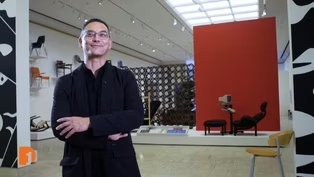
A recent exhibit called "With Eyes Opened" celebrated the work from alumni over the past 90 years.
- [Narrator] Banglatown, east side, Detroit over by Hamtramck Artist Chris Schanck has a studio here.
He's been working in the city for the past decade.
- You can't blame a student for wanting to go to the west or east coast seeking, seeking more opportunity.
But I had spent 14 years in New York.
I had a decent understanding of how the cosmopolitan city worked and, and a good grasp of art history.
What I needed was time alone to grow.
- [Narrator] Schanck came to Michigan to the Cranbrook Academy of Art, which led to this works made from styrofoam, oil, and a team to make them.
- The point of going to Cranbrook is develop your own point of view.
That's the goal.
Our olive oil process was something I invented at Cranbrook through just a series of rapid iterations.
The best advice I got there from a colleague was just try a lot of things.
- [Narrator] The art and design world knows Cranbrook's impact.
You'll find it around here, the GM tech center in Warren, the spirit of Detroit downtown 90 years on the Cranbrook, Academy's got an exhibition.
- [Blauvelt] Cranbrook was a real incubator and it was an attractor for people across the country.
- [Narrator] Curator Andrew Blauvelt, put the show together.
- With eyes opened as actually a phrase that Eero Saarinen used in an unpublished manuscript that he wrote at the end of his life, reflecting on all the things that he had done at Cranbrook.
- Finnish Architect, Eero Saarinen designed the Bloom Build Hills campus, starting the academy in the early 1930s, a radical new approach, Blauvelt says.
- Yeah, it's radical in the sense that this was the first time that someone articulated that you should have a practicing artist be in charge of the, of the program before that it would have been a professor and in the United States, there was a lot of what we call maybe Art Theory, like principles of art making.
- [Narrator] So here more doing than hearing people talk Cranbrook recruited some leading artists like Carl Millis from Sweden, his figures surround the Orpheus fountain, a fountain without a centerpiece.
And here the tiny model of what was supposed to go there.
- That's part of the Cranbrook mythology that Saarinen who is the master architect thought that the figure was too big and too much, which I would personally agree with (laughs) at that scale.
- The full-sized sculpture ended up in Stockholm, Sweden.
Cranbrook's influence kept traveling far and wide.
This painting by Jose Hoya who came here in the late 1950s.
- It's considered a living treasure as an artist and has such an impactful career in bringing modernism to the Philippines.
- [Narrator] Here's Wook-Kyung Choi from Korea.
- Now She's considered one of the pivotal figures for helping introduce Western abstraction back into Korean culture.
- [Narrator] Frank Okada, a Japanese American from Seattle.
- He helps introduce the idea of abstract expressionism into the Pacific Northwest.
- [Narrator] Cranbrook art.
You can also see it at the TCF center Alum Sonya Clark's healing Memorial, a participatory tapestry for those lost to the pandemic.
- Beaded Prayer, there is a packet or an amulet that has a message in the inside it's sealed shut.
And it has at least one bead on the outside.
- [Narrator] Clark's work at the exhibition, a Confederate flag threads, meticulously extracted.
- Yeah, I think for Sonya, for the artists, it's definitely a question of social justice.
And so her artwork is often dedicated to those projects where she's trying to advance those kinds of issues and causes.
- [Narrator] Then there's design of the mid-century kind.
Ruth Adler Schnee wanted to be an architect, off-limits to women at that time so she excelled at fabrics.
- She was basically developing a new industry so her with, along with a few guys, actually, and another woman really developed the whole modern era of textile design.
- [Narrator] Schnee and others like Florence Knoll of Knoll Furniture Fame would help define modern interior design.
Harry Bertoia cast tech grad.
He studied here creating chairs from wire at Cranbrook, Charles and Ray Eames learned to bend wood.
With the war on, they made a leg splint into a work of art.
Then came the chairs that permeated post-war America.
- Thank you, Ray.
All right, Charles, let's start with the first one right here.
- It's the molded plywood chairs are a result of a, in a way letting the mass production technique show through in the result.
- Uh-huh - But the traditional, what we call the Cranbrook Cannon has been the figures of like Charles and Ray Eames and Florence Knoll and Harry Bertoia all of these figures from mid century and they all did really amazing things, but that's not the complete story.
- [Narrator] Ken Isaacs led the school's design department in the fifties.
In the seventies, he make his celebrated super chair when Watergate and an oil crisis were going on.
- So he was one of the pioneers in what we call DIY furniture design or do it yourself furniture.
So we think he's a really important figure that has been kind of forgotten about, but happily we have his archive now at Cranbrook.
In 1984, somebody who also studied here at the academy in the 1950s, Neil's different, has a totally different other approach to his design.
He is the one of the fathers of ergonomics.
- [Narrator] Niels Diffrient.
Another cast tech grad, his lounge chair created with the dawn of the personal computer.
Later he created his own line of fancy office chairs.
Diffrient died in 2013, Isaacs in 2016, the next wave of designers carry on, but not so much with mass production in mind.
- Jack Craig, who has this piece here, this is from his thesis project done here at Cranbrook.
So again, experimenting with materials, not unlike the Eame's experimenting with wood to bend it.
He's experimenting with PVC pipe.
- Every time I decide to make a table or a chair, I have to, you know, chop it up like this.
This would be a chair someday.
I'm going to these giant plumbing supply places that only deal with municipalities and giant contractors.
And I show up asking for one pipe, I was more into the idea of what you get through this natural process, But what you get out of it is it's very industrial design looking curvatures.
- [Narrator] Jack Craig's work keeps evolving.
- So slowly I sent, you know, the pipe around these irregular features.
- [Narrator] He made an abandoned tool and dye shop in Detroit lower east side in his studio after finishing it Cranbrook.
- I was not really that introduced to the city during my time, I do wish there was a stronger relationship and I hope that's changing.
- [Narrator] Craig's connected to his neighborhood like fellow alum Chris Schanck.
- I got to know my neighbors and eventually my work required assistance.
So my first assistants were my neighbors who lived adjacently across the street, and that's how I got to know my community.
That's how I got to be a part of the community.
- [Narrator] Schancks work, too, featured in the Cranbrook exhibition, amongst all those other pieces.
- The influence of Eame's is strong, I mean, the ghosts are there and you feel the inspiration and the pressure.
Cranbrook is a school of making, you know, theory and practice heavy on the practice.
- And for more on our arts and culture stories, just head to onedetroitpbs.org for more, that's going to do it for me, but we're going to leave you with a performance from Detroit Performs Live from Marygrove.
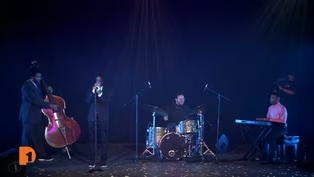
This is the Trunino Lowe Quartet.
I'll see you next time.
Take care.
(upbeat Jazz music) - [Narrator] You can find more at onedetroitpbs.org or subscribe to our social media channels and sign up for our One Detroit newsletter.
- [Narrator] From Delta faucets to Behr paint, Masco corporation is proud to deliver products that enhance the way consumers all over the world experience and enjoy their living spaces.
Masco serving Michigan communities since 1929.
- [Narrator] Support for this program has provided by the Cynthia and Edsel Ford Fund for Journalism at Detroit public TV, the Kresge Foundation Community Foundation for Southeast Michigan.
- [Narrator] The DTE Foundation is a proud sponsor of Detroit Public TV among the state's largest foundations, committed to Michigan focused giving.
We support organizations that are doing exceptional work in our state.
Visit DTEfoundation.com to learn more.
- [Narrator] Business Leaders for Michigan.
Dedicated to making Michigan a top 10 state for jobs, personal income, and a healthy economy.
Also brought to you by the Fred A and Barbara M Erb Family Foundation and viewers like you.
Video has Closed Captions
Clip: S5 Ep27 | 7m 39s | Cranbrook Academy of Art | Episode 527/Segment 3 (7m 39s)
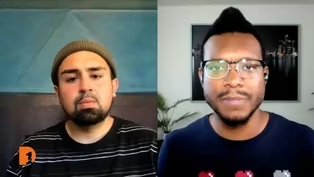
Southwest Detroit Singer/Songwriter Gabriel Duran
Video has Closed Captions
Clip: S5 Ep27 | 5m 37s | Southwest Detroit Singer/Songwriter Gabriel Duran | Episode 527/Segment 2 (5m 37s)
Video has Closed Captions
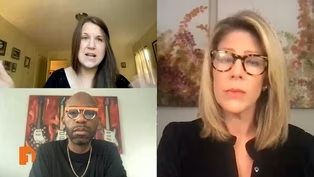
Clip: S5 Ep27 | 6m 32s | Detroit Public Theatre’s Performance of Thurgood in New Center Park | Episode 527/Seg 1 (6m 32s)
Video has Closed Captions
Clip: S5 Ep27 | 1m 47s | Trunino Lowe Quartet | Episode 527/Segment 4 (1m 47s)
Providing Support for PBS.org
Learn Moreabout PBS online sponsorship
- News and Public Affairs

Top journalists deliver compelling original analysis of the hour's headlines.

- News and Public Affairs

FRONTLINE is investigative journalism that questions, explains and changes our world.












Support for PBS provided by:
One Detroit is a local public television program presented by Detroit PBS