One-on-One
Tierney Wade; Diana B. Henriques; Satyen Raja
Season 2024 Episode 2670 | 7m 57sVideo has Closed Captions
Tierney Wade; Diana B. Henriques; Satyen Raja
Steve and his Co-Host Mary Gamba are joined by Tierney Wade, Chief Operating Officer at the National Society of Leadership and Success, to discuss why we need compassion and empathy in business; Journalist Diana B. Henriques explores FDR’s battle to regulate Wall Street after the 1929 stock market crash; Satyen Raja, CEO & Founder, WarriorSage Trainings, discusses Transcendent Leadership.
Problems playing video? | Closed Captioning Feedback
Problems playing video? | Closed Captioning Feedback
One-on-One is a local public television program presented by NJ PBS
One-on-One
Tierney Wade; Diana B. Henriques; Satyen Raja
Season 2024 Episode 2670 | 7m 57sVideo has Closed Captions
Steve and his Co-Host Mary Gamba are joined by Tierney Wade, Chief Operating Officer at the National Society of Leadership and Success, to discuss why we need compassion and empathy in business; Journalist Diana B. Henriques explores FDR’s battle to regulate Wall Street after the 1929 stock market crash; Satyen Raja, CEO & Founder, WarriorSage Trainings, discusses Transcendent Leadership.
Problems playing video? | Closed Captioning Feedback
How to Watch One-on-One
One-on-One is available to stream on pbs.org and the free PBS App, available on iPhone, Apple TV, Android TV, Android smartphones, Amazon Fire TV, Amazon Fire Tablet, Roku, Samsung Smart TV, and Vizio.
Providing Support for PBS.org
Learn Moreabout PBS online sponsorship- [Narrator] Funding for this edition of One-On-One with Steve Adubato has been provided by Wells Fargo.
Newark Board of Education.
PSEG Foundation.
New Jersey Sharing Network.
The Fidelco Group.
Holy Name.
New Jersey’s Clean Energy program.
Lighting the way to a clean energy future.
PSE&G, committed to providing safe, reliable energy now and in the future.
And by The Adler Aphasia Center.
Promotional support provided by Meadowlands Chamber.
Building connections, driving business growth.
And by NJ.Com.
Keeping communities informed and connected.
- This is One-On-One.
- I'm an equal American just like you are.
- The way we change Presidents in this country is by voting.
- A quartet is already a jawn, it’s just The New Jawn.
- January 6th was not some sort of violent, crazy outlier.
- I don't care how good you are or how good you think you are, there is always something to learn.
- I mean what other country sends comedians over to embedded military to make them feel better.
- People call me 'cause they feel nobody's paying attention.
-_ It’s not all about memorizing and getting information, it’s what you do with that information.
- (slowly) Start talking right now.
- That's a good question, high five.
(upbeat music) - Folks, I'm about to introduce you to a segment that my colleague Mary Gamba over on our sister series, Lessons and Leadership, we did with Tierney Wade, Chief Operating Officer of an organization called the National Society of Leadership and Success.
What was the topic?
What is the topic?
Empathy.
Who has it, who doesn't have it?
Its connection to leadership.
Its connection to life.
How those who may think they lack, the degree of empathy that they need, how they can gain it, whether you're born with it, whether you can teach it, coach it, learn it.
These are questions that I think about all the time in my other life as a leadership coach.
And Tierney Wade talks about empathy.
It's more important than ever before.
Let's listen to her.
Welcome to Lessons in Leadership, Steve Adubato, with my colleague Mary Gamba, how we doing Mary?
- It's another great day, Steve.
You know me, always setting those positive intentions for the day and let's make it a great day.
- Oh wow, that is so uplifting.
Let's welcome Tierney Wade, who's Chief Operating Officer, the National Society of Leadership and Success.
The website will be up.
Tierney, welcome to Lessons in Leadership.
- Thank you Steve and Mary for having me.
- You got it.
Your expertise in a whole range of areas about leadership is so fascinating.
But the one that really we wanna focus on today, empathy.
You understand empathy better than most.
So here's the question I've been struggling with for 20 plus years as a leadership coach, can you teach people to be empathetic or does it have to be in your DNA?
- That's a great question that, you know, I've read studies and seen studies that suggested that empathy is actually a primitive emotion that we are biologically programmed.
So we're born with it.
It's the nature that is instilled in us.
It's actually called like emotional contagion.
So it's contagious.
It's the ability for us to share another being's emotion.
And so that's why sometimes when you're in a room and you see a baby and it hears another baby crying, it too will start crying, right?
It's like a contagious emotion.
So it's a reflex of shared emotion.
So some researchers actually suggest that empathy is hardwired biologically inside of us so that we can take care of our young, right?
So increase our odds of our genes continuing.
So you are born with empathy, right?
It's the emotional contagion.
But what happens as you get into adulthood is that your capacity or your bandwidth to have empathy in the forefront of your life, it really shrinks, right?
Because you're thinking about taking care of yourself or your loved ones.
So that capacity that you have and that bandwidth that you have to exert empathy, it really shrinks.
And so I think it's really important that you are able to go back to having awareness that you have it inherently, and just making sure that it's something that you are aware of and bringing forth.
But it's definitely something we're born with.
Now, whether or not we have it into adulthood as an awareness piece, that's something we need to work on.
- Well, Tierney, here's the dilemma.
For those of us who coach, teach, write about leadership, obsess about leadership.
You're working with a client who is a vice president of whatever, CEO of whatever, manager, whatever.
And they're saying, the feedback I'm getting is that I'm not empathetic enough with my team members.
They don't sense that I care enough about them and their world.
And I'm sitting there trying to coach them to be more engaged, empathetic, and care more.
And you seem to be saying, what are you doing, Steve?
It is what it is.
- [Tierney] I think that if you're a leader, listen, results, goals, achievements, those are all really important.
We can all agree on that.
What we can also agree on is building relationships has to be a leader's top priority in order to exhibit empathy.
And so when I think about building relationships, and I think about the best ones that you have in your life, whether it's your personal relationship or your professional relationship, why do you stay in those relationships?
It's because you.
- Well, sometimes I need a job.
Sorry for interrupting.
Sometimes we need a job.
because you need a paycheck to pay the rent.
- Correct, yeah.
So you stay in it because there's a benefit you're receiving, right?
Either because you feel cared for, you're financially or intellectually benefiting, to your point.
And what you need to do as a leader is build that relationship so that the person feels valued and heard, and that they're receiving a benefit from it.
Now you say they can receive a financial benefit from it.
Correct, so in that relationship that you're building, you really need to listen, have them be heard, understand what it is that they find mutually beneficial from that relationship so they can be more motivated, more invested, more successful, and they will stay.
So I think if you're talking to a leader and really trying to get them to be more empathetic in the workplace, they need to spend the time to authentically want to build that relationship.
To get that individual to stay.
- Got it, easier said than done, but it's important.
Go ahead, Mary.
- Yeah, Tierney, what do you say to people because I have heard this before, that I've heard some of the leaders that Steve and I have coached, Steve and I have worked together for over two decades.
Say, Hey, if I show too much empathy, too much compassion, it's going to show that I'm a weaker leader.
It's gonna show that I'm too soft.
What do you say to those leaders?
Because I do believe there's a fine balance between, as a leader, you do need to make some tough decisions and it's gonna make you not popular.
But how do you balance being just mean and but also being empathetic and not being too wishy-washy.
- I think there's a separation between being mean or to, as you say, wishy-washy versus being transparent and being human in the way that you communicate.
So when I hear that individuals say, well, I don't want to be shown as weak, right?
I say, at the end of the day, you're building a relationship with your coworkers.
You're building a relationship with your employees and your staff, you showing yourself as being vulnerable in your thoughts.
And you're asking for opinions shows that you have no ego.
It doesn't show that you're weak.
It shows that you have no ego.
So when it goes to building that relationship with your coworkers and your employees, what I do personally is obviously I listen and I ask for their opinion, right?
And I show that I care about what they're saying.
I also try not to be rehearsed.
So what I do then is when I speak to them, I don't use corporate jargon or philosophical, philosophies from like a book or a strategy that I've read.
Instead, I share with them in plain speak as if we're just talking, right?
So that we can focus on what we're saying versus having them decipher what I'm trying to mean, and I think it's important as a leader, that you are able to be relatable and share your experiences, what you're thinking and what you're feeling as well.
It doesn't mean that you're weak, it's meaning that you're being transparent and not having an ego.
So I one, not to really believe and you know, showing and demonstrating by force or by that I know it all.
It's more about relating to actually being interested and invested in their thoughts, in their feelings.
At the end of the day, they're the ones who really make the work environment what it is and really grows our company.
- Tierney, last point on this.
There have been times where we have to make a decision to let some people go.
And empathy in some people's minds means, well, they have a family, they have a mortgage, they have rent to pay, they have kids, they have college, the bills, they have whatever.
And you have to make the right decision for the team.
And if that decision is to let that person go, you want to empathize with that person's experience and the fact that they're gonna suffer financially.
But you still have to do what's right for the team.
And if that person walks away thinking you're a horrible person and you hurt them, you have to live with it.
And that's why leadership ain't for everybody.
Because while we're being empathetic, we also have to be empathetic and compassionate and real to the bottom line of the organization and everybody else.
Complex stuff, Tierney Wade, Chief Operating Officer of the National Society of Leadership and Success.
I wanna thank you so much for joining us on Lessons in Leadership, thank you.
- Thank you for having me.
- You guys stay with us, we'll be right back.
- [Narrator] To watch more One on One with Steve Adubato find us online and follow us on Social media.
- We're now joined by Diana Henriques, who is the author of the book, "The Wizard of Lies, Bernie Madoff and The Death of Trust."
We did a separate segment with Diana, all about the Bernie Madoff case.
Go on our website and check it out.
But Diana has a new book coming out.
Is it about FDR?
- It is Steve.
It's a story I've wanted to tell for decades, and it's about FDRs unprecedented effort to regulate Wall Street when he took office in 1933 and the aftermath of the 1929 crash.
- Post Herbert Hoover.
- Yes, post Herbert Hoover and Calvin Coolidge and Warren Harding, who gave us... - Oh, those guys.
- Those guys gave us the roaring twenties.
And while it's remembered in our kind of glossy, you know, memory bank as this wonderful time of flappers and cocktails and Stutz Bearcats and raccoon coats, in fact, it was a time of incredibly unequal prosperity and a time when the financial markets, especially the aspects of the financial world we all rely on today, banks, mutual funds, Wall Street investments for our retirement savings were a jungle.
They were absolutely a jungle, largely unregulated, dominated by the richest and most powerful.
And the little people, the ordinary investors were chewed up and spit out by that system.
FDR came of age during that decade.
He became governor of New York in 1928.
So he had spent his adult life on the doorstep of Wall Street, actually worked briefly at a Wall Street law firm as a young man before he was crippled with polio.
And when he saw what wreckage this unregulated wild west marketplace had created, he made it one of his core priorities in the new deal to tame the street, to reign in this kind of ruthless predatory finance so that average people like you and me could safely put our money in banks, could safely invest our savings in mutual funds, and could really participate in American capitalism in a way that we could not have safely done just a decade earlier.
- By the way, I should have mentioned, in addition to the book on Bernie Madoff, Diana is one of the country's top financial journalist and award-winning journalist and respected by so many in the field of finance and Wall Street and etc, etc.
How about this, the SEC, the Securities and Exchange Commission, did that come out of Franklin Delano Roosevelt's administration?
- It did, it was born in June of 1934, and its first chairman was Joseph P. Kennedy, the father of President Kennedy.
- Wait, hold on.
But he was... - Yes.
- But Ambassador, hold on.
Ambassador when?
And then head of the SEC when?
- Head of the SEC first, that was his first government job, was as chairman of the SEC in 1934.
It was after he left the SEC, he became the very controversial US ambassador to Great Britain on the eve of World War II.
So an incredibly complex character.
My book, which is called "Taming the Street."
- Say it again, "Taming the Street."
- "Taming the Street: The Old Guard, the New Deal, and FDRs Fight to Regulate American Capitalism."
And while FDR and Joe Kennedy are two of the figures I focus on, two others are William O. Douglas, who most of us my age remember as a life long, one of the longest serving Supreme Court justices in history.
Yes, and a great civil libertarian.
Yes, great civil libertarian and early environmentalist.
So this was before he ever dreamed of going on the Supreme Court.
He became the third chairman of the SEC.
So my book looks at the very early years of the SEC and how FDR envisioned it as the cop on Wall Street and the battles that they fought.
And one of those biggest battles was with the fourth character Richard Whitney, who was this incredibly patrician president of the New York Stock Exchange, who was secretly a crook.
So it's quite a story and a lot of dramatic developments.
- A totally inappropriate question.
Joseph Kennedy becomes the head of the SEC first.
- Yes.
- Did that get in the way of his bootlegging business?
- You know, there's no evidence at all that he was a bootlegger.
I do deal with this, but my editor made me move it through a footnote.
So check the footnotes.
- In public broadcasting we have to only go with facts.
So it's not a proven fact.
- No, it is not.
Absolutely not.
And highly dubious.
After he left private practice and went to work for the SEC, he went through two, three subsequent senate confirmation investigations at a time when he was already pretty controversial.
And you know, there are a lot of people... - Is that because of isolationist as policy or did that come later?
- Partly that, partly his growing isolationism, partly just his personality.
He was always gonna be the smartest guy in the room.
He had nothing but contempt for other people who didn't think we were as smart as he was.
- And wanted to be President.
- And many people felt he was going behind Roosevelt's back to secretly, you know, try to become a candidate for the 1940 election before FDR had quite decided what he was going to do about the 1940 election.
So he wasn't fully trusted even by FDR's own people.
So we have to believe that if anybody could have turned over a rock and come up with evidence that he was a bootlegger, they'd have used it and they never did.
- That was totally inappropriate and irresponsible on my part.
I apologize.
Biggest lesson, particularly for those who follow Wall Street on a regular basis, and more and more average citizens are participating in the stock market and Wall Street.
Biggest lesson from the regulatory initiatives and the zealous, I don't mean that in a negative way, but the very aggressive regulatory efforts of the Roosevelt administration.
Biggest lesson we should take from that for all investors today is?
- Roosevelt was right.
He was right.
That we needed to regulate the world of finance to keep it safe for ordinary investors.
He was right then.
He's still right today.
- Diana, I wanna thank you so much for joining us.
We appreciate it.
- It was a delight to be with you, Steve, thanks.
- Thank you, stay with us.
We'll be right back.
- [Narrator] To watch more One on One with Steve Adubato find us online and follow us on Social media.
- Folks, I'm about to introduce you to someone we interviewed, Mary Gamba, my colleague and I interviewed Satyen Raja the author of this book, "Accelerated Evolution, Well, what is that, how is it relevant?
Well, that's what I wanted to find out, and that's what Mary and I did when we talked to Satyen Raja about his view of leadership, his view of the workplace, and how it's changed and how people need to be treated.
And frankly, he talked about mixed martial arts and Bruce Lee as someone who taught him about being a leader and transformative, very deep ways of touching and connecting with people.
I didn't understand all of it, but I think it can make a difference for you.
Satyen Raja right here.
- Welcome back to Lessons in Leadership.
Thank you so much again for joining us today, and we are thrilled to have with us Satyen Raja, CEO and Founder, WarriorSage Trainings.
Satyen, thank you so much for joining us today.
- Good morning, thanks for having me here, Mary and Steve, looking forward to sharing with you today.
- Absolutely, and speaking of sharing, please tell us what is WarriorSage trainings?
We'll talk about your books in a little bit, but just talk a little bit about the training and the coaching that you do.
- Our organization, we train CEOs and executive teams, C-suite teams, to really cross the finish line to be deeply aligned, going from chaos to coherence, and really, I create super teams in any type of organizations that are here to make big impact.
We dial up the teams on the inside out so that the effects that they have in the world are very profound, impactful, but they're all done in a new paradigm without struggle, without strain, without overwhelm coming from, let's say, another level of attunement from within.
- Yeah, no, and I have a question regarding that though.
When it comes to that attunement that you're talking about and the struggle coming from within, how did your training and your approach to training, how is it impacted by COVID?
Right, you couldn't have more chaos in those three years than that.
Talk a little bit about how your training and your approach to that evolved.
- Well, you know, with the warrior philosophy, I come from a warrior sage lineage.
That's my martial arts background, and in the warrior sage philosophy, there is no obstacle.
Whatever comes our way is something to take advantage of.
And so when we have that dialed in, that whatever challenge comes upon us, it's not something that crush us, slow us down.
As Bruce Lee said, you must flow like water when you hit a rock.
Don't stop, don't freeze, don't gasp, don't brace, embrace.
And so that's what we train our leaders to do, to embrace whatever is in front of them.
Now, most of the challenges we have are mental, psychological.
When we shift those, when we make an attune within, then what happens is what used to be a problem now is a huge opportunity, and that's what's been happening with the teams I've been leading, the organizations I've been leading and supporting over the last few years.
- Lemme follow up on that.
For those of us who have not been trained in the mixed martial arts and do not have the- - Steve, you're telling me you have not been trained in the mixed martial arts?
- No, I enjoy watching UFC fights and I enjoy mixed martial arts, but you are not messing with the money maker here.
- Hey, Steve, one thing before you move on, I actually took many, many years of karate.
That is probably something else that you did not know about me, so yeah.
- Fantastic, another martial artist.
- There's a whole thing they do.
You gotta take your shoes off.
- In the warrior arts, we're taught to have a strong spine and an open heart.
So the warrior is a strong spine that uncollapsible spirit within us, and that's what we cultivate.
So in our trainings, what we do is with CEOs and executives, we take 'em through duress training, helping them stay calm in the center of the storm.
You can do mindfulness and all that, but that's pretty beginner stuff nowadays.
What we need to do is really anchor people in their true self.
When we're anchored in who we really are, then what happens is we're far more agile, we're far more resilient, but when we're identified with our ego, the roles we play, the faces we put on in the corporate or business world, and we're not coming from who we truly are, that it's easy to get knocked down and stay down.
But when we cultivate that strong warrior spine that resiliency within, and we open our heart, then we attune to our intuition because intuition, not only tactics, is what's really needed in the business world right now.
We need to tap into the feminine wisdom, which is inherent in all of us, which is that attunement to people, the human dynamics in the organization, I've discovered that's the most important thing in our families, most important thing in our organizations and government is the quality, the power, the beauty, the joy of the human dynamics inside.
And if that's faltering, so is the (indistinct).
- Yeah, why is that feminine wisdom?
- Well, because the feminine has a lot to do with the embodiment and the flow of connection within us.
And the masculine has a lot to do with attainment, realization.
Next goal attainment, breakthrough, breaking through challenges, but that's fantastic in the business world, but it's become imbalanced to the place where self destroying ourselves.
You know, I work with a lot of business leaders.
On the outside, things are great, amazing success, billionaires.
On the inside, there's all types of challenges.
It has lots to do with relationship, with family dynamics with their children because of the overexertion in one area of their life, it affects another area of their life.
It's detrimental.
- Is it about balance, is it about balance and wellness in the end?
- Balance, wellness, equilibrium, but also of spirit, which means tuning into our deeper purpose.
In India, we call it our dharma.
In the warrior traditions we call it, what's our purpose for living.
When we discover and open to that and marry that with our business purpose, our success purpose, then we become a whole individual.
We're not fragmented within ourselves.
- Yeah, but Satyen, I have a question about that when it comes to, this all sounds good and great.
Absolutely, I'm a firm believer.
Steve and I talk all the time about how I state my intentions every day before I start my day.
But where does the bottom line come in, right?
For these CEOs, for the presidents of organizations, where do they balance making sure that they are making all ends meet, right?
No money, no mission, while also staying in tune with this culture that you're talking about.
Don't they sometimes conflict?
- Hold on, hold on one second, one second while you answer that, I now have to bring in for our other organization together with Mary, $3.6 million a year, or we're gonna have a problem.
That's real.
It doesn't feel especially spiritual to me, in all candor, I have to get it done, so please help me.
- Absolutely, well, all the top leaders that I know have been along the path and have, you know, attained levels of success, they recognize their internal state makes a huge difference on what's going outside.
They already recognize that life is a mirror reality.
If I'm frowning on the outside, if I'm frowning, the mirror is gonna reflect a frown.
If I'm smiling and positive and intentional on the inside, the mirror reflects that the same.
The frown doesn't turn into a smile, when we look into a mirror, the smile reflects back a smile.
In the same way, our physical, mental, emotional and spiritual alignment.
When we have that dialed in, and that's a simple thing to do, it's not as onerous as we think.
We already have that inner alignment.
We just gotta get back on board with it.
We already have the navigation masking within us.
We've lost touch with that navigation.
We're using some other GPS outside of ourselves.
- Hold on, time out.
How does that help, or how does that relate to me having to bring in $3.6 million a year to keep our engine going, that's real.
- Absolutely, we've done this dozens of times in the company.
What we do is we take a look at the company, we take a look at the individuals, the leaders, and we say, okay, what are the biggest challenges right now, could be in the financial world.
We look brass tacks, we start with the pain.
We start with where's the biggest problems in the company?
Then when we boil down to it, it has a lot to do with limiting beliefs.
All the impressions from the past of what can be attained, limitations in some team members, some are really brilliant.
They're like, we can achieve it.
Some go we can't, and they're holding back.
There's breaks on.
So what we do is we go into the mind, we go into the subconscious of our leadership and we transform it so that those obstacles that used to be ceilings are now gone.
When you have a team that's coherent, when the obstacles are gone in their limiting mindsets, then what happens is the goals come to us.
It's less strain and struggle, less push, less yang power and more yin power where the actual fulfillment comes our way.
And the paradox is, you know, at first it's hard to believe if you're coming from a traditional mindset business, which I have for decades, right?
I come from a family lineage of business people.
I had to break away from that paradigm of over burning out, overstressing.
Yeah, we made lots of money, but the results were pretty poor on the inside.
So now I've realized that when we have equilibrium in our lives and in our teams, what happens is they perform way better.
They're healthier, they're happier, they're joyful, and they're way more loyal, and they go the extra mile big time.
And that's what crosses the finish line.
- Real quick, Fred, the name of the book, Accelerated Evolution.
Good stuff, a lot to think about, and we appreciate you joining us on Lessons in Leadership, thanks so much.
- It's wonderful to be here, thank you, Steve.
Thank you, Mary, have a wonderful day.
- [Narrator] One-On-One with Steve Adubato has been a production of the Caucus Educational Corporation.
Celebrating 30 years in public broadcasting.
Funding has been provided by Wells Fargo.
Newark Board of Education.
PSEG Foundation.
New Jersey Sharing Network.
The Fidelco Group.
Holy Name.
New Jersey’s Clean Energy program.
PSE&G, And by The Adler Aphasia Center.
Promotional support provided by Meadowlands Chamber.
And by NJ.Com.
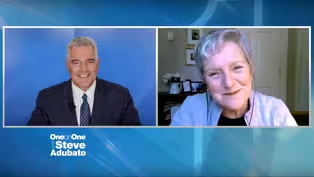
Diana Henriques Highlights Her Novel "Taming The Street"
Video has Closed Captions
Clip: S2024 Ep2670 | 7m 57s | Diana Henriques Highlights Her Novel "Taming The Street" (7m 57s)
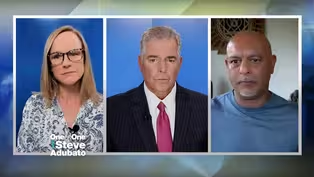
Transcendent Leadership and Shifting Workplace Culture
Video has Closed Captions
Clip: S2024 Ep2670 | 10m 43s | Transcendent Leadership and Shifting Workplace Culture (10m 43s)
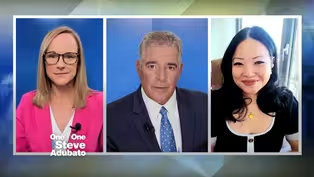
Why Compassion and Empathy is Needed in Business
Video has Closed Captions
Clip: S2024 Ep2670 | 9m 53s | Why Compassion and Empathy is Needed in Business (9m 53s)
Providing Support for PBS.org
Learn Moreabout PBS online sponsorship
- News and Public Affairs

Top journalists deliver compelling original analysis of the hour's headlines.

- News and Public Affairs

FRONTLINE is investigative journalism that questions, explains and changes our world.












Support for PBS provided by:
One-on-One is a local public television program presented by NJ PBS