
Tijuana Historical Society & Takoyaki Bros
Season 15 Episode 8 | 24m 47sVideo has Closed Captions
Step into the past with the Tijuana Historical Society.
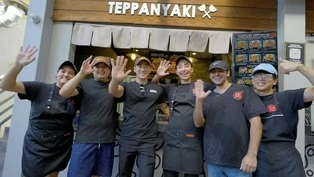
Step into the past with the Tijuana Historical Society, where a local historian shares untold stories of the city’s rich history. Then we visit the Takoyaki Bros, a Japanese-Mexican family serving sizzling Takoyaki and Teppanyaki with a Baja twist. Jorge even jumps behind the counter to help make an Asian shaved-ice treat!
Problems playing video? | Closed Captioning Feedback
Problems playing video? | Closed Captioning Feedback
Crossing South is a local public television program presented by KPBS
Tijuana Historical Society & Takoyaki Bros
Season 15 Episode 8 | 24m 47sVideo has Closed Captions
Step into the past with the Tijuana Historical Society, where a local historian shares untold stories of the city’s rich history. Then we visit the Takoyaki Bros, a Japanese-Mexican family serving sizzling Takoyaki and Teppanyaki with a Baja twist. Jorge even jumps behind the counter to help make an Asian shaved-ice treat!
Problems playing video? | Closed Captioning Feedback
Where to Watch Crossing South
Crossing South is available to stream on pbs.org and the PBS app.
Providing Support for PBS.org
Learn Moreabout PBS online sponsorshipJorge Meraz: Hey, folks, on this episode of "Crossing South," we dig into Tijuana's past with the city's historical society.
We then get to taste its global flavors as Japanese cousins bring authentic street food from Japan straight to TJ.
History, culture, and a bite you won't expect coming to you right now.
♪♪♪ ♪♪♪ Jorge: You know, I've driven past this building where we're at right now.
It's the Tijuana Historical Society building, and I've never known what was in here, but now we're gonna be informed as to what it's all about, what the society actually does, and the person that's gonna tell us about that is the person standing next to me right now.
How you doing, my friend?
Alvaro Montaño: How are you, Jorge?
Jorge: What's your name?
Alvaro: Alvaro Montaño.
Jorge: Alvaro Montaño, Mr.
Montaño.
Alvaro: Mucho gusto.
Jorge: Mr.
Montaño, I've never known what this place actually does, and I hope you can fill those gaps today.
Alvaro: Of course, of course.
Well, this is the Historic Society of Tijuana.
This is the place where all the information from the city gathers, the guys from study history come here to give us a speech every conference, I will say a conference every month, so we can be updated.
Tijuana is a young city.
It was founded in 1889.
It's a young city compared with Veracruz that has more than 500 years, compared with Michoacán, Querétaro, or Mexico City, and some other-- Jorge: It's very young.
Alvaro: Yeah, very young.
Jorge: Everyone has a lot of-- their own version of how the city began.
Even the name of Tijuana, some people say the ranch of the Tía Juana, Aunt Juana.
Some people say tecuán, like some pre-Hispanic animal.
Can you tell me which one it is?
Alvaro: I will say that, este, because of the ranch of Tía Juana.
Jorge: So it is because of the ranch of the Tía Juana?
Alvaro: Yes, yes.
You know what?
In 1846, there was a war between the US and Mexico.
1846 through 1848.
Alvaro: So in order to get to end that war, they signed, both countries signed a treaty that's called Tratado de Guadalupe Hidalgo.
So Mexico lost a good part of its territory, and Tijuana ranch, the line of that treaty, went in the middle of the ranch.
So in the US part was Tijuana in, so they had to name it in a different way, so it was named Tijuana, the Mexican side.
Jorge: What else can you tell us?
Like, the mission is to preserve the history of Tijuana officially.
Alvaro: The historic memory of the city.
Alvaro: Yeah.
So we, as the born Tijuanenses, we need to preserve the memory of the history, and this is a great place to do that.
Jorge: Well, can you give us a tour?
Alvaro: Of course.
Jorge: Sometimes you take the documenting of daily life for granted.
It is so important, because you blink and one day everything around you has changed.
And if not for oral accounts, there's no way of knowing where you came from, progress you made, your roots.
The only way you can truly see it is if someone documents it.
Be it by painting, daguerreotype, photograph, video, it's simply fascinating.
Alvaro: The situation here is that he came and photographed the normal Tijuana without any poses, so you can see-- Jorge: The day to day.
Alvaro: Exactly.
Jorge: Oh, this is the day to life in stores shopping, right?
And they're not posing, they're living day-to-day life.
Alvaro: Exactly, exactly.
Jorge: You've got some Americans here, some tourists.
Tamales de carne y elote.
Alvaro: Ice cream, Lupita ice cream.
Jorge: Lupita, yeah.
Oh wow, this is so cool.
Oh, now, now I'm trying to find the angle.
Oh, here's the Jai Alai.
Alvaro: That's the Jai Alai Bar.
Jorge: Right, yeah, yeah, you're right, it's Constitución, so Revolution would be right here parallel to this.
Alvaro: Exactly, exactly.
Jorge: I tell people that only know Tijuana today, like, you have no idea how far the city has come.
Some of these streets you're driving, I remember as a kid, some of these streets.
All of these are paved now.
Yeah, yeah, yeah.
Alvaro: No subways in that part, I can imagine.
Jorge: Right, right.
I remember this vividly.
Even during the '80s there was colonias like this, so, yeah.
You know, a cool thing they have on their walls are the blueprints for the Agua Caliente Casino, the one that flourished in Tijuana during prohibition in the States.
Now, that structure would have been quite the historical attraction had they chosen to preserve it.
It was no small thing.
Jorge: You know, it peaked during Prohibition, gangsters, Al Capone, and all that stuff.
Alvaro: All those guys were here, and you know what?
It was the best casino in the world.
So this is the entrance of the casino, this is the lobby, this is the hotel.
The hotel was here.
This is the tables, the restaurant, the casino.
It was an old casino, but it was the best casino on the world.
Why?
Because it had a a lot of amenities.
It had the greyhound right there.
The horse racing was on top, on a hill but very close.
It had a golf course.
This casino was competing with Monte Carlo Casino.
Jorge: No, come on, really?
Alvaro: Yeah, yeah.
But the Monte Carlo Casino, they only had the casino.
Alvaro: So this one is my--it was better because we have the hot springs here, we had a hotel, we had the greyhound, the racetrack, the aviation, a lot of planes will arrive.
The casino of Agua Caliente, the casino that was here in Tijuana, in 1928 it was founded, so it's gonna be a 100 years old in a few--in a couple of years, was the inspiration of Las Vegas, because the architect of all this was Wayne McAllister.
So Bugsy Siegel and all the guys that you-- Jorge: The gangsters.
Alvaro: The gangsters that were here, they come here to see how-- Jorge: Scope it out and copy.
Alvaro: Exactly, and copy it.
So they took Wayne McAllister to Las Vegas, and he start making the first hotel.
Jorge: Hey, Vegas, your origins are right here.
Alvaro: Exactly.
Jorge: Right?
Alvaro: Exactly, exactly.
Guys from Europe, from Arabia, from Dubai, from a lot of places, wealthy guys, were playing here.
Jorge: And they're flying in-- aviación.
Alvaro: That's correct.
That's correct.
Jorge: They say that Al Capone would even--that he had a secret tunnel that would drive under the border.
Alvaro: Yeah, but I will say, he didn't need it.
By then, by those days, I don't think he needed it.
Jorge: What they say is that you gotta like--you just drive in, didn't have to go through customs, he just drove through a tunnel.
Alvaro: And then we are very proud of Federal Highway number 1, in all of Mexico.
Jorge: Oh, really?
Alvaro: Mexico has a lot of highways, but we have number 1.
And that highway starts in Tijuana, it goes all the way to the Baja Peninsula and gets its last point in Cabo San Lucas.
Jorge: All the way to Cabo.
Alvaro: All the way to Cabo.
Jorge: You know, the scenic road that takes you from Tijuana to Rosarito and Ensenada is a beautiful drive, the Pacific Ocean at your side as you glide through Baja's towns and cities, but this highway has another distinction.
Alvaro: There's three iconic highways in the whole world.
The first one will be, or is, Route 66.
The second one will be Route 40.
And the third one is this one.
Jorge: Oh, really?
Alvaro: This one, this one.
It would be a good idea to go visit the monument erected in behalf of the 50th anniversary of Federal Highway 1.
Jorge: Oh, really?
Where is that?
Alvaro: That one is in kilometro 14.
The toll booth is in kilometro 11, 11 kilometers, so 3 more kilometers to the right.
It will be a good, a small park, and it's right there.
Jorge: So past the Playas toll booth?
Alvaro: Yes, correct.
Jorge: Going towards Rosarito.
Alvaro: Yeah.
The last place in all of Mexico that the sun sets is right there, because the sun sets, goes in Acapulco at 8 o'clock, here it's 6 o'clock, and then-- and the sun keeps rolling.
It comes in Mazatlán, it goes at 8, and here's 7, so the last place where the sun sets in Mexico, and I will say in Latin America, is right there.
And the same monument was built, or is built, in Cabo San Lucas.
Jorge: Okay.
Alvaro: That's because of them.
The mayor of Cabo San Lucas called me, he said, "Hey, we want to invite you to Cabo San Lucas.
We wanna build one just the same."
So I sent the blueprints, and I had a visit with them, and at the end, they have a--they have one monument erected for Highway 1, because that highway is the one that unites the three Californias: Baja California Sur, Baja California, and California from the US.
Jorge: My friend, thank you so much.
Very nice to meet you.
Alvaro: Thank you very much, thank you very much.
Jorge: Thank you for letting us know all the things that make Tijuana what it is.
Historical city, even though it's a young city, it has many features, many events, many aspects of its history that make it worthwhile to know.
So it's "Crossing South," folks, don't go anywhere.
More coming your way.
Jorge: We're now gonna meet a couple of entrepreneurs who decided to drop anchor in Tijuana and add their culture to the city's wealth.
Jorge: You know, folks, I've always said it: Tijuana is a city that embraces new flavors, in Baja for that matter, and we are here right now at a food court where we're going to taste a very particular cuisine from the Land of the Rising Sun: cuisine from street food scene from Japan.
And the guy that brought it to this city, authentic Japanese street food, is the guy right next to me.
He's right here.
How are you doing, Ru?
Ru Nakamura: Good, how are you?
Jorge: So talk to me, man.
Where are you from originally?
Ru: Yeah, I'm from Japan originally.
Jorge: No way!
Ru: Yeah.
Jorge: So you're not Mexican?
You're not a Mexicano?
Ru: No, I wish.
Jorge: So Japan originally?
Ru: Yeah.
Jorge: Where have you lived?
Have you lived in the States, or?
Ru: I lived in the States in the past 15 years.
Jorge: Okay.
Ru: Yeah.
Jorge: What age did you arrive to the States?
Ru: I arrived to the States when I was 18.
Our journey started a while back when I was in San Diego as an exchange student.
I lived with this Mexican-American host family for almost five years.
And we often visited TJ to explain--you know, to experience the culture and explore the city of TJ.
We even, you know, came to the dentist here, yeah.
Jorge: As many Americans do.
Cross the border.
Ru: So from an early age I was able to experience this, you know, the border crossing culture with them, and, you know, I was surprised how vibrant the city was.
Right, diversity, you know, full of energy, and most importantly, big street food culture here.
Jorge: You loved the street food culture.
And you were like, "I want to be a part of that."
Ru: That's--exactly, yeah.
Jorge: So what's your background?
Did you already have a culinary Japanese background in your family, or did you have to learn it to bring it down here?
Ru: No, I'm the first generation here.
Jorge: You're the first generation.
Ru: Yeah, so, and then, you know, later my cousin is like the main guy, you know, they follow me, and then we're trying to, you know, make a business here.
Jorge: Hey, hey, hey, let me see if I--let me see if--let me polish it up, let me see if I say it right.
[speaking Japanese] Ru: Perfect!
Jorge: Is it?
Ru: Yeah!
Jorge: Yeah!
Thank you, Ru.
Thank you, Ru.
We're gonna get to see the food, friends.
Don't go anywhere.
We're gonna get to see his cousin Isaac, who is the man with the food, and Ru here with the Teppanyaki Brothers.
Jorge: Isaac, I understand you're the man.
Ru was telling me that you're the man in charge here.
Tell me, what kind of food are you guys making here?
Isaac Kodoma: Obviously like Japanese food, because we are from Japan.
Jorge: Is it fully Japanese, or Japanese-inspired food?
Isaac: No, it's like original, authentic, 100% for sure Japanese food in Tijuana that we have.
Jorge: So if I'm walking in Japan, street food there, this kind of stuff is what I'm gonna find?
Isaac: Yeah, you can find it in Japan, yeah.
Jorge: So now, you have multiple places.
There's three spots you guys have in this food court.
This one is called-- Isaac: Teppanyaki.
Jorge: Teppan Bros Teppanyaki.
Jorge: Yeah, these cousins are all in.
They burned the ship behind them, and it's make it or bust.
Three spots with three different foods.
I love the adventurousness of these guys.
Jorge: What's the characteristic in this one?
Isaac: So this one, we actually focus on like a teppanyaki, which is like one of--like a grilled Japanese-style grill, and then-- Jorge: Japanese-style grill.
So everything here is grilled.
Isaac: Yeah.
Jorge: Okay, folks, we've arrived to the part of the competition that we've all been waiting for.
Weaponize for the task at hand.
This is bona fide street food from Japan.
So, they look interesting, right?
Let's go to this first one.
Look, this one is called a yakisoba.
These are noodles with shrimp, it's got cabbage, it's got carrot, little mayonnaise there, and you see this dried fish which I suppose will be kind of like a seasoning, like a salty seasoning.
I like to make sure that every ingredient is accounted for, okay?
Guys, I wish I could tell you how incredibly delicious that dish is.
Wow.
It's fantastic, it's phenomenal, it covers everything.
It covers your craving for noodles, it covers your seafood, salty just to the right degree, and the mayonnaise just does something to it.
It is amazing, folks.
It is such a good dish!
Home run out of the park, out of the gate.
Okay, so the first one was a home run, guys.
This next one, I'm gonna try it reluctantly because it just looks weird to me.
It's got soy sauce, it's got sake, which sounds great, it's got sugar, which I guess it'll give it a little bit of a caramelly taste.
Maybe not as chewy as I thought it was going to be.
The seasoning is great.
It's not bad, it's just maybe not my cup of tea.
Ru and Isaac have prepared this, which they call the Baja Combo.
So this is shrimp representing Japan, Asian seafood.
The steak, New York steak.
It all has Japanese barbecue flavor on it.
They brought some sauces that they think we should try, some potato salad right here, so let's go right into it.
Let me try their shrimp first.
It's all right, it's just a tame flavor, not like the first dish that just exploded.
Let's try both.
Nice and tasty.
As you start going deeper into the flavors, into the sauces, you start appreciating it more.
Tell me, what was the thought process of making a business in TJ?
You saw the food culture.
What did you think?
What did you do?
Ru: Yeah, so like, when I first--to TJ, I saw the potential, okay?
It made me dream of one day I wanna have a--you know, how would I have a business here.
Jorge: Really?
Ru: Yeah, and then the right moment came when you know my cousin Isaac moved to TJ from Japan to do the business here.
Jorge: Really?
Did you invite him or did he say, "Hey, let's open a business in TJ?"
Ru: No, I invited him.
Jorge: You invited him.
Did he have the background in cooking?
Ru: No.
Jorge: Neither one of you guys?
Ru: No, but we were confident that we can, you know, we can learn from, you know, doing-- by doing so.
Jorge: For sure, and you seem to have done it.
Isaac: So this one is actually, like, original our brand.
We started this business at the beginning, so we focused on a takoyaki at the beginning, because "tako" meaning like octopus in Japanese.
Jorge: It means octopus?
Isaac: Uh-huh, and "yaki" is like a baked or like grilled.
Jorge: So all this is like baked octopus?
Isaac: So like all of the balls, it has inside octopus.
Jorge: Oh, man, it sounds phenomenal.
I love octopus to begin with.
Is this something that you guys created for Mexico or is it something you can find in Japan too?
Isaac: That's a good question.
Original, our takoyaki, it just only has octopus inside it in Japan, but like we created something different for Mexican people, so we put in the shrimp inside it.
Jorge: Ooh, you were like, "People in Baja love shrimp, so let's give them what they want."
Isaac: Yeah, that's right, yeah.
Jorge: They have this option that has mozzarella cheese.
They have their umami flavor, the dried fish, mayonnaise, melted mozzarella.
They put shrimp on these.
So they have two versions.
This one with the leeks, you know, with the little onions and stuff, is the classic octopus one.
So we're gonna try both.
I have hopes for this one.
All right.
Oh, that's good.
Mmm.
It's actually kind of creamy inside.
Mmm, okay, so that one was really good, the one they made for the local population.
And now let's try the original one, the one with the leeks, the one with the octopus.
Fantastic.
Mmm.
Now that you're part of the vibrant street food culture that attracted you, now that you're in it, what are your thoughts?
Ru: I mean, the first of all, when we first started the business here, you know, people in TJ have welcomed us in, you know, open arms, you know.
And then I was surprised how, you know, people in TJ are very open to, you know, new flavor, new taste of the food.
Jorge: I've been saying that for years, so, yeah.
Ru: Yeah, so I mean, that's actually part of the reason why we're doing well.
Jorge: For sure.
Ru: Yeah, you know, the street food business in Japan is fading away.
Jorge: Is it?
Ru: You know, as time--you know, times change, you know?
But, you know, here in TJ it's still very alive.
Jorge: It's thriving.
Ru: Right?
And then, you know, why not bring a business here, you know?
It just makes sense to bring a business here.
Isaac: You know, at the beginning, when we started this business from the street, you know, I just started on preparation, and then like making a takoyaki, and to get many attention from like people on the street, and then, "Oh, this is a chance to make our own company!"
And then here we are.
Sometimes like, you know, when we're getting hot like during the summer, and people are not coming oftenly for the restaurant, so we decided to start shaved ice, so something like people getting hungry in the summer.
Jorge: Something cool that can refresh.
Isaac: Yeah.
This is Kakigori Bar.
Jorge: Kakigori Bar, oh, man!
Isaac: Almost like a Japanese-style shaved ice.
Jorge: Okay.
Isaac: And what's the difference between raspados and kakigori is, like, this machine is special.
Jorge: That is the difference?
Isaac: Yeah.
We brought from Japan originally, and it makes super like tiny like a shaved fluffy ice cream, we can make it.
Jorge: Really?
So the shaved ice is not as harsh as the raspado.
It's softer, melts in your mouth.
Isaac: Yeah, uh-huh.
Jorge: Yeah, there you go, I know what you're talking about.
Jorge: I've gotta say, I've not tried a kakigori before, but I'm excited to do so.
And by the looks of the flavors they're adding, like matcha, banana, mango, and others, this looks like it's gonna be real good.
Jorge: Check that out.
It looks so rich, right?
And it's shaved ice.
Mmm.
Oh, man.
This is so good!
It's delicious!
You know what it tastes like?
It literally tastes like a fresh powder snow from Mount Fuji, flavored with matcha.
Mmm.
Jorge: I must learn this discipline.
Isaac: So this is the most important part.
We need to prepare unfrozen ice.
Jorge: Unfrozen ice?
Isaac: Uh-huh.
Jorge: What does that mean?
Isaac: So usually, the ice, if it's frozen-frozen, we cannot see the other side, but if it's like unfrozen, look, we can see inside.
Jorge: So we're gonna put this in there?
Isaac: Yeah, put it in here, and then make sure the handle is going down, and then lock it.
Jorge: Unfrozen ice.
Isaac: Yeah, put the syrup of the mango, that one-- Jorge: Okay.
Isaac: Like, that side, just halfway.
Jorge: All right.
Isaac: And I'm gonna put on the Lechera.
Jorge: La Lechera.
Isaac: I want you to put the yellow on the surface first, then put it in the middle.
Jorge: How am I gonna do that?
Isaac: So I'm gonna show you.
Just only the half, okay?
Jorge: Okay.
Oh, wow, the blizzardness!
Isaac: Yeah, yeah, yeah.
Jorge: I think I don't have the technique.
I think I'm--I think I'm overcoating.
Isaac: No, it's okay, okay, keep going, keep going.
Jorge: Really?
Isaac: And that's it!
And now, middle section, we need to prepare.
Jorge: Okay.
That's the middle section.
So it's in phases?
Isaac: Yeah.
And then we need to tap gently onto the--flat, make it flat a little bit, uh-huh.
Jorge: More?
Isaac: So like that.
Jorge: Oh, that's good.
Yeah, I know, I know he's fixing it for me.
Isaac: Yeah, yeah, yeah, yeah, yeah.
Jorge: I'm being generous for myself.
Isaac: Yeah.
And then put the mango sauce on all of the part of the ice.
Más, más.
That's not enough for customers.
Jorge: Oh, wow, wow, okay, okay!
Isaac: Más, más, más, más, más!
Jorge: Fantastic!
Isaac: Then you're gonna put the whipped cream.
That's good.
That's good.
Jorge: Just a little more, a little more.
Isaac: That's enough, that's enough!
Jorge: Just top it off.
Isaac: That looks amazing.
Okay, and then can you put in the mango?
Jorge: Okay.
Oh, man, this is full!
This is gonna have some really good stuff!
"We see Jorge with a keen eye looking at what he'll ingest later."
Isaac: Yeah, yeah, yeah, yeah!
Jorge: I got it?
Isaac: Yeah!
Jorge: Am I doing it?
Isaac: Yeah.
Jorge: Look, Mom, no hands!
Isaac: I think I can hire you.
And this is the most interesting part.
Jorge: Okay.
Isaac: You're gonna touch like touching as your wife, like super gentle touch, just make sure the stuff is gonna be more-- Jorge: [whispering] Soft.
Isaac: Uh-huh, uh-huh.
Jorge: Is that good?
Isaac: Yeah, that's super good.
Then-- Jorge: I see you're a little rougher with your wife, but anyway, that's okay, continue, continue.
Isaac: And the right hand has this one.
And then put the Lechera all on-- Jorge: On top?
Isaac: On the top, yeah.
Can you put the mango from that, and expanding-- Jorge: Oh, wow, okay.
Isaac: Más, más, más!
Jorge: Más?
Isaac: Más!
Jorge: Oh, man, I just wanna make sure I'm covering that side too.
Wow, these guys are generous!
You say when, okay?
Isaac: Yeah, I think that's good, that's good.
Jorge: That's good?
Isaac: Yeah, that's good.
Jorge: Some more?
No, I'm just kidding.
Isaac: Very, very good.
That's good, that's good, that's good.
Jorge: You sure?
Isaac: Yeah.
Jorge: Sure?
Isaac: That's good, that's good!
And then we're gonna put the mango on the top.
Jorge: More mango?
Isaac: Yeah, yeah, yeah.
Jorge: All right folks, well, with this monstrosity, I guess it's time to say goodbye.
We hope you enjoyed the show.
We'll see you next time.
Isaac's gonna make a real one.
This is Jorge's Frankenstein right here.
Take care, folks!
Let me try this.
Jorge: After exploring Tijuana's rich history and tasting the global influences shaping its streets today, we leave reminded that this border city is always evolving, honoring its past while embracing new traditions.
And as Tijuana continues to surprise us at every turn, we look forward to the discoveries still waiting ahead the next time we get to cross south.
Jorge: That looks like Mount Fuji right there, right?
♪♪♪ ♪♪♪ male announcer: Like to know more about the places you've just seen?
Maps, videos, podcasts, and more at CrossingSouth.com.
We also do Facebook, Instagram, and YouTube.
Tijuana Historical Society & Takoyaki Bros Preview
Video has Closed Captions
Preview: S15 Ep8 | 30s | Step into the past with the Tijuana Historical Society. (30s)
Providing Support for PBS.org
Learn Moreabout PBS online sponsorship













Support for PBS provided by:
Crossing South is a local public television program presented by KPBS