
Tim Blake Nelson & Afroditi Panagiotakou Talk Socrates
Clip: 4/23/2019 | 16m 53sVideo has Closed Captions
The infamous trial of the Greek philosopher Socrates has been adapted for the stage.
Actor, director and playwright Tim Blake Nelson has adapted the infamous trial of the Greek philosopher Socrates for the stage, in collaboration with the Onassis Foundation. Hari Sreenivasan sits down with him, and the foundation’s director of culture, Afroditi Panagiotakou to discuss.
Problems playing video? | Closed Captioning Feedback
Problems playing video? | Closed Captioning Feedback
Tim Blake Nelson & Afroditi Panagiotakou Talk Socrates
Clip: 4/23/2019 | 16m 53sVideo has Closed Captions
Actor, director and playwright Tim Blake Nelson has adapted the infamous trial of the Greek philosopher Socrates for the stage, in collaboration with the Onassis Foundation. Hari Sreenivasan sits down with him, and the foundation’s director of culture, Afroditi Panagiotakou to discuss.
Problems playing video? | Closed Captioning Feedback
How to Watch Amanpour and Company
Amanpour and Company is available to stream on pbs.org and the free PBS App, available on iPhone, Apple TV, Android TV, Android smartphones, Amazon Fire TV, Amazon Fire Tablet, Roku, Samsung Smart TV, and Vizio.
Watch Amanpour and Company on PBS
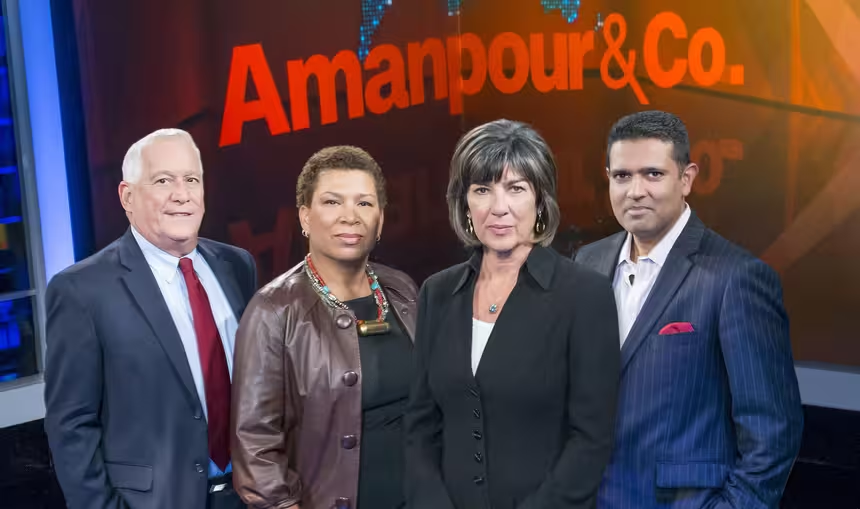
PBS and WNET, in collaboration with CNN, launched Amanpour and Company in September 2018. The series features wide-ranging, in-depth conversations with global thought leaders and cultural influencers on issues impacting the world each day, from politics, business, technology and arts, to science and sports.Providing Support for PBS.org
Learn Moreabout PBS online sponsorshipNow we're going all the way back to 400 B.C.
The ancient Greek philosopher Socrates changed the way we look at the world forever, making us question what is right and wrong, what's good and bad.
The key existential questions that we still wrestle with, of course, today.
Now, his infamous trial for being a disruptor within Greek society is on stage at the Public Theater in New York in collaboration with the Onassis Foundation.
It's written by actor, director and playwright Tim Blake Nelson who you may remember from the Coen brothers film O Brother Where Art Thou Art.
Above all, Socrates is about democracy and what we take for granted in an open and free society.
Hari Sreenivasan sits down with Tim Blake, nascent Nelson and with Aphrodite Piano Taku of the Onassis Foundation Aphrodite founded Utako.
Timberlake Nelson.
Thank you both for joining us.
I want to start with a clip from Socrates The worst wild person must consider only this.
Do I act rightly or wrongly?
Am I a good man or bad And what are you to say to me right now, Socrates?
We will let you go free, but you must stop philosophizing or face death.
I would answer that.
I will not stop.
But look, Keep pursuing questioning everyone.
I mean, saying you Fenian.
Why do you seek wealth and power?
And every comfort.
But refuse to ask what your life.
And the world around you might actually mean.
What is true and what is not truth.
In this blessed life, I doing so means to you that I corrupt you for an atheist or worship the wrong gods.
So be As long as I live freely, I shall do just as I have done.
No matter the mendacious accusation you are six to ten.
Blake Nelson.
What is Socrates doing right there?
He's representing himself at his own trial, but four or 501 die casts who are deciding whether he's guilty as charged by the Archon for having corrupted the youth of Athens, for having practiced atheism, and for having worshiped unsanctioned gods.
And he's finished describing what it is in terms of his own perception that he is done in Athens, in terms of wandering the city, questioning anyone he meets, and how that has been misconstrued.
And contorted into these charges.
That will mean life or death for him.
So here he is facing a life or death situation and talking to the people that could decide to kill him.
And that's his attitude.
That's his tone, as I imagine it.
Yes.
From what I've read, it certainly his tone in the play that I wrote and this production.
But I will say it's very heavily researched.
This is not a play that you wrote in reaction to our reality today.
Correct.
When do you start working on it?
Well, I really wanted to write this play 30 years ago when I was in drama school.
And I was very captivated by Socrates as not only a historical figure but as a character.
And then also between that, I was also captivated by the tension that exists between the historical figure of Socrates and then the Socrates and Plato.
And they're very different people.
And I tried to write the play then, and I just didn't have the the cleverness to to try and take it on And it took really three decades of helping others to tell stories and sometimes telling my own and also living in a in a democracy or I'd rather call what we live in here in America a republic, and also being a parent and a husband to restore the hubris that I had when I was in my twenties that maybe I could try and tell this story again.
And so it was in the summer of 2015 that I started writing this.
But I don't know, I guess like anyone who tries to create stuff and I think that there are no exceptions to this, anybody who tries to create has to have their antennae in the air.
And maybe I was picking up some stuff just like any creative person does.
And suddenly a lot of what I was writing about started to happen around me in the present reality of the United States.
And I just kept writing.
Aphrodite, this is part of a three week festival called Democracy Is Coming.
It's a collaboration between the Onassis Foundation and the Public Theater.
You've had several different themes to your festivals over the years.
Why Democracy now?
Well, even when it comes to the rest of the themes of our festivals, democracy was always there for us as the owners foundation.
Health, education and culture when it comes to our pillars.
But all these three pillars are just vehicles in order to talk about the major issues like social justice and democracy and human rights.
So in that sense, we try to be corruptors of the citizens of Athens or of the world, the same way that Socrates did in a way.
So we want to pose the questions and we want to bring people together, and we try to collaborate with people who actually share the same adjectives that we do.
So all these adjectives or nouns or words are definitely words like democracy.
And of course, democracy is always coming.
It never arrives.
Greece is the place that helped create this idea.
As Greece have it.
Yes, it does.
First of all, if you are in a country where you can actually say that this is not democracy, that means there is and there are other countries where they call themselves democracy.
But, you know, go on Google.
And if you say something against the president, you go to prison.
So I guess that it's good when a foundation like the US Foundation.
And I need to stress here that, yes, it is called the foundation but we are never sponsors.
So we are producers of content and we act as a platform for artists and thinkers and scientists.
And we provide this content to as many people as possible.
I think it's important that we raise this kind of questions because the problem is actually when we sleep and we take everything for granted what's the role of the arts in creating that public conversation about ideas like democracy?
Culture is not just the arts and arts it's only part of culture.
So I would say that the arts, yes, can do something that can change your mind.
If they actually are a part of life, of culture, of general education, of the society itself.
So I think that our job, when it comes to the foundation again, is actually to be disruptors.
Otherwise we will think that everything is okay, everything is safe, and in Greece in particular in Europe, but always and forever and everywhere in the world.
Certainties just die at some point.
And I think that this is what has happened in the U.S.
This is what has happened in Europe.
This is what Greece went through lately.
So I think that through the arts, you can talk about the permanent possibility of the loss of certainties.
What is the death of certainty due to Greece in the recent past?
Well, we realized that things like a job cannot be taken for granted.
The fact that your pension cannot be taken for granted, the fact that you're a public servant doesn't mean anything.
The fact that you lived in your country until the age of 40 doesn't mean that you're going to be living in your country when you are 45.
Did that make us wiser?
You know, wisdom doesn't last, but I think it really, really change this.
You need a tragedy, unfortunately, to understand life.
And when it comes to entering Greek tragedy just let's just bear in mind that the protagonist, whether that is Santiago, Chile, or whoever that is, and because we're going to see you and take on you also as part of the festival are never the solution to the problem.
They are the problem.
The problematic figures in any, Anderson, Greek tragedy are the heroes, which is something completely different from Hollywood.
Movies.
So in order to be a hero, in order to be a protagonist in a Greek tragedy, you have to cause problems and you have to be full of trouble.
Yeah.
Which is much closer to life.
Yeah.
There's one more clip I want to show.
This is kind of encapsulating some of the wisdom that Socrates says that he has.
What doesn't he understand?
I know what you think.
He doesn't understand that only by seeing this through will your life have meaning your 70 but Athens feared you enough to condemn you.
Already proves your life has meaning.
One thing I've learned in 70 years is that man is well suited for tyranny.
But especially when that tyranny is disguised as democracy.
Meaning it is no longer about me.
I thought you weren't political Of course I'm political.
What are you trying to say about democracy then versus now?
With the line about disguising tyranny is democracy.
I think that's happening all over the world.
And there's another moment in the play where he says anybody can use the word democracy.
And of course, there's democracy in the title of the the country of North Korea.
It's a misused, misapplied word.
I think that ancient Greece was far more of a democracy than what the United States of America is.
And we are now considered or we consider ourself ourselves, the great democracy of the world.
But we are really more of a republic something of an oligarchy, because you have to have a lot of money and you have to be connected to a lot of money, and you have to have a certain level of education that's very expensive.
For the most part to get elected to high office.
And so there are just institutionally prevent active measures that the government takes in in in being very selective about who ends up getting promoted to rule.
And that wasn't the case in Athens, where they drew names from urns.
People were put into office through a lottery system.
There were plebiscites pretty much on every major issue faced by the city state.
And we don't do that.
We have experts whom we vote there are almost platonic experts who've come up and they've been educated either as a sometimes as autodidact, but usually through law.
School or very fancy educations in in other topics.
But they've been trained and schooled to lead in much more of a platonic sense.
And we give them our vote.
We don't use plebiscites.
So in a sense, we are less Democratic than Athens was.
Or one of the questions the play asks is, is that necessarily a bad thing?
Why do we choose our leaders?
How do we choose the best possible leaders?
Why have we ended up with the leaders we do have right now?
And these were questions being asked in particular by Plato back in the in the fourth century, after every one of the things that he points out is that democracy seems to be backsliding in several parts of the world.
How do you see it evolving across Europe, for example?
Well, I would say that things are quite different in Europe, but very scary.
I think that we would never think that fascism would be that strong again.
And I'm going back to this idea regarding that.
We should be taken for granted things.
We thought that after two wars to over world wars, fascism wouldn't be there as a term in our everyday discussions nowadays.
So I will tell you that I'm very worried I'm glad that is not just me, obviously.
I'm glad that people are starting getting worried whether we have like opportunities or not opportunity is like Grexit or Brexit in order to talk about it.
And people also understand that voting is not enough.
If you want to fight for democracy, if you want to fight for human rights, I can see that there's a new form of activism all around Europe.
So it's no longer some eccentric hippies that are demonstrating in the streets And I just go back to the ancient times because not because I'm a fetishist or any of that.
And in Greece, we're actually fighting not to be referring to our cultural heritage all the time in order to prove that there's something really interesting happening in our country.
So contemporary culture is something that we really care about.
But the person who only cared about what was going on in his own private space back and in entering Greece was called in the notice from which the the word idiot comes front.
So the idiot, according to ancient Greek, is a person who only cares about his own private space.
So I think that is a matter of responsibility and not just some kind of of we have the right to vote.
And it's our responsibility to vote.
It's our responsibility to be politically aware.
Otherwise, I'm just being but not a human being.
So I think that since we were given this catastrophic intellect, well, we have to do something with it.
So let's not go after the dream of happiness.
I think that we should go after the responsibility of awareness, and then we will appreciate happiness in a different way anyway.
You've been an actor, a director, screenwriter.
How does this stack up?
Where how hard was this?
It's taken a long time to get to the point where I could write this, but it wasn't hard to write, although it it was thousands and thousands of pages of research and and then delving in almost forensically into Plato's dialogs to try to find the real Socrates in there.
Because, of course, most of what Socrates says in Plato, Socrates never said it's it's Plato putting his own ideas into the mouth of this figure.
Whom he so admired for the the approach he had to thinking it was a lot of time.
But it was quite joyous I mean, I really get excited about this stuff and excited about the ideas when Socrates and the Socratic thinkers and also Plato and to a degree Aristotle were writing, the philosophers were really interested in the basic stuff.
Who are we?
Why do we do what we do?
What's good, what's evil, what's true, what's false?
How do you live what's called a you diamond life and that stuff really turns me on.
And so, you know, I have a religious fervor about the ancient thinkers.
And so the more I can read of them and about them, the happier I am.
So it was a great process.
Timberlake Nelson After The Departed you talked with.
Thank you both.
Thank you so much for having us.

- News and Public Affairs

Top journalists deliver compelling original analysis of the hour's headlines.

- News and Public Affairs

FRONTLINE is investigative journalism that questions, explains and changes our world.












Support for PBS provided by: