One-on-One
Tina Cervasio; Tim Crouch; Adam Perle
Season 2025 Episode 2838 | 27m 52sVideo has Closed Captions
Tina Cervasio; Tim Crouch; Adam Perle
Tina Cervasio, Lead Sports Anchor at Fox5 NY and Host of Sports Xtra, celebrates her successful broadcasting career. Tim Crouch, Chief Strategy Officer of Choose NJ, talks about the significance of attracting film, media, and technology industries to NJ. Adam Perle, President & CEO of ArtPride New Jersey, discusses why funding the arts is essential to preserving cultural vitality.
Problems playing video? | Closed Captioning Feedback
Problems playing video? | Closed Captioning Feedback
One-on-One is a local public television program presented by NJ PBS
One-on-One
Tina Cervasio; Tim Crouch; Adam Perle
Season 2025 Episode 2838 | 27m 52sVideo has Closed Captions
Tina Cervasio, Lead Sports Anchor at Fox5 NY and Host of Sports Xtra, celebrates her successful broadcasting career. Tim Crouch, Chief Strategy Officer of Choose NJ, talks about the significance of attracting film, media, and technology industries to NJ. Adam Perle, President & CEO of ArtPride New Jersey, discusses why funding the arts is essential to preserving cultural vitality.
Problems playing video? | Closed Captioning Feedback
How to Watch One-on-One
One-on-One is available to stream on pbs.org and the free PBS App, available on iPhone, Apple TV, Android TV, Android smartphones, Amazon Fire TV, Amazon Fire Tablet, Roku, Samsung Smart TV, and Vizio.
Providing Support for PBS.org
Learn Moreabout PBS online sponsorship- [Narrator] Funding for this edition of One-On-One with Steve Adubato has been provided by Hackensack Meridian Health.
Keep getting better.
The New Jersey Education Association.
The New Jersey Economic Development Authority.
Congress Hall.
A Cape Resorts property.
The North Ward Center.
PSE&G.
Powering progress.
New Jersey’s Clean Energy program.
Lighting the way to a clean energy future.
Johnson & Johnson.
And by PSEG Foundation.
Promotional support provided by NJBIZ.
Providing business news for New Jersey for more than 30 years, online, in print, and in person.
And by CIANJ and Commerce Magazine.
- This is One-On-One.
- I'm an equal American just like you are.
- The way we change Presidents in this country is by voting.
- A quartet is already a jawn, it’s just The New Jawn.
- January 6th was not some sort of violent, crazy outlier.
- I don't care how good you are or how good you think you are, there is always something to learn.
- I mean what other country sends comedians over to embedded military to make them feel better.
- People call me 'cause they feel nobody's paying attention.
_ It’s not all about memorizing and getting information, it’s what you do with that information.
- (slowly) Start talking right now.
- That's a good question, high five.
(upbeat music) - Hi everyone.
Steve Adubato.
We kick off the program with a great broadcaster in the New York/New Jersey market.
Tina Cervasio, lead sports anchor over at Fox 5 New York and host of "Sports Extra," a great iconic show on Fox 5.
Tina, how you doing?
- Steve, I'm doing great.
Thank you so much for having me on.
I really appreciate it.
As a long time, native New Jerseyan and still living in New Jersey, I'm a big fan of you and your work and your show.
- Well, it's mutual.
Hey Tina, you got obsessed with sports when and where?
- You know, I was growing up in a family that was in education, so we had a lot of teachers, principals, and with education comes athletics.
So there were a lot of coaches.
My mother had her brother, our cousins, my fathers, brother-in-law, everybody was a coach in some capacity from softball to boys and girls basketball, to college, women's college basketball, and crew, wrestling, freshman football.
My godfather was John Senesky, who was the head coach of the Belleville High School football team for many, many years.
So Friday night- - Coach Senesky.
- Yes, we would see Uncle John Senesky, Friday Night Lights in Belleville at the Municipal Station.
On Saturday mornings we would go watch Uncle Joe's freshman Nutley football team.
And then however the seasons would pan out, of course we would see Uncle Joe Zara as the head coach for Nutley wrestling.
And then Carl Carino with Belleville Softball and Jim Carino with basketball and Mark Carino at Caldwell College.
- Hold on one second, Tina, every name so far ends in a vowel.
- Of course.
- Mine does as well.
- And by the way, I grew up in Newark, right up on the Belleville border line.
Is part of your passion and enthusiasm and the way you come across, I have to do this.
Is it in part being Italian-American?
- I think so.
I think because also family is so important.
So that was number one.
So here we are supporting our family and that was kind of what we did socially.
It was either big parties, you know, the big Thanksgiving in my grandmother's huge garage and grandfather's garage in Belleville, or it was going out and supporting the third cousins and whoever was playing in sports or coaching in sports.
So I think it really, it's the Italian American tradition of family and it stemmed from there.
And then just being a spectator and trying sports myself, you know, that built my passion.
- I first picked you up.
I'm a Knicks fan.
We're taping this on the 20th of May.
Don't know what's gonna happen.
Love what the Knicks did against Boston, but I wanna know, this is always around me, but I gotta ask you, Tina was MSG, MSG from when to when?
- So 2008 to 2018.
So it was a little bit of the light years.
- And Fox 5 comes in when?
- 2018, I freelanced here at Fox 5 for quite a few years, from 2009.
I would work weekends and work when my schedule was light as a fill in.
- What's the deal with you and soccer?
- So soccer, tried the sport.
I wasn't very good at sports that involved balls.
So I was great at track and field, gymnastics.
Those are my key sports, and cheerleading came as an ancillary sport with all of those skills.
So always loved the game of soccer.
Worked in a soccer store when I was in junior high.
It was my first job.
Killer Bee Sporting Goods on Franklin Avenue in Nutley, New Jersey.
- Know it well.
- And so I loved the sport.
I got to meet Tony Meola.
- The great goalkeeper from Kearny, New Jersey.
He did an autograph session.
He was still at Virginia at the time, but he was on the US men's national team and they were going to the World Cup.
So he came in and did autograph signings and all of that.
So I really started to take an interest in international soccer and learn more about, more of the World Cup games versus necessarily the European teams at the time.
And then in college, I wanted to go to a big school.
I could have gone to a division three school and ran track and field, chose University of Maryland, combination their location, they're a great journalism school, and also the sports program.
And couldn't play sports there but I wanted to cover division one sports.
They were the ACC at the time.
And I became the manager of the women's soccer team.
It gave me an identity.
I was on the floor at an all girls dorm my freshman year and half the women's soccer team was there, freshman and sophomore players.
They became my friends.
I would run with them in the off season.
And I worked for April Heinrichs, who went on to become the US women's national team coach, taking the team to Olympics and World Cups.
But then it was her assistant coach, Jill Ellis, who became the women's head coach that won two World Cups.
So I really have a unique, for somebody who couldn't play the game, I have a unique soccer background, went on to cover the Red Bulls, and the rest is history.
- Let me try this on you.
You've had so many great experiences as a broadcaster, but I'm fascinated by leadership.
And you may ask, what the heck does that have to do with what we're talking about?
First of all, being a woman in sports broadcasting by itself, I can't imagine the challenges that you have faced, you know?
And fortunately, there are more women in sports broadcasting than there were 10, 15, 20 years ago.
That being said, the word grit is a word from Angela Duckworth, who wrote a wonderful book called "Grit."
You should check out either the book or her TED Talk, folks.
But the reason I mentioned grit is, I wonder with all the, with broadcasting, for me, I mean I've been, in addition to my broadcasting and public media, I've been fired, let go, or told not to come back from a variety of places.
Rejection, dejection.
- I have too.
(laughs) - How the heck do you keep the confidence when someone says, "You're not the one, we're going in another direction.
Don't come back tomorrow.
We'll call you when we need you."
Go ahead.
- I mean, early on when I was coming out of college, applying for jobs, sending out those VHS tapes all the time, I mean, that's, I'm dating myself, but so many times I was told, Steve, "You're too New York."
But I wasn't getting the job or I wasn't getting the interview.
And I always thought, "But wait, that's a compliment.
I wanna be a New York broadcaster and I wanna cover New York sports.
I don't wanna go to your little town in whatever state."
I don't wanna, you know, hurt anybody here.
But there's 49 other states I was applying to.
- And by the way, that was the argument.
If you wanted to be in New York, you had to go somewhere, to a really small market three more times and then get to New York.
Go ahead, pick it up.
- So that small market ended up being Staten Island, New York.
I mean, think about it.
They wanna defect all the time and be their own state.
And I got a job at Staten Island Cable, There were a couple re- renderings of that station.
And I did everything from pull cables.
Then I would go into the truck, do the little fox box for sports.
There were days where I would lay cables, do play by play for girls basketball.
I would go out and one man band cover, you know, see what people in the parks are talking about, and Richmond Boulevard, about the deer that made it across (indistinct) bridge.
And then I would go cover a Staten Island, you know, SI University game or Wagner basketball game.
So that's really where I found my way to acceptance.
And ironically, it was right in New York.
But you know, many a times, I was either not asked back to jobs or my contract dried up and it's like, "Oh, we're going in a different direction."
So, you know, it hurts.
What I learned in life was to not identify with my job.
There was a long period of time where I was Tina Cervasio, Knicks reporter, and that's who I thought who I was.
And then when that job dried up, it was a really hard time for me to accept that change.
It came so sudden, there was no warning signs.
So I went through that whole transition period and you know, now I know who I am as a person.
And yes, my career is very important to who I am as a person and it's, after family, it's my top priority in life.
And I've been so grateful and blessed to have all these different opportunities.
But I guess just the support of my family is how I've stayed positive and confident and I love it.
And I've tried other careers, Steve, and it keeps pulling me back in.
- Let me just say this, people sometimes ask, "Hey, why do you have someone on?"
There's a simple reason why Tina Cervasio is on, because I've been a fan of hers for a long time.
Wanted to have her on.
Our producers were great, finding her and bringing her in.
And I cannot thank you enough not just for being with us now, but for the great work you've done for a few years.
- Thank you.
- And I wish you nothing but the best to your team over at Fox 5 in New York and you take care.
- Thank you Steve, for having me on.
All the best to you and your crew.
They're wonderful.
- They absolutely are.
Thank you.
That's Tina Cervasio, we'll be right back.
- [Narrator] To watch more One on One with Steve Adubato find us online and follow us on Social media.
- Recently, my colleague Mary Gamba on our series "Lessons and Leadership", we sat down and spoke with Tim Crouch, who's chief strategy officer at Choose New Jersey, talking about going out to the West Coast.
Choose New Jersey as a not-for-profit that promotes economic development in the state of New Jersey.
And Tim talked about the effort to bring film, television initiatives from the West Coast to New Jersey, and really talking to folks about what New Jersey is versus what the perception of New Jersey may be to a whole range of folks.
And we also talk with Tim about international trade in these very challenging times, and bringing more industry and business into New Jersey.
Here's the conversation Mary and I have with Tim Crouch.
Check it out.
Tim, how you doing?
- Very good, yeah.
Great to be here.
- You got it.
Tell everyone what Choose New Jersey is.
- So, Choose New Jersey is the state's leading economic development nonprofit.
We work closely with the state government to tell New Jersey's story right the way across the world.
- Tim, what part of New Jersey did you grow up in?
- Closer to Old Jersey than New Jersey.
Happy to be in this one for sure.
- Where where did you grow up?
- So, born and raised in Southern England.
Actually, I've crossed the threshold, I've now spent the majority of my adult life in the United States.
So, this is home.
It doesn't sound like it, but this is home now.
- Awesome.
Talk to us about the West Coast Initiative.
There's a strong effort to tell folks on the West Coast that, no, this is New Jersey not what you may think New Jersey is.
Talk about that.
- Yeah, I think that's exactly right.
So, for a good while now, New Jersey in the economic development world, we've known that it's really important to tell our story internationally.
So, we've had offices in Europe.
As recently as last year, we opened offices in East Asia, Tokyo, Taipei, and Seoul.
We have two offices now in India.
We've long accepted the need to tell New Jersey's story outside of the borders of the United States.
But really actually, when we do visits domestically to key markets where key industries for our state are headquartered, it dawned on us probably about this time last year that there's more to do domestically.
And I think when you think about a market of the scale of California, you know, whatever it is, it's the fourth or fifth biggest economy in the world, if it was treated as a separate country.
- The world, that's right.
- The justification for having a presence there to tell that story was pretty clear.
And I think for us, the reality is, is that we think we're lucky I suppose We know what New Jersey is, because we live it, we breathe it, we see it every day.
We see it strengths in life sciences, biotech, pharmaceuticals.
We see its rising prominence in film and TV production.
We see its legacy in FinTech, in innovation, and so on.
And a whole host of other things besides.
That's not necessarily the case for those outside of the state who don't necessarily can't draw the distinction between kind of what New Jersey offers versus Pennsylvania versus Connecticut versus Massachusetts, to telling that story with that nuance is critical.
- Yeah.
So, Mary, jump in, 'cause I wanna talk a little bit more about film.
- Oh, you know, that's where I was going.
That's near and dear to my heart.
So, Tim, my son is currently studying acting over at NYU Tisch, and yeah, I'm very excited and also excited I live in a little town called Westfield, and there's a Netflix special being filmed here right now.
Timothee Chalamet was right down the road filming one of those little biopics about Bob Dylan.
- Hold on one second.
J.Lo is here in Montclair where I am as we're taping, just to be clear.
- You're kidding me.
All right, you win.
- Just telling you.
I got your attention now.
April, our makeup artist, just said, "Yeah, I heard."
- Yeah.
She's driving around trying to find her, get that autograph.
- Yes.
- It's so exciting.
It is just to be here to hear the excitement and just the business that it brings to the town or the small businesses, the cafes, the coffee shops, et cetera.
Talk about that film industry coming to New Jersey and what it means to our economy and to our community.
- Yeah, for sure.
And such a good way to frame it.
I mean it's exciting.
We are all excited when you get these big productions coming to the state, but it matters for the businesses on the ground and the communities that the productions are going into.
To put that into perspective, and kudos to the Governor and First Lady for the work they've done to put the film tax credits in place and make sure that the Film Commission is equipped to support those productions.
If you go back a couple of years pre-pandemic, I think physical production in the state was valued at something like 50 or 60 million a year, not to be sniffed at.
That's a big sum of money.
That's now tenfold, and with a trajectory that could have that topping a billion per year by the next couple of years.
So, what that means in practice, of course, it's not just the actors, the directors, the cinematographers.
It's the dry cleaners, the hotels, the catering companies,- - Restaurants.
- the transport companies, all of the kind of, what we think of, I guess is a supply chain for film and TV production.
Not to mention the physical infrastructure that's being built out across the state.
So, Netflix's landmark announcement a year or so ago that they were gonna build their East Coast production hub in Fort Monmouth, it's huge for the state that's, you know, close to $1 billion in investment- - Big deal.
- across 300 acres of what was Fort Monmouth, the military facility there.
That's a real statement of trust by Hollywood that New Jersey has both the locations, but also the production talent and that supply chain to cope with really, really big productions.
And I think maybe the other thing I'd say on that, it's interesting when we have our conversations with the major studios who, you know, they make film and TV shows in the UK, in Australia, other bits of Europe.
Hungary is quite an important destination.
We all know that Georgia has done well to attract a lot of production.
New Jersey now plays at that level.
We are generally, considered in the top three states across the United States and top five globally as places to bring big film and TV.
- Well, hold on.
New Jersey is, one second.
New Jersey is top five globally?
- Top five globally.
Yeah.
Generally our competitors, really, California is its own thing.
Although the news in the industry is that production is leaving the state, which is pretty tough for California.
Domestically competitors will be New Jersey, Georgia- - What about New York?
- to an extent.
- New York is set.
We don't just put New York and New Jersey together though, Tim.
Do we distinguish New York from New Jersey?
Because New York City, - Absolutely.
Yeah.
- that doesn't count on our bill does it?
Not our bill.
- Not at all.
Completely separate.
So, I think the feedback we get is that New York is increasingly becoming quite a difficult place to film.
Quite difficult place to get permitting, but simply the traffic of moving people in and out of sets.
The ability to shut down roads temporarily to be able to film scenes is getting unworkable in several parts of New York.
And, of course, in New Jersey that's good news in that they're a direct competitor and we're able to really differentiate ourselves with a very film-friendly environment.
So that means that we play really well against those domestic competitors and actually, increasingly against UK and Australia as the two big international competitors.
- Help us on this.
AI and the work that you and your colleagues are doing.
- Yeah.
- Creating and developing the strategic direction of the organization.
- Yeah, indeed.
So, really, really important for the state.
Important, because we see it as a huge opportunity for New Jersey.
We've got a history and legacy of innovation.
We have the right mix of existing industries that are likely to be catalyzed, that innovation is gonna be driven by AI.
You think about pharma and drug discovery.
You think about FinTech in that corridor of sort of Jersey State.
- Financial technology, FinTech.
- Exactly right.
- Go ahead.
- Exactly right.
These are all industries that are gonna be catalyzed by advanced artificial intelligence, generative AI.
And for us, we've then got Princeton as the sort of crown jewel educational institution.
So for us, critical, you get the right partners involved.
The Princeton AI hub that was announced about a year ago, the founding partners announced about a month ago.
- We just, one second.
Check out our interview with Chris Paladino, who heads up the Helix, 'cause he talked about that as well.
Go ahead.
- Brilliant.
And the Helix, again, a kind of great asset for the state.
Another strategic innovation center alongside the AI hub at Princeton.
So, yeah, two great examples of where you've got existing strengths of the state being turbocharged, catalyzed, and where AI will be a critical component to us.
- Tim Crouch, chief strategy officer at Choose New Jersey.
Tim, thank you for joining us.
We appreciate it.
- Thanks so much.
Great to be here.
- You got it.
Stay with us, we’ll be right back.
- [Narrator] To watch more One on One with Steve Adubato find us online and follow us on Social media.
- We are pleased to be joined by our friend Adam Perle, President and Chief Executive Officer of Art Pride New Jersey.
Good to see, Adam.
- Thank you for having me, Steve.
Always a pleasure to be on your show.
- You got it, website's up.
Plug the organization.
- So for the folks that don't know, Art Pride New Jersey is the state's largest arts service organization.
We have 350 plus member organizations, arts and cultural organizations across the state.
We do a number of different things, but all of it is to work to ensure that the arts remain vital to our state's economy and quality of life.
Connecting people with arts organizations and providing professional development for the arts sector.
So that's public policy, advocacy, professional development, research, and of course the platform Discover Jersey Arts, where residents and visitors can learn more about cultural opportunities all across the Garden State.
- Listen, we're a non-profit.
You're a non-profit.
I'm sure people who watch us are tired of me talking about this, but no money, no mission.
I'd love to just do the art.
I'd love to just do this.
You would just love, and your members would love to be engaged in art.
We don't have that luxury, do we, because we spend more than half.
I don't know about you.
I'm like between 60 and 70% of my time raising money.
You?
- So for us as an organization, a lot of our programs and services are actually funded in partnership with the New Jersey State Council on the Arts, and we're funded by membership dues and individual donations and private foundation support.
But you're right, for most of our members, the arts organizations that produce and present, 'cause we're a service organization, a trade association, if you will.
But the performing arts centers, the museums, the local community arts centers, the libraries, the museums, all of the arts, cultural, humanities organizations across the state, you're absolutely right.
Whether it's the Executive Director or Director of Development or teams of development, funding continuously for the past 25 years has been the number one concern of those running non-profit organizations and arts organizations across the state and across the country, of course.
- Let's put that in perspective.
The National Endowment for the Arts.
What is it?
And what is at risk as it relates to federal funding of the National Endowment for the Arts?
Why does it matter?
- So the National Endowment for the Arts, and I will say as well the other relative cultural agencies, the National Endowment for the Humanities, the Institute for Museum and Library Services, and the Corporation for Public Broadcasting, have all been devastated by the Department of Government Efficiency, - Fully, I'm sorry to fully disclose, the Corporation for Public Broadcasting is the private entity that funds a significant portion, a portion of public media, PBS and NPR, National Public Radio and the Public Broadcasting Service.
We're part of the arts too.
But go ahead.
I just wanted to clarify, because we are part of that world.
We do not receive dollars at the Caucus Educational Corporation from the Corporation of Public Broadcasting.
But I just wanna make that connection.
Please, Adam.
- No, no, no.
I appreciate it.
And I think the clarity's important.
And let's start with the National Endowment for Arts and the NEA, the NEH and the IMLS.
Each of these agencies have undergone, over the last few months, a very similar fate, where grants that were out in the field were withdrawn or terminated, where senior staff members at each of these agencies have left en masse.
And where President Trump's skinny budget, which he presented to Congress, calls for the closure of each of these agencies in fiscal year '26.
So each of these entities is under attack.
- We're taping at the end of May.
We have no idea what's gonna happen.
Pick up your point.
So say they slash it all.
It goes, Adam.
Tell folks what that means.
- So I could try to break it down for each one, 'cause they're a little bit different in how they support New Jersey, each one.
The National Endowments for the Arts right now supports 54 non-profit arts organizations, and about $2.75 million in grants.
And these organizations include major cultural institutions as well as grassroots arts groups.
And they help to ensure a variety of arts programs for people across the state.
The New Jersey State Council for the Arts, so that part of the Department of State, which receives funding and grants out, over 900 grants across New Jersey, receives about $1.1 million from the NEA.
They use that money for their overhead, for their administration, so that - - NEA, the National Endowment of the Arts, but go ahead.
- Yep, the National Endowment for the Arts.
So they use that for their administration, for their overhead, and that allows them to provide the funding that comes from the state budget.
Nearly $32 million to go out the door for arts organizations, cultural centers, artists and arts education programs.
The numbers are different for the National Endowment of Humanities and Institute for Museum and Library Services.
I can share if you'd like.
- No, that's okay.
But in the time we have, do this for our audience.
Tell folks from your perspective, Adam, why the arts are more than the arts.
They're about healing community and quality of life.
- I would say simply to say the arts are not just a luxury.
They're a fundamental part of who we are as a state and as a nation.
And without these critical federal resources, we risk losing a core part of our cultural identity, our economic vitality.
And we need to ensure that doesn't happen.
- So people say, "Come on, seriously, it's not a priority."
You say what to them?
- Well, I say that the arts are, again, not just about the intrinsic value of enjoying and experiencing the arts, but the arts are integral in our community development.
They are integral in education.
They're an important part today of healthcare, of business, of tourism.
They are in every nook and cranny and every village and dell across New Jersey.
And they're part of what makes us unique.
It is not just alone, that great experience that you have going to a museum or seeing live music.
It's a part of what makes us a community, a society.
It's what helps to provide creativity, empathy, innovation.
- PS, as we wrap up this segment, Adam also, he and his colleagues also talk about equity in the arts.
Yes.
I use the word equity, meaning arts equity.
Every community, regardless of one zip code, or socioeconomic status, ability to pay for the arts, has access to the arts.
You can decide for yourself whether you think that's important.
We do.
Adam Perle, President and Chief Executive Officer of Art Pride New Jersey.
Thank you, my friend.
We'll keep, stay connected with you, and keep the conversation going.
All the best, Adam.
- Thank you for having me.
- You got it.
I'm Steve Adubato.
We'll see you next time.
- [Narrator] One-On-One with Steve Adubato is a production of the Caucus Educational Corporation.
Funding has been provided by Hackensack Meridian Health.
The New Jersey Education Association.
The New Jersey Economic Development Authority.
Congress Hall.
A Cape Resorts property.
The North Ward Center.
PSE&G.
New Jersey’s Clean Energy program.
Johnson & Johnson.
And by PSEG Foundation.
Promotional support provided by NJBIZ.
And by CIANJ and Commerce Magazine.
- (Narrator) A cancer diagnosis changes everything.
- So does where you go for treatment.
- (Narrator) Where other cancer centers offer radiation, at Hackensack Meridian, John Theurer Cancer Center, We’re utilizing the world's most advanced precision radiotherapy... - That can pinpoint and destroy your cancer.
- (Narrator) Some performed clinical trials, but we have one of the nation's most rapidly growing drug discovery programs... - Providing hope with the medicine of tomorrow.
New Jersey's best cancer center.
Know the difference.
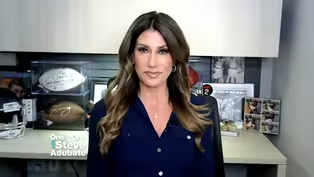
Fox5 NY anchor reflects on her career in sports journalism
Video has Closed Captions
Clip: S2025 Ep2838 | 9m 20s | Fox5 NY anchor reflects on her career in sports journalism (9m 20s)

The importance of bringing film & media to The Garden State
Video has Closed Captions
Clip: S2025 Ep2838 | 11m 3s | The importance of bringing film & media to The Garden State (11m 3s)
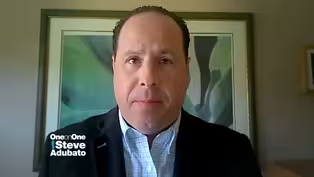
President of ArtPride discusses preserving the arts in NJ
Video has Closed Captions
Clip: S2025 Ep2838 | 8m 3s | President of ArtPride discusses preserving the arts in NJ (8m 3s)
Providing Support for PBS.org
Learn Moreabout PBS online sponsorship
- News and Public Affairs

Top journalists deliver compelling original analysis of the hour's headlines.

- News and Public Affairs

FRONTLINE is investigative journalism that questions, explains and changes our world.












Support for PBS provided by:
One-on-One is a local public television program presented by NJ PBS