To The Point with Doni Miller
Toledo Metropolitan Area Council of Governments
Special | 27m 47sVideo has Closed Captions
TMACOG Executive Director, Sandy Spang discusses the future of our region.
TMACOG brings together counties, cities, townships, schools, and institutions across Northwest Ohio and Southeast Michigan to plan, protect, and propel our region forward. TMACOG Executive Director, Sandy Spang discusses the future of our region with Doni.
Problems playing video? | Closed Captioning Feedback
Problems playing video? | Closed Captioning Feedback
To The Point with Doni Miller is a local public television program presented by WGTE
To The Point with Doni Miller
Toledo Metropolitan Area Council of Governments
Special | 27m 47sVideo has Closed Captions
TMACOG brings together counties, cities, townships, schools, and institutions across Northwest Ohio and Southeast Michigan to plan, protect, and propel our region forward. TMACOG Executive Director, Sandy Spang discusses the future of our region with Doni.
Problems playing video? | Closed Captioning Feedback
How to Watch To The Point with Doni Miller
To The Point with Doni Miller is available to stream on pbs.org and the free PBS App, available on iPhone, Apple TV, Android TV, Android smartphones, Amazon Fire TV, Amazon Fire Tablet, Roku, Samsung Smart TV, and Vizio.
Announcer 1: The views and opinions expressed in to the point are those of the host of the program and its guests.
They do not necessarily reflect the views or opinions of WGTE public media.
Today, we turn our lens to the quiet powerhouse shaping the future of our region.
The Toledo Metropolitan Area Council of Governments, or TMACOG, is a coalition of communities working as one, recognizing that our biggest challenges don't stop at city limits.
TMACOG brings together counties, cities, townships, schools and institutions across northwest Ohio and southeast Michigan to plan, protect, and propel our region forward from the roads that we travel to, the water we depend on to the vision that guides our growth.
TMACOGis where regional voices become regional action.
This is a story of collaboration.
This is a story of a region planning its future together.
Today we're talking about team Acog with its executive director Sandy Spang.
I'm Doni Miller, and welcome to the point You can connect with us on our social media pages.
And remember, you can always email me at Doni underscore Miller at wgte dot org for this episode and other additional extras.
Go to wgte.org.
To the point I'm so glad you're with us today.
Joining us is Sandy Spang.
Sandy is the executive director of TMACOG I'm sorry.
That's a twist.
My tongue every time.
She's a regional, leader with deep experience in public service.
But you may remember her as Toledo's deputy director of economic development.
You did that for a while.
And an at large member of Toledo City Council, which you did for a very, very long time.
And, all of those things combined to show your strong record of collaboration, both locally and regionally, and you are a perfect fit for this amazing job at this amazing place called TMACOG.
And one of the things we talked about, in prep for this show and just a few minutes ago, in fact, was that we got to talk about TMACOG louder.
We gotta make sure people understand exactly what you do.
So why don't you tell folks?
Well, thank you for this opportunity to do just that.
I really appreciate it.
So yeah, quite an acronym.
I live in a world of acronyms now.
Doni but the Toledo Metropolitan Area Council of Governments is involved in, planning and education.
Funding and, and advocacy for our 83 governmental members and for the whole region.
And there's a couple distinctive to what we do.
One, you mentioned we take the regional view.
We know that roads and trails and waterways and rail lines do not stop at jurisdictional borders, that they create a network.
And having a stronger network is a part of that planning process.
The other thing they're distinctive is with those 83 governmental members, they're it's we're an apolitical organization.
They leave their politics at the door and come in and engage in decision making.
That's right for our region.
And I think that's really a powerful and important thing right now.
Yeah.
It's critical.
It's critical.
There there are tons of things that you're involved in.
But the three that I'd like to talk about today, are water transportation and economic development.
It's good with you.
Absolutely.
Let's start with water.
Okay.
So, you know, it's a lot of people are not aware that in our region, in the TMACOG, the seven counties that we do work in, and that would be Fulton, Lucas, wood, Ottawa, Sandusky and and some work in Seneca County now, two in economic development.
But, we have 19 drinking water facilities and 29 wastewater facilities.
And so and, you know, it's critical that we protect the health of our waterways.
It's critical to our future economic development, to the quality of life here in our region.
So we do planning both on the wastewater and the stormwater side.
Interestingly, on the wastewater side, we we have a nationwide problem that the EPA required licensed operators in the facilities across the country are expecting 50% of their licensed operators to retire in the next ten years, and the numbers were worse or worse regionally.
So this is a wonderful example, though, of the work that we do.
We didn't want those facilities competing with each other for licensed operators, and it's tough to become one.
You have to pass a very tough EPA test.
I think the wastewater pass rate was about 24%.
And you also have to have 20 to our 20 200 hours in a plant.
So we worked with Owens Community College to create a curriculum with one day in a plant.
We worked with the facilities to make that happen.
And over the last two years, we have graduated about 70 new trained folks as operators.
Many of them have passed the level one test, and some have gone on to pass the level two test and are employed throughout our region.
And, you know, we temporarily have this on hold because our region, unlike the rest of the country, has currently met our need for these great jobs.
So that's an example of the work we do.
Another, project I love to talk about, and it's 30 years old, is our student Watershed Watch.
And it has taken over these years 25,000 students.
So now we're on second generation students that are going out with their class and, and testing waterways near to home.
And they're looking for all sorts of things, nutrient levels.
They're picking up rocks to look for, macro invertebrates, which kind of give us a sense of how the health of the habitat is.
And they're learning firsthand that they're putting waders on and they're getting in that water, and then they're creating a presentation, sometimes very humorous and engaging, that they present to other classes that have done this at the Toledo Zoo every year.
And it's an incredible day.
And they also learn about about, jobs in, in this fascinating area of protecting, one of our greatest, assets.
So it's a great day.
Are you still responsible for maintaining the 208 plan?
We are.
We are.
The, EPA Ohio EPA has tasked us with being the 208 area wide water plant.
So that means that if there's going to be a development, that's going to, you know, put additional strain in the wastewater system.
We make sure that it's in alignment with the plans.
And by the way, we we do create those plans, and then we also determine which facility they'll, they'll be getting service from.
So that is a very important thing.
You know.
And storm water also is something that we have a unique program in.
We have many communities throughout our region that have a permit and ms4 permit from the Ohio EPA, and it requires a lot of educational, pieces to it.
You have to educate your staff.
You have to educate other, professionals in the community, and you have to educate the public.
And so, about 20 years ago, the communities that were, this was a new mandate, this and then, of course, an unfunded mandate to have this permit.
They came together and collectively we help them meet those educational requirements.
We have trainings for their staff.
We had a realtors training last year.
But if you see, television commercials, perhaps saying this is how you should salt your, drive or don't forget to pick up after your pet.
That is that's Lake Erie starts here.
And n w o h.org.
And it's an incredible education tool for our region.
And so we do that because, you know, here we are in the former Black Swamp where low and flat and stormwater can do a lot of damage.
It can it can, heavy storms can overwhelm, our treatment facilities put harmful nutrients into the water, create flooding in people's basements.
So stormwater management and wastewater management are two very important areas.
The work that we do, and you're doing lots of cross state, coordination around, not only that particular project, but managing the Lake Erie watershed as well.
Absolutely.
You know, that's what we need.
We need, and there have been others who have called for this over the years.
We need coordination throughout the watershed.
We tend to be in a spot where we're most impacted as sort of, you know, a lot of the algal blooms, they flow to us, but we need to be addressing the entire watershed, finding solutions together so that is progress happening.
Yes, I think so, I think so, I think one of the things that's important is to understand what the Great Lakes region.
Is means to us from a quality of life and economic development standpoint.
I think getting people to look at the student watershed, getting young people to understand from an early age that we have to protect these resources.
So I do think they're tough problems because you have to balance the interests of a lot of different folks, you know, agriculture and and so many different, you know, development.
But, that's why it's important that we're doing this work.
You know, we we have a slogan.
We empower connection and we amplify impact.
So that empowering connection is when we bring the region together to make decisions.
And we have a bigger impact when we advocate together.
You recently, advanced a recommendation for Lake Erie, to have greater strategies around a number of things, including the reduction of phosphorus runoffs.
What what recommendations did you guys come up with to manage that issue?
It's a huge issue.
Lots of attention being paid to that.
Yeah.
And you have to address point and non-point sources.
Yeah.
And so it is complex.
I will say that, I think one of the most important things is that these H2 Ohio dollars that we've had, are deployed.
Well, and so some of those projects have really made a difference.
But, the recommendations are broad.
So there are things that communities can do.
There are things that the agricultural community can do, to prevent, excess runoff.
So it's a pretty broad spectrum.
It's there's not one answer to this problem.
Lots of opinions, lots of approaches.
In the couple of minutes that we have left in this in on this first segment, tell me what the thing is that you're proudest of in terms of the water management piece of your work.
Yeah.
I think, I think right now I would say it's what we've done to be able to secure our region in having, qualified people in our plants.
You know, without those licensed operators, you're you're really not going to be able to function.
So I think that but long term, I think it is this constant reminder that our waterways are important to us in so many, many ways.
That's right.
And we one of the reasons I wanted to talk to you about this, and talk to you about it in our first segment, is that people take this for granted.
Yes.
They don't understand the complexity of the management of this huge system, and especially the role that team of tax payers plays in.
You know, if the Great Lakes region was one nation, it would have the third largest gross domestic product in the world.
No kidding.
And the potential of our waterways.
Ohio is the eighth ranked state for for maritime freight.
It's that remarkable.
It is.
I mean, just Cleveland Cliffs coming into our community alone added 100 ships to the Port of Toledo per year.
So this is key to so many pieces of the future of our region is the health of our water health.
And I think we have to I think we have to keep it at the forefront.
I think you're absolutely right.
Stay with me, will you?
We need to step away for just a moment.
But you go nowhere.
To me, community means connecting to others.
I'm Doni Miller and welcome to the Point.
I love PBS kids.
We're a community committed to education.
Discover new ideas, dive into exciting subjects, and engage with the world around you.
I would send them personally a t shirt.
Crime doesn't pay in the old West End.
Pass it on.
That's how we cleaned up the neighborhood.
Vision loss for people is not the end.
It's the story.
It's the next chapter.
WGTE Public media invites you to get out and play day.
Monday through Friday.
It's the 419 powered by WGTE with Matt Killam, Gretchen DeBacker, I'm Kevin Mullen.
What can people expect on the show?
Give me an hour.
A reminder of why this is a great place to live, work and play.
Where you come to watch, listen and learn.
Connect with us on our social media pages.
You know that.
You can email me at Doni underscore Miller at wgte dot org.
And for this episode and any others that you'd like to see, don't hesitate to go to wgte.org to the point.
I'm really sorry if you missed this first segment.
I hope that you did not.
Because what we talked about are some of the most important things in the management of our, of our lives that we take for granted and the organization that you probably don't know much about.
But we're on a quest to change.
That is TMACOG.
We are speaking to their executive director today, Sandy Spang.
You know, Sandy, from her longtime role as an at large city council member and, she served as the Toledo deputy director of economic development.
She has now taken that long term time of public service to TMACOG It's a great fit.
We went to break talking about water, but I would really now like to talk about transportation.
Yes.
And I think if there's one thing that maybe people do recognize TMACOG for, it's transportation because you often hear about funding coming through TMACOG for a lot of the larger projects.
Absolutely.
And transportation projects.
One thing I want people to know is that the way that that works is TMACOG does not make the decisions.
It is the member communities in our region that make those decisions.
Federal highway, allocates a certain amount of money for our region.
It's often in the 20 to $25 million range.
And for projects and those, projects that they're submitted, they go through Odot, the funding, and then communities submit projects.
Those projects are scored by a technical advisory committee made up of the engineers and technical folks in the communities.
And then there the final decisions are made by a board of elected officials.
Are we're a metropolitan planning organization, one of about 500 in the country that does this work.
And those decisions are made regionally.
And it is inspiring.
If you think, oh, does regionalism really happen?
You should see that scoring in those discussions, because it's really about what our transportation network needs and what's best for our region.
And it's just a really inspiring moment.
But I would also say that people are not as aware that we do a lot of transportation planning.
We're required by the Federal Highway Administration to create a long range plan that looks out at least 25 years.
We just completed our looking at a 2055 plan.
We had 700 public comments on that plan.
We recommended by Federal Highway for that.
I'm very proud of that because people want a voice.
People want passenger rail, which we are working very much in the passenger rail area, advocating for the proposed route from, Toledo to Detroit, which people are very excited about, potentially even to Columbus.
Trails are a part of that.
Freight is a part of that.
But I think here's one really interesting example that, transportation planning is a long range vision.
That's what's required.
You need a long range vision.
In 1996, our we began our long range plan, began to talk about a, a better route to get to Columbus.
Every day.
That conversation started in 1996, 30 years ago.
And now we have real action in it.
And I want to tell a little bit about that, because first of all, we're the only metropolitan area, the only region in Ohio that doesn't have a free flowing route to the 12th largest metropolitan area in the country to one of the fastest growing.
They expect to add a million people in the next 20 years, and double truck traffic in the next by 2050.
So all of those other areas have a zero traffic light route to our state capitol.
In our lifetime, 38 traffic lights have been added, you know, in Delaware County between like Waldo and I-270.
38 traffic light.
And so the the development that's happened in that area has slowed down our route to Columbus.
And so this is an area where the region has really spoken with one voice and amplified impact.
We had one meeting, for example, about this with state officials.
150 regional leaders came to the train station, to our offices in the grand lobby and spoke with one voice about this.
And now we have our our legislative delegation from this area, especially our Senate, our senators, Senator Reinecke, Guevarra and Hicks, Hudson, McCauley have really made this happen because they put into the last state transportation budget a mandate and funding for an actual plan for this actual engineering plans.
Next October, we will have phase one engineering plans for that route.
They've chosen sort of a middle area, in the in the, in the area of Ashley.
And, determining that that's going to be the most return on investment and that will connect directly over to, to route 71 so that they get us around those traffic lights.
Yeah.
Wow.
It's a bypass.
And so that is the result of 30 years of our region planning and advocating together.
And it's going to make an amazing difference, especially with the Gordie Howe Bridge opening and the expected traffic that's going to be coming through there.
It's going to make a real difference.
Well, in addition to, it being more convenient, it's a critical thing that needs to occur for Toledo and for Columbus.
And why?
Well, you know, we are the freight powerhouse of Ohio.
We have we are the crossroads of the longest East-West and north south highways in the country.
We have, one of the busiest, freight rail lines for freight in the country in the top five.
Our waterways, as I mentioned earlier, are a powerful freight mover.
And so and we have an airport that's increasingly bringing more freight in it, Toledo Express.
We are a freight powerhouse.
We open up markets for Ohio to the rest of the country.
So it's really important that we're connected to the development that's happening in Columbus, that we're unified as a state so that the state develops, to its its greatest potential for the residents.
I know we've been talking about this for decades here.
Yes.
And I know that no one really expects it to happen.
But you're here to tell us that we're well on our way.
Absolutely.
These these, you know, people will say, oh, plans.
Well, plans are how we get places.
You know, the Glass City veterans, bridge.
Bridge was in our plans for decades.
And these.
That's how transportation planning works.
You have to take the long view.
Right.
And and the fact that this region has spoken so consistently for so long with the support of other, other partners, like the, Toledo Regional Chamber of Commerce, tag no other groups that have had a strong voice in this.
We will achieve this.
Getting to the point of a plan that is critical to implementation.
You've heard the term shovel ready a lot, but that's how funding comes.
And so we there are a lot we don't there's a lot we don't know is potential.
It could be a toll road.
But we know that with the anticipated increase in truck traffic, we've got to do something.
And we think that this not only benefits northwest Ohio, but it also benefits central Ohio.
And we're working closely with our peer organization down there, the Mid Ohio Regional Planning Commission.
To, to make this a joint effort between our two regions.
So this may not be a fair question.
Okay.
All right.
But you have the money for the planning.
You're, you're you're moving well into the planning outside date.
When do you think that this whole project might be shovel ready?
Well, I certainly think that if the decision is made that tolling it is most appropriate.
You're going to see it move a lot faster.
Okay.
And otherwise, it's going to be less because of the revenue that would be generated from the tolls.
And, you know, and that can create benefits for the area that it goes through too.
You know, there can be sort of a residual benefit for them of tolls.
And if so, if that is determined.
And that's part of this study is a tolling study as well.
If that's the direction that it goes, of course we'd love it not to be a toll road.
So the reality is we need it to happen.
And so, that would speed it much quicker.
I don't think it's unreasonable to say it can happen in in this coming decade.
Maybe even maybe even a little less that that would really spur the development.
We could see 5 to 7 years is one estimate.
If we go with the tolling plan.
Otherwise, you're sort of up to, you know, the vagaries of of federal funding and where that comes from.
An example would be the Brant Spence Bridge down in the Cincinnati Cincinnati area connecting to Kentucky.
They've been they've known they needed that extra capacity for, again, decades.
But through, some of the transportation funding that happened through the bill, they were able to, get that funding for that bridge.
And that bridge is is going to be constructed.
Yeah, it's under way.
So, I think that it's going to be a matter of what we learn from that tolling, study and what the will of, you know, our state and federal legislators are to move this forward so the advocacy doesn't end, right.
Okay.
We, yes, will have engineering drawings, will say this is doable.
It takes into account all the environmental issues we'll be going through.
Some wetlands is a lot to a lot to consider.
So that will just mean we just renew the advocacy and push push forward.
Yes.
So we have a few minutes and I can't let you go without talking about economic development.
What are you doing?
That's wonderful.
Well, this is one of the things that really brought me to TMACOG.
About 30 years ago, our region realized that we should form an economic development district, which is a program of the Economic Development Administration.
There are about 400 in the country.
And, they about half the population lives in one.
We didn't act then.
We are acting now.
And what that will mean for us, there was a ten year study.
Those economic development districts, eds, they received over ten years, 71% of EDA grants.
79% of construction grants and three times per capita of the dollars we are on the wrong side of that fence and we need to move for that.
We're working hard on it.
We've just completed a five county comprehensive economic development strategy, a blueprint for economic development in our region, and that is for Lucas, Wood, Ottawa, Sandusky and Seneca counties.
That is going to be that's giving us real things that we can implement with metrics to measure them.
That's one step on the road to becoming an Ed.
But we are getting an indication that we could be designated as early as 2026 this year, and that is going to open up new resources in our region.
I do want to say the economic development work that we're doing is not duplicative of what all the other great economic development practitioners in our region are doing.
It's another resource for them to turn to, to fund projects and make things happen in our region.
So that's very exciting to me.
Another part of it is that we are doing, really one on one funding checkups with our members.
Our member communities, we visited now about almost 25 of them, to say, what do you need?
And we're watching for funding opportunities to come forward, whether it's federal, state or even, private, foundations, because we need to make sure that northwest Ohio is receiving funding for the regional priorities that we have.
You know, we've got about one minute left, but as a as a long term business owner, business person in this town, I have to ask you this question.
If there was one thing that everybody could do to support local businesses, to encourage local businesses, what would it be?
This is this may surprise you, but I would say show grace.
It is tough.
It is very, very hard.
It is whether it's food service or any other kind of local business.
They are they're dealing with more pressures than they've ever dealt with before.
Hiring pressures, higher costs of their products.
You know, it's the the world has really changed, and so be loyal, but be consistently loyal.
And if something isn't perfect, talk to them about it, but keep being a supporter.
Show great grace.
I love that I love that show.
Grace.
You'll come back and talk to us again and we would love to see you again.
We will see you next week.
Have a wonderful, wonderful day.
My name is Danny.
I'll see you soon.
Announcer 1: The views and opinions expressed in to the point are those of the host of the program and its guests.
They do not necessarily reflect the views or opinions of WGTE public media.
Announcer 2: To the point is supported in part by viewers like you.
Thank you.
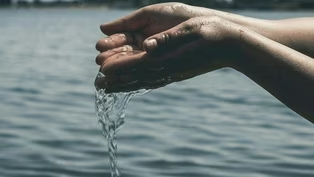
Toledo Metropolitan Area Council of Governments promo
Airs Friday, January 30th at 8:30 p.m. and repeats Sunday, February 1st at 11:00 a.m. (30s)
Providing Support for PBS.org
Learn Moreabout PBS online sponsorship
- News and Public Affairs

Top journalists deliver compelling original analysis of the hour's headlines.

- News and Public Affairs

FRONTLINE is investigative journalism that questions, explains and changes our world.












Support for PBS provided by:
To The Point with Doni Miller is a local public television program presented by WGTE