State of Affairs with Steve Adubato
Tom Bergeron; Cindy Shields; Asw. Heather Simmons (D) – NJ
Season 9 Episode 14 | 27m 27sVideo has Closed Captions
Tom Bergeron; Cindy Shields; Asw. Heather Simmons (D) – NJ
Tom Bergeron, Founder, CEO, & Editor-in-Chief of BINJE.com, analyzes the changing media landscape. Cindy Shields, Senior Policy Analyst for Early Childhood Advocates for Children of New Jersey, examines the rising cost of childcare and its broader impact on the economy. Asw. Heather Simmons (D) of the 3rd Legislative District discusses the unique needs of the southern region of New Jersey.
Problems playing video? | Closed Captioning Feedback
Problems playing video? | Closed Captioning Feedback
State of Affairs with Steve Adubato is a local public television program presented by NJ PBS
State of Affairs with Steve Adubato
Tom Bergeron; Cindy Shields; Asw. Heather Simmons (D) – NJ
Season 9 Episode 14 | 27m 27sVideo has Closed Captions
Tom Bergeron, Founder, CEO, & Editor-in-Chief of BINJE.com, analyzes the changing media landscape. Cindy Shields, Senior Policy Analyst for Early Childhood Advocates for Children of New Jersey, examines the rising cost of childcare and its broader impact on the economy. Asw. Heather Simmons (D) of the 3rd Legislative District discusses the unique needs of the southern region of New Jersey.
Problems playing video? | Closed Captioning Feedback
How to Watch State of Affairs with Steve Adubato
State of Affairs with Steve Adubato is available to stream on pbs.org and the free PBS App, available on iPhone, Apple TV, Android TV, Android smartphones, Amazon Fire TV, Amazon Fire Tablet, Roku, Samsung Smart TV, and Vizio.
Providing Support for PBS.org
Learn Moreabout PBS online sponsorship- [Narrator] Funding for this edition of State of Affairs with Steve Adubato has been provided by The Turrell Fund, a foundation serving children.
Holy Name.
Rutgers University Newark.
Operating Engineers, Local 825.
IBEW Local 102.
Celebrating it’s 125th Anniversary.
Delta Dental of New Jersey.
We love to see smiles.
Eastern Atlantic States Regional Council of Carpenters.
Valley Bank.
And by The New Jersey Education Association.
Promotional support provided by CIANJ, and Commerce Magazine.
And by BestofNJ.com.
All New Jersey in one place.
[INSPRATIONAL MUSIC] - Hi everyone, Steve Adubato.
We kickoff the program continuing to talk about media leadership with our good friend and colleague, Tom Bergeron, who's the founder, CEO and editor in chief of Business in New Jersey Every Day, otherwise known as BINJE, BINJE.
Good to see you, Tom.
- Good to be here.
- Tell us what BINJE is.
The website is up right now.
- So BINJE is essentially a business journal at heart, but we always describe ourselves as not what we cover, but who we cover for.
We're providing news and information about the business community, for the business community.
So it doesn't matter if you're a thought leader in a three person company or a 30,000 person company, we're giving you the information you need to run your business.
- Tom, you have covered business politics.
In fact, the convergence of business and politics plays itself out in the 2025 gubernatorial race between Mikie Sherrill, the Democrat, Jack Ciattarelli, Republican.
You actually were telling me before we got on the air, you were at an event last night, were they both there?
- They were both there.
- Okay.
The gubernatorial campaign, who becomes governor and business in New Jersey, you're on.
- Look, one of the key issues of the campaign is gonna be economic development in the state and the economic future of the state.
And both candidates laid out very specific ideas of what they wanna do.
Jack, perhaps a little bit more specific, talking about creating a department of commerce to help business in the state.
Jack very specifically talking about reducing the CBT or the corporate business tax.
He wants to essentially cut it in half to match Pennsylvania, going down 1% a year for six years.
Those and other ideas of reducing regulation, reducing taxes.
He said, you know, a lot of people feel you can't tax your way out of this.
You need revenue and his push is to create more revenue by being more business friendly.
- Tom, you talk to business leaders in the state.
How much do they talk about quote, tariffs, tariffs from Washington, tariffs from the Trump administration and its impact on business activity in the state and the overall economy?
- It came up a little bit last night, but you could have asked me about this on almost every topic.
The biggest answer that I get from business leaders is we have to see, we have to see, we have to see.
Things are changing so quickly.
Obviously if massive tariffs come in impacting their property, it's gonna have an impact.
But right now it's just been a lot of talk, forgive me, a lot of bluster.
They're waiting to see specifics that come out and when that happens, they'll be able to adjust.
Look, Steve, you've been doing this as long as I have.
All business leaders want is certainty.
And right now there's a lot of uncertainty.
- Tom, speaking of uncertainty, the graphic will come up right now, media leadership.
It's an ongoing series we're doing because the truth is we're a media organization.
We're trying to figure it out.
Producing this way, we'll continue to evolve and trying to find more economic, efficient ways of doing what we do.
You're doing the same thing only in a different platform.
How challenging is it to start up and to operate profitably your operation?
- Look, there's challenges in every business.
The media landscape certainly is different, but I view it more as an opportunity.
And you and I have both been around this block for a long time.
You have to understand that the media landscape has changed, right?
It's more niche publishing, you have to find your lane.
I don't believe that people don't want media.
I don't believe that people don't read.
People consume more information now than ever before.
The key is to find information that appeals to a certain level.
- Who would you say, like we struggle to ask ourselves on state of affairs and our other programs, who is our audience?
Sometimes it's challenging to figure that out, who's yours?
- My audience is the business leaders.
People in the C-suite, again, of companies of any size.
The people that are making decisions for their businesses, both internally and externally.
And it's that narrow focus that we have to go back to.
We constantly say, no, that's not a story for us.
This is a story for us.
So we wanna make sure that when people come to BINJE, it's information, it's news they can use for their business.
- You know, Tom, again, following up on this media leadership issue, one of the concerns I have along with countless other people in media, is not just the question of how much people trust us or not, and we're not a monolithic entity and our friends and colleagues and brothers and sisters in public broadcasting, we think they're the best, but they're challenged as well.
Along those lines, what do you believe we need to do as leaders in the media to frankly build back some of the trust that we have lost with all kinds of folks calling us publicly, often with a loud megaphone, the enemy of the people, which we obviously are not.
- Well, I think if anybody saw our work hours and our work ethic, they would understand that we're not doing this because we pick A and B.
To address the issue of supporting one side over the other, I always ask, I'm like, okay, so we're only gonna take advertising from side A instead of side B, and how do we pick which one's better?
So I think that's a little silly.
The biggest issue that we can do though is there's a lot of noise.
There's a lot of media.
Anybody with a website can produce information.
The key for media is to be truthful.
The key for media is to be straightforward.
Anytime we get too caught up into clickbait and catchy heads and catchy situations where you're trying to track people, it might work for one day or one event or one show, but it's a consistency over time.
Look, it's no different than your relationship with individuals or people.
It's what you do over time to build that trust.
So you're not gonna do it in a day, you're not gonna do it with a story.
You're not gonna do it in an event.
But if time and time again, people understand you to be knowledgeable and truthful and helpful, they're gonna keep coming back and you're gonna earn that trust.
The key is you can lose that trust in a second.
So you have to stay focused on making sure that you're accurate and straight down the middle.
- You know, but Tom, even though you're a business publication, you're concerned about the future of our quote unquote representative democracy.
How much do you foresee BINJE being engaged in writing about those issues, about our democracy in danger?
Graphic comes up, because that's a long standing series we've been doing as well.
Or do you say, no, this is business, that's politics since government.
- So look, our philosophy has always been, we will talk about any issue with the lens towards the business community for the business leader.
So when I cover Mikie and Jack at an event, whatever their social policy is, is very interesting and fascinating and important to the state.
But people aren't coming to BINJE for their social policy.
They're coming to business to learn about their business policy.
So we need to stay focused.
And in that regard, that's whereas the impact to democracy impacts business.
If you're talking about cutting funding to public broadcasting, okay, there's a business angle that's gonna hurt journalism, right?
A huge one, so that's what you're gonna get.
- And hurts the people we serve.
- 100%, 100%, but the key is to stay in your lane, let other people stay in their lane.
When media companies trying to be too broad based and cover everything, you're covering nothing.
- Last question, you've talked a lot and we've known you for a long time.
We've been business partners, we collaborate.
You are heavy into collaboration versus the pie is only so big, we've gotta get our piece, we're competing against each other.
You don't buy that thinking, do you?
- Not in the least bit.
And this goes back to when I was a sports editor at the Star Ledger.
Media, listen, we're all competing to break a big story, I get that.
But overall, we're all on the same team.
And quite frankly, that team's a lot smaller than it's ever been.
I don't believe that someone looks at one show versus another and says, I'm only gonna watch you and not B, we're gonna read by one publication, not the other, people are gonna go where they get trusted information.
And if there's 19 sites, that's all the better.
So my aim through all this collaboration, we're working out one with you and with other media companies.
We wanna make sure that people see all the good media is out there and show that we're doing this all together.
- We see it the same way my friend, that's Tom Bergeron, founder, CEO and editor in chief of Business in New Jersey Every Day BINJE, BINJE.
Thank you Tom.
- Pleasure to be here.
- Best to you and your team.
- Thank you.
- You got it, stay with us, we'll be right back.
(grand music) - [Announcer] To see more State of Affairs with Steve Adubato programs, find us online and follow us on social media.
- We're now joined by Cindy Shields, who is Senior Policy Analyst for Early Childhood...
Excuse me, at Advocates for Children of New Jersey, ACNJ.
Cindy, good to see you.
- Good to see you too, Steve.
Thanks for having me.
- Well, this is part of our ongoing series of programs, looking at the childcare situation in our state, in our nation, but primarily in New Jersey, quality, accessible, affordable childcare.
The website for the First 1000 Days Policy Coalition will come up.
First of all, what's the coalition and what is the role of ACNJ as it relates to the coalition?
- Sure, Steve.
So, the first 1000 Days Policy Coalition was created to ensure that all families in New Jersey have access to affordable childcare options in the setting of their choice with a qualified and stable workforce.
So ACNJ partners in that organization, in that coalition with the Center for Women and Work out of Rutgers, New Jersey Citizen Action, Moms First, and New Jersey Association for the Education of Young Children.
And I think there's a few other organizations in there.
- By the way, check out our website, SteveAdubato.org.
You'll see previous interviews we've done on the subject of childcare.
Cindy, let me ask you this.
There's gonna be a new governor in January, 2026.
If that new governor were truly committed to the cause of childcare, to the childcare crisis, and if not resolving it, improving the situation, what would he or she do?
- They would listen to our stories and they would listen to the families.
You know, we all know that childcare is very costly.
It's not affordable for families.
If we have supports for- - How expensive?
Is it 20% on average of a family's income?
Could it be that- - On average.
So can I give you some quick statistics?
- Please.
Please.
- To qualify for subsidy in New Jersey, families need to earn 185% or less of the federal poverty level.
So in New Jersey, that's $64,300 for a family of four, $42,300 for a single parent with only one child.
Cost of childcare annually is between $18,000 and $20,000 a year for one child.
It surpassed housing costs, even here in New Jersey.
So you're looking at over 20% for a dual income family sometimes and close to half of a single parent's income.
So it's really unaffordable to work and have children.
- What could the governor do?
- The governor can ensure that there's sustained funding.
So we know that ARPA dollars had grants for centers, stabilization grants, and those were very helpful.
But all that money ended a couple years ago.
So centers are struggling again.
They're struggling to retain their workforce.
They're struggling to retain qualified teachers.
There needs to be sustainable funding and it needs to be a priority because we know workforce is an issue in the state for all industries.
- Make it clear to folks, Cindy.
We've been talking about this with a whole range of people and the business community and others.
What is the impact on the economy of the state, on the economic vitality of the state, when families disproportionately parents, women, moms... Men as well, but disproportionately women, can't get affordable, who can't afford childcare?
What's the impact, especially if they can't work?
- They can't work.
So New Jersey alone loses $3.6 billion annually in lost tax revenue, employee productivity, payroll taxes, and quite frankly, just for families to have some extra money to put back into the economy.
Right now, they're making choices between whether they're gonna pay their rent or feed their family.
And that's not a choice any family in New Jersey should make, especially if they're working hard.
- Cindy, what is the role of the federal government as it relates to childcare in the state, meaning there are federal programs, funding of programs, cuts in federal programs that affect state policy and the people in a particular state?
I know that sounds convoluted and complex, but what do you believe the impact of what's going on in Washington has been on childcare in the state of New Jersey?
- It's very complex.
So one of our Head Start offices was shut down.
So we have a large number of Head Start programs that have lost their supports.
They're sending emails into cyberspace and they're not getting any responses.
- Are you mentioning Head Start because that's a federally funded program?
- Federal.
Yeah, it's a federally funded program, but it impacts the greater economy because those parents may not have a place to go to work.
Their funding has been flat.
They're not gonna be able to compete with increases in costs.
We all know our costs are rising every day for everything.
So that impacts the greater good.
- Let me ask you this.
So there're gonna be debates and we're gonna have in-depth interviews with Congresswoman Mikie Sherrill, the Democrat, former state legislator, Jack Ciattarelli, the Republican.
We're gonna have in-depth policy discussions with them and we'll ask them specifically about childcare.
We'll try to do our part and we'll try to have them be as specific as possible as it relates to what kind of governor they would be as it relates to childcare.
But without being too self-serving which I'm not gonna be, what the heck do you think we need to do in the media to raise the profile of the issue of childcare because it doesn't get talked about a lot?
It's not a hot issue.
Please.
- We need to make it a hot issue.
We need to shine a light on it.
You know, like I said, our state loses a lot of money every year.
I feel like if we could bolster childcare and the workforce, make it affordable for families, keep families working, and keep children learning, that would go a long way on return in investment.
- So I wanna be clear on this.
This is a policy issue, but it's an economic issue.
It's a quality of life issue.
It impacts our children.
It impacts our family.
It impacts our overall state.
This is not wonky policy stuff, is it?
- No, nope.
It's data-informed decision making.
- Say that again?
- It's data-informed decision making.
- Translate that.
- We have the data.
We know how much money we lose.
We know what children need to grow and develop at their best and reach their full potential.
And we know what families need to make it affordable.
We know what's broken.
We need to fix it.
- And we also know- Sorry, for interrupting.
We also know that employers face the potential of workforce shortages because the people they need to work don't have childcare.
Boy, this is all connected.
- Yep.
You just put it all together, Steve, right there.
- No, I didn't.
I'm just trying to make sense of it, Cindy.
And Cindy and her colleagues at ACNJ, Advocates for Children of New Jersey are frankly doing everything they can every day.
It's a great not-for-profit organization.
Check out previous interviews we've done with leaders from ACNJ.
And also, one more time, can we put up the website for the First 1000 Days Policy Coalition?
Cindy, thank you so much for joining us.
We appreciate it.
- Thanks a lot, Steve.
Have a great day.
- You too.
Stay with us, we'll be right back.
(grand music) - [Announcer] To see more State of Affairs with Steve Adubato programs, find us online and follow us on social media.
- We are joined for the first time by Assemblywoman Heather Simmons, who represents New Jersey's third legislative district.
Where is that Assemblywoman?
- We represent most of Gloucester County, all of Salem County, and the western side of Cumberland County.
- That's in South Jersey, I'm recording all the way up in North Jersey.
Assemblywoman, are we still one state?
I just wanna make sure we're all together in one state.
- We are absolutely one state.
I'm really proud to be the voice for a big chunk of Southern New Jersey in Trenton, but in my first term as I've gotten to work with my colleagues in Trenton, I can assure you we are one state.
- Talk about your top legislative priorities please.
- My top legislative priority right now is menopause.
Steve, I've been working on a package of bills focused on making sure that all perimenopause and menopause treatments and approved services are covered by all insurance carriers in New Jersey.
And to go along with that, making sure that providers have access to education, because for too many women, they are misdiagnosed, disbelieved, misunderstood in terms of the symptoms that every single woman over the age of as young as 35 will present with during the course of their lifetime.
- What are the implications of not being where we need to be as a healthcare system with women who are perimenopausal or experiencing menopause, please?
- Well, if you look at the statistics nationally, there are billions of dollars lost every year due to absenteeism by women who are unable to perform their job duties.
And when we take it from that and we look at interpersonal relationships, and mental health, and their ability to be their best selves in their community, anecdotally, the implications are much, much worse than that.
From a medical perspective, I've been working with ACOG, The American College of Obstetricians and Gynecologists on this.
And their perspective is that, if we don't properly address the causes and the treatments for menopause, then women spend up to half of their lives without estrogen, without the hormone, this and other hormones that they need to properly function.
And the cost to the medical system on that is much higher than the cost to treat the problem.
- You know, when we talk about cost, I wanna switch gears and talk about affordability.
Obviously, affordability a major issue in this campaign for governor who will be a new governor in New Jersey, taking office in January of 2026.
Do you believe the issues of affordability in our state are any different in the southern part of the state versus where I happen to be up north?
And if so, what are they?
- Well, if we look at the issue of energy affordability as as one example- - Sure.
- I would say that the issues in the southern part of the state, as in a number of other issues, is much higher because there simply isn't the capacity here.
There isn't the capacity statewide, but the capacity issue here is much greater than it is- - Capacity for?
- For power.
- Because?
- Because there just simply isn't the capacity present right now for the industries to come in and grow here.
If there's going to be growth in New Jersey, the growth's gonna happen in the southern part of the state.
- Are you saying that because there is land there, there is space there, there's opportunity there?
- All three.
All three.
What we don't have here is investment.
Investment in education, investment in transportation, investment in healthcare, investment in workforce development.
So when you say what's the difference in affordability between the north and the south, and the difference is a difference in opportunity.
- Assemblywoman, you are implying, if not going beyond implying that the southern part of the state on some levels getting the shift?
- I would say that that's true in a lot of cases because the money just isn't there for the southern part of the state.
- Yeah, but I'm trying to understand why?
Like what would be the reason or the reasons for government officials, public policy makers to give the shaft to shortchange the southern part of the state?
- I'm not suggesting that there's a nefarious intent here at all.
I think that traditionally the southern part of the state is the site for a lot of farming and a rural environment.
And a lot of these communities want to maintain that.
And therefore there is less investment in sewer and power grid and all of the things that go along with industrial investment in a community.
Right, arge- - I'm sorry for interrupting.
In some level, aren't southern New Jersey residents pushing back on some of that 'cause they don't want it?
- Well, that's exactly what I'm getting at.
That in order to preserve the rural culture of the communities, a lot of our municipalities are fighting back.
A lot of the local leaders here fight back against investment.
But then on the other side of it, say that there is no investment and what do we do about that?
So, we have a dichotomy here.
- So what do you tell them?
What do you tell local mayors, municipal officials, Assemblywoman, who say, we wanna keep it the way it is, but the way it is, as you so effectively articulated, short changes the southern...
It doesn't add up.
So what do you say to them?
- I think there are a couple of things.
I think first of all, we really need to look at the way we do master planning on a municipal and a regional basis.
I think that there are tools, and I have a bill out there that calls for this to provide tools for regional economic development planning so that the municipalities maintain control to say, okay, we wanna limit the amount of industrial investment that takes place here because of our rural environment, but we wanna identify the right places for industrial investment.
And on the other side of it, we need to work with the educational institutions in Southern New Jersey on things like workforce development.
So when we're talking about bringing in industry, we wanna make sure that the workforce in southern New Jersey is prepared to take those jobs and that we're not importing people from Delaware and Southeastern Pennsylvania to do those jobs.
- Before I let you go, to what degree have you communicated to the democratic nominee for governor, Mikie Sherrill, Congresswoman Sherrill about these issues?
- I have left her a voicemail, I'm excited to hear back from her and I'm excited to work with her as we go through this election.
South Jersey is poised to be a part of the state and the Democrat party throughout the state and I'm excited to work with her.
- Yeah.
Before I let you go, you admitted before we get on the air that you are a Philly fan.
- Yes.
- Philadelphia Philly's baseball, and I'm a Yankee fan.
And you also said you're a Philadelphia Eagles fan.
- Both true.
- The Fly Eagle, fly thing.
Is that real?
Is people care about the "Fly Eagles Fly" song?
- Absolutely.
It is probably one of the most popular songs that you hear in my part of the state.
- When are you gonna stop gloating over winning the big one?
- Never.
(Steve and Heather laughing) - I say this as a frustrated New York giant fan.
Congratulations, I have to say begrudgingly.
- Thank you.
Philadelphia and the region is a place of underdogs.
And we fought, we're scrappy down here and we fight like heck.
And I'm thrilled for Philadelphia and the entire South Jersey region.
- But you told me we're all one state, so why are you not rooting for the team that's based in New Jersey?
No, I'm only kidding.
I'm only kidding.
- That's a much bigger discussion than we have time to address.
- Yes, Philadelphia is a lot closer.
- Assemblywoman Heather Simmons, who represents the third legislative district down in the south, they matter.
- Thanks for your time, Steve.
- No, thank you.
We appreciate it.
All the best.
- Take care.
- I'm Steve Adubato, that's Assemblywoman, Heather Simmons.
We'll see you next time.
- [Narrator] State of Affairs with Steve Adubato is a production of the Caucus Educational Corporation.
Funding has been provided by The Turrell Fund, a foundation serving children.
Holy Name.
Rutgers University Newark.
Operating Engineers, Local 825.
IBEW Local 102.
Delta Dental of New Jersey.
Eastern Atlantic States Regional Council of Carpenters.
Valley Bank.
And by The New Jersey Education Association.
Promotional support provided by CIANJ, and Commerce Magazine.
And by BestofNJ.com.
- (Narration) Healing is never just about medicine and technology.
It has to go further than that.
It has to combine science with humanity.
It has to be our best medicine, combined with large doses of empathy, kindness, dignity and respect.
It has to be delivered by people who love what they do and who they do it for.
Holy Name.
Great medicine, soul purpose.
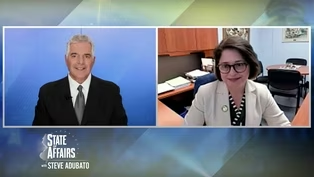
Asw. Heather Simmons addresses the needs of South Jersey
Video has Closed Captions
Clip: S9 Ep14 | 9m 59s | Asw. Heather Simmons addresses the needs of South Jersey (9m 59s)
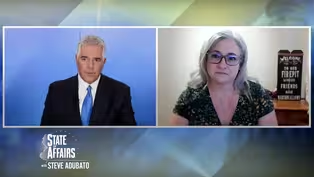
The economic impact of rising childcare costs in New Jersey
Video has Closed Captions
Clip: S9 Ep14 | 8m 36s | The economic impact of rising childcare costs in New Jersey (8m 36s)
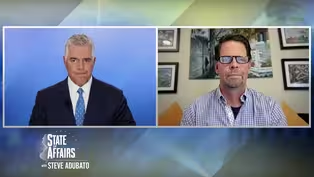
Founder of BINJE analyzes the changing media landscape
Video has Closed Captions
Clip: S9 Ep14 | 9m 42s | Founder of BINJE analyzes the changing media landscape (9m 42s)
Providing Support for PBS.org
Learn Moreabout PBS online sponsorship
- News and Public Affairs

Top journalists deliver compelling original analysis of the hour's headlines.

- News and Public Affairs

FRONTLINE is investigative journalism that questions, explains and changes our world.












Support for PBS provided by:
State of Affairs with Steve Adubato is a local public television program presented by NJ PBS