
Town Hall: Affordable Housing
1/10/2022 | 26m 46sVideo has Closed Captions
ncIMPACT hosts a town hall in Greensboro to discuss affordable housing.
Housing is fundamental to a person’s wellbeing, but many individuals are struggling and living in poor housing conditions. ncIMPACT hosts a town hall at the Union Square Campus in Greensboro to find out how communities can provide safe and affordable housing.
Problems playing video? | Closed Captioning Feedback
Problems playing video? | Closed Captioning Feedback
ncIMPACT is a local public television program presented by PBS NC
Town Hall: Affordable Housing
1/10/2022 | 26m 46sVideo has Closed Captions
Housing is fundamental to a person’s wellbeing, but many individuals are struggling and living in poor housing conditions. ncIMPACT hosts a town hall at the Union Square Campus in Greensboro to find out how communities can provide safe and affordable housing.
Problems playing video? | Closed Captioning Feedback
How to Watch ncIMPACT
ncIMPACT is available to stream on pbs.org and the free PBS App, available on iPhone, Apple TV, Android TV, Android smartphones, Amazon Fire TV, Amazon Fire Tablet, Roku, Samsung Smart TV, and Vizio.
Providing Support for PBS.org
Learn Moreabout PBS online sponsorship[upbeat ambient music] - NC Impact is made possible by funding from Civic Federal Credit Union, and is a PBS North Carolina production and association with the University of North Carolina School of Government.
- Hello and welcome to NC Impact.
We're in downtown Greensboro at the beautiful Union Square Campus.
We're here holding a town hall, taking a look at housing conditions in Greensboro.
We all know housing is fundamental to a person's wellbeing, and yet many people are struggling in poor housing conditions.
We'll find out how this community is providing safe and affordable housing.
This is NC Impact.
The federal COVID-19 eviction moratorium has ended, and we're seeing a surge in evictions.
In so many cases, those removed from their homes have nowhere to go because of the lack of alternative affordable housing.
But our NC Impact's, David Hurst shows us a local program that advocates for those facing eviction.
- [speaking foreign language] - [David] Francisco Gonzalez and her family have lived in the Jamison Homes Mobile Park in Greensboro for nearly 20 years.
- [speaks foreign language] - [David] But she and her neighbors are now facing eviction.
The mobile home community is expected to close because the property is under contract to a developer that plans to build apartments.
At first Gonzales in her family looked at other homes they could potentially move to an explored moving their mobile home to another piece of land, but quickly found out that moving would be very expensive.
- [speaking foreign language] - [David] Many like Gonzalez fine that stain Put in this hot housing market as often their best bet because of the shortage of safe affordable homes in the area.
- Because the housing prices are going up, then the rental prices go up.
So it's just out pricing folks in potential home ownership and in rental.
So it's just squeezing everyone from all ends.
- [David] Renee Norris with UNC Greensboro Center for housing and Community Studies says the rising rent prices is one of the reasons why Greensboro has a high rate of eviction.
[knocks on door] - Hello.
[David] She says it's only been made Worse by the COVID-19 pandemic and evictions have increased since the moratorium expired in August.
- A lot of landlords who have been waiting for quite some time to be paid.
So there's frustration on their end and a demand that they actually either get the property or get paid.
- [David] Norris overseas he eviction mediation program launched in December of 2020, the program helps tenants facing eviction reach an agreement and mediation with their landlord.
The program also makes sure those tenants are aware of funds that may be available through the emergency rental assistance program.
I think it benefits community because it stabilizes the housing.
It helps the children to stay in a place that they know and are safe and secure.
It helps older people who have come here and may have had something horrible happen that they're on a fixed income, but there are these resources, and to get their stories told and understood.
- [David] For Gonzalez, her community has reached an agreement with the property owner to postpone eviction until at least January of 2022.
She says, she's thankful for the support from local community organizations, such as the Center for Housing and Community Studies and Siembra NC.
- [speaking foreign language] - I am delighted this afternoon to be joined by Sofia Crisp, Housing Consultants Group Executive Director.
This organization provides financial wellness education and partners with local governments to offer down payment assistance.
Michelle Kennedy is a city of Greensboro's neighborhood development director.
She's also the former Executive Director of Interactive Resource Center, which worked with homeless people and Stephen Sills, the Center for Housing and Community Studies Director.
He's a UNC Greensboro researcher on affordable and healthy homes in North Carolina and beyond.
Stephen, I wanna start with you and I wanna pick up on our video and this issue of evictions.
It's one thing to hear that Greensboro has high eviction rates, it's another thing to unpack the data point that Greensboro has the seventh highest eviction rate in the nation.
What is it about the context of this housing market that makes that so?
- It's the lack of affordability in our area combined with low wages.
When we look at the earnings potential of the average worker here and the cost of living to live here, there's a gap.
So many people fall through that gap one paycheck, one medical bill, one car breakdown away from being evicted, unable to pay their rent or their mortgage even.
So that lack of affordability placed us, number seven in the country and number one in North Carolina for our eviction rate per renter household, according to the Princeton Eviction Lab.
Our numbers haven't gotten better since that study in 2016.
We saw that in the year prior to COVID, there were still 5,000 writs of possession issued in the county.
That's 5,000 Sheriff's lockouts for eviction in this area.
- Sophia jump in here for me, please.
We're here in Greensboro and not just because of the significant need, but because of the responses that this community has taken to try to meet that need.
In 2016, your voters are approved at $25 million bond, is that right?
- Yes.
- To increase efforts, to build and repair affordable housing.
And the Greensboro 10-year Housing Plan resulted from that work.
How do you think the implementation is going?
- In the area of home ownership is going great.
We took up a disaster that happened in 2018 and turned it into a huge success story.
The tornado that hit in 2018 significantly affected people living in some of the poorest zip codes in the city.
- Mm-hmm.
- And a year later, my organization launched something called hashtag 100 homes, hoping that a 100 of the 600 people that were affected by the tornado would wanna be on the path to home ownership, and that's exactly what 317 of them did in 2019.
- But your goal was a 100 and you ended up at 317.
- Yes, 317 in 2019.
- Wow.
- Home owners, significant percentage, maybe 60 to 70% in that same zip code, which was great.
- Hashtag, you rock.
- Yeah, thank you, thank you.
[chuckles] And then last year, you know, despite the pandemic, the numbers were even higher, they were 347.
So there's no lack of people that wanna be homeowners.
- Hmm.
- There's a lack of homes for them to purchase.
And the city has done a great effort in providing that gap, financing needed to help developers grow, even new developers, several minority developers even start their careers in developing homes, but there's not enough.
So there's no lack of effort, there's just not enough people who find it and are passionate about home ownership in areas of need and are willing to make a little bit less money on a home, but start people on the path to generational wealth by owning a home.
- Tell me a little a bit about the process of people coming together.
Who are you involving?
How are you involving them?
And what is the result?
And any one of you could answer that question for me.
- So I think that everybody sitting up here with you today have been working with each other for years and in different lenses and it's same tables, and it involves elected officials, it involves people in local and county government, it involves neighborhood associations, it really involves the citizenry of Greensboro to be at the table.
If we don't center the lives of those with lived experience, we're really missing the point.
We're currently looking at trying to establish our first permanent supportive housing development for high acuity folks who were transitioning out of homelessness.
There are huge gains in that because when you raise the floor, you raise the ceiling.
- I wanna piggyback on what she said about making sure that you're making decisions for people with them.
- Yes.
- It's town halls.
It's coming together sessions, it's a little bit of work, but it's necessary to work to make sure that we're not sitting here because we do this work assuming what people want.
You don't know what people want until you ask them.
- Has anybody tried to figure out the price tag?
What would it take to have an adequate supply of affordable housing in Greensboro?
- That's a huge question.
- I know, that's why I asked it.
- Hmm.
- Oh, I think that that's where you get into conversations around subsidies, around vouchers, around what kind of supports need to be built in on top of just market rate housing to help determine that.
That sounds like a great project for a researcher.
[laughing] - Sorry Stephan, I didn't mean to give you more work, but since you're here.
- Not at all.
I think that return on investment kind of question is key here.
But even more key is what is the cost for not providing more housing?
Our issue is both the economic input, as well as the expense.
- Yeah.
- It's the wages as well as the cost of living.
So if we don't provide good housing, if we have all of these health issues and food access issues, then we're going to lose even further in attracting good business, attracting living wages and addressing it on the front end.
And I think that's gonna cost us.
When we have a vacant property in a neighborhood, it impacts the city and its revenue and its tax revenue.
It also impacts the values of the homes around it.
And there've been some good studies that look at what is one vacant property?
What is 10 vacant properties cost a city in terms of lost potential revenue.
But that overall cost, we have 45% of renters and 25, 27% of homeowners who are cost burdened, spending more than 30% of their income on housing and housing related expenses.
If we could bring those numbers down, if we could make it so that people could afford the places they live, what kind of new economic impact would that have?
I think it would pay off in the long term.
The dollar invested in the five returned would be worthwhile.
- So I wanna leave you with an opportunity to look forward a bit, parenting your crystal ball, to the extent that you remember to clean it recently.
What are you hopeful about?
- I'm hopeful that the city will continue to partner with developers and make it more attractive for them to wanna build.
We have some great startups and we have some great existing nonprofits and for-profits.
I think the more the city engages with developers, the more we'll be able to get some more single family housing that's available for homeownership.
- Excellent.
- I think I'm hopeful that city county partnerships continue to grow and evolve.
They're so critical to expand the resources that are available.
And to look forward to another housing bond so we can continue to have transformative projects to move us forward as a community.
- I think we finally have the alignment between the need that has been there, the nonprofits and governmental agencies that have been trying so hard to work together and the resources beginning to flow that can address some of the underlying root causes that have created the situation that we're in.
- It is clear that it's not coincidental that for each of the three of you, what leaves you hopeful is the ability to work together in partnership, in collaboration with others.
I wanna congratulate you on how far those partnerships and collaborations have brought this community and tell you that we'll be watching you very carefully and wanting to profile the next great leap forward.
Please audience, join me in thanking this panel.
[crowd applauds] Living in substandard housing is often the only option for those seeking affordable housing, but one local collaborative found that improving housing leads to better health outcomes.
NC Impacts, David Hurst has the story.
- There are shards of glass.
- [David] Sel Mpang grew up in the Cottage Grove community, but it wasn't until she went to high school across town when she realized other neighborhoods seem to have more access to food, transportation and healthcare.
- It's just really, really sunk into me that we were disinvested in, like they didn't care about us.
And we were kind of forgotten about in terms of what can be developed in your community and your neighborhood.
- The Cottage Grove Neighborhood in Southeast Greensboro bustled with development in the 50s and 60s, but over time, businesses closed and housing conditions declined.
- It's a place that everyone went to, it's so vibrant.
And as a young person, I also want that for the next generation as well.
I want this place to be remembered as the place to be.
- You got kids down there.
- [David] Josie Williams is the Executive Director of the Greensboro Housing Coalition and has been working in the Cottage Grove community for years.
- You can walk through here, it's a pathway.
- [David] She says as housing conditions declined in the community, so did health outcomes.
- And when we talking about affordable and decent affordable housing, we're talking about housing that does not make you sick.
We see cases all the time where someone's unit is literally causing them a respiratory issue, it's complicating their asthma, it's exasperating the asthma, making it worse.
- What the priorities are in Cottage Grove - [David] As a result, a group of residents teamed up with several nonprofit organizations to revitalize the Cottage Grove neighborhood they called the work Collaborative Cottage Grove.
- People are now understanding in order for us to make the changes that the residents are envisioning, you have to look at what are those social determinants of health and you have to look at things from a holistic perspective.
Otherwise we're not gonna be addressing the root causes and then change will not come.
- A lot of the work in the community has focused on improving living conditions, including making repairs and upgrades that prevent health problems down the road.
- Rather than have the child go into the emergencies room and spend $5,000 for an emergency visit, spend $4,000 to fix the house and they never have to come back.
- This residential [indistinct].
- Those who live in the Cottage Grove neighborhood are actively involved in the work.
Monthly meetings give residents the opportunity to express their community's biggest needs.
- Their voice is at the center, because there'll be the ones leading us to kind of the end goal that we're trying to reach is just a healthier and safer community.
- Yeah, I have never seen anything like this.
- [David] For Sel Mpang, a lot of her work right now is centered around Bingham Park.
It's a city park in the Cottage Grove neighborhood on top of an old toxic landfill that is full of environmental hazards.
- And it's not even usable.
And I don't think anyone bringing their child to this park, would, anyone have any part of Greensboro wouldn't wanna bring their child here to play.
And that's an issue.
- [David] State officials planned to clean up and restore the park, and Mpang says it's a positive step forward for a community that many feel has been left behind.
- Things are gonna change, and I'm really excited to be a part of that change in that momentum and that movement.
- I am honored to be joined by Kim Cameron, North Carolina, A&T Real Estate Foundations Executive Director, and the Chair of the North Carolina housing coalition.
Welcome Kim.
Sel Mpang Greensboro Housing Coalition Community Engagement associate, welcome.
Great to have you.
And Antonia Monk Richburg Cone Health Foundation's Vice President and Chair of the Greensboro Housing Coalition.
Thank you for being with us.
- Thank you.
- When you have this kind of tight housing market, it means that there are fewer options for people who are toward the lower end of the income spectrum.
Talk a little bit about the challenge of substandard housing in the Greensboro region.
- So when you add the problem of substandard housing to affordable housing, really what substandard housing means is that the conditions of the house endangered the general health or welfare of that occupant.
So you look at substandard housing along with affordable housing, that's a result of segregation, primarily racial segregation.
And individuals and families that lack the housing mobility, which means they lack the financial needs to increase or better their housing situation.
And then you also have homelessness that is in there.
And all three of those are primary the driving factors.
So again, when you combine that lack of good quality affordable housing, the tight rental market, that's as a result of the skyrocketing real estate market, and basically, when you look at the rental market, the landlords are not motivated to maintain the houses properly, or their rental markets properly because they can get somebody else in there that needs the housing, so why should they fix anything?
So you have all of that in there and you look at the substandard housing, or the challenge of substandard housing in Greensboro, and it is prolific right now.
- Mm-hmm.
Antonio, we could spend a lot of time talking about housing in of itself, but part of why this is such a critical conversation is housing isn't just about housing, help us think through the health impacts that you observe for residents who are living in substandard housing.
And then what is the community doing to mitigate these impacts?
- Thank you.
So when I think about health and housing, the first thing that I think about is the fact that individuals spend about 90% of their time inside and of that 90%, majority of that is inside their homes, and so if you can imagine what it's like to live in a home that substandard that has leaky roof or has roach infestation, or maybe there's mold.
It's impossible if you're spending almost 90% of your time inside and about 85% of that time in your home and your home is substandard in that way, in terms of all of the negative impacts for health, then what we start to see is individuals who have asthma issues, people who are having trouble with respiratory diseases, we have individuals who are struggling with chronic diseases that can't be fully addressed because they have to continue to go back to that same home to live in and because we live in a country where people still think that affordable housing is a privilege and not a right, then they don't have other options.
- Mm-hmm.
= And because they don't have other options and they're grappling each day with the struggle of what to do because they're in a place and they can't afford to live anywhere else, but it's affecting their health.
And so they have to make those hard decisions as to what can they do without, so that they can have better housing.
And unfortunately for so many of them, there are not many options.
And so then we see them struggle.
- Sel, health is obviously critical in this conversation, but so our educational outcomes, and the reality is as we think about helping to move people up the income continuum, the level of educational attainment matters.
And so to the extent that your housing conditions create barriers to educational attainment, they actually are limiting your life opportunities.
So talk to us about that a little bit and other forms of wellbeing for residents who are living in substandard housing.
- Yeah, so one of the benefits from having education, I know that the Greensboro Housing Coalition, we have two healthy homes inspectors that are HQS certified, and when they do come in to the homes, they assess the home and they are also inform those that they are visiting, this is what's going on with your home, this is what you can do to advocate for yourself.
And also like supporting them while they're advocating with their landlord as well to fix the issue.
And I think education is just really important, I'm always a firm believer that knowledge is power, and the more that we know, the more that we feel comfortable in our voice and who we are and knowing our value.
A lot of the times, you know, being a resident of Cottage Grove myself and living in east Greensboro, we become so conditioned to our environment.
And with that, we think that is the only thing that is available for us.
And so everything else is out of our reach and not meant for us.
- Mm-hmm.
- And so we're excluded from that.
And, you know, coming from being a refugee background and going to college, I see how that has changed my life and changed my family's life as well, because I can advocate for them and be there for them.
And so that's the power of education and getting outside of those walls at such a young age was really important.
And I hope that many young children have the opportunity as well, so they can know that there's so much outside of their current condition right now, and that they deserve so much more.
And that's just the power of education.
- Questions from the audience.
- Good afternoon.
Thank you all for being here and thank you for this conversation.
Antonio, you brought up something I was really gonna bring up really truly is the red line and piece.
That is what we really need to focus on because those policies in some regard are still in effect today.
Okay.
And our communities have suffered because of that, because we can't get the commercial or the retail development because of the stigma attached to the community of being high in crime, low in poverty and high in unemployment.
And until we change the economics of the people who reside in those properties to raise up their level of incomes, all those things that you came and talk about can not happen.
Okay.
- Yeah.
- That's what we need to first strive for.
- Hmm.
- Is to get income raised.
So all people who are interested can own homes or live in a town home or pay a decent rent so they're not subjected to a slumlord.
That is the policies that we need to be working towards change, policies are what we really need to be focused on, we get to get some of these things changed.
What do you think is the best way to move us forward on that?
- Anybody jumped in.
And so I love the question because it's saying we can't have conversations about housing that are divorced from conversations about income.
- I don't know that I have the answer, but the first thing that came to mind when you said that is a mindset, changing of our mindset, because I think until our leaders first acknowledge the wrongs that have been done historically in our community and then make an effort to change that, then nothing will change.
And so I think that that's the first step is for our community to acknowledge the wrongs that have been done, the injustices that had been done for decades in our community, and then to make an effort to make changes there.
And I think that that's gonna come with great leaders like you leading the charge to make that happen at the city level so that those of us that are on the ground can make that happen.
- Thank you all.
- Thank you.
- For a very engaging conversation.
Thank you all for joining us.
This has been a conversation about a really big issue as the questions make clear, the panelists have made clear, but it's also true that there are creative solutions out there, and we're hoping that you and your community will watch Greensboro, learn from Greensboro and figure out what you need to do to make housing more affordable [upbeat ambient music] for all of your residents.
Thank you so much.
I'm Anita Brown Graham, this is NC Impact.
[crowd applauds] ♪ - [Narrator] NC Impact is made possible by funding from Civic Federal Credit Union, and is a PBS North Carolina production and association with the University of North Carolina School of Government.
[upbeat ambient music]
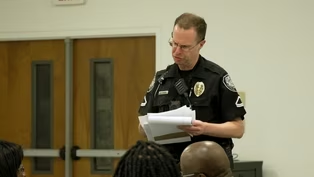
Collaborative Cottage Grove improves housing outcomes
Video has Closed Captions
Clip: 1/10/2022 | 3m 3s | ncIMPACT features a resident-led group that is improving housing and health outcomes. (3m 3s)
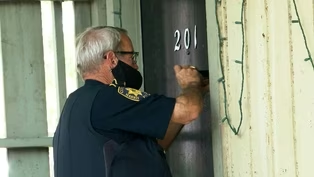
Evictions intersect with lack of affordable housing in Triad
Video has Closed Captions
Clip: 1/10/2022 | 2m 50s | ncIMPACT highlights a program that is advocating for renters facing eviction. (2m 50s)
Preview | Town Hall: Affordable Housing
Preview: 1/10/2022 | 20s | ncIMPACT hosts a town hall in Greensboro to discuss affordable housing. (20s)
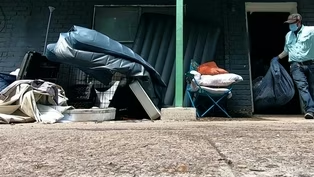
Rising evictions amid an affordable housing crisis
Video has Closed Captions
Clip: 1/10/2022 | 24m 1s | Panelists join host ncIMPACT Host Anita Brown-Graham to discuss the rise in evictions. (24m 1s)

Solutions to improve housing and health outcomes
Video has Closed Captions
Clip: 1/10/2022 | 26m 12s | Panelists join Anita Brown-Graham to discuss improving housing and health outcomes. (26m 12s)
Providing Support for PBS.org
Learn Moreabout PBS online sponsorship
- News and Public Affairs

Top journalists deliver compelling original analysis of the hour's headlines.

- News and Public Affairs

FRONTLINE is investigative journalism that questions, explains and changes our world.












Support for PBS provided by:
ncIMPACT is a local public television program presented by PBS NC