
Town Hall: Coastal Resilience
1/3/2022 | 26m 46sVideo has Closed Captions
ncIMPACT hosts a town hall to explore solutions for protecting our coastline.
Our coastlines are a valuable asset to our state, but they are threatened by natural disasters and flooding. ncIMPACT hosts a town hall on the campus of UNC Wilmington and explores how communities can bounce back and plan ahead for future storms.
Problems playing video? | Closed Captioning Feedback
Problems playing video? | Closed Captioning Feedback
ncIMPACT is a local public television program presented by PBS NC
Town Hall: Coastal Resilience
1/3/2022 | 26m 46sVideo has Closed Captions
Our coastlines are a valuable asset to our state, but they are threatened by natural disasters and flooding. ncIMPACT hosts a town hall on the campus of UNC Wilmington and explores how communities can bounce back and plan ahead for future storms.
Problems playing video? | Closed Captioning Feedback
How to Watch ncIMPACT
ncIMPACT is available to stream on pbs.org and the free PBS App, available on iPhone, Apple TV, Android TV, Android smartphones, Amazon Fire TV, Amazon Fire Tablet, Roku, Samsung Smart TV, and Vizio.
Providing Support for PBS.org
Learn Moreabout PBS online sponsorship- [Narrator] ncIMPACT is made possible by funding from Civic Federal Credit Union, and is a PBS North Carolina production in association with the University of North Carolina School of Government.
- Hello and welcome to ncIMPACT.
We're here on the beautiful campus of the University of North Carolina, Wilmington.
We're hosting a town hall that's taking a look at coastal resilience.
We'll find out how communities bounce back and plan ahead as natural disasters threaten our future.
- Hello and welcome.
We're so happy you've joined us today on this beautiful campus of the University of North Carolina, Wilmington.
This is going to be a special moment where we will hear from distinguished panelists, and also have the opportunity to hear your questions and to get your input.
Our coastlines are not just beautiful, they're a valuable asset to our state.
But we all know that they are threatened by natural disasters and by flooding.
We also know that what it will take to build resilience will be not just good ideas, but a lot of resources.
Indeed, one recent study suggests that it could be 36 billion, that's with a B, dollars just to protect the coastlines of our state, our North Carolina.
ncIMPACT's David Hurst has had a chance to talk to some people who have been affected by these natural disasters.
Let's hear their stories.
- Maybe six inches higher.
- [Reporter] Every time a storm rolls through the town of Fair Bluff, Al Leonard is reminded of 2016.
- Everything in our town hall that was chest level and down stayed underwater for two weeks and was destroyed, so we had nothing.
- [Reporter] Water from the Lumber River flowed into the Columbus County town, and flooding from Hurricane Matthew destroyed almost a quarter of the homes and most of its businesses.
One of those businesses was Mike Mike's Computer Repair Shop.
- Emily, who runs the pharmacy next door, we both came down, literally couldn't believe it.
Heartbreaking.
- [Reporter] Two years later in 2018 when Hurricane Florence hit, there was little left to destroy.
- Those two back to back that quickly was more than anybody can imagine.
- [Reporter] Like many communities in Eastern North Carolina, the town of Fair Bluff has struggled to bounce and build back after Matthew and Florence.
The town's population of about 1,000 people fell by about half following the storms.
- We've told everybody, the only business that came back to downtown Fair Bluff was the US Post Office.
- That beautiful window, so all that plaster work I still haven't repaired.
- [Reporter] About 70 miles east, in downtown Wilmington, most businesses have survived the storms but many are barely holding on.
Gwenyfar Rohler is the managing partner of Old Books on Front Street.
Having lived in Wilmington since 1980, she's experienced her fair share of storms.
- The fan in the ceiling... - [Reporter] But she says nothing was like the flooding experience during hurricanes Matthew and Florence.
- Books are not a great thing to combine with water and wind.
And we fear flooding both from below and above.
- [Reporter] Rohler lost thousands of dollars worth of inventory, as the storm surge from both hurricanes overwhelmed the Cape Fear River, pushing water into downtown.
- We're working on these problems.
I'm seeing them with greater intensity and greater frequency, and it's an ongoing concern for us.
- [Reporter] And it's an ongoing concern for towns like Fair Bluff, that find themselves at a crossroads.
Do they rebuild or move on?
For Al Leonard, he says the choice was made clear after many homeowners decided to rebuild instead of move.
- The fact that those people wanted to come back and give Fair Bluff another chance, they wanted to live here, this was their home, that's a reason I come here all the time and try to make Fair Bluff have that better future because there's some people that want that better future.
They voted with their feet by staying here.
And five, six, seven, eight, along Main Street.
- [Reporter] He says plans for that better future include turning the flooded out downtown into a park that can withstand flooding, and building a new downtown a few blocks away on much higher ground.
- If we're not resilient, we have no future.
If we are resilient, we've got a chance at a future, and maybe even a better future.
- I'm delighted to be joined by this distinguished panel to talk about this issue of resilience.
And hopefully, to talk about it in a way that helps the rest of the state understand why it's so important to this region.
I want to start with you, Rob.
Help us understand: When we talk about a resilient community, what does that mean?
- Oh, it's obviously...
Thank you.
And good morning, good morning to everyone here.
I'd like to just take a moment and recognize Chancellor Sartarelli, who's here in the audience today, and thank you very much for the use of UNC, this beautiful campus, and ncIMPACT.
Thank you so much for your interest in all of this.
A resilient community is a lot of different definitions.
I, personally, think it has to do with the ability to be able to prevent, withstand, respond to, and ultimately recover from a major disruption.
And that would be described as a natural disaster, or a pandemic, or changing climate; anything that will disrupt a community and their ability to, again, withstand it and recover.
- So, Jenny, you talked about resiliency being the ability to leap forward earlier.
How do you build consensus about what that looks like?
- That's a great question.
So any more, it seems, when we define coastal resiliency, we're talking about the impacts to property, public infrastructure, and natural ecosystems.
That seems to be where, at least, the three camps come.
And, of course, that's where a lot of the tension arises because when you bring up protecting private property and public infrastructure, a lot of that protection comes from natural systems that we're losing at a rapid pace.
Land use laws, and degradation of the ecosystems themselves, we lose those natural buffers.
So that's one piece of it, I think, that... And that raises up the issues of how do we zone in a more holistic way, where we consider the impacts of that particular development on its surrounding properties?
And so, I think my answer to the question of, "how do you build consensus?"
I come from a collaborative governance perspective, so it's bringing everyone together, it's community engagement, it's providing forums like this to educate but then bringing all of the big stakeholders together in a room to talk it out, to hash it out, to work through the points of disagreement and find a common ground.
- Clifford, I'm going to give you a chance to answer the same question about where you see the tensions, and what are the opportunities for bringing people together to create some kind of common vision and consensus agenda?
And while you're answering the question, those of you who have questions for the audience, please go ahead and make your way to the microphone.
- Okay, I think that the neat thing is that there's plenty of opportunities, and I believe that one of the great things that we're doing here in New Hanover County is we are building consensus.
We are building bringing people together.
An example could be the New Hanover County Resiliency Task Force.
We have over 700 people from different organizations and communities who were teaching everyone how to look at life from a resilient perspective.
For example, everyone in the county has been trained through CRM, Community Resilience Model, which talks about how to look at people that recognize that trauma has affected them, and how to look at them from a different lens.
So I think that there's a lot of opportunities for us to be resilient and [murmurs] consensus.
One of the things that we did here, they established what is called the North Carolina Disaster Recovery and Resilience Alliance, which was made up of mayors from all of the other areas throughout the area.
And we all pulled together and said, "Okay, here's what we need to do "to make sure that we continue "to be resilient in the days ahead."
- So recognizing that this has to be a regional approach, which I think a lot of communities miss from time to time.
Given the interrelatedness of our physical attributes, if your neighbors to the left or the right aren't paying attention to these issues, whatever you're doing is going to be mitigated, right?
Impressive.
Audience, questions for this great panel?
- [Audience Member] Good morning.
I am so glad that both Jennifer and Rob mentioned the issue of planning and zoning.
I think this is a struggle that we all have living in this community.
I live in Surf City.
At what point do we start talking seriously about the need for planned migration for those properties that just cannot be saved, no matter what hardened structure, no matter what dune you put in front of it?
It's a...
I wish it were something that wasn't going to happen in my lifetime, but it absolutely will.
It is coming fast, and I'd love for your all's perspective on how...
When you talk about consensus building, it is, to my mind, the most difficult thing that we can face right now is, how do you encourage that, incentivize it?
- And you thought I asked the hard questions.
- I'm sorry, I missed your name.
- [Audience Member] Anne.
- Anne, great question.
The answer to that is it's already happening.
Those kinds of discussions are happening.
Certainly within county, city governments, up and down the entire coast.
And I know in New Hanover County, which I can speak most specifically to, we have a unfortunate situation that's happening, that is driving that conversation, which is the federal government making the clear move to want to back out of beach re-nourishment.
Again, an issue that we're still waiting to see how, if there's some way we can recapture it.
But they have prompted a very vigorous debate within our own planning and zoning, and elected officials.
What happens to us if we don't have the $37-38 million to re-nourish our beaches?
Where does that go?
Well, the truth is it falls back on the community and on...
The local community and on the state, and that's going to change the balance.
And so, to your point of, how do we move off the coast there?
It's going to put a lot of pressure on the insurance companies who continue to insure properties that are clearly in a danger zone.
It's going to change that dynamic a lot.
Again, I hate...
But so much of my life, it boils down to the money.
And when you finally get to that point where it makes no sense to the property owner, that's going to be the biggest driver.
Although, we can certainly move that conversation along by, again, being intentional as to where we plan and zone and allow, and the type of structures that they have.
The second part of that is preserving natural spaces.
Here, in New Hanover County, we only have 199 square miles, dry square miles, there.
So being very careful about leaving open spaces, natural spaces, that allow Mother Earth to continue to do what they need to do and absorbing.
That factors into this conversation as well.
- Clifford, I'm going to end with you and give you a chance to tell us, really quickly, what gives you most hope on this topic?
- What gives me the most hope is people working together.
What gives me most hope is, and you shared it, not only just bouncing back but bouncing forward.
And we have a community that's going to be bouncing forward, and I'm excited.
I'm excited about where we are, and all the great things that will come about as a result of the disasters that wake us up.
- I'm excited too, and incredibly impressed by the level of participation you all have articulated and the willingness to wrestle through the tough decisions.
There will be tensions, no question about it.
We're asking people to think fundamentally differently than they have had to think before.
But I think the rest of the state will look to you as an example for how to do that work.
Thank you all very much.
Please join me in thanking this panel.
[audience applauding] It's clear that there is a growing need for resiliency in this region.
It is also clear that innovative solutions are on the rise.
Let's take a look at David Hurst's conversation with people across the region.
- [Reporter] After starting at NC State, Nicholas Deosaran transferred to UNC Wilmington because of the new coastal engineering program.
- I looked around to see what other engineerings there were, and I saw UNCW had this new coastal engineering program.
I was like, "huh, that sounds interesting.
"Let me look into that."
- [Reporter] Growing up in Trinidad and Tobago, he was well aware of the impact of coastal erosion at an early age, and now wants to be a part of the solution on the North Carolina coast.
- Sea level rises every year.
We have crazy climate.
Look at the hurricanes we've been having the last couple of years.
Look at Louisiana, it's just been bombarded with hurricanes for the past year.
- [Reporter] Dr. Joseph Long is the director of the coastal engineering program at UNC Wilmington.
He says the program is preparing students to address the needs of coastal communities in the midst of climate change.
Long says with the issues facing our coastline, there's a growing demand to build a coastal engineering workforce.
- When we think about coastal resilience, and we think about we need to prepare, we need to adapt, we need to bounce back, we need to learn from that and adapt better and bounce back faster.
And so, it's a loop and we're continually learning more.
And these students are being equipped with skills in terms of field measurements and modeling techniques.
And we really try to present them with the big view of the problems that they need to solve.
- [Reporter] For students like Ashley Holsclaw, the program allows her to take part in field research, and she now views the beach in a brand new way.
- I can define the different parts of the beach.
I can look and see what is going on, tell like what the tides are, what different processes are happening with longshore transport and all of that kind of stuff.
So I find it really cool just being aware or being able to process what is going on around me.
- [Reporter] The coastal engineering program also recently scored a grant to study how barrier islands will be impacted by climate change and future storms.
Most of the work has focused on Masonboro Island, where students and faculty will research the erosion and recovery cycles of barrier islands.
- We are witness to nourishments that go on.
We are witness to the storm impacts to these islands.
And our students go to those beaches and they collect measurements.
This is the place for them to get both the classroom and the hands-on experience.
And so, I think I venture to say they'll, hopefully, be more well-prepared than I was when I entered the field, because I didn't have all of those opportunities.
- [Reporter] It's work that makes students like Nicholas Deosaran excited about coming up with solutions to some of the challenges our coastlines are facing.
- What excites me about the future of our continuous work is that knowing that I'm going to be making a huge impact with helping, either assisting with sediment transport, erosion, trying to mitigate all of those things, knowing that I'm helping, instead of just like doing research and just moving on.
I actually want to be in the field, working and fixing the issues.
- I'm pleased to be joined by these distinguished guests.
Chad McEwen, who's the Pender County manager, and one of the individuals credited with creating the Eastern North Carolina Disaster Recovery and Resiliency Alliance.
The name alone is impressive.
Todd Miller, executive director of the North Carolina Coastal Federation.
And Debbie Smith, who serves as mayor of Ocean Isle Beach.
Debbie is also a realtor and a member of the Coastal Resources Advisory Council.
Thanks to all three of you for being with us this morning.
Debbie, we've heard about a lot of consensus building that's happening in this region.
I wonder if you would talk a little bit about the particular role of local governments in stimulating these conversations around resiliency?
- Well, certainly, your local governments are the feet on the first line of the fight.
We see it and live it every time we have a disaster, or high tide, or storm.
I think it's our voices that maybe start the conversation a lot.
And the cooperation of many other organizations and knowledge bases hopefully will help us get to a good consensus that will move us forward in our communities.
- Todd, to help us get our heads around, what are the available resources?
What are the gaps in resources when we start to have meaningful conversations about resiliency?
- Yeah, I think the starting point is we've got to think holistically about not just how to deal with the most immediate problems, but it's really an every day management issue.
And I come from an environmental group, I firmly believe if we do a good job managing and protecting our environment, that it will do a good job of protecting us.
But those aren't decisions that are made after a storm.
It has to be the way... Standard operating procedure or business.
- Now, I'm going to ask you to offer the one-on-one to a television audience that may not quite see the connections, that might totally understand why Pender, and New Hanover, and Brunswick might be working together, but are saying, "Wait a minute, "I'm way up in the Piedmont.
"What do I have to do with this?"
- Talk to me?
Well, one thing that the Alliance brought forward, and the Alliance is very much a collaboration between Mayor Saffo, the city of Wilmington, and the genesis from that was collaborating with Chairman Brown in our county.
The realization that, obviously, inland issues are created by these storms, but when we got everybody in the same room, and again, probably six, eight different counties, numerous municipalities, environmental groups, there was not Democrat, there was not Republican.
There was not rural, suburban, there wasn't beach communities, inland.
When we put all those things aside, we realized there was some core issues that came out of it, and that we all dealt with.
You mentioned further inland areas.
Who would have thought that seven days after landfall, that a wall of water would've come down Northeast Cape Fear River and blown out Highway 421, which was, at the time, the last connection between Pender and New Hanover County?
It was the last means, out of Pender County, to any connecting surrounding county.
So that water falling west of here has a significant impact, because it ultimately runs to the coast.
So there certainly needs to be a realization beyond this Southeastern North Carolina that the impact is felt here for things that happen in those counties.
- Chad, what's your thought on this regional funding approach?
- Obviously, the issues that we all face are regional.
Water doesn't stop at a county line or a municipal boundary.
The biggest challenge I feel like we've encountered in the Pender County experience, in Matthew and Florence, has not been the availability of funds is so much as the expediency of getting them where they need to be.
A lot of times, we encounter programs that are well-funded, but the guidelines relating to the distribution of those funds haven't been created yet at the state or federal level.
Very frustrating situation.
So I'm encouraged a lot by what Todd mentioned about HB500.
Front page of that bill says, values, and pushes for an efficient means of planning and implementing projects.
And I'm encouraged that NCore and others involved in the distribution of those funds understand the importance of that.
It's been three years since Florence, and we are probably, in terms of the county organization, probably at 85-90% recovered, but a lot of that delay has been related to our inability to spend funds in an expedient manner to address our needs.
- That's something I hear from local governments a lot in these natural disaster recovery efforts.
Questions from our audience on the solutions, the path forward.
- [Audience Member] Hi.
My question is about community support for resiliency.
Do you get a sense that communities understand and are in support of the changes, the big changes, we need, or do we need to do a better job of educating them to bring them along?
- I think those that live along the coastline anyway do have a decent understanding of that.
If they've been there long enough, you see it over and over and you do become more knowledgeable about what happens.
Of course, I've lived on Ocean Isle Beach all my life, but we do require extra freeboard to try to prevent loss, and we do work on capturing stormwater, even though we're all on small parcels of land, to try to capture that stormwater on our own land and diffuse it underground, without just letting it run out and runoff.
And I think our community has made a big improvement there.
Is it perfect?
None of us are perfect, but we have made a big improvement.
And we're very adamant about those things.
And as new opportunities come up and new resources, we try to be forward-thinking and do that.
Todd and I don't always agree on everything, but I feel like I'm as much of an environmentalist as he is because I live there, and I chose to live there.
So it is important to me.
None of us want our communities degradated because we ignore what's causing the issues.
So I think all of us are very aware.
- I think that's a great question to do a lightning round on.
So what's your temperature check on community readiness, Todd?
- I think we're probably at 75-80%.
I think people are ready.
I think they have lots of questions about what are the best things to be doing.
And just one point, a lot of the problems we have now come from our existing uses of land across the state.
It's not new development, it's what we've already done.
So we have to invest in making those existing land uses more resilient, as well as thinking about not adding to the problems in the future.
- That is certainly a consistent theme coming from the three of you, and I'm grateful that you each sit where you do and are trying to do the basic common sense things that protect our communities.
Thank you for your leadership.
Please join me in thanking this panel.
[audience applauding] [upbeat music] ♪ - [Narrator] ncIMPACT is made possible by funding from Civic Federal Credit Union, and is a PBS North Carolina production in association with the University of North Carolina School of Government.
Coastal Resilience: What is it and why is it needed in NC?
Video has Closed Captions
Clip: 1/3/2022 | 24m 11s | Panelists join Anita Brown-Graham to discuss the need for coastal resilience. (24m 11s)
NC communities struggle to recover after natural disasters
Video has Closed Captions
Clip: 1/3/2022 | 3m 20s | ncIMPACT shares the stories of those still trying to recover after two deadly hurricanes. (3m 20s)
Preview | Town Hall: Coastal Resilience
Preview: 1/3/2022 | 20s | ncIMPACT hosts a town hall to explore solutions for protecting our coastline. (20s)
Solutions to help communities protect against flooding
Video has Closed Captions
Clip: 1/3/2022 | 23m 51s | Panelists join Anita Brown-Graham to discuss solutions to protect communities. (23m 51s)
UNC Wilmington trains next generation of coastal engineers
Video has Closed Captions
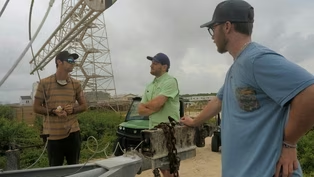
Clip: 1/3/2022 | 3m 4s | Students at UNC Wilmington come up with solutions to the issues facing our coast. (3m 4s)
Providing Support for PBS.org
Learn Moreabout PBS online sponsorship
- News and Public Affairs

Top journalists deliver compelling original analysis of the hour's headlines.

- News and Public Affairs

FRONTLINE is investigative journalism that questions, explains and changes our world.












Support for PBS provided by:
ncIMPACT is a local public television program presented by PBS NC