
Town Hall: Keys to Economic Recovery from COVID-19
1/31/2022 | 26m 46sVideo has Closed Captions
ncIMPACT hosts a town hall to discuss economic recovery from COVID-19.
The COVID-19 pandemic has not only been a public health crisis, but also an economic crisis. ncIMPACT hosts a town hall at Fayetteville State University to share some local solutions that are helping people and businesses bounce back.
Problems playing video? | Closed Captioning Feedback
Problems playing video? | Closed Captioning Feedback
ncIMPACT is a local public television program presented by PBS NC
Town Hall: Keys to Economic Recovery from COVID-19
1/31/2022 | 26m 46sVideo has Closed Captions
The COVID-19 pandemic has not only been a public health crisis, but also an economic crisis. ncIMPACT hosts a town hall at Fayetteville State University to share some local solutions that are helping people and businesses bounce back.
Problems playing video? | Closed Captioning Feedback
How to Watch ncIMPACT
ncIMPACT is available to stream on pbs.org and the free PBS App, available on iPhone, Apple TV, Android TV, Android smartphones, Amazon Fire TV, Amazon Fire Tablet, Roku, Samsung Smart TV, and Vizio.
Providing Support for PBS.org
Learn Moreabout PBS online sponsorship[funky upbeat music] - [Narrator] ncIMPACT is made possible by funding from Civic Federal Credit Union, and as a PBS North Carolina production and association with the University of North Carolina, School of Government.
- Hello and welcome to ncIMPACT.
We're here on the campus of Fayetteville State University.
The COVID pandemic has not only been a public health crisis, but also an economic crisis.
We're holding a town hall about the keys to economic recovery.
We're exploring what local leaders here in Fayetteville are doing to help people and small businesses bounce back.
This is ncIMPACT.
[funky upbeat music] Small businesses are a powerful piece of a local economy but many were forced to shut their doors as a result of COVID.
ncIMPACT's David Hearse introduces us to a local program that supported its small businesses and help them get the funding they needed to stay open.
- [David] After being in business for more than 30 years, Shirley Williams thought the COVID-19 pandemic would shut down her barbershop.
- It was devastating.
I didn't think I would be able to survive.
- [David] Many barber shops and other service-based industries closed for several months during the height of the pandemic.
Even when they reopened, they dealt with staffing shortages.
- A lot of other barbers and stylists they quit.
They refuse to work in close contact with people that refuse to be vaccinated.
So I lost some employees and it was understandable.
They didn't wanna take it home to their family.
I understand.
- [David] Williams ended up applying for and it was accepted for a $10,000 grant and a $5,000 loan from the city.
The city partnered with local non-profit Center for Economic Empowerment, also known as "ceed" to administer the funding to local small businesses.
- It was a very strange time for everybody.
It was first in history.
I think for what people were experiencing, what small businesses were experiencing.
We've never had a government shut down.
- [David] Local leaders were able to quickly respond after many business owners express that they could not afford to wait for funds from the federal government, by the city's estimate, they give out $700,000 in small business grants and retained about 400 jobs.
- Throughout this entire pandemic.
I think the one thing to take away from it for small businesses and how the city has kind of risen to the challenge there is building that big ten and bringing in people from lots of different walks of life to give feedback and help us understand really what the challenges were and how we could best rise to meet them.
- See how quick that was.
- [David] And during a time when businesses were shutting down, six new businesses opened up in Fayetteville during the pandemic.
One of those businesses is a barber shop and nail salon run by Glenise Lesane and her husband.
Lesane says Ceed was monumental in helping her business get off the ground.
- I'm really excited.
I'm creating jobs for other upcoming nail technicians and cosmetologists and Barbers.
- Having to ask for help.
- [David] Also grateful for the help is Shirley Williams.
She says it gave her business stability during a time with so much uncertainty.
- I was grateful because at that point I was thinking of closing down, tried to sell it, couldn't sell it.
And she told me about the program I called and they were very helpful.
I mean, I couldn't have done it without them.
- I couldn't have done it without them.
Those must be music words to your ears.
I am just delighted to be joined for this first paddle by Glenn Adams who's a Cumberland county board of commissioner.
He actually serves as chair of the board and is also on the board of trustees for Fayetteville State University.
Thanks for having us.
- Thank you.
Chris Cauley is a city of Fayetteville's economic and community development director and Suzy Hrabovsky is the executive director of the Center for Economic Empowerment and Development, otherwise known as ceed.
Glenn you've been profiled and not you personally, but the region has been profiled for this really exceptional work with small businesses during COVID.
Before we get into a conversation about what you did or how you did it, let's back up for a second and just think more broadly.
When you look around, what do you see as the economic pain points that remain in the city and the county?
- Well, you know, one of the things is workforce.
A lot of people dropped out of the workforce when the pandemic came, they went home and they haven't come back.
Childcare is tremendous, you know, as school's closed down and these parents went home and they couldn't go the day cares.
In this region, we really don't have enough day cares for people to go back to work, especially some of these young mothers and, you know, they were honed during this pandemic and say, "look, I think I can stay home with my child."
And I think as you listen to everybody on this panel and the next panel workforce is going to be one of the, you know, trying to get people back into this workforce because one of the things I talk about is when you own the highway and something takes you off that highway, whether it's a healthcare, child, sickness or whatever, if you off, how do you get back into that accelerated lane and get back onto that highway?
Those are the pain points.
And you know, one of the things that I would tell you is that we talked about all of this money that came down from the federal government, the American rescue funds.
I think all across the state, we all got excited.
All the county commissioners got excited but then reality set in.
We had to wait for treasury guidelines on how to be able to do that.
And then there were state guidelines on how to do that.
But you and your colleagues at UNC School of Government, thank goodness you stepped in, you had us a seminar over a number of days and the number of hours, just to be able to do that.
A pain point is that we see people out here hurting, and we can't really get it to them as fast as we think we can because of those rules.
- So hold on to that thought, 'cause I want to come back and talk to you a little bit more about all this funding that's coming from the federal and the state governments and how you're using that to move the recovery forward.
But I'd like Chris to pick up on this point about people falling off the highway and not being able to get back on.
And in particular, I wanna ask you Chris, about the role of local governments in assembling stakeholders to support economic recovery.
- Sure.
That's one of, kind of my personal favorite things about Fayetteville is that about once a month, a lot of that economic development folks, some of the folks I see in this, in this room right now, get together and talk about what are the challenges being faced by small businesses in our community?
And we took that same approach into the pandemic when we didn't know what to do, we didn't know how long it was gonna last, we didn't know how people were gonna be impacted, and we didn't know how far we could push the limits of local government to assist here.
And so just like commissioner Adams just said, the School of Government folks really help guide that.
And Fayetteville is really unique in that we had already had some of these partnerships in place with Fayetteville Technical Community College and the universities along with folks like Suzy at ceed and our chamber and we try to keep that the big tent kind of idea.
But with that, we also had programs that were already running and helping small businesses.
It was a quick tweak to kind of change those things towards a pandemic relief.
And so we had programs that required a 50% match, and we reduced that match requirement because of the pandemic.
And some of that was feedback from partners like Suzy and our chamber and other folks who really understand what small businesses are going through.
- Suzy I've mentioned restaurants and retail, and those employers in particular are struggling with staffing shortages.
There's a lot of evidence that some of the reasons that we have these staffing shortages back to Glenn's original point has to do with working parents who cannot find available or affordable childcare.
Say little bit more about how that plays into the recovery here.
- So some of what we saw at the women's business center, you know, keyword women, 74% of who we work with are women, are women in business or women who are looking to start a business, some type of supplemental income.
What we saw during the pandemic was that women are still the primary caregivers of their families.
And so many women stepped away from their businesses.
So many women stepped away from their jobs.
And a lot of those jobs are jobs where we have service to others because women naturally give service to everyone, right?
We're caregivers.
It's part of who we are.
Let's just say it.
So it's who we are, it's what we do.
And so we are in many of those service industries.
And so what we found was that those restaurants were kind of scrambling.
Restaurants were scrambling, the retail was scrambling.
Everybody was trying to figure out like, how can they come back to work?
And when you'd had schools closed, parents had to make decisions, right?
They had to figure out, am I gonna stay at home with my children?
Or am I gonna go back to work?
Or how am I going to juggle this?
And when day cares closed, that was most, most detrimental to the core of family.
Business and the economy no longer supported that core family.
And so they had to make choices.
And what we saw, I will tell you this in the entrepreneurial world, we saw that not only did people maybe stop working, but they called us.
And at that point, when they called us, it was because they were trying to figure out how they were going to make money.
If were gonna do it online, if they were going to open up their own business, if they were gonna start their own service because they had to make their time, their own.
And so we opened 12 businesses this past year.
You think COVID is the most detrimental thing that's happened, but it's also been the most creative time for people to figure out.
Entrepreneurs, figure things out.
They have a growth mindset.
They're not fixed.
They don't sit there and say, "I'm not gonna do anything."
They get up and they get things done.
I think our community is more of an entrepreneurial community more than anything.
We fix things, we grow.
And that's the spirit that we saw in our restaurants, in our retails, in our mothers who were trying to make it work.
- Glenn I'm gonna pitch this to you because you actually brought this to mind.
You talked about small businesses needing capacities.
Capacities around technology and I presume that includes e-procurement.
As people are opening businesses in their basements, in their garages, in the bedrooms, how do they connect to a broader market?
What are the opportunities for supporting that kind of capacity building?
- Well, I'm gonna tell you that this state, State of North Carolina, with its community college system.
It is probably one of the strongest community college systems in the entire country.
That's where it starts.
They have the workforce, development.
You hear from Todd the king, he'll probably tell you as much as I can, but to get those individuals over to those places like community colleges.
And as we do this in terms of the city and the county, the problem we have though, Anita, is that again, I talk about people having to work Monday through Friday to meet their needs.
So we have to adapt now.
We have to be able to do things on Saturdays and in the afternoon for these small businesses.
Because if you run a small business, you up before six o'clock in the morning, and you're there at six o'clock in the afternoon, just trying to do that, get home, feed your family, and then try to get back out.
We've gotten to reinvent how we help these individuals to be able to do that capacity.
That means doing some workspace for them.
So they can come in and have a space to be able to do that with people there, to help them with the technology, to be able to tap into those resources and those grants.
It's all about being able to be a resource and creating that resource.
And that's what government does.
I always say that government, we start the fire, but it's the community that builds the flame.
And so ceed and those nonprofits that we're gonna take care of.
They're gonna go in there and they're gonna help those folks be able to do that.
And from that, this entrepreneurship and this region is just gonna grow.
You're gonna find that Fayetteville, Cumberland County is the gateway to Southeastern North Carolina.
And it all comes through here.
And so that's one of the things that we always talk about.
- You heard it first here, folks.
[audience clapping] It all comes through here.
Anybody who knows me knows collaboration is one of my most favorite words.
And you all are walking the talk.
When it comes to collaboration, it has been such a pleasure to spend some time with you and to be able to share this story of what's happening in this region with the rest of North Carolina.
Thank you so much.
- Thank you.
[audience clapping] - COVID has caused layoffs staffing shortages and changes to the overall way we work.
Some who left the workforce have not been able to return.
ncIMPACT's David Hearse shows us local efforts to help people return to work.
- Some of us are gonna be doing a butterfly at the tables.
- [David] Even as the economy reopens, some mothers have struggled to return to the workforce.
- If parents don't have childcare, they can't go back to work.
And so it is a pivotal economic driver.
- [David] Mary Sonnenberg, president of the Partnership for Children of Cumberland County says parents at low-income levels have had the toughest time returning to work.
They're less likely to access paid, leave, remote work options, or affordable childcare.
That's where her organization steps in and helps parents find childcare and connects them with subsidies.
- Childcare is a hot commodity.
It's not necessarily affordable and it's not easily accessible.
- [David] Fayetteville State University is also working to remove childcare barriers for students and faculty.
With more than half of their students as adult learners, the university has kept a lot of their classes and even job fairs virtual.
- One of the things that will emphasize and with our classes is that, look, if you can't come to class, we'll make it work for you, but also the workplace itself, not just Fayetteville State, but the jobs that students are looking for right now, there are some flexibility.
We're trying to enlighten our corporate partners about, what they need to do to help students out in the future.
- [David] The pandemic also spurred some to consider career changes at Fayetteville Tech, they're helping veterans make that change through a program called transition tech.
The program provides certification courses and connects veterans to careers in high demand fields.
- There's just to see the soldiers when they call and say, I don't know what I wanna do and went well I've got welding, I've got EMT welding.
I like that.
I did that in high school.
I think that would be fun.
Or I wanna drive a truck.
- [David] For Mary Sonnenberg, she says the collaborative approach is having an impact across the community, but says there's still work that needs to be done pointing to the issue of low pay for childcare workers.
- It will take all levels of funding to transform the childcare industry and it needs to happen because that is part of our economic vitality for the future.
- Well, it seems almost redundant to introduce this panel because the first panel does such a good job of introducing all of you.
But let me say very excited to be with you, Chancellor Darrell Allison of Fayetteville State University, President Larry Keen, Fayetteville Tech Community College, and Lisa Turlington, who is the Dean of advancement and foundation director at Sampson Community College.
Think I got all of that right.
Yes.
I want you to help us understand what is different today about your thinking in serving your students and your community than two years ago, and maybe different is too stronger word, maybe there things that have more salients for you because of what the community has just gone through in terms of COVID 19.
What has changed?
- Well, I think a lot has changed.
I think all of us have a great respect and honor for traditional approaches to higher education.
There's real value in that, but the manner and the methodology that we use to get there may have changed rather dramatically.
I think in my estimation that we were forced, none of us intentionally went into the scenario we went into in the last two years I promise you, but at the same time, we had one of two choices to make.
That's either accommodate this need and respond rapidly and effectively to it or suffer.
And more importantly, our communities would have suffered.
And so it is a process where we had to learn very quickly to take wonderful processes and systems and create systems whereby that was more available to the people out there because they couldn't come face to face under the vagaries of COVID-19.
And yet I think what adapted so quickly, and it was not without pain all over the state, four year colleges and universities to include community colleges and others.
It required really, sharpening the proverbial ax to getting better at delivering online, doing hybrid instruction and not relying solely on face-to-face and traditional instruction.
- So, Lisa, I want you to help us look ahead for a moment.
Picking up exactly where Larry has left us.
What do you see in the future around innovations for accelerating learning, for more technology-based learning?
Where are we going?
- Well, I think as Larry said, we all kinda got caught and we're forced to adapt in ways that maybe we never expected to be able to.
And so I think we definitely all have to find a way to improve the delivery of these online programs.
I think there's a huge disparity in what the community colleges are able to do and what the universities are able to do.
I had an experience, you know, a few years ago with the delivery of the MPA at UNC.
It was seamless and beautiful.
I know a lot of our faculty have struggled to come along with it, but we're gonna have to do a better job with that.
We've got so many of our students are part-time and trying to figure out a way to make ends meet.
Many of them are working and, 72% of the students at Sampson are part-time.
And so we have to be creative and flexible in how we deliver it.
And some of them are gonna want the face to face, and some of them are still demand and expect high quality, distance learning.
And we've got to find a way to continue to get better at that while at the same time offering the traditional classes that Larry mentioned.
Some people are not as successful with the online.
And we've seen that, you know, with us at Sampson, we're having to offer some really small sections because we're trying to spread everyone so thin and you have to be able to accommodate it, even though you may have most of your students in online.
So that's, you know, challenging with resources at a small school.
- So education is going to be a differentiator going forward, we know that.
The vast majority of new jobs that will be created will require some kind of post-secondary attainment, whether that's a degree or some high-value certificate.
We also know that even if we looked at all jobs being created, those that are gonna pay a living wage are the ones that will require more education.
More and more, it's clear that if you don't have access, you're not in the game.
What is the plan for students who have significant gaps coming out of high school?
Do we say, sorry, or do we have bridge opportunities?
- We do.
And I'm not just saying this because Dr.
Keen who I have a tremendous respect for.
Aaron was taping here.
We literally have a play day in a couple of days and he didn't know it.
- Wait you have a what?
- Play day.
He doesn't know it, but my team.
Listen, we have 58 community colleges in this great state.
Fayetteville Tech Community College is the best.
- You can't say that 'cause we got Sampson sitting here.
You can't say that.
[Darrell mumbles] [Panelists laugh] Candidly, you know, Fayetteville State University, we can be a strong partner and so this lunch in play day was ways in which we were gonna be a strong partner with the Fayetteville Tech Community College.
- I think you should just invite yourselves to.
- Well, we come in that way.
I've already shared where we come in that way, but we have to understand we can't do it alone.
If we're going to make sure that we're gonna reach every child and no matter where you live, regardless of your zip code, regardless of where you live, you too can achieve the American dream fully on you.
If you're not collaborating, if you're not partnering, if you're not leveraging, we're not reaching out to say highways and byways.
If you're not looking at, I call him Dr. King, K-I-N-G. 'Cause he's great at what he does.
He'd ride down the road, come on, let's get together here.
And let's leverage what we're we're we're doing here.
So we can be a greater impact to that next generation.
That's what it's all about.
And as we collectively come together, the nation looks at the UNC system, whether it be the higher ed or our community colleges, and they marvel at what we do, can we imagine when we all come together, just how much more dynamic that can be.
That's how we win.
That's how we ensure that no child is left behind.
And when we do that, we'll be the will be the marvel of the world.
It'd be a United States impact.
[audience clapping] - There's so much that you heard here tonight first.
The region, the gateway to the Southeast.
And I now realize that Glenn didn't mean in North Carolina.
He meant in the whole country.
And you're taking me along with you and ncIMPACT.
I love it.
I could be in this region all day.
I could be here all week talking about how these collaborations are differentiating the region, making a difference and setting.
Is that a sign that we've gone on too long?
Making a difference and really setting the course for the rest of the state.
But right now I'm standing between you and the reception.
And so I wanna thank you for being with us this evening.
Thank you so much to the panelists.
I'm Anita Brown-Graham, and this is ncIMPACT.
[audience and panelists clapping] [bright upbeat music] - [Narrator] ncIMPACT is made possible by funding from Civic Federal Credit Union.
And is a PBS North Carolina production in association with the University of North Carolina School of Government.
[bright upbeat music]
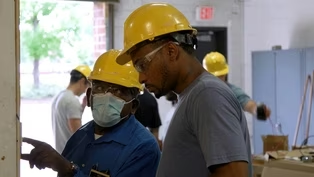
Cumberland County helps people return to work amid COVID-19
Video has Closed Captions
Clip: 1/31/2022 | 2m 10s | Collaborations in Cumberland County that are helping people return to workforce. (2m 10s)
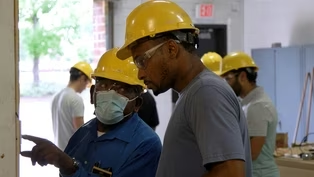
How Fayetteville supports small businesses during pandemic
Video has Closed Captions
Clip: 1/31/2022 | 2m 36s | The City of Fayetteville acted quickly to support small businesses recover from COVID-19. (2m 36s)
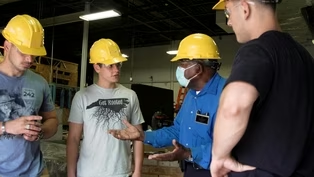
How to economically recover from the COVID-19 pandemic
Video has Closed Captions
Clip: 1/31/2022 | 25m 26s | Panelists join Anita Brown-Graham to talk about how to economically recover from COVID-19. (25m 26s)
Preview | Town Hall: Keys to Economic Recovery from COVID-19
Preview: 1/31/2022 | 20s | ncIMPACT hosts a town hall to discuss economic recovery from COVID-19. (20s)
What’s being done to help people return to the workforce?
Video has Closed Captions
Clip: 1/31/2022 | 25m 10s | Panelists join Anita Brown-Graham to discuss how to help people return to the workforce. (25m 10s)
Providing Support for PBS.org
Learn Moreabout PBS online sponsorship
- News and Public Affairs

Top journalists deliver compelling original analysis of the hour's headlines.

- News and Public Affairs

FRONTLINE is investigative journalism that questions, explains and changes our world.












Support for PBS provided by:
ncIMPACT is a local public television program presented by PBS NC