
Town Hall: Local Sustainability Goals
1/24/2022 | 26m 46sVideo has Closed Captions
ncIMPACT hosts a town hall in Asheville to feature local sustainability goals.
There is a growing need for communities to become sustainable in order to overcome environmental challenges. ncIMPACT hosts a town hall on the campus of UNC Asheville to share some homegrown solutions that are making a positive financial and environmental impact.
Problems playing video? | Closed Captioning Feedback
Problems playing video? | Closed Captioning Feedback
ncIMPACT is a local public television program presented by PBS NC
Town Hall: Local Sustainability Goals
1/24/2022 | 26m 46sVideo has Closed Captions
There is a growing need for communities to become sustainable in order to overcome environmental challenges. ncIMPACT hosts a town hall on the campus of UNC Asheville to share some homegrown solutions that are making a positive financial and environmental impact.
Problems playing video? | Closed Captioning Feedback
How to Watch ncIMPACT
ncIMPACT is available to stream on pbs.org and the free PBS App, available on iPhone, Apple TV, Android TV, Android smartphones, Amazon Fire TV, Amazon Fire Tablet, Roku, Samsung Smart TV, and Vizio.
Providing Support for PBS.org
Learn Moreabout PBS online sponsorship[upbeat music] - [Narrator] ncImpact is made possible by funding from Civic Federal Credit Union, and is a PBS North Carolina production in association with the University of North Carolina School of Government.
- Hello and welcome to ncImpact.
We're here on the lovely campus of UNC Asheville.
We're holding a town hall about local sustainability goals.
There's a growing interest in communities to become more sustainable in order to overcome challenges.
We'll share some solutions from the Asheville region that are having positive financial and environmental outcomes.
This is ncImpact.
Renewable energy is an effective way to reduce CO2 emissions and air pollution.
Communities across Western North Carolina are implementing creative ways to adopt renewable energy.
ncImpact's David Hurst, introduces us to some of these solutions.
- We got a nozzle called the stubby.
- [Narrator] Ian Baillie is in charge of the vehicle fleet at Warren Wilson college.
- And that's the quick connect stubby nozzle in here that that attaches to.
- [Narrator] When he got 10 new vehicles in 2019 that run on propane fuel he not only saw an environmental benefit, but it also saved the college money.
- And when gas prices get high and competitive, we see that $354 a gallon, I sometimes pay more than $2 a gallon less for propane.
- [Narrator] Warren Wilson college is a partner of the Land of Sky Clean Vehicles Coalition.
The program helps vehicle fleet save energy and promote the use of domestic fuels and advanced vehicle technologies.
- There's a lot of focus on electric vehicles, and clearly there's a reason for excitement there, but also there's other alternative fuels here in Western North Carolina that are used like propane, biodiesel, and compressed natural gas.
- [Narrator] The Clean Vehicles Coalition also partners with local governments, like the city of Hendersonville and Henderson county.
Both municipalities have been outfitted with biodiesel and compressed natural gas vehicles to reduce greenhouse gases.
- Measuring the environmental impact before the pandemic, we cut 8,000 metric tons of emissions in the air, which is the equivalent of about 1800 vehicles off the road, every day.
- So we're a little late in the season, but this is an example of some of the permaculture gardening.
- [Narrator] On the campus of UNC Asheville, their emphasis on renewable energy can be illustrated by the Sam Millar Facilities Complex.
- Our student environmental center has three gardens on campus that they maintain and manage-- - [Narrator] It incorporates a number of environmentally sustainable design features, both inside and outside the building.
- Those things put in solar panels, for example, where we are making clean energy and then offsetting energy costs those to me are just, are win-win situations all the way around.
[machinery whirring] - [Narrator] The building also uses a geothermal heating and cooling system, which draws energy from the earth to provide cooling in the summer and heating in the winter.
- We see and identify places we can make improvements all the time, but it's always a challenge to find funding that we can direct to those things.
So we do spend a lot of time seeking out grants, where we can find those or being creative in how we use the finances we have to implement things, to improve our sustainability stance.
- So this is the propane dispenser-- - [Narrator] For Ian Baillie, he also struggles to find funding to create a more energy efficient fleet.
That's why he's slowly upgrading his vehicles over time and looks forward to more research and technology that'll make the initial investment more manageable.
- There's a lot of good solutions.
We're finally starting to really acknowledge the development and research work and alternative fuels and electrification, and I think that the fact that we're finally, as a nation embracing that, makes a big difference.
- For a conversation this evening, we're joined by Julie Mayfield, co-director of MountainTrue, and also a North Carolina state Senator, Alison Ormsby, who's a lecturer here at UNC Asheville in Environmental studies.
And interim co-director of sustainability, Nathan Ramsey, who is the executive director of the Land of Sky Original Council, and also the director of the Mountain Area Workforce Development Board.
Thank you for being here.
Julie, I wanna start with you.
We hear the word sustainability umpteen times a day.
What are people talking about when they use this word?
- Well, there, I'm gonna estimate there are about maybe 60 people in this room and I think you'd probably get 60 different answers.
So I will give you mine.
I think about two things when I think about sustainability.
The first, is the concept of doing no harm to future generations or, you know, preserving things, making things better, don't take anything away from, from future generations.
So that's one piece.
The other piece is, the idea of again, sort of doing no harm to people, planet, and the economy generally.
So those three pillars, that sort of make the world go round.
So that's, that's the way I think about it.
But again, a lot of people, I'm sure I left something out.
I'm sure people will tell me that I left something out.
[Anita laughing] - I think you protected yourself with the disclaimer.
You're good.
Why has the conversation around sustainability been particularly salient in this region?
- Wow, well, because we live in one of the most bio-diverse places on the planet.
This is a very special region, in terms of its ecology, and we have threats to it.
So there are threats to it.
It also is the lifeblood of the economy in this region.
So we are a nature-based region, we are a tourist based economy, not just here in Asheville, but throughout the region, and we, we have to protect the things that people come here to see.
Now, we're lucky in that we have a lot of national forest and we have national parks, and those are, those are protected, but there is still a lot of land that is not protected.
And if we don't take care to protect that from encroaching development, from our ever increasing population, expanding roads that just cut through everywhere, we're gonna lose it.
- Alison, what would you add to this conversation, either about the definition of sustainability or why it matters so much to this region?
- Well, I think we should think about climate resilience, right?
And some people call Asheville, climate city, or this area, because we have The Collider, we have NEMAC, we have the NOAA climate data center.
So when we think about adaptation and mitigation to climate change, we have to think about our stormwater management and the impact of people moving to the area and our millions of tourists per every year.
So if we wanna maintain the quality of the place we live and tourists come to visit, we need to think about our actions-- - Yeah.
- Now.
- Again, sort of that forward looking perspective, Nathan, you wanna weigh in?
- Well, I think the economy, our environmental health, in Western North Carolina are just one and the same.
Over 10 million people come to our region every year from all over the world.
You know, hospitality tourism is a multi-billion dollar industry in Western North Carolina, but it goes far greater than that.
A lot of companies come here because this is a special place, and you step outside and you look and see those mountains.
When I was a student at UNC Asheville and it still does today, when I walk out the front door of the library and look in the distance and see Mount Pisgah, you know, it just has a special effect on you.
So, I don't think it's either protect the environment or protect your economy, I think here we can see, how we can do it, but do it all well, and do it, do both of that.
I mean, there are challenges as our region continues to grow and other things, but, we've made a lot of progress over the last 30-40 years, and I think that potential to move forward is, is certainly there, and that's what the team at Land of Sky works on every day in support of our local governments.
- Alison, talk to us a little bit about the role of our university.
We saw in David Hurst piece, UNC Asheville, doing really good research that is supporting some of the development of technologies in the region.
How else, what else is the university doing?
- Right.
So sustainability is one of our core values of the university.
And we, our goal is to educate the future generation about all dimensions of sustainability, social, economic, and environmental.
And we also have goals in terms of our operations.
So recently we signed the nationwide carbon commitment with a pledge to be carbon neutral by 2050, and that's in line with Buncombe county's goal of a hundred percent renewable energy by 2042.
So that's just renewable energy.
But when we're looking at our whole carbon footprint or our ecological footprint, we have to look at food.
You know, how are we procuring our food?
What's our stormwater management?
So it ties into classes and the way that the campus is operated and our grounds.
We have lots of accolades, like being a tree city, tree campus, we're Asheville's tree city, and then bee campus, so it permeates the classes and then outside the classroom and applied research projects as well.
- Terrific.
Thank you.
Questions from the audience.
- That was very kind.
My name is Keith Thompson.
I'm a local IT business owner and graduate of UNC Asheville, the same year as chairman Ramsey.
My question, is regarding local government, particularly ability to be a market maker for microgrids.
So I'm gonna read it.
Our rural and small town fire and police stations provide critical services for public health and safety, community resilience during fires, floods, and extreme weather events can be strengthened by critical services microgrids.
Microgrids save taxpayer money year-round, but ensure power during power outages, can our local businesses build microgrids, create jobs and help us serve and protect our citizens?
And I think chairman Ramsey knows something about how to help create jobs in our local area.
Thank you.
- Well-- - It sounds like that was an alone to alone question.
- I think I helped elevate Mr. Thompson and his class ranking.
I was probably below him.
So when I was a student here at UNC-- - So this is the way he thanks you.
- I don't know.
But that was a long time ago.
That was in the late 80s.
For young folks that's a very distant time.
But, certainly, we're really excited in the Land of Sky region to be home of one of the first microgrids in the state of North Carolina.
In the town of Hot Springs, it was a very remote part of Madison county, right adjacent to the Tennessee border was often subject to power outages, and so there's a microgrid there with a solar array battery storage to help that community.
So when the transmission of power gets cut off, they can still have access to vital services in that community.
So we have very many local governments that are innovative and is certainly in the city of Asheville and Buncombe county, but other local governments as well are well, looking at how they can better use energy, save taxpayer dollars, and make their communities more resilient.
- Okay.
Can I add one thing to that?
- Absolutely.
- Through partnership, a partnership that has been going on now for, oh gosh, I don't know, almost five years maybe, between the city of Asheville Buncombe county and Duke energy because of the work of those three entities and a number of folks who are in this room.
We have in North Carolina, Western North Carolina, more battery storage than any other region in the state.
And I mean, by far.
We, and maybe the next panel is gonna talk about that.
But last I knew, we were up to 19 megawatts of battery storage.
That includes the hot Springs.
And there's a battery storage place, location here in, at least one here in the city.
So, we're, as a community, Asheville and Buncombe county and Western North Carolina generally are, we're going with this technology.
Very important.
- Well, the question and the answers were actually perfect segues to the next panel.
I wanna thank Nathan, Alison, Julie, for being with us this evening.
Fabulous insights.
Can't wait to see what you do in the next five years.
- Thank you.
- Thank you.
[audience clapping] [audience cheering] - Partners are coming together across the region to address the needs of present and future generations.
ncImpact's David Hurst shows us some of the local goals and strategies that are building a strong sustainability ecosystem.
- So this is Pearson garden.
This is Bountiful Cities, kind of flagship property.
- [Narrator] Nicole Hinebaugh is the program director of the Asheville nonprofit Bountiful Cities.
- In fall season now-- - [Narrator] She oversees the organization's community garden network program.
- And there was sort of a renewed interest and recognition of the importance of being able to access food right where we live.
This is one of the plants, one of the herbs that we grow.
- [Narrator] There are 36 community gardens within the network, and the goal is to teach sustainable agriculture skills, to promote social justice and economic viability for those who live in the community.
- They can plant their own food, grow their own food, eat their own food, and it increases community and family sustainability for years to come.
[birds chirping] - [Narrator] Gardens depend on pollinators to thrive and right up the road on the campus of UNC Asheville is a Bee hotel.
The bee hotel is a place of refuge for native pollinators that are facing a number of environmental threats.
- I think we've really seen an increase in appreciation for that in our campus community as we get certifications, like our bee campus USA certification.
People start to take pride in that, and a bee isn't necessarily a scary thing anymore.
It's like an important part of our campus ecosystem.
- [Narrator] Sustainable solutions like these are what Sophie Mullinax, of the Blue Horizons project is trying to promote.
The Blue Horizons project launched in 2018 to build a cleaner and affordable energy future in Buncombe county.
- This affects all of us.
We all have a role to play.
Businesses and residents to take action, to reduce energy use, to be more energy efficient and to adopt clean energy and renewable energy as much as we can.
- [Narrator] The Blue Horizons project partners with the city of Asheville, Buncombe county, Duke energy, and other private businesses.
They have a community wide goal of transitioning to 100% renewable energy by 2042.
- We here at Blue Horizons project, and many of our partners firmly believe that energy efficiency is the foundation of clean energy.
The less energy you need or use, the less you need to produce.
- We've got some propagation spaces here where-- - [Narrator] As for Nicole Hinebaugh, her goal is to expand the community garden network.
It's becoming a model that other communities in Western North Carolina are adopting as they look for more sustainable solutions.
- What are the resources that we have?
What are the resources that you need?
How can we share those resources and information?
How do we plan together for our collective future as opposed to neighborhoods operating independently.
- Delighted to be joined by Jeremiah Leroy, Buncombe county sustainability officer, Amber Weaver, city of Asheville sustainability officer, and Christine Wittmeier, Environmental program supervisor, Henderson county.
Welcome.
- [In Unison] Thank you.
- I wanna start by focusing on these local goals for renewable energy or sustainability.
Let's start with the city of Asheville.
What's going on there.
[audience laughing] - All the things are going on there at the city of Asheville.
We've had really thoughtful city council members, and over the years, since the office was created, they've thought about having policy around food policy.
What we saw, just most recently, as well as thinking about waste reduction efforts.
We have policy around renewable energy, also carbon mitigation goals, and most recently, something that I think is very important when we're talking about sustainability is the climate emergency.
And really through that climate emergency, what our office has focused on is climate justice and the work of sustainability in frontline communities.
- Christine, give us the perspective from another county.
- Yeah.
- From Henderson County.
- So Henderson County is just south of Buncombe and although we haven't set any recent sustainability goals, I don't think that has prevented staff from being innovative when it comes to the environment.
For example, we operate our own CNG station, we are about to pilot our first DC fast charger, thanks to a grant from department of Air Quality, the VW settlement, and we also passed our Greenway Master Plan in 2019.
And then, for me, it looks a little different than Amber and Jeremiah 'cause my position is out of our solid waste department.
And so the bulk of my work is for waste reduction, recycling and composting, which is something that, I find that we are leaders in Western North Carolina.
For example, we started collecting food waste from our convenience center in 2017, and since then we have composted 96 tons of food waste that has been diverted from a landfill.
- Oh!
- And... [audience clapping] Thank you.
And we were able to use that data to fund a school program that has turned into six elementary schools, and then we've also piloted a industrial compost facility on our transfer station.
So, yeah, I think it's just a couple of examples of how a different county can operate.
- First question.
Yes.
- Hi, I'm Dawn Chavez.
I'm the executive director of Asheville GreenWorks.
And the question I was going to ask earlier had to do with equity and impact, especially on vulnerable communities, but that was very well answered by Amber, so I have a different question for you all, mainly for Mr. Leroy and Ms. Weaver.
What role do you see urban forestry playing, in sustainability, in both our city and our county?
- Sure thing.
Thanks for asking that question, Dawn.
I think, what we in sustainability have been talking about, as of late, is carbon sequestration, and what does that mean, what does that look like, with some of our aggressive climate goals?
I think it is, I think, I believe it's something that, I know it's something that the city is very interested in.
The urban forestry commission has been working over the years to encourage an urban forestry master plan for the city, and I think it goes back to the conversation around development as well.
So, multifaceted.
Thinking about development, thinking about the need to maintain our canopy cover and also thinking about carbon, and what does this mean altogether as a community, as we're trying to also expand and thrive, right?
We heard that there are people that are moving here, and so, how do we continue to do that.
- And they wanna have two kids and have a mortgage.
- That's right.
And an electric vehicle.
[Anita laughing] - I do.
So, I'd actually like to kind of piggyback on that a little bit and put in a plug, if I can, because I do think it's really important.
You mentioned your comprehensive plan.
Buncombe county is actually just starting the process of our comprehensive, our new comprehensive plan.
It's a long range view, and one of the major things we wanna look at is how do we develop?
I mean, again, we care about this community, we see these issues, and we want the voices of our community to be a part of that planning process.
So please, go to our website, get on the newsletter list, and show up to these meetings, and make your voices heard because this comprehensive plan is going to really be a guiding document for how we move forward as a community.
So it's a really good opportunity for folks like yourselves to participate in that process.
- Thank you.
Let's get another question in.
- Hi, my name is Jack Parker.
I live in South Asheville, and my question relates to both Asheville and Hendersonville.
There's a lot of attention on the IPCC report that just came out that devoted a whole chapter of the report to methane emissions, and you mentioned about food waste, and so my question is, I'm concerned not only with efforts to reduce food waste going to a landfill, but also paper, which turns out paper is also degrading and producing methane.
And so, I read where 40% of the municipal solid waste here is paper.
So are there any efforts to reduce paper waste as well as food waste, and in addition to the composting?
- I'm gonna have each of you respond to that question.
It can be, yes, no, I don't know, [audience laughing] but you have a minute.
Go.
- All right, I'll go first.
So I think we need to make recycling more accessible and easy, and when you have a trash bin, you need to have a recycling bin next to it.
And, I think we have different hauling structure in Henderson than Buncombe, so we don't have, carts throughout Henderson county.
That's something that we could definitely, maybe look at in the future, but making it easy and accessible.
But I am really proud of our convenience center where anyone can go and recycle all their paper and maybe even also targeting businesses and the schools.
So, one positive part of our composting programs with the school system is that also gets to look at the recycling program to see how well they're doing.
So that's one way we can reduce how much paper gets sent to our landfill 'cause we have a closed landfill in Henderson county, and we send about 15 to 30 tractor trailer loads of trash down to South Carolina a day.
And so, that is another financial incentive that we are working on to not only conserve the land for future generations, but also save us hauling costs and our budget.
- Thanks.
So the whole point of this is to get everybody leaving feeling very positive, but you only have one minute.
Go.
[audience laughing] - You know, gas to energy.
Gas to energy is something that's been around for an extended period of time, and that's capturing methane gas and putting it on the energy grid.
The city of Asheville does not own and operate its own landfill.
I'm very envious of Buncombe county.
My previous county I worked in, owned and operated a landfill, and there's lots of opportunities for a landfill.
So I'll kick it over to Jeremiah.
- Yeah.
So I've got a minute and a half then.
[audience laughing] You know, so, our landfill gas to energy projects is something, and I wish my solid waste director was up here to talk about it because it's such a cool project, but the gist of it, because of our time constraints, is that the methane gas that is created by our garbage, goes into a generator, is converted to electricity and goes back onto the power grid, and we've been running this for several years now.
And so we actually have a power purchase agreement with Duke.
They buy the energy from us.
It's amazing.
- Sustainability continues to be an issue for communities all across North Carolina.
The Western region of North Carolina is rolling up its sleeves and doing something about it.
I'm Anita Brown.
This is ncImpact.
[upbeat music] - [Narrator] NC impact is made possible by funding from Civic Federal Credit Union and is a PBS North Carolina production in association with the University of North Carolina School of Government.
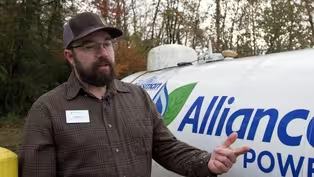
Communities in western NC set local sustainability goals
Video has Closed Captions
Clip: 1/24/2022 | 26m 49s | Panelists join Anita Brown-Graham to discuss homegrown solutions towards sustainability. (26m 49s)
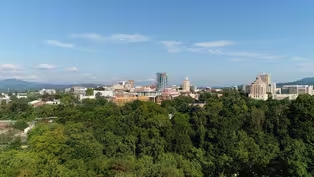
The environmental and economic impact of sustainability
Video has Closed Captions
Clip: 1/24/2022 | 23m 12s | Panelists join Anita Brown-Graham to explore the impact of local sustainability goals. (23m 12s)
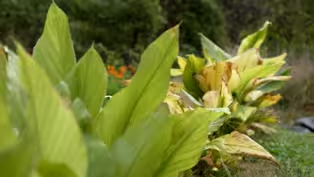
Partnerships help build a strong sustainability ecosystem
Video has Closed Captions
Clip: 1/24/2022 | 2m 32s | ncIMPACT features local goals and strategies that lead to community sustainability. (2m 32s)
Preview | Town Hall: Local Sustainability Goals
Preview: 1/24/2022 | 20s | ncIMPACT hosts a town hall in Asheville to feature local sustainability goals. (20s)
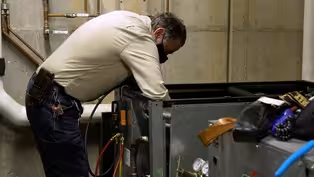
Western NC gets creative in adopting renewable energy
Video has Closed Captions
Clip: 1/24/2022 | 2m 59s | Communities across western NC are getting creative in adopting renewable energy. (2m 59s)
Providing Support for PBS.org
Learn Moreabout PBS online sponsorship
- News and Public Affairs

Top journalists deliver compelling original analysis of the hour's headlines.

- News and Public Affairs

FRONTLINE is investigative journalism that questions, explains and changes our world.












Support for PBS provided by:
ncIMPACT is a local public television program presented by PBS NC