
Town Hall: Student Success
1/17/2022 | 26m 46sVideo has Closed Captions
ncIMPACT hosts a town hall to talk about solutions for student success.
Student success is critical in meeting the state’s educational attainment goal and providing a talented workforce. ncIMPACT hosts a town hall on the campus of UNC Chapel Hill to feature the work being done across the state to help students thrive.
Problems playing video? | Closed Captioning Feedback
Problems playing video? | Closed Captioning Feedback
ncIMPACT is a local public television program presented by PBS NC
Town Hall: Student Success
1/17/2022 | 26m 46sVideo has Closed Captions
Student success is critical in meeting the state’s educational attainment goal and providing a talented workforce. ncIMPACT hosts a town hall on the campus of UNC Chapel Hill to feature the work being done across the state to help students thrive.
Problems playing video? | Closed Captioning Feedback
How to Watch ncIMPACT
ncIMPACT is available to stream on pbs.org and the free PBS App, available on iPhone, Apple TV, Android TV, Android smartphones, Amazon Fire TV, Amazon Fire Tablet, Roku, Samsung Smart TV, and Vizio.
Providing Support for PBS.org
Learn Moreabout PBS online sponsorship[relaxing music] - [Narrator] ncImpact is made possible by funding from Civic Federal Credit Union, and is a PBS North Carolina Production in association with the University of North Carolina School of Government.
- Hello and welcome.
We're here at the School of Government on the campus of UNC Chapel Hill.
We're holding a town hall about ensuring student success.
We feature the work being done to help our students thrive.
This is ncImpact.
Partnerships across educational institutions create pathways for our students.
One of those partnerships takes place at the Union Square Campus in Greensboro.
ncImpact's David Hurst shows us the state-of-the-art campus training for much needed nurses in our state.
- [David] For Tyesha Harvey, nursing runs in the family.
- My mom was a nurse.
She made nursing look so easy.
- Harvey is a nursing practitioner who has returned to school to earn her doctor of nursing practice.
She's one of the many nursing students who takes classes at the Union Square Campus, a state-of-the-art facility in downtown Greensboro.
- [Nurse] She took her off the monitor.
- [David] The campus includes simulation rooms that give students hands-on experience.
- What we do is very technical and reading a textbook is not solely enough to take care of our patients.
- They still want to reduce your flows.
- [David] The campus opened in 2016 and is shared by UNC Greensboro, NC A&T, Guilford Technical Community College and Cone Health.
Guilford Tech offers an associate degree nursing program that prepares students to become a registered nurse.
- I think it's important for a community to have networks because medicine is so multifactorial.
It takes everybody doin' the best that they can do and doin' proper communication, so the more you work together, studies show, the better off a team will be in any type of management, especially crisis management.
- She is anatomically correct.
- [David] The campus prepare students for high demand, high paying jobs as shortages of nurses and other healthcare workers are impacting hospitals across the country.
- The only way you can really deal with those shortages is to prepare, educate, train even more nurses and that's what this facility and this partnership allows, it gives us space to grow.
- [Instructor] This is just slightly taped over here.
- [David] The campus includes 12 simulation rooms and 27 high-tech mannequins, the professors can control the mannequins and watch how students respond to a wide range of medical situations.
- So when we're in the field of nursing, we need to make sure we're critically thinking, so our focus is patient centered care.
So while we're in simulation, we're utilizing our critical thinking for when we're out in the field and we don't have resources.
How can we effectively utilize what we know?
- You're not gonna be able to get a blood pressure.
- [David] For some students, the benefit of the program is not only the technology, but also the one-on-one attention they get from their professors.
- I think one of the reasons that myself and some of my peers come here is because everything's very inviting.
We know that we're not just a number and that we'll be supported throughout the process.
I think for many of us that makes a really big difference.
[group chatter] - And for Harvey the program has only affirmed her decision to go into nursing and it gets her excited for what's next.
- I think it's really what gets me through the day, just knowing what I'll be doing in three years after I graduate, the hands-on care, patient interaction, I love it all.
- I love it too.
I'm joined in this first panel by Charles Bowman, the president of Bank of America, North Carolina.
Welcome Charles.
Ralph Emerson, program director of Cummins, Inc.
Welcome.
Skylar McLean, UNC Chapel Hill student who transferred from Central Carolina Community College.
Hi Skylar.
And Chris Rivera, the executive director of GuilfordWorks.
And so Skylar, I want to talk to you first, if I might.
You are one of the students on this pathway to becoming a nurse, thank you in advance for that service.
You've been a consumer of the K through 12 system, you graduated from Chatham County Schools, you attended community college and now you're here at UNC Chapel Hill.
You're the poster child for success and yet I'm sure there have been barriers along the way.
So talk us through one or two barriers you've faced and maybe how you think our institutions could be better positioned to support students through these challenges.
- Okay, so I guess, if I'm gonna start off with the high school side of it first.
In high school, a lot of people don't tell you about the community college route.
I personally did not know too much about C-STEP until about two weeks before their application was due and I knew that- - [Anita] What is C-STEP?
Go ahead and tell everybody.
- C-STEP is the Carolina Student Transfer Excellence Program.
So, it's where you go to community college first for two years and when you're accepted into C-STEP you automatically are accepted into Carolina and I always wanted to come here, but you know, sometimes you don't have the drive.
Well, I had the drive, but I didn't think I could do it, even though I knew I could, and so I wish I would've known more about that in high school, 'cause I think in high school, a lot of people are like, "Oh, you have to go to a four-year institution, "that's the only way you can do it," but I personally would go through community college every single time.
I really enjoyed it because it was one-on-one and I was able to focus a lot better, where, I mean, don't get me wrong, I love Carolina, I love the big classrooms and everything, but I would not have thrived as a student in that type of environment just 'cause there's 200 people in the class with me, so I really enjoyed that.
So I think just in high school and just having more people come represent from community college would have been nice because you kind of feel like you have to hide that you're going to community college 'cause all of your friends are going to an institution, but, I mean, I enjoyed community college, I would do that all over again, if I could.
- So Chris, you're not just a customer, you're also a partner with educational institutions.
Say a little bit about what workforce development boards do for people who are not aware and why they're such a critical partner in communities with educational institutions.
- Absolutely.
Thank you for that question, it's kind of loaded in that I could probably spend 30 plus minutes talking about the work we do, I certainly won't.
- [Anita] You go three, my friend, you got three.
- So, first and foremost, workforce development boards work very closely with business and industry and we work with them to really try to understand those pain points, the skills that are needed, and then we reach into the coffers of our communities to develop that talent pipeline to be able to move into those positions that businesses are needing to fill.
We're fortunate to have 23 very high performing workforce boards in our state and so we work very closely with education to be able to develop those curriculums to meet the employer needs.
- So you're a broker, in some ways.
- We're a broker, yeah, I love that word.
I love the word.
I loved Skylar's story in that it reinforces the importance of the work that we, at the local area, do.
So equally, if not more importantly, we work with residents who are looking to transition careers they may be underemployed, unemployed, and we work very closely with them to put together these employment plans, often inclusive of needing to go back to school to get the credentials needed to get into the workforce.
In Skylar's position, we work very closely with K-12 systems certainly with our community college partners, higher education institutions, to put together those plans, help them understand how to enter into these various careers and provide the resources that are needed.
So where we talk about individuals having these non-traditional ways to get into two or four year institutions, or not knowing which way they want to go, that's what systems like ours do and providing the students the support and guidance and resources to mitigate barriers that they may experience 'cause life happens when you graduate high school.
- Yeah, Charles, Bank of America has made headlines all year about really innovative things to work with communities to create opportunities.
The most recent is pledging to hire 20,000 people from low and middle income families.
I only care about North Carolina.
[panel chuckling] Just so that we're clear.
So, how many of those jobs are gonna happen in North Carolina and what kind of support are you gonna need from our educational institutions in order to make that real?
- You're gonna be disappointed in the first part, because we probably know that but it's something we don't really share broadly, but think about it, they're about 18 to 20,000 employees in North Carolina for Bank of America, many of them, or most of them, frankly, in Charlotte and most of this activity is happening where we have concentrations of employees, like North Carolina, Dallas, Phoenix, L.A., New York, would be some of the other markets that we have a real focus and concentration on this.
But just to tell you a little bit about how it works, we work with non-profit partners in those communities to refer young people from low and moderate incomes, who may not to the other panelists here who sit, they may not have any idea what a bank is about, other than they know they go to an ATM to get money.
But the truth is 80,000 of our 200,000 employees work in technology and operations.
So we call ourselves a technology company that's got a bank in there somewhere.
And so some of this is just making people, young people in particular, aware, but then the second part is we take it upon ourselves to bring them in and then they enter what we call the academy.
We have an academy that helps take the skills that they have and put them to a level where they can start a high paying job and we begin paying them and one of the other things that I think we're really proud of is the fact that we've moved our, anybody who works at Bank of America makes at least $21 an hour and we've pledged to move that to $25 an hour by 2025.
- I'm not disappointed in your answer yet.
[everyone chuckling] - But those are some of things that I think we're trying to do for ourselves, but also be a catalyst for others.
- So Ralph, there are a number of enterprises that have learned through the pandemic that they can recruit talent from anywhere in the country and that talent can remain wherever it is in the country, my guess is that is not as true for you as it may be for others, is that fair to say?
- Yeah, we have a mix, it's probably 75/25.
We have about 25% of our employees can work from home and work virtual, it's generally finance roles, scheduler planners, things of this nature, IT, but for the most part, the manufacturing floor engineers, people there that are making product and putting their hands on product, of course we need them at the plant and we want to recruit regionally for those individuals, simply because when you hire somebody from the region, they're at home and their friends are here and their brothers and sisters and their mother, and so when they get married and have children, they want to be around grandmama and grandfather, and they want to do the things, share the things with their children that they did as a child.
So when we hire somebody from out of state, a lot of times they're short-lived.
They may come to us for two years, three years, and then they get homesick and they decide to move back home.
And so, Eastern North Carolina is where we prefer to recruit from, but anywhere in North Carolina or Virginia, I think that I can take people from Virginia, North Carolina, South Carolina, 'cause they're all people that like to do the things that we have here in the great state of North Carolina, but we use the mountains and in the coast and the things like that to our recruiting advantage because it's a beautiful state and the weather is great as well.
- Charles, Ralph, Skylar, Chris, thank you so much for being with us and setting the stage for this next conversation about how our educational institutions respond to the needs of you all very important consumers.
Thank you.
- Thank you.
- Thank you.
- Thank you.
- Thank you.
[audience applauding] - Many are struggling with mental health as a result of COVID-19, our students are no exception.
Colleges and schools across the state are working to respond to these mental health needs.
ncImpact's, David Hurst has more on some of these strategies.
- [David] After dealing with mental health struggles in middle and high school, Raymond Palma is well aware of some of the challenges his peers are facing.
- I know how much it would've meant in that moment for someone to have reached out and asked me how I was doing and to let me know that I'm not alone in the struggles and that there is a brighter future.
- Free hugs to anyone who wants one.
- [David] Palma is a junior at UNC Chapel Hill, where hearts have been heavy following reports of two deaths by suicide since this semester began.
[group chatter] It's highlighted the burdens and stress that college students feel as the pandemic drags on.
- I think with a push back to normalcy, as welcome as it is, I think it's important to remember that when it comes to mental health, there is no normalcy.
- [David] In an effort to help, Palma recently became an instructor for the Mental Health First Aid Initiative.
It's a program launched by the UNC system in response to the rising mental health needs among students.
[metallic tapping] The North Carolina Community College System is also offering the training at their 58 colleges across the state.
The training is designed to help students, faculty and staff recognize signs of an issue and provide effective early support.
- We've been isolated so long and I think there's a lot of people out there that are just waiting for help, that don't know how to ask for it but are exhibiting some concerning signs, and so if you can recognize those signs, feel comfortable reaching out to them and then connecting them to the right resources, we want to help people live a better life.
- [David] By December of 2022 classes will provide qualifications for more than 10,000 Mental Health First Aid Certified faculty, staff and students at campuses across North Carolina.
I hate to wish time away, but in many ways I want to wish the next year away 'cause I want to be on the other side where we say, "There's 10,000 people out there that are first aiders "and that they are recognizing the signs of distress "and that they have probably saved several lives "over this past year," so I'm very excited to see how this will help us create more meaningful, helpful communities and you know, really, if we just save one person it's just gonna be all worth it.
- Nice job, thank you for being silent and being ready.
Excellent job.
- [David] The pandemic has also had an impact on the mental health of K through 12 students.
Data from the CDC shows that mental health related emergency department visits have increased since the pandemic began.
- Let me have everybody's attention.
- [David] It's one of the reasons the North Carolina Department of Public Instruction is helping school districts promote social and emotional learning.
- The more we've learned and the more we've really gotten into children, how they work, how they tick, what's really good for them, the more we've realized that we need to pay closer attention to that social and emotional piece, it's not just academics.
- [David] Raymond Palma, he's optimistic about the work surrounding mental health and believe it's building the framework for a more resilient future.
- Because a lot of times you can feel like you're really alone and you're not.
And there are resources.
There are people that care about you and you are gonna be able to get that help.
- Welcome everyone, I am just thrilled to be joined by President Peter Hans of the UNC System, President Thomas Stith of the North Carolina Community College System and Superintendent Catherine Truitt of the North Carolina Department of Public Instruction.
Let's start with you, Superintendent Truitt, what keeps you up at night when you're thinking about what COVID has meant to student achievement, to proficiency, to the potential for growth over the last 18 months?
- What keeps me up at night is the fact that pre-pandemic only 67%, sorry, 67% of our students were not reading proficiently when they started ninth grade and that same statistic holds true for math.
We had decades long challenges in our state that are actually not dissimilar from the rest of the United States that have been exacerbated by the pandemic and we absolutely must be laser-focused on preparing students to read before they reach the third grade.
And I do believe that, thanks to federal dollars, thanks to the legislature and the governor's office and the Department of Public Instruction, we are well on our way to correcting that.
We're partnering with both the Community College System office and the UNC System to ensure that our pre-service teachers are getting what they need to not just help students recover from the pandemic, but also to help them be even better teachers, instructors, and yes, even mental health professionals when they graduate and come into the classroom.
- You all have talked a lot about collaboration and it certainly seems to be increasing among the systems, or maybe I'm just reading more press releases.
[everyone laughing] Looks like it's increasing to me.
Examples include our teacher preparation degrees at community colleges, seamless transfer to the UNC System, are there other examples of collaboration that you are particularly proud of, and I'll let you go first this time.
- Okay, okay.
The pressure's off you all there.
You know, Anita, it helps that the three of us are friends and we've worked together in previous lives and there's a lot of trust and support between us, but yes, I think that is real, more collaboration.
While I was at the Community College System, we started the effort towards a two-year associate degree in teacher preparation.
President Stith has taken that, elevated it, I'm excited about what that may mean for the supply of well-qualified teachers in the future, particularly those that can stay in their local communities, rural areas, coming to mind in particular.
Very much focused on the establishment of a common course numbering system for about 180 entry level courses within the university that will help community college transfer students and students transferring within the university itself.
- [Anita] That's huge.
- Yeah, it amounts to about a third of our student population will transfer at one point or another, saving them time and money and keeping them on track towards graduation, so wonderful collaboration there.
Superintendent Truitt and I, trying to improve, certainly, our early literacy efforts, our schools of education have a responsibility to do their part as the single largest provider of North Carolina public school teachers and we're very much on the same page about the science of reading and applying best practices, because I think we all feel the fierce urgency of now when it comes to early grade reading proficiency and North Carolina's not where it needs to be.
- No, we are certainly gonna do something about that 67% of students entering ninth grade not on reading level, that's just not acceptable.
- It's unacceptable.
- Yes.
- Question?
- Yes, one of the previous panelists mentioned that there was a little bit of challenge and understanding the importance of community college for high school students, so I think the collaboration that you all have mentioned that you have is gonna be vital, but I wanted to ask specifically, what is being done to kind of de-mystify the stigmas attached to high school students understanding the enrollment and considering community colleges as a viable option?
- Excellent question and if you've been in a room with me you've probably heard it too often, and it's, you hear many times people say that the North Carolina Community College System is the best kept secret in North Carolina and they say that as a compliment but I don't take it as such because of the excellent opportunities that exist within our community college system, as I mentioned earlier, whether you're a high school student that wants to matriculate and potentially participate in our university system, from an accessibility and affordability, when we speak about our articulation agreement or our collaboration agreement with the university system, if you want to become a teacher, as an example, those first two years, on average, are a third of the cost, and I'll say that again, a third of the cost if you start off at one of our Community College System and then go on to our excellent four-year institutions.
As a high school student there's initiative, and they may have spoken about this already, in dual enrollment, as a high school student you're taking high school courses, you're also taking community college courses, earning college credits, and that is no cost to that student.
So again, the affordable nature, but at the same time, those courses are transferring seamlessly to our four-year institutions so you're getting an excellent education as you're not only demystifying but helping students realize that it is an excellent education and it is a pathway to success.
- Terrific, thank you.
We'll take one more question.
- Hello everyone, thank you so much for taking the time to answer my question and mine does go back to that mental health need and it is often the case, and it's tends to continue to be the case, that we're very reactive when it comes to mental health and I've often thought, when I was in the classroom and even now, we do a lot of preventative and pre-screenings for physical health, do we ever think there's gonna be a mental health screening for our students that's universal, maybe perhaps in middle school or in fifth grade.
- Yeah, so I totally agree with you and it reminds me of the mental health screenings that the military does when new cadets or sailors, what have you, enter the military, there must be a mental health screening.
We are not doing mental health screenings in a formal systemic way across our state.
What I would say is that, we do a lot of, kind of, first tier surface level work with mental health and then I think we don't really have comprehensive second and third tier interventions.
I was happy to see mention of the Mental Health First Aid training that has come to higher education.
I remember taking that training a few years ago and we certainly are making it more widespread for teachers, but what I have to say to you, and to all of our teachers, is that our public K-12 schools are not a long-term solution for mental health challenges for our students, and to that end, we must find a way to grow our pipeline of professional school psychologists so that they are part of a school's everyday experience.
If I waved a wand and gave our districts the money to do that we wouldn't have those people to hire.
We need to attract them to North Carolina.
We actually have started to look at how we can do that.
How can we build that pipeline?
Can we do tuition reimbursement for those who need to do their clinical hours?
That's a standard number of hours that these students need to do before they can become school psychologists.
Can we get more social workers into our more rural areas where we may not have social workers?
But, as the expression goes, something's got to give.
We cannot expect our teachers to continue to do more and more of those non teaching duties and responsibilities, like giving insulin shots, like taking care of mental health needs for middle-schoolers.
We've got to do a better job supporting our teachers with those extra school support personnel.
- So I want to thank all of you for joining us for this conversation on educational opportunities in North Carolina.
I hope that you are as inspired as I am.
I hope you recognize that the work that happens, while led at the state system, rolls out in local communities and there are local communities all across the state who are taking their cues from the top and collaborating to ensure student success.
[upbeat music] Thank you.
I'm Anita Brown-Graham.
This is ncImpact.
[upbeat music continues] ♪ - [Announcer] ncImpact is made possible by funding from Civic Federal Credit Union and is a PBS North Carolina production in association with the University of North Carolina School of Government.

Challenges and solutions to student success in NC
Video has Closed Captions
Clip: 1/17/2022 | 29m 38s | Challenges and solutions to student success in NC (29m 38s)
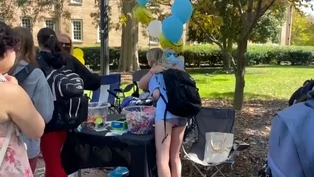
NC colleges and schools respond to mental health needs
Video has Closed Captions
Clip: 1/17/2022 | 3m | Colleges and K-12 schools are addressing mental health needs for students. (3m)
NC education leaders discuss the keys to student success
Video has Closed Captions
Clip: 1/17/2022 | 40m 17s | NC education leaders join Anita Brown-Graham to discuss the keys to student success. (40m 17s)
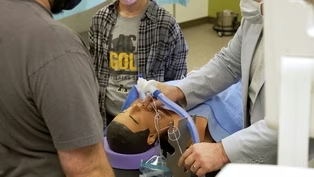
Preview: Town Hall: Student Success
Preview: 1/17/2022 | 20s | ncIMPACT hosts a town hall to talk about solutions for student success. (20s)

Union Square Campus helping fill nurse shortage in NC
Video has Closed Captions
Clip: 1/17/2022 | 2m 41s | A state-of-the-art campus in Greensboro is training nurses for the future. (2m 41s)
Providing Support for PBS.org
Learn Moreabout PBS online sponsorship
- News and Public Affairs

Top journalists deliver compelling original analysis of the hour's headlines.

- News and Public Affairs

FRONTLINE is investigative journalism that questions, explains and changes our world.












Support for PBS provided by:
ncIMPACT is a local public television program presented by PBS NC