
Town Hall: Workforce Shortage
8/5/2022 | 26m 46sVideo has Closed Captions
ncIMPACT's Anita Brown Graham hosts a virtual town hall on workforce shortages.
The pandemic caused a major disruption to our country's labor force and the challenges continue. ncIMPACT hosts a virtual town hall to discuss why labor shortages exist in our state and innovative strategies that can help alleviate those shortages.
Problems playing video? | Closed Captioning Feedback
Problems playing video? | Closed Captioning Feedback
ncIMPACT is a local public television program presented by PBS NC
Town Hall: Workforce Shortage
8/5/2022 | 26m 46sVideo has Closed Captions
The pandemic caused a major disruption to our country's labor force and the challenges continue. ncIMPACT hosts a virtual town hall to discuss why labor shortages exist in our state and innovative strategies that can help alleviate those shortages.
Problems playing video? | Closed Captioning Feedback
How to Watch ncIMPACT
ncIMPACT is available to stream on pbs.org and the free PBS App, available on iPhone, Apple TV, Android TV, Android smartphones, Amazon Fire TV, Amazon Fire Tablet, Roku, Samsung Smart TV, and Vizio.
Providing Support for PBS.org
Learn Moreabout PBS online sponsorship- [Announcer 1] "ncIMPACT" is a PBS North Carolina production in association with the University of North Carolina School of Government.
Funding for "ncIMPACT" is made possible by... - [Announcer 2] Changing the course of peoples' lives, that's the impact UNC Health, and the UNC School of Medicine, work to deliver every day.
Our 40,000 team members across the state of North Carolina are committed to caring for you, our patients and communities.
As well as educating the next generation of healthcare professionals.
Individually, we can do a little, but collectively we can do a lot to create impact.
- I'm Anita Brown-Graham, welcome to the ncIMPACT Virtual Town Tall on Workforce Shortages.
It goes without saying that the pandemic has caused major disruptions to our country's labor force, and the challenges continue.
Joining us to bring expert eyes to the issues are Dr. Erin Fraher, who is the Deputy Director of Policy at the Shep Center for Health Services Research, Gerald Cohen, who is the Chief Economist at the Kenan Institute of Private Enterprise.
And our North Carolina Secretary of Commerce, Michelle Baker Sanders.
Before we get to questions though, let's examine the issue a bit.
Worker shortages did increase over the course of the pandemic, but many industries were already facing a lack of workers before COVID-19.
That's certainly the case for some professions critical to our wellbeing.
And data show things may well get worse.
"ncImpact"'s Evan Howell reports.
- You probably have a lot of advantages though, because- - [Evan] Erica South says the physical and emotional impact COVID had on her and her colleagues in the emergency department grew over time.
And by the time the pandemic had eased, some took that opportunity to leave.
- When we talk about, like, burnout in the emergency department, and that sense of overwhelming, I think a lot of it came because there were multiple waves of the pandemic, and we didn't know what the future was gonna bring.
- [Evan] The lingering effects of the pandemic, and nurse shortage, have cast a broad shadow over operations here at UNC Rex Hospital, and daily improvisation is now part of the job.
- There are times where we have, you know, 30 plus patients in the lobby, and I have to use all my resources to stabilize a critical patient.
So I have to maybe close some beds in the back, in order to keep those patients in the lobby safe, as well as the patients that are more critical.
- [Evan] A nurse shortage was predicted even before the pandemic.
With other industries, such as manufacturing, education, and IT suffering similar issues, leaders across the board are forced to come up with creative solutions to meet the challenge.
To meet some of that challenge, UNC Health is collaborating with the UNC School of Nursing, to both help new nurses coming in, and retain the experienced staff, giving new opportunities that hadn't existed before.
- One of the key critical things is gonna be to ensure that we continue to have a pipeline of nurses.
Our nursing schools last year weren't able to take as many qualified applicants that applied, because we didn't have enough spots for nursing students.
- [Evan] UNC Health also offers signing bonuses and flexible work schedules to recruit nurses, but healthcare leaders admit more will need to be done to reverse the shortage.
- Now, as we're ending the most recent surge, we're still dealing with some staffing issues from nurse retirement.
We certainly have a fair number of nurses across the country have gone into travel nursing, to go make some additional money, where they're being paid additional dollars to go help with other staffing needs.
And so we're continuing to be creative.
- She was really excited.
- [Evan] In the short term, paramedics are being hired at Rex Hospital to help alleviate the shortage.
Meanwhile, South says their training and commitment to patients has made them come out stronger.
- Adaptable, we're resilient, and that's something that we've really seen through the pandemic, is we've made changes, we've really faced things head on.
And I think that's so important, and I think we have a lot of hope because of that.
We didn't let it get us down.
- Erin, let's talk a bit more about nurses in particular.
Prior to the pandemic, you estimated that North Carolina was facing a probable shortage of about 12,500 nurses.
But with the pandemic stretching many nurses to their limit, what do you believe that estimated shortage looks like today?
- Yes, thank you for the question, it's really important.
As we just heard, you know, even before the pandemic, we were looking at shortages.
And with burnout, and with nurses exiting the workforce to become travelers, we actually projected that shortage increases to 21,000 nurses.
And then if we add on the fact that we're gonna be competing with other states for nurses, that exacerbates the shortage.
So one of the things we discovered in our modeling efforts was more than half of our new nurses, every year, who come into the state, are from out of state.
And so if we're in competition, it's gonna exacerbate and make those shortages even worse.
- So let me stick with you for a moment.
What kind of impact would a shortage, like what you have described- - Yes.
- have on our healthcare system overall?
- Tremendous, tremendous impacts.
I mean, if you remember early in the pandemic, we were talking about ventilators, and we were talking about ICU beds.
And we all kept saying, "But what about the staff that are needed to, you know, be with those beds, and be with those patients?"
And so in a critical nursing shortage, you look at beds that can't be staffed.
Patients, as we just heard, that can't be seen.
We have longer wait times for care, and those patients who need care immediately, will have higher mortality rates.
And so we also, that's on the patient side, you know, the risk of, you know, dying is higher, the risk of becoming sicker is greater.
But for the nurses themselves, there's also huge impacts as we just heard.
I mean, what about the moral distress of not being able to care for patients the way you want to be able to care for patients?
Huge issue, but I love this story about resilience, it's there, so we're also seeing that as well.
- Thank you so much, Erin.
Gerald, let me turn to you.
Outside of healthcare, what are some other industries that are facing big challenges with worker shortages?
- Thank you, Anita, it's great to be here.
I think one of the biggest, in the recent job openings and labor turnover survey illustrated this, is in the entertainment hospitality industry, leisure and hospitality, so think restaurants and hotels.
They face one of the largest shortages, in terms of companies that are looking to hire.
And they also indicate about roughly 10% of jobs that are out there are, or 10% are job openings, which is up from less than 5% before the pandemic.
So there's a huge need in that industry.
It also happens to be that that's the industry where, in our labor shortage, that they were also 1.4 million jobs short, relative to where we were prior to the pandemic.
So companies are out there looking, and they're not able to find the labor.
And so there are still places where restaurants and hotels are closed, or working on smaller staffs, but they can't find those workers.
That's what that latest data suggests, so 10% job openings rate in that industry.
- Wow.
North Carolina has been ranked one of the best states to do business, and we continue to add more and more jobs, thanks to you, and your department, and your partners.
How do we ensure, then, that we have the talent pool necessary to keep up with this growth?
- Yeah, that is a priority for the state, and definitely needs to be.
The way that we are gonna do this is to work together, number one, around a common mission and focus, of ensuring that we have the talent for the jobs today and tomorrow.
That we're able to meet the business needs, because as you know, it does us no good, as we just heard about the entertainment industry and restaurants, if we have people who are skilled, but they're not skilled to meet those needs and demands of what the economy and businesses are telling us today.
We still have a gap.
Commerce has a First in Talent Plan that we launched.
And that First in Talent Plan is focused solely on our top asset, which is our people.
I have not met with one company that does not ask about talent, the workforce.
Are we gonna be able to hire in North Carolina?
Do we have the diverse, skilled talent?
Fortunately, we have a university and community college system that we continue to need to invest more in, to produce the talent.
We also have organizations across the state, Anita, that are focused on helping us with this talent that we have.
And frankly, problem that we have before, such as myFutureNC, where the mission is to attain, have 2 million, I believe it is, post secondary and highly qualified credentials by 2030.
The chamber is working with companies to ensure that we are focused on the needs of industry.
There are organizations and entities across the state, and I'm really pleased to see that we are coming together around this common need, and coming up with different ideas.
So we are gonna have to invest in our community, with those entrepreneurs and small businesses out there, building more talent through those pipelines.
Invest in our education system, invest and put forward strong advocacy for policies that make our economy thrive.
And for ones that are gonna attract and build a talent pool here in the states.
And most importantly, you know, to meet the needs today, and the future; it is very competitive.
So I believe that we are gonna have to be more creative and innovative about how we develop that talent, and what we're focusing on.
- Thank you, next question.
This comes from Eric, "How much is the level of wages being offered contributing to the labor shortages?"
Gerald, I think as Chief Economist, we ought to give this one to you.
- So that's a good question.
I think what you're seeing is people are saying to themselves, "Well, if I'm gonna work, I wanna be compensated."
And you've had this, and again, it very much depends on your skill ladder.
So you've had people who have lower skills, have their wages have not kept up with inflation for quite, for almost 40 years.
And so what, because of the strong demand right now, you are seeing large wage increases.
Unfortunately right now, as we speak, those are even, again, being eaten up by inflation.
But I think in a market where there's just very limited supply and increased demand, you're likely...
This is a good time to be negotiating with companies.
And so I think that's a point where you think that that wage, we're at a period where wages are likely to rise, and I think it points rise more than inflation.
So that's something that has definitely been keeping people out of the labor force.
And you're starting to see people reenter the labor force, I think because of that, because they're seeing decent wage gains.
And I think to previous points about skills, I think one of the things that you can do is increase training, and look for training in areas where there is is growth in, you know, demand in healthcare professions.
Where you have the ability to train up, and you know, get those skills and then move it, and then you get compensated for that.
So I think that's somewhere, and at the Kenan Institute, we're actually developing some indicators that are gonna look at where skills gaps exist, where there's strong demand for certain skills, and weak supply for them.
And on the other hand, work with companies, and work with the government to say, "Here are places, where if you developed those skills, you could really get some substantial growth," and so by kind of doing economic development.
So I think all of those things will combine to create potentially significant wage gains, if you can move into those areas where there's strong demand.
- Love it.
So Erin, Gerald, Michelle, thank you, thank you, thank you.
Please know how much we appreciate the great work you all are doing, and thank you for sharing your time and your insights on this important topic.
To our audience, we're gonna take a quick break to allow for our second panel to join us.
Don't go away, we'll be back in a few minutes to talk about solutions.
[upbeat music] The demand for talent is soaring, and it can be painful for employers, but sometimes competition leads to innovation.
"ncIMPACT"'s David Hurst visited two local businesses that are getting creative in their strategy to recruit and retain talent.
- [David] Like many restaurant owners, Maggie Kane struggled to fill positions during the pandemic.
- We put jobs postings out there everywhere.
And I think there is just, frankly, a shortage of folks wanting to be back in the restaurant industry.
- [David] Kane is the Founder and Executive Director of A Place at the Table, a pay what you can restaurant in downtown Raleigh.
She says while it was tough to fill positions for a brief time during the pandemic, they generally have success attracting and keeping talent.
- The rumor is that, you know, restaurants, no one wants to work for restaurants anymore.
I don't think that is true, I think that the restaurant industry is a great industry.
The hospitality industry is a great industry to be in, and so I am excited for it.
- [David] Kane says they offer a living wage and family-friendly benefits, including paid parental leave, which only 6% of restaurants offer to their employees.
A Place at the Table also relies on partnerships to fill employment gaps.
- We would not be here if it wasn't for our nonprofit partners, our restaurant partners, and everyone in this community that helps make this impactful mission happen every day.
- [David] In the corporate world, where competition over talent can be fierce, offering creative benefits can be key in attracting workers.
- Thinking about the workforce holistically, understanding that there are different needs across your workforce, depending upon the stage of life that they're in.
So we have an elder care benefit that allows individuals to get that kind of support.
So we try to be as creative as we can, and really listen to what the workforce is telling us is really needed.
- [David] Leaders at Blue Cross North Carolina say the pandemic has shaped what prospective and current employees want.
- They're looking for flexibility, they're looking for inspiration from their leaders.
They want to be able to bring their authentic selves to work.
And I think as we talk about this, the pandemic has heightened that awareness, among the workforce and the potential workforce.
- [David] At the end of the day, for small and big businesses alike, it's all about giving employees a voice.
- When you show up every day, and you feel loved and cared for, and that we hear you, and we wanna be the best employer we can for you, so tell us how to do that.
- A lot to think about there.
We have another wonderful group of experts joining us to share reactions and more solutions.
Welcome to Gary Salamido, Gary's the President and CEO of the NC Chamber.
Danielle Frazier, Danielle is President and CEO of the Charlotte Works.
And Lisa Finaldi with Family Forward NC.
Thank you all for being with us.
For those of you watching on Facebook live, again, our guests wanna hear from you.
So please comment in the chat with any questions or suggestions.
Lisa, I wanna start with you, because your work is so well aligned with what we just heard in that first story.
You work with businesses like the ones we saw in that piece, and help them to think about what kinds of family-friendly practices their employers need.
Talk to us first about what you see as some of the biggest challenges that employers are facing right now, as it relates to attracting talent.
- [Lisa] Sure, thanks, Anita.
I think we have to step back, and look at who our workforce is today.
And we see that the millennials and Generation X are 68% of our workforce, and they are looking for a more worker, and family-friendly employer, and that's where they're going to go work.
So that's a really important part of how employers are challenged, because they're not looking at the significance of that part of our workforce.
- Huh, so let me stick with you for a moment here.
- Sure.
- About 67% of North Carolina employers have, or are considering, increasing family-friendly benefits, so they're thinking about it.
What evidence would you share about the impact of these benefits on recruiting and retaining talented employees?
It's not an inexpensive proposition, so what's the ROI?
- Sure, and it can be an inexpensive proposition.
We have to really think about what is a business's journey to create a more family-friendly workplace.
People can start at different places, depending on the size of your business, but the ROI is really about today and it is about tomorrow.
So for today, businesses see that employees want to work there, they will stay, the productivity increases.
Also employees are more present, they like their job, they want to be there.
And also, especially for working parents, there's a reduction in absenteeism.
But then now, let's look for a minute at our working parents, and what they need.
When they have access to some of these benefits, they are going to, you know, remain in the workforce.
And some of them are making difficult choices about staying home, when they really can't afford to stay home.
And when we look at our future workforce, which are our children, everyone can contribute to giving them the best start they can.
And when they have that strong foundation for academic and career success, we're building the workforce of our next generation.
- Hard to argue with that ROI.
Danielle, the demand for technology continues to grow.
This is making IT skills highly valuable in the workplace.
Talk to us a little bit about the role education plays, in both generating interest in these types of high-demand fields, and preparing people for them.
- Thank you, Anita.
You know, I think while we are seeing the growth in the tech sector, we're seeing an increase in demand, just for new technical skills across all industries, especially with the impact of the pandemic.
And we're working in a much more digital and remote world.
And you know, where before, you may have needed technical skills, because it was your role, such as cybersecurity or software development.
You know, now businesses are needing their workforce to have more technical skills, around using different communication and collaboration platforms, just to perform their work.
So education is critically important to raising the awareness of these top skills in demand, especially in IT.
And we know that there are still huge interest gaps for many industries, because of a lack of awareness.
And so I'm fortunate to serve as the Co-chair for our school system's career and technical education, our education advisory board, and career awareness, and CTE awareness is one of our strategic pillars.
We find creative ways to partner with industry, to provide work-based learning opportunities, such as having someone come to a classroom and speak about their career, their industry, or organization.
Students participating in internships, and even partnering with businesses on curriculum development, to insert these critical skills that they're looking for, within classroom instruction.
You know, just to name a few of how we're connecting the dots for our students, from classrooms to careers.
And it's not just about student awareness, right?
It's about teacher awareness as well, those that are directly influencing our students' journey.
- Excellent, next question.
"What additional training are companies offering for employees to move up in the company, and get additional skills?"
This is coming from David.
And Gary, I'm gonna pitch this to you, because a lot of times we hear a company saying, you know, "Our educational institutions are not doing enough to give us the workforce we need."
But increasingly companies recognize they've gotta invest in up-skilling their own workforce.
So talk to us a little bit about what you're seeing.
- Yeah, I think the pandemic, again, has given us an opportunity to use technology in a way that, historically, perhaps, we were a little slower to use.
So when you look at online learning now, in whatever capacity it is, whether it be online learning that we've learned how to do, through our high schools, community colleges, our university systems, public and private, those universities that are out there that are largely are not exclusively online learning.
We're seeing a whole lot of opportunity now for, A, companies are listening and saying, "Okay, let's figure out exactly what you need," right?
The first thing to do is listen to understand what the challenges are.
So companies are listening, and employees are communicating more openly, and then developing unique opportunities through whatever systems makes sense.
Whether that makes going into a community college something that works for the employee, or if it's an online version of that, we're gonna see all different types of ways companies are gonna innovate, based upon the needs of the employee.
And based upon how that employee can, or wants, to receive the additional training and education that they need, so it's a great opportunity.
Technology has shown us that we can Zoom and continue to do things, and that's a really important asset to have now.
The challenge is gonna be that balance between in-person learning and remote learning.
And how do we make sure that we maximize that, and make sure that we're getting the best out of both, not just one or the other?
- So I have time for one last audience question.
How does NCWorks help individuals get the credentials they need to fill jobs and help businesses up-skill existing employees?
This is coming from Tammy.
And Danielle, it feels like it's tailor-made for you.
- I feel like it, thank you, Tammy, for that question.
So NCWorks, as many of y'all know, it's our career center system across our state.
We've got about 80 career centers across the state that help adult workers, 18 and older, from all spectrums of their career.
Those that are just entering the workforce, to your 20, 30-year banker that may have, unfortunately, been laid off.
And so we assess our job seekers coming through the door, to understand their experience, to understand their background, and where their interests are.
And we help to triage that and to understand, you know, what credentials, what skills are needed.
And we partner with our community college system and other partners in the community, to help to steer them in that direction where they can get that credential.
We also provide what we call Employee Training Grants to businesses to help try to upscale individuals coming into their places of employment, through on-the-job training grants.
That we subsidize some wages for them, for a certain period of time, so that they can help kind of unload that liability, and that weight of that financial liability, with individuals coming into their work and getting them up to speed with training.
And then we provide training grants to up-skill their workers that are already within their workforce, to help them advance within the organization, and continue to grow their skills that they need to continue with employment.
- Wonderful.
Lisa, Danielle, Gary, I can't thank you enough for joining us, and for the great work each of you are doing in this state to support people getting connected to work.
And of course, I wanna thank the leaders who were featured in the episode.
Stories for generously, always generously, allowing us to share their inspirational work together.
And then finally, we never end without thanking you, our amazing audience, for watching and engaging.
You know solutions are out there if we work together.
I'm Anita Brown-Graham, this is "ncIMPACT".
[dramatic music] ♪ - [Announcer 1] "ncIMPACT" is a PBS North Carolina production, in association with the University of North Carolina School of Government.
Funding for "ncIMPACT" is made possible by... - [Announcer 2] Changing the course of peoples' lives, that's the impact UNC Health and the UNC School of Medicine work to deliver every day.
Our 40,000 team members across the state of North Carolina are committed to caring for you, our patients and communities.
As well as educating the next generation of healthcare professionals.
Individually, we can do a little, but collectively, we can do a lot to create impact.
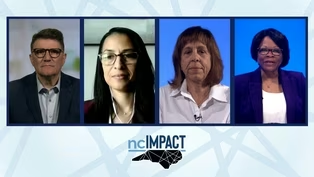
Experts highlight solutions to recruit and retain talent
Video has Closed Captions
Clip: 8/5/2022 | 26m 34s | Panelists join Anita Brown-Graham to discuss solutions to recruiting talent. (26m 34s)

Family friendly policies are key in recruiting employees
Video has Closed Captions
Clip: 8/5/2022 | 2m 19s | The demand for talent is soaring but sometimes competition can lead to innovation. (2m 19s)
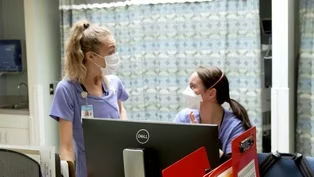
North Carolina hospitals face critical nursing shortage
Video has Closed Captions
Clip: 8/5/2022 | 2m 29s | Hospital leaders are forced to get creative in attracting and retaining nurses. (2m 29s)
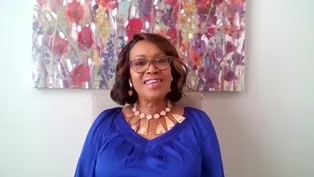
Some industries still facing major disruptions to workforce
Video has Closed Captions
Clip: 8/5/2022 | 26m 15s | Panelists join Anita Brown-Graham to discuss workforce shortages. (26m 15s)

Virtual Town Hall: Workforce Shortage
Video has Closed Captions
Preview: 8/5/2022 | 20s | ncIMPACT's Anita Brown Graham hosts a virtual town hall on workforce shortages. (20s)
Providing Support for PBS.org
Learn Moreabout PBS online sponsorship
- News and Public Affairs

Top journalists deliver compelling original analysis of the hour's headlines.

- News and Public Affairs

FRONTLINE is investigative journalism that questions, explains and changes our world.












Support for PBS provided by:
ncIMPACT is a local public television program presented by PBS NC