
Tracy K. Smith on Her New Book "Wade in the Water"
Clip: 6/17/2019 | 18m 18sVideo has Closed Captions
Tracy K. Smith joins the program to discuss her new book, "Wade in the Water."
Walter Isaacson speaks to Tracy K. Smith, the 22nd U.S. Poet Laureate about her new book, “Wade in the Water,” which explores American history through an extraordinary series of letters between slaves and their owners in the 19th century.
Problems playing video? | Closed Captioning Feedback
Problems playing video? | Closed Captioning Feedback
Tracy K. Smith on Her New Book "Wade in the Water"
Clip: 6/17/2019 | 18m 18sVideo has Closed Captions
Walter Isaacson speaks to Tracy K. Smith, the 22nd U.S. Poet Laureate about her new book, “Wade in the Water,” which explores American history through an extraordinary series of letters between slaves and their owners in the 19th century.
Problems playing video? | Closed Captioning Feedback
How to Watch Amanpour and Company
Amanpour and Company is available to stream on pbs.org and the free PBS App, available on iPhone, Apple TV, Android TV, Android smartphones, Amazon Fire TV, Amazon Fire Tablet, Roku, Samsung Smart TV, and Vizio.
Watch Amanpour and Company on PBS
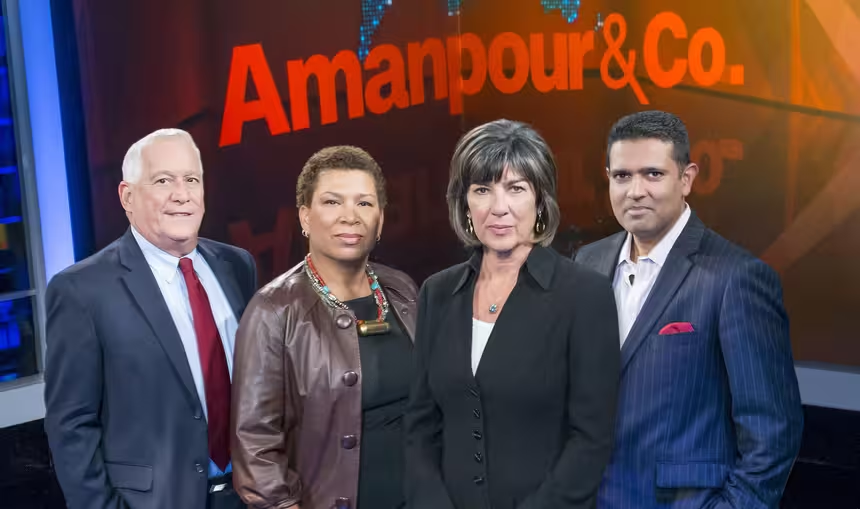
PBS and WNET, in collaboration with CNN, launched Amanpour and Company in September 2018. The series features wide-ranging, in-depth conversations with global thought leaders and cultural influencers on issues impacting the world each day, from politics, business, technology and arts, to science and sports.Providing Support for PBS.org
Learn Moreabout PBS online sponsorshipOur next guest is the official poet laureate of the United States.
Tracy K Smith won the Pulitzer Prize in 2012 for Life on Mars, a collection of poems on science and religion.
And she's been the face of American poetry ever since 2017 when she became poet laureate.
Her new book, Wade in the Water brings us back to Earth and explores American history through an extraordinary series of letters exchanged between slaves and their owners in the 1800s.
And she sat down with our Walter Isaacson to talk about it.
You've written an extraordinary memoir Ordinary Light in which you talk about your childhood your background.
How does that relate to your poetry?
I think a lot of the stories that I tell, an ordinary light and some of the questions about family and individuality live in my poetry.
But they came out differently in prose.
I felt like telling the story of my family in prose was an act of persistence, peeling back different layers that in my poems I managed to leap away from It also allowed me or even maybe forced me to develop a vocabulary for talking about race that I hadn't as a poet.
Found.
And faith was also part of my upbringing and life on Mars there.
There are some questions about God and the afterlife that come in, but I wanted to go back to the very beginning and think of how did God become a part of my life?
How have I wrestled with with that relationship?
And what does it tell me about who my parents were and who I am?
So the memoir answered answered those same questions differently for me.
So let's start with your father, who's a naysayer engineer, but growing up black in the segregated South before then.
Right.
And then you write Life on Mars, which seems to have some resonance from what he's doing.
My father was born in 1935 and rural Alabama.
He left the South in the early fifties to join the Air Force and he always told us he left because the South was too hot.
But I think that there were other factors at play as well.
He was somebody who had a huge curiosity about the world and about the universe and about the universe.
Really systematic mind.
He was an engineer by training.
After he left the service, he took a civilian job, which allowed him to work on the optics for the Hubble Space Telescope.
And that was something that I think delighted him because he had been a science fiction lover growing up and to be working on a tool that would show us, as he described it, how the universe itself was born with something that filled him with immense delight.
And tell me about your mother and the influence she had.
My mother was my dad's generation.
They were born within a year of one another.
And she had been a librarian and a schoolteacher before I was born.
And I knew her as a stay at home mom.
Her faith in God was something that really drove our family and I think gave us a sense of hope and support getting through what was hard was always a matter of let's get together and let's pray about it.
And she was also somebody who was really funny who loved meeting new people and listening to their voices and stories and who would delight us with stories of her own upbringing in the South together I think my parents really gave my siblings and me a sense of anchoring that stretched from, you know, the spirit realm and the sense that we belong to a creator who who loves and cares about us and the sense of the world as something that was structured and orderly and that we needed to work hard to contribute to.
Was there any tension between your father's view of the universe as a scientist looking at it through the Hubble spacecraft?
And your mother's view of the universe, looking at it from a religious and spiritual viewpoint?
It seems like there should have been right.
You know, we think about these two things as really different from one another.
But my dad had this really beautiful way of synthesizing these perspectives.
And I remember the question of, you know, creation versus evolution would always come up in conversations when they were talking about faith with somebody who wasn't a believer.
And what I would say, you know, the Bible talks about time and heavenly terms in earthly terms.
And I would love to believe that God's sense of seven days might be millions or billions of years on Earth.
And in that time, evolution is probably something that could happen.
And and instantly I felt free.
I felt free from this bird and of having to say, well, if I love God, then I have to turn my back on these other things that feel real to me.
He said, no, you don't like the universe is huge, and there's a space in it for a lot of connections.
We might not think are logical.
And your more recent book, Weighed In The Water is about thinking about what it's like to be black in this world.
Quite a bit.
Yeah.
I mean, in some ways, those very same questions, who are we?
How do we relate to one another and what do we do to one another?
Move through.
I think most of my work but in this book, race became the, the, the point of collision.
And I think it's because we live in a moment where those questions of difference have suddenly become so profound and unsettling and divisive.
Yeah.
I mean, there's a sense of violence that's erupted around, I think, fear over this difference.
And I felt suddenly like the history that used to feel so far behind us was kind of catching up.
How can poetry help solve that?
Well, I love poems because they pull me out of my own perspective no matter what I'm reading.
It's a poem that's coming from someone else's vocabulary and imagination.
And poems are sometimes challenging to our own sense of authority.
Our own assumptions about the world.
And if we let them, they invite us into a larger and stranger view of experience and of what is possible if you do that enough that you become better at accepting other people on their own terms, You also become more curious about who they are and what experiences have contributed to their perspectives.
And I feel like, you know, that's one of the one of the bridges that might get us from where we are now to where we really ought to be.
And one of the devices you use to do that is making poems out of a collage, really, of letters and entries and writings of African-Americans who are fighting the Civil War or others.
How did how did you come up with that idea and how does it work as poetry?
Well, I was interested in history because it felt so eerily present.
And so I just was looking back at historical documents, trying to learn.
I had a question about what the experience of black soldiers and their families would have been and the Civil War.
And so I found all of these primary documents, letters and deposition statements.
And whereas I thought I was going to be reading them, kind of metabolize them and coming up with my own vocabulary for discussing them.
I was overwhelmed by how moving, how coherent, how persuasive, poetic and also alive those voices felt.
And I said, it doesn't make any sense to overwrite these voices with my own.
I should curate something And so that's where the impulse toward a found poem began for me.
And another thing you do in this book is I think you call them erasure poems in which you take a document, a document maybe we all know some words we all know, but erase a couple of words and explain that to me.
And I think you have an example declaration, which I'd love you to, if you don't mind.
Well, the erasure is a is a is an art form that's been around for four generations.
And I think it's interesting because it takes one document that expects to live in a specific context and to be received by a specific audience.
And it tampers with that a little bit.
It invites us to hear it differently.
And sometimes what you hear is a counter current.
So I have a poem that is called Declaration that comes from the Declaration of Independence.
I was rereading that document, and I got to a place where I began to hear something and the grievance that the colonists had against England that felt very similar to a grievance that contemporary blacks might have about the nature of America and American history, about the role of black life in this country through the ages And it felt very unsettling to me.
It's funny because when you're writing, you're often saying, Okay, I want I want to be spoken to.
I want to hear something that's not just me.
But when that happens, it can be really surprising until the poem is called.
This poem is called Declaration, as in the Declaration of Independence.
But with a writer's declaration, he has sent hither Swarms of officers to harass our people.
He has plundered our, ravaged our, destroyed the lives of our taking away our abolishing our most valuable and altering fundamentally the forms of our.
In every stage of these oppressions, we have petition and for redress in the most humble terms.
Our repeated petitions have been answered only by repeated injury.
We have reminded them of the circumstances of our emigration and settlement here taken captive on the high seas to bear and that's, of course, from the Declaration accusing the King of England of things he's done.
And yet, when you do the erasure it makes it more universal, something we live through every generation in our history.
Yeah, I think you're right.
I mean, I definitely hear grievances that feel very, very applicable.
But I also understand that it tells me this is a story that others have also lived in their way And shouldn't that foster a kind of compassion and a kind of understanding or couldn't it?
And I think that's a question that runs through many of these poems and their poems that are hard on this country.
Because I love this country.
Another of those poems that striking in its political resonance strikes home to me because I'm from Louisiana.
It's about Baton Rouge, and it's about an amazing photograph of an incredibly well-dressed African-American woman elegantly standing there as the police are trying to restrain the crowd.
Did you do that poem from looking at that photograph?
And if so, what was in your heart when you did it?
And then maybe we did some of it.
Yeah.
Yeah, I absolutely was looking at that photograph.
It's by Jonathan Bachman, the photojournalist and the woman in it is named Aisha Evans.
And she was at a Black Lives Matter march.
And she's wearing this gauzy sun dress on a day where there's like a gentle breeze.
And so there's this incredibly lyrical image of her with this, the wind blowing the dress back.
But on the other side of the photo, there are a number of police officers in riot gear.
And so there's this really interesting imbalance between, you know, the weight and the defense on one side and somebody that seems to be standing in peace.
I had an immediate gut reaction to that photo, but I wanted to look at it and see what else I could gather.
I wanted to see if the photo could invite a different kind of vocabulary for for the sense of tension.
And so this is what this is what I found.
Unrest in Baton Rouge.
Our bodies run with ink, dark blood, blood pools in the pavement.
Seems.
Is it strange to say love is a language few practice, but all or near all speak.
Even the men in black armor.
The ones jangling handcuffs and keys.
What else are they so buffered against?
If not love's blade, sizing up the heart's familiar meat we watch and grieve.
We sleep, stir, eat.
Love the heart.
Sliced open.
Cut it clean.
Love naked.
Almost in the everlasting street.
Skirt lifted by a different kind of breeze.
Well, I read a really nice New York Times profile of you, and it said that after reading that poem, I think maybe it was in South Carolina somewhere.
A group of police officers came up to you and said, Ride with us.
See it from our side.
Tell me about that.
Yeah, I read this poem at a community center in South Carolina, and that happened.
I shared it as I was reading the poem.
I could see the officers in the back, and I was thinking, I wonder what they're going to make of this poem.
And afterward, they came up and said, You're welcome.
If you come back, here's our card.
You're welcome to come along with us and see how we do our job.
I read a lot of different things in that offering.
It was kind.
I think it was offered in a kind of mode of civility.
But I think there were also saying it's a complicated job that we do.
There's a lot at stake.
And we want to show you how we how we take it.
I wish I could have gone with them.
You do it sometimes if I go back.
Yeah.
I mean, that's one of the things about poetry in your poetry.
In particular, is that even though it's sort of tough at times, it has a healing undercurrent to it.
Do you feel that these poems could heal?
Is that something you feel is the role of poetry?
Well, I think poetry can do that.
I think poetry teaches us to look at things in a more courageous way.
And to sit with them longer than most other forms of of communication urge us to, at this moment in human civilization, But, you know, even going back to that offering, I believe that we're accountable to each other.
And I think I want to believe that's what those officers were saying.
We're accountable to one another.
We are accountable to you.
And maybe your imagination could also be accountable to the world that we move through.
And I think the wish of that poem is to say how can we take this more seriously?
Love is a huge enterprise and it exacts a lot of assets.
It's challenging.
It's frightening.
To say, if I love you, then I can't be happy or safe.
If you are not happy and safe That's a big investment, right?
But I feel like it's something that we need to begin to contemplate.
And I think poems at least when I'm writing them, they feel like a little laboratory.
You know, I can do these mental exercises, these thought experiments that might prepare me to live a little bit differently, to live with a greater sense of accountability.
What did you learn from studying from Seamus Heaney?
Oh, I learned that poems can take on huge questions, questions about responsibility, and that poems can also bring us into greater contact with the private with the world that we know and belong to, even if it's changing, even if it's gone.
Poems can help us to touch base with the people that we love, even if they're lost to time or distance.
I also learned that being a poet can be a joyful enterprise, even when you're writing about things that are serious.
I remember when I was Seamus, a student, I gave him a book to sign at the end of the year.
And it was my senior year of college, and so my heart was heavy.
I didn't know what I was going to be doing exactly, but I know what I hoped to do.
And so I gave him the book, and I was sitting there as he signed it.
And his inscription was a quote from Yeats, and it said, And wisdom is a butterfly and not a gloomy bird of prey.
And I love that because he was telling me kind of, Buck up, kid, we're doing this.
Do you think that informed your because there's a lot of gloomy stuff that you have to write about, but you keep the butterfly alive.
I hope so.
I mean, think about that a lot.
I think about that.
What I now realize was kind of an ugly seriousness that I was that I was taking and applying to these questions.
And I think Shamus, his model is you can do this with an abundance of hope and joy and kindness and generosity.
And you can still get to the hard stuff to Tracy K Smith.
Congratulations on your new collection.
Thank you for being with us.

- News and Public Affairs

Top journalists deliver compelling original analysis of the hour's headlines.

- News and Public Affairs

FRONTLINE is investigative journalism that questions, explains and changes our world.












Support for PBS provided by: