
Traditions & Nostalgia
11/24/2022 | 26m 14sVideo has Closed Captions
Traditions & Nostalgia
Thanksgiving conjures images of tables covered with food, surrounded by family and friends, and a time of celebration. In this edition of InFocus, we’ll look at the history of Thanksgiving, as well as how old things are new again – as vinyl record sales are again setting records.
Problems playing video? | Closed Captioning Feedback
Problems playing video? | Closed Captioning Feedback
InFocus is a local public television program presented by WSIU
Support provided by:

Traditions & Nostalgia
11/24/2022 | 26m 14sVideo has Closed Captions
Thanksgiving conjures images of tables covered with food, surrounded by family and friends, and a time of celebration. In this edition of InFocus, we’ll look at the history of Thanksgiving, as well as how old things are new again – as vinyl record sales are again setting records.
Problems playing video? | Closed Captioning Feedback
How to Watch InFocus
InFocus is available to stream on pbs.org and the free PBS App, available on iPhone, Apple TV, Android TV, Android smartphones, Amazon Fire TV, Amazon Fire Tablet, Roku, Samsung Smart TV, and Vizio.
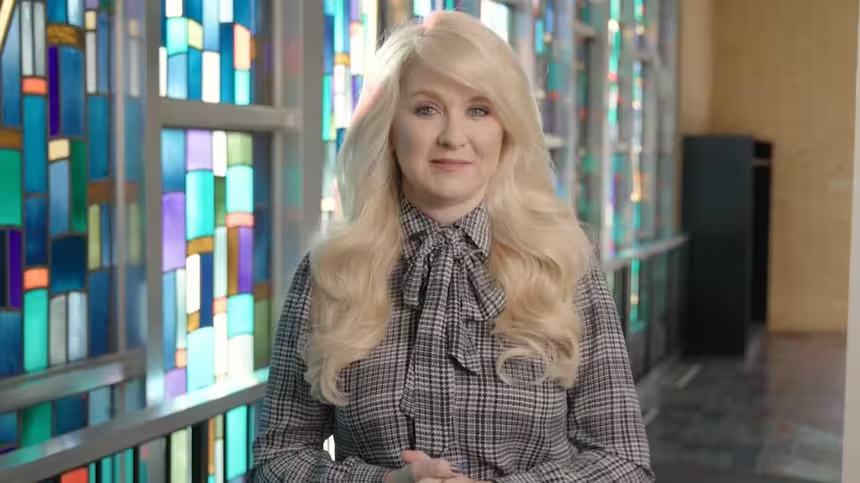
InFocus
Join our award-winning team of reporters as we explore the major issues effecting the region and beyond, and meet the people and organizations hoping to make an impact. The series is produced in partnership with Julie Staley of the Staley Family Foundation and sponsored locally.Providing Support for PBS.org
Learn Moreabout PBS online sponsorship(peaceful music) (energetic music) - Welcome to a special Thanksgiving episode of InFocus on WSIU.
I'm Jennifer Fuller.
Since Thanksgiving is centered so much around food, we thought we'd talk with our resident expert on foods and history of foods and all things foods.
Niki Davis, the professor of hospitality, tourism, and event management at SIU Carbondale.
So we've heard from you on things like copi and food trends.
Thanksgiving, we thought we need to talk to you again.
So for people who are unfamiliar with traditions and how they get started, how did Thanksgiving really get started?
We all know the story we learned in school, but how did it really get started?
- Well, I won't discount the story we learned in school by any stretch, but Thanksgiving really is the work of one woman, and her name was Sarah Hale, and she published a novel in the late 1820s, called "Northwood."
And in that novel, she spends an entire chapter describing an English dinner that included the roasted turkey and all of the trimmings.
And around the same time, she was moving to petition to have Thanksgiving a national holiday here in the United States.
And that was an effort to unite a nation that was very quickly separating itself.
But it took a very long time for all of it to happen.
And in fact, it was Abraham Lincoln who kind of signed it into proclamation, but it wasn't until 1942 that we decided that Thanksgiving would be on the fourth Thursday of November.
So it took quite a long time for it to happen.
- I imagine that, you know, when we think back to that first Thanksgiving, that image we all have in our minds that we learned, and people talk about the fact that there was turkey at the table, more than likely it was whatever they could find, right?
- More than likely it probably was not turkey.
There is no written indication anywhere that there was actually turkey served at that first Thanksgiving.
And in fact, that first Thanksgiving really wasn't a Thanksgiving like you and I would think of one, like what we grew up with.
And more than likely it was a harvest feast, which happened all over Europe at the end of of harvest as thanksgiving for the harvest.
And that's where that comes from.
Now what we do know is that there were wild game served.
So venison would've been that, probably rabbit, maybe squirrel.
We also know that there was wild fowl, and possibly a turkey in that, but more so duck, goose, maybe pigeon.
- How do things evolve?
You mentioned that, you know, it took nearly a hundred years for Thanksgiving to be moved permanently to the fourth Thursday in November.
But how do these things change from, "We're having a harvest feast," to, "this meal must include turkey and mashed potatoes and gravy and all of the things that go with that traditionally.
- Sure, food historians pretty much credit Sarah Hale's first novel as that because of the chapter on the English feast.
But A Christmas Carol also had a little bit of a turkey feast in it as well.
And I think that's where we get maybe that Norman Rockwell-ish type of image in our minds.
And we've talked about marketing magazines showed that, you know, that advertisement, that image, in magazines and newspapers and that's what we just consider to be a traditional Thanksgiving meal.
Is it for everybody?
Not necessarily.
- Let's get to that because, you know, people pride themselves on the fact that the United States is a melting pot of cultures.
- [Niki] Sure.
- And so there are a lot of people who include a lot of other things on their Thanksgiving table.
What are some of the more common things that maybe aren't a part of that Norman Rockwell picture?
- Well, common and Norman Rockwell might not go together.
(both laugh) But I think when we look across the country as a whole and look at regional cuisine, the things that show up in the various regions of the the USA, show up on our holiday tables, whether it's Thanksgiving, Christmas, whatever.
And you know, a couple of examples here, in the Midwest in the heartland, most of us roast a turkey.
Some of us smoke a turkey.
Typically we'll have pies and mashed potatoes and all the wonderful things, right?
But if you head up north just a little bit in the Midwest, you'll have wild rice casserole.
If you head a little bit more south you'll have sweet potatoes.
And not just sweet potato casserole, but sweet potato pie.
You'll have oysters in New England and venison in Oregon.
- We talked a little bit about this when we discussed copi, in terms of what people are able to get.
I think there were probably some people surprised this year, maybe they couldn't get a turkey.
- Yeah.
- Or maybe they had to pay a little bit more for the turkey that they wanted.
How much does that availability play into what people will put on those holiday tables?
- Well, I think this year it will play a large part and because of the turkey shortage, which really began because of the bird flu in the spring of this year, we're seeing higher prices and we're seeing fewer of them in the grocery store.
And the closer we get to Thanksgiving, the fewer there will be.
If you have to have a turkey, you'll have a turkey, and it might cost you a little bit more, but if it's something that you can maybe make a change, then there are a lot of other proteins that you can put on the table.
Other wild fowl, duck and goose, for sure.
Venison is another opportunity.
- A lot of people will talk about cultural differences when it comes to just one dish that's on that table, and that comes to the stuffing.
What kind of stuffing do you have?
How do you cook it?
How do you present it?
How do all of those things evolve, and what are some of your favorites?
- Well, the first question, is it stuffing or dressing for you?
(both laugh) It's both for me, depending on how it's being prepared, and my family, we grew up with oyster stuffing or oyster dressing.
And that was largely because of my grandfather, having fallen in love with oysters during World War II.
And that came back with him.
So that's what my mom fixed.
That is not common here in the Midwest.
That's more common in areas where oysters are readily available.
That changes based upon the ingredients.
In California, sourdough bread is what we make our stuffing out of.
Oysters certainly is one of those kind of all-across when we're on the coast.
So I think depending on where you're located, what you put in that stuffing is very much what you have seasonally available for you, at least traditionally.
- How important are those traditions and those really specific dishes when you think about the the cultural norms?
You know, are people really going to feel lost if they're not able to be a part of a meal that has these ingredients?
- I think that will depend entirely on the person and what they're willing to maybe shift and do with or without.
If you grew up with the same meal on the table every year for your entire life, then yes, you're going to miss a little bit of that if you can't have the same thing this year.
I grew up with the same basic foods, and then we interchanged things when we wanted to.
And now that I'm raising my own kiddo, things change a lot, based upon what she is in love with, let's say, for that particular year.
So this year it's going to be Italian food on the Thanksgiving table.
My mom doesn't know that, but she has requested at least one pasta dish for Thanksgiving, so- - Sure, sure.
How important are foods culturally?
I think a lot of times people share their cultures, or share their love for their heritage- - Sure.
- Through food.
So Thanksgiving obviously does that.
But in a more general sense, how much does food mean to a group of people?
- A lot of us identify ourselves through our heritage.
I'm German-American, my family is German.
I descended from German settlers here in Southern Illinois.
And that's very much a part of how I see myself.
And I think that goes across the board, regardless of what your cultural background happens to be.
Food in general, for those of us who are foodies, food nerds, whatever label you want to put there, we cook because we love to do it, but what we love more is cooking for somebody, friends, family, whomever, and that's how we show love for that group of people that's close to us.
- How does that change as cultural norms change, though?
You know, we've had a lot of conversation about sustainable farming- - Mm-hmm.
- and sustainable buying.
- Yeah.
- So does that change what you cook and what you serve?
- I think in some sense it can.
And I think as people move around the country, we're very mobile now, compared to a hundred years ago.
As we change, as we move around from place to place, living as we travel, travel's a big piece of this too, we pick up things in those travels that we bring home.
And back to my grandfather, that necessarily was not travel, but an example nonetheless.
I've traveled all over, eating food.
I travel on my stomach, as it were, and I seek out that food culture where I go, and I bring that back home with me.
So we tend to eat the things that we've eaten on vacation, back at home.
- You mentioned the economy and tourism and how that all goes.
- Sure.
- There is a group of people, though, that maybe don't have that history with coming to a family table or spending the day cooking before they get to a family table.
There are still quite a few people who will spend this holiday at a restaurant.
- Sure.
- Or eating out.
Is that something that is another cultural thing for them, do you think?
Or is this out of necessity?
- I think in some sense it's cultural.
If you grew up eating out on Thanksgiving, because nobody wanted to cook the meal, let's say, or if you're from a smaller family, and that was just an easier situation, that becomes part of your culture, right?
And that's something that you continue to do as you grow up and grow older.
This year, it might be a situation where that typical 10% that eats out on Thanksgiving might increase a little bit because we're seeing a turkey shortage and some other supply chain disruptions, making it a little bit more difficult to purchase the items to cook the meal at home.
So time will tell on how many people actually eat out this year for Thanksgiving.
- Another thing that time will tell is how cultures change both during a pandemic and coming out of a pandemic.
Thanksgiving is traditionally one of the busiest times of year in airports and for travel in general.
So a lot of people are going perhaps home to visit family - [Niki] Sure.
- But still others are planning vacations, and they're not doing the traditional Thanksgiving meal.
What does that do in terms of, say, food tourism?
Do you see some restaurants or some tourism agencies saying, "Hey, come try this," in terms of a food, a culinary tourism aspect?
- A little bit.
And to some extent, you know, culinary tourism food tourism, it's not just about the restaurants it's about the culture and the food heritage and the destination and the place.
And I think that's largely why we travel.
That said, if you have a favorite restaurant chef, or you see an article in a magazine about a restaurant you want to go try, that's part of it as well.
- Sure.
Thanksgiving kicks off what people like to call the holiday season.
What are some of the things that you look for as far as foods that you like to cook this time of year?
Foods that are easy to find and perhaps easy to prepare?
- So you're asking me what my favorite foods are.
(both laugh) I'm very much this time of year, I'm looking for local foods, and I'm shopping farmer's markets for our local winter squash, and making various dishes out of those.
Butternut squash is one of my favorites.
And it's versatile, we'll say, and certainly can be something that you serve on the holiday meal table, or just for dinner on a weeknight.
I personally, and I think we're seeing this as a result of the pandemic a bit as well, shopping local, whether it's the farmer's market, local meat markets, a market that might be attached to the orchard.
You're going to have fresher ingredients.
They're going to taste better because they are fresher and honestly, you're putting money in the pockets of your local farmers and that's sustainable, certainly, but also a bit of a feel-good.
- Do food trends tend to follow seasons as well?
- Depending on where you're at.
(laughs) I think seasonal food is seasonal food.
And if we are personally the type of family or the type of person that cooks that way, that's not so much of a trend as it is just part of how we function in the kitchen and in our homes.
- Certainly.
What do people need to think about now compared to, say, 20 years ago, when it comes to being culturally aware, if they're serving a big meal, or if they just want to maybe branch out a little bit and learn something new.
- I think now it's easier than ever to learn about foods from different cultures.
And we can thank technology largely for that.
20 years ago, let's say pre-internet, we had to travel.
We could pick up a book or cookbook certainly in the library, but to experience that firsthand and travel, was much the preference.
Now still, we can pick up the cookbook and learn to cook a different food from a different culture, but you can find a lot of that on the internet as well, if you don't want to mess with the cookbook.
I think there are generations of who are cookbook-readers and who are internet recipe-finders.
So, but absolutely that's something that's easy to do and something that I think we should be doing.
- Do you find that there is a generational gap?
You just mentioned that a little bit, where you've got people who are recipe book people people who are internet recipe-finders.
- Mm-hmm.
I put myself in both camps.
- Mm-hmm.
- But for people who are the, you know, "I wanna hold onto a book."
- Sure.
- Is that a part of the culture of cooking for them?
- Yes, absolutely.
- [Jennifer] Sure.
- And whether it's purchasing that new cookbook that just came out last week, or reading the the food magazine that you subscribe to and get in the mail, that's absolutely a part of it.
And it's where we find those new recipes that we want to try to cook at home for our family.
- Historically though, you're looking, too, at people who pass down recipes - Absolutely.
- From generation to generation.
- Yes, yes.
- Is that slipping away at all?
- Yes.
And it's unfortunate that it is, and I think in families where generations cook together, that still exists very much.
And that was how I grew up.
We cooked, kind of at the knee of my grandmother and certainly my mother.
And those recipes have traveled down the generations to us, and eventually down to my own kiddo, Family is where there was- I'm seeing a generation of cooks who are missing those generations of recipes.
- You can definitely get an opportunity to try those new things during the holiday season.
- Absolutely.
- You can find more at Dr. Niki Davis's website.
You can check that out.
We've got it here on the screen for you here on InFocus.
Niki, thanks so much for your time and happy Thanksgiving.
- Happy Thanksgiving, thank you.
- As we talk about nostalgia, the popularity of vinyl record sales stayed steady after World War II.
In fact, the Recording Industry Association of America started keeping track of record sales across the country way back in 1952.
Throughout the decades they've included sales for records, tapes, CDs, streaming, and now 70 years later, they're reporting a new milestone on an old trend.
Julie Staley shows you where music sales have been and where they're going.
- These vinyl record stores seem like a step back in time to a bygone era, but they're proving to be more and more a real part of the future.
Record sales are setting their own records once again.
(tonearm clicks) (ragtime music plays) After Thomas Edison introduced his cylinder phonograph in 1877, Emil Berliner perfected the shellac disc on his gramophone, and recorded music spun into commercial success.
By 1900, approximately 3 million discs were sold.
Known as records, sales by 1910, flew to nearly 30 million.
- ♪ Come Josephine in my flying machine ♪ ♪ Going up she goes, up she goes ♪ - [Julie] Records survived World War I, the emergence of radio, and the Great Depression.
("Sing, Sing, Sing" by Benny Goodman and his Orchestra) After World War II, those shellac records changed to vinyl and there was a new long play, or LP, record format.
This allowed more songs to be played on one side.
New music fans rolled in.
("Roll Over Beethoven" guitar intro by Chuck Berry) It led to a new genre of music, much to the dismay of parents of screaming teenagers everywhere.
After a young man stepped in front of the camera on the Ed Sullivan Show in 1956, vinyl Sales in America soared.
By 1960, over 600 million had been sold.
- ♪ You ain't nothing but a hound dog ♪ ♪ Crying all the time ♪ (audience screaming) - Rock and roll changed the industry.
You had all those huge, immensely popular bands that came out.
You know, going back from, you know, Elvis, Chuck Berry, little Richard, Buddy Holly, and then stretching into the 60s when you got the Birds, the Buckinghams, of course, the Beatles.
- ♪ I'll buy you a diamond ring, my friend ♪ ♪ If it makes you feel all right.
♪ - [Julie] Music fans did buy what they love after rock and roll came along, and 1970s record sales were on a fast track.
(opening guitar riffs of "Life in the Fast Lane" play) (intro to "Stayin' Alive" plays) - ♪ Lookin' for some hot stuff, baby, this evenin' ♪ ♪ I need some hot stuff, baby, tonight ♪ - [MTV Announcer] Ladies and gentlemen, rock and roll.
(MTV theme music plays) - [Julie] When MTV revolutionized the industry, artists were given the spotlight just like they had on the Ed Sullivan show, 25 years earlier.
Album sales reached a historic high that has yet to be surpassed.
- ♪ 'Cause this is thriller ♪ ♪ Thriller night ♪ ♪ And no one's going to save you ♪ ♪ From the beast about to strike ♪ ♪ You know it's thriller ♪ (needle scrapes across record) - [Julie] But with a new trend in portable tunes with the Sony Walkman and CDs, music sales began to shift.
Vinyl records were left lifeless.
- Records went out of style.
They kept printing them, they kept pressing them, but they did go out of style.
It's so much easier to pick up a CD.
It's so much easier to pop that in.
You don't have to care for it as much.
- [Julie] By 1989, vinyl was no longer in mass production, but record store owners knew old songs had new value.
- ♪ 'Cause we are living in a material world ♪ ♪ And I am a material girl ♪ ♪ You know that we are living ♪ - But I think everyone started losing something along the way and they started realizing that they wanted that intimacy with music.
They wanted that physical object that they can hold, that they can look at, feel, listen to, and enjoy.
You can see that needle hitting the groove and just watch it follow.
It's a completely different experience.
- If you're going to be collecting music and if you're going to be going after a physical format, then why not vinyl, really?
It's like, it makes the most sense as something you can hold and put on the wall, you know?
It's got the largest- It's almost like a poster in some ways, too.
I think it's the best display of album art, myself.
- [Julie] Now, vinyl sales are setting a new record.
In 2021, records outpaced CD and digital album sales, reaching the $1 billion mark for the first time in 35 years.
(Pink Floyd's "Money" intro plays) - And one thing that I've noticed over the last six and a half, seven years is that the younger crowd is coming in more and more.
And not only just for the stuff that's out today, you know all the music that's out today, but they like a lot of the older stuff.
They do, yeah.
And they, I'd say probably maybe half of my record sales come from folks who are, I would consider younger than myself.
- ♪ With the lights out, it's less dangerous ♪ ♪ Here we are now, entertain us ♪ ♪ I feel stupid- ♪ - A lot of that stuff, they're just kind of making their way down the, certain bands' discographies and stuff.
You know, if they had an album that came out at some point in the 90s, you know, it could have not been pressed on vinyl at all.
So it's like, now out on vinyl for the first time.
- ♪ You're so golden ♪ - [Julie] Today's artists are cashing in on this vinyl revival as another way to reach diehard fans.
But the turnaround for vinyl pressing can be up to a year.
So with low supply and a longer wait, record prices are going up.
- ♪ Haters going to hate hate hate hate hate hate ♪ ♪ Baby, I'm just going to shake shake shake shake shake ♪ ♪ I shake it off, I shake it off ♪ ♪ Ooh-Ooh-ooh ♪ - The cost of vinyl has really gone up, especially in these pandemic years that we are in, which I feel like probably goes to say about a lot of different things.
You know, there's a such a high demand for it right now, especially high demand when it comes to those newer releases, that they only press a certain amount of.
- In the late 80s and early 90s, there were so few records being pressed that there are certain artists that none of them are on vinyl.
And yeah, they're playing catch-up, and good for them.
(laughs) - ♪ Crystal ball ♪ ♪ There's so many things I need to know ♪ ♪ Crystal ball ♪ - [Julie] Record store owners know that history shows music trends come and go quickly, but what do they say about what's ahead for vinyl?
- There's always going to be fans of music and there's always going to be the need for people to collect things and hold them, you know?
So I don't think that- yeah maybe, if anything, we'll see vinyl sales reach a a point where it stays the same, I guess.
And I guess things are always going to be changing, too, but I don't see it going away anytime soon at all.
- ♪ One thing leads to another ♪ ♪ You told me something wrong ♪ ♪ I know I listen too long, but then ♪ ♪ One thing leads to another ♪ ♪ The impression that you sell ♪ - Trends come and trends go, but you're always going to have folks that are out there that are wanting to hear the best that they can, to learn about new things, to maybe even just come in, and just blindly pick out one record and take it home just to see what it's like.
And I think that's going to continue, because curiosity continues and people are always going to be curious about stuff like that.
You know, there's so much to learn out there.
You can learn a person's life story in three and a half minutes, and it's a beautiful thing.
- ♪ We could have had it all ♪ ♪ You're gonna wish you ♪ ♪ Never had met me ♪ ♪ Rolling in the deep ♪ ♪ Tears are gonna fall ♪ ♪ Rolling in the deep ♪ ♪ You had my heart inside ♪ - Backlogs and delays in production aren't expected to end anytime soon.
So these records will keep their value even longer.
For InFocus, I'm Julie Staley.
- ♪ We could have had it all ♪ ♪ You're gonna wish you ♪ ♪ Never had met me ♪ ♪ Rolling in the deep ♪ ♪ Tears are gonna fall ♪ - Used record stores have something for collectors on every budget.
Most stores have dollar bins where you can find some real music treasures, but some of their hard-to-find albums can go for hundreds of dollars.
For many music lovers, though, the nostalgia is priceless.
For all of us at InFocus, thanks for joining us.
I'm Jennifer Fuller.
We'll see you next time.
(calm music)

- News and Public Affairs

Top journalists deliver compelling original analysis of the hour's headlines.

- News and Public Affairs

FRONTLINE is investigative journalism that questions, explains and changes our world.












Support for PBS provided by:
InFocus is a local public television program presented by WSIU