
Traffic Stops/Legacy of Dr. Charles H. Wright
Season 50 Episode 5 | 26m 45sVideo has Closed Captions
Racial Disparity in Traffic Stops, Legacy of Dr. Charles H. Wright
Investigating an independent study from MSU's School of Criminal Justice that showed Black drivers were stopped by Michigan State Police at disproportionately high rates in 2020. Examining the steps being taken to address these racial disparities. Plus, the life and legacy of the late Dr. Charles H. Wright. Episode 5005
Problems playing video? | Closed Captioning Feedback
Problems playing video? | Closed Captioning Feedback
American Black Journal is a local public television program presented by Detroit PBS
Traffic Stops/Legacy of Dr. Charles H. Wright
Season 50 Episode 5 | 26m 45sVideo has Closed Captions
Investigating an independent study from MSU's School of Criminal Justice that showed Black drivers were stopped by Michigan State Police at disproportionately high rates in 2020. Examining the steps being taken to address these racial disparities. Plus, the life and legacy of the late Dr. Charles H. Wright. Episode 5005
Problems playing video? | Closed Captioning Feedback
How to Watch American Black Journal
American Black Journal is available to stream on pbs.org and the free PBS App, available on iPhone, Apple TV, Android TV, Android smartphones, Amazon Fire TV, Amazon Fire Tablet, Roku, Samsung Smart TV, and Vizio.
Providing Support for PBS.org
Learn Moreabout PBS online sponsorship>>Coming up on "American Black Journal," we'll talk with the head of the Michigan State Police and the Michigan Department of Civil Rights about a new report that shows African-American drivers are pulled over in much greater proportion than other drivers on Michigan roads.
Plus, we'll take a glimpse into the life of the man who created what was once the largest African-American history museum in the United States.
Stay where you are.
"American Black Journal" starts now.
>>From Delta faucets to Behr paint, Masco Corporation is proud to deliver products that enhance the way consumers all over the world experience and enjoy their living spaces.
Masco, serving Michigan communities since 1929.
>>Support also provided by the Cynthia & Edsel Ford Fund for Journalism at Detroit Public TV.
>>The DTE Foundation proudly supports 50 years of "American Black Journal," in covering African-American history, culture and politics.
The DTE Foundation and "American Black Journal," partners in presenting African-American perspectives about our communities and in our world.
>>Also brought to you by AAA, Nissan Foundation and viewers like you.
Thank you.
(upbeat music) >>Welcome to "American Black Journal."
I'm Stephen Henderson.
A new report shows that Black drivers in the state of Michigan were pulled over at a disproportionately high rate by state troopers in 2020.
In addition, Black and Hispanic drivers were searched and arrested more than white drivers over the same period.
Now it might surprise you to learn that it's the Michigan State Police who commissioned this report all on its own.
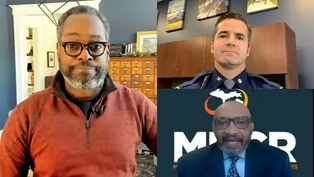
I sat down with the Director of the Michigan State Police, Colonel Joe Gasper, and the Executive Director of the Michigan Department of Civil Rights, John Johnson, to talk about how we deal with this disparity in policing.
So I wanna start with both of your reactions to this report and what it says about policing in our state, and then we'll talk about kinda where we go from here, but these are very stark conclusions drawn by this report, and I think they demand a lot of our attention.
Colonel Gasper, it's your department that is the subject of this report.
Tell me what your reaction was to all of this.
>>Yeah, I think that we're in a time, and in the country right now, really where, you know, all police departments need to be looking internally and externally to making sure that we're evolving and that, you know, we're demonstrating best practices.
And sometimes, you know, when you engage in some self-reflection, you have a reminder that sometimes it's not what you want it to be.
And this would be one of those times where, you know, we saw some disparity that was concerning to us.
And so we, you know, wanted to make sure that we understood it.
So we hired Michigan State University and partnered with them and, you know, they did the analysis on our traffic stop data and it, you know, was not where we want it to be.
So now we're in a time period here where we need to better understand it.
The goal of the report was to identify if there was disparity.
Clearly there's disparity and now, you know, we've got an opportunity to understand why that's occurring.
>>Colonel, I wonder if you were surprised by what you saw.
I mean, it's always, I think a little jarring to see things drawn out in statistics, right, and data, but I guess what I'm getting at is what was your sense of how this issue was playing out in the department before you saw the numbers?
>>Yeah.
You know, I think when you, when I looked at something like this and we see, you know, in the beginning, kind of the aggregate data, where it was, and you know, obviously that's something that we wanted to understand a little bit more.
And I think when the numbers came out, I'm confident that our troopers are out there doing what they've been trained to do.
And you know, where the disparity is now, clearly, it's concerning to everyone involved.
And you know, now the goal needs to be to do what we can to reduce that disparity.
>>So, John, this is an issue that you and I have discussed before.
It's an issue that I know you've worked on for a really long time, trying to draw attention to this disparity.
Give me your reaction to the report.
>>Thank you, Stephen, again, for having us on this and our reaction was not one of surprise, as you can imagine.
As you've indicated, we've worked in these issues for decades, beginning with a role with the Detroit NAACP and surrounding suburbs of Detroit, where we identified racial profiling going on in a number of areas and to continues today.
So this is not a surprise.
I do, however, must applaud Colonel Gasper for ordering and commissioning this report, releasing the data of it and owning up to what it says, and then making some recommendations as to what he sees needs to be done in order to improve the conditions and going forward.
So we applaud him for that, and our department stands ready to work with him in any way that we can, in order to actualize the recommendations that he's put forth already.
>>Yeah.
So John, as you point out, I mean, you've done a lot of work here in the city of Detroit on civil rights issues for a really long time as well.
I'm really curious what you think the distinction might be between this data about state police and what we might see if we did the same kind of report with DPD.
You know, there are a lot of citizens who complain about their interactions with Detroit Police.
Do you think this is a problem that would look the same here as it does at the state police?
>>Oh, I think that issue was raised recently, by some folks in regards to DPD.
>>Mm-hmm.
>>And I think what, allegations made by the public defender that arrests have escalated against people of color during the pandemic, based on possession of weapons.
I don't think any law enforcement agency is excluded from this and one of the things I hope comes of this and what Colonel Gasper has done, is that other agencies will take stock of themselves and do their own internal audit, to be able to bring the truth to light.
And he's shown us how to be a leader in this category, and I hope other folks will follow suit.
You know, there's other problems in other areas.
There's other studies that have come out, about Lansing, and the 85% rate of Black juveniles arrested over there.
So it's, as we know, it's something that unfortunately, that exists throughout our law enforcement departments, and it's a culture that needs to be addressed, as we know.
And I'm glad that Colonel Gasper is taking the steps to do that.
Some of the recommendations that he's put forth, some of the ones that have been recommended in the MSU report of which we're speaking, I think would bring a lot of accountability, and that's what we seek.
It is good to have policies, but it's more important to have accountability when people don't violate those policies and procedures.
And that must be in place also.
>>Yeah.
Colonel Gasper, two of the things that jump out at me from the report in terms of recommendations, obviously, you know, training of officers in some sort of sensitivity, I guess you might call it, to differences, cultural differences, but then also, you know, the racial makeup of the department itself.
Now neither of those is a snap your finger kinda solution.
These are things that departments struggle with all the time.
So tell me what your approach is gonna be to those things.
>>Yeah, so the training, that's probably an easier thing to accomplish.
We've already started to make some significant modifications in the area of training.
In the last couple of recruit schools that we've done, we have a couple hour block every week in the evening where we have the recruits, and the current environment's a virtual environment, and they sign on to a cultural competency or cultural awareness speaker.
And so we've had a number of speakers from various communities.
One obviously is the African-American community.
And it's it's been very insightful, because especially from a historical perspective.
You know, that, obviously, is an important part of, you know, some of the challenge that we have here and making sure that our members are aware of that history is very important.
We are actually implementing a much more comprehensive history of policing in our recruit school, hoping to start that as soon as our next recruit school here in the next several weeks, and then offering that in an in-service capacity, too.
And then, you know, just broadly, paying attention to how do we bring in more specific training when it comes to cognitive or implicit bias?
You know, the cultural awareness, there's a lot of troopers that may not grow up in a very culturally diverse area of the state or the country, and would not have any way of really knowing some of that background.
So that's an important part.
So we feel really confident that we're gonna be able to be successful with that.
And a huge component of that, too, is partnering with the community.
You know, we recently solicited input and interest from the community to come be part of our several day scenario-based training.
And we wanted the community to actually be role-players for that.
So that was successful.
We plan to continue that, but then also, continuing to partner with some of our community groups, some of our universities and colleges, to work on that training.
The recruiting, you know, we're not where we wanna be, we're not where we need to be.
You know, we need to continue to try.
You know, a big component of recruiting and getting people into the department is making sure, especially from a diversity perspective, that young people or people that are interested in coming into the Michigan State Police, that they can see themselves, not only as a trooper, but in various ranks throughout the department, so that there is, you know, the idea that, you know, they might be able to promote, or, you know, even potentially lead the agency at some point.
We've had African-American directors in the past, we've had a female director in the past.
And so, that's important, and then, again, right now, it's just really working with the community to see what we can do to partner together to create that interest.
>>So, John, I wanna ask you about the kind of broader context of discussion about police reform.
And you know, there are a lot of people talking about much more drastic changes to the way that we fund policing, the way that we structure policing.
Are there things from that narrative that you would throw onto the pile here as well, and say that we oughta be thinking about in terms of the state police?
>>Well, yes, a package of bills have been introduced in the legislature that would allow us to have more police accountability.
So certainly, we embrace those.
In this instance, again, I just have to refer back to the study that was done by MSU, and where it shows even post-stop, the level of searches that are involved with people of color, significantly higher than those of other of other races.
So I refer back to some of the recommendations made in the report, specifically seven through nine, which deal with post-stop outcome results and recommending that the Michigan State Police track when searches are conducted, the outcomes of those searches, the disposition of those searches, and also recommendation number 12, which wants to mesh the trooper's characteristic with the traffic stop database.
So we begin to get a profile of the troopers who are beginning, who are making these stops in which they are significantly higher percentage of people of color being arrested than others, per the census and per other things.
So those are sort of the, I think the progressive sort of recommendations that could be embraced that again, would bring more accountability, which is what we seek.
Again, we laud Colonel Jasper and we laud his leadership, and just the fact that he is reform-minded.
So we're behind him all the way with that and we'd like him to embrace some of these other things, which will take the reforms to the level where there's, again, some accountability.
>>Okay, Colonel Gasper, and John Johnson, it was great to have both of you here to talk about this important work and Colonel Gasper, of course, we wish you the best in implementing these recommendations.
>>Yeah.
>>Thanks for having me.
>>I appreciate that.
>>Okay, thank you.
>>Thank you.
>>It's Black History Month, and we wanna kick it off with a look back at a Detroiter who really left a legacy here in the city.
Dr. Charles H. Wright was a visionary and an activist, and of course, a noted obstetrician who delivered thousands of babies in the city.
I was one of those children that he delivered.
He also founded the city's first International Afro-American Museum in 1965.
Today, of course, we know that state-of-the-art facility as the Charles H. Wright Museum of African-American History.
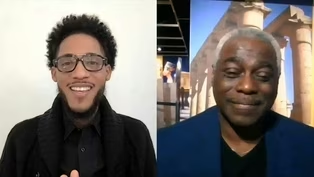
Bridge Detroit's Orlando Bailey had a conversation with someone who knew Dr. Wright very well, the museum's Director of Design and Fabrication, Kevin Davidson.
>>Kevin Davidson, Director of Design and Fabrication at the Charles H. Wright Museum for African-American History, welcome to "American Black Journal."
>>Thank you.
It's a pleasure to be here.
>>You're getting ready to make 40 years- >>That's right.
>>Being at the Charles H. Wright Museum for African-American History.
Okay?
40 years.
>>Yes.
>>Talk about your experience being there.
I mean, I think 40 years, you've seen it, in at least two of the locations, the former locations, and now the current location.
>>Yes.
>>Talk about this journey of 40 years, getting to 40 at The Wright.
>>Well, I was just a kid when I started, you know?
>>Oh, okay.
>>Just a young college student.
I did a year at Alabama State and it just happened to be Dr. Wright's alma mater.
>>Yeah.
Who delivered half of Detroit, right?
>>Yeah.
(both laughing) Thousands of babies, something like- >>Thousands of babies.
>>7,000-8,000, yeah, of babies, but I started over on the Boulevard in the little three row house that was the museum.
Back- >>That's the first location, right?
>>That's the first location.
>>Yeah.
>>Yes.
And I started the officially in 1983.
And you know, my first job was to design an exhibit on Black voting rights.
>>Wow.
>>And Dr. Wright loved that exhibit, I was a contractor, started as a contractor, then moved onto an exhibit on Charles Drew.
He loved that, and then finally, he just said, "Hey, you may as well hang around."
(laughs) So I was hired and wasn't there long before this partnership between the museum and the City of Detroit came about.
And Coleman Young worked with Dr. Wright to increase the vision and provide the resources to expand the museum and you know, bring this larger vision to, if you wish it.
That was one of Dr. Wright's favorite words, if you wish it.
(both laughing) >>Well, it's so interesting and funny to hear you tell of this history because some of it was happening in my lifetime.
>>Mm-hmm.
>>Well, I remember being a younger Orlando.
>>Yes.
>>Going into the present edifice.
And all of the grandeur- >>Okay, yup.
>>When it opened.
>>Yeah.
>>Yeah.
>>Yeah, yeah.
Yeah, so I remember architects drawing up the plans for the second museum.
That's a block from here, just a block north of where we are right now.
That's occupied by, it was bought and is occupied by CCS now.
>>Yes.
>>And even, and then construction began, and it finished, we moved in there.
And I think even before the building was finished, they were starting on drawings for the new facility.
You know?
So Dr. Wright and Coleman Young were moving fast.
>>You had a personal relationship- >>Yes.
>>With Dr. Wright.
Tell me about that relationship, that mentee/mentor relationship and how you carry that with you today.
>>It started from day one when I was hired.
And you know, Dr. Wright, in addition to, you know, wanting to put together exhibits over on the Boulevard, also conducted educational programming that took place at Wayne State.
And so, you know, he'd have me designing little cards that contained information on these different workshops and presentations he was giving at Wayne State.
So we worked very closely together.
You know, he would provide people to work with me on the exhibitions, to write scripts and collect images and objects and that sort of thing.
And so we kinda had shared vision.
You know, he knew what he wanted, in terms of what that exhibit was gonna be, but not necessarily, the best way to pull it off and make it look great.
And so, we kept our heads together on that.
And so, we kinda laid the foundation, you know?
And there has been occasion where, you know, he's come to me and asked for artwork.
So I've created illustrations for promotional posters related to programming that he organized.
And even after we moved to the second facility, he was still engaged in quite a bit of educational programming.
>>Black History Month is literally a page turn away.
And I'm sure that the Wright is going to see an influx of visitors and the King Tut exhibit is back!
What can people expect?
>>Well, you know it's an exhibition that includes replicas of the various items, chairs, sculptures, chariot, things that were found in King Tutankhamen's burial chamber, as well as, and that would be regarded as the private stuff.
And then you have the more public King Tut items that are in the first four sections in our larger gallery.
So it's between two galleries, the AT&T, which is our largest gallery, and then, the Chase Gallery, which is a little smaller, probably about a third, no, half the size.
And so in the public area, you know, you also have sculptures of, you know, of Akhenaten, of Nefertiti, and, you know, objects that would have been sculpted for them.
So that's the full scope.
>>Kevin, tell me, as you know, the Director of Design and Fabrication at the Wright, what your role is in bringing an exhibit like the King Tut exhibit to life at the museum.
>>Well, here at the museum, my department is a department of two.
It's myself and another designer.
Her name is Shivani Gajjar.
And, you know, we collaborate on a lot of this design.
She's a very technical person and knows how to, you know, she's a wizard with all the software and she can work on these interactives and bring those to life.
And so, that's an important component of what's been added to this exhibit.
But my role is to lead the design of these permanent and changing exhibitions here.
And so, for the King Tut exhibit, we essentially took a collection of stuff and it's our job to create an exhibit out of that.
And so, we start with, you know, generally, a list of what the items are and photographs of them and dimensions and put together a floor plan.
Then we move to elevations of the spaces and then the color scheme and the lighting and you know, design the overall environment for it.
So a lot goes into it.
>>It's actually- >>To make it exciting, yeah.
>>Yeah, it's actually really cool, and I think this exhibit is particularly exciting because, you know, it seems so recent, right?
The 1920s was not long ago, where archeologists actually discovered and found a lot of these artifacts from King Tut, and so, people are still very interested- >>Oh, absolutely.
>>Yeah, yeah.
>>Absolutely, and we're celebrating the 100th year of the discovery of these things, so it's a milestone and an opportunity, you know, for us to bring it back and for our community to enjoy it and experience it.
>>Happy Black History Month to you and all the folks at the Wright.
Kevin Davidson, the Director of Fabrication and Design at the Charles H. Wright Museum.
Thank you so much for joining us on "American Black Journal."
>>You're welcome.
Thank you for having me.
>>That is gonna do it for us this week.
Thanks for watching.
You can always find out more about our guests at americanblackjournal.org, and you can connect with us on Facebook and on Twitter.
We'll see you next time.
(upbeat music) >>From Delta faucets to Behr paint, Masco Corporation is proud to deliver products that enhance the way consumers all over the world experience and enjoy their living spaces.
Masco, serving Michigan communities since 1929.
>>Support also provided by the Cynthia & Edsel Ford Fund for Journalism at Detroit Public TV.
>>The DTE Foundation proudly supports 50 years of "American Black Journal," in covering African-American history, culture and politics.
The DTE Foundation and "American Black Journal," partners in presenting African-American perspectives about our communities and in our world.
>>Also brought to you by AAA, Nissan Foundation and viewers like you.
Thank you.
(bright music)
Video has Closed Captions
Clip: S50 Ep5 | 12m 58s | Study Shows Black Drivers Were Stopped by MSP at Disproportionately High Rates (12m 58s)
The Legacy of Dr. Charles H. Wright and His Museum
Video has Closed Captions
Clip: S50 Ep5 | 9m 32s | The Legacy of Dr. Charles H. Wright and His Museum | Episode 5005/Segment 2 (9m 32s)
Providing Support for PBS.org
Learn Moreabout PBS online sponsorship
- News and Public Affairs

Top journalists deliver compelling original analysis of the hour's headlines.

- News and Public Affairs

FRONTLINE is investigative journalism that questions, explains and changes our world.












Support for PBS provided by:
American Black Journal is a local public television program presented by Detroit PBS