Inside California Education
Training Student Journalists
Clip: Season 5 Episode 3 | 6m 13sVideo has Closed Captions
Meet a new generation of student journalists in Sacramento.
Meet a new generation of student journalists in Sacramento telling stories about their schools.
Problems playing video? | Closed Captioning Feedback
Problems playing video? | Closed Captioning Feedback
Inside California Education is a local public television program presented by KVIE
Funding for the Inside California Education series is made possible by the California Lottery, SchoolsFirst Federal Credit Union, Stuart Foundation, ScholarShare 529, and Foundation for the Los Angeles Community Colleges.
Inside California Education
Training Student Journalists
Clip: Season 5 Episode 3 | 6m 13sVideo has Closed Captions
Meet a new generation of student journalists in Sacramento telling stories about their schools.
Problems playing video? | Closed Captioning Feedback
How to Watch Inside California Education
Inside California Education is available to stream on pbs.org and the free PBS App, available on iPhone, Apple TV, Android TV, Android smartphones, Amazon Fire TV, Amazon Fire Tablet, Roku, Samsung Smart TV, and Vizio.
Providing Support for PBS.org
Learn Moreabout PBS online sponsorship♪♪♪ Lilah: I really like writing, and I've just always really liked words.
And so, having a new opportunity to like, try a new style of writing that I've never had experience with before, it was like, a really cool idea to me.
Narrator: For Lilah, writing is a career path she may want to pursue.
That's why she joined a countywide journalism training program, along with about 20 other students from high schools throughout the Sacramento region.
Steve: If you look at how the schools operating, then you can kind of connect that to what creates this situation.
They want to tell stories.
So, were... we're just facilitating what they already want to do.
Narr: Steve ODonoguhue runs the high school student journalism program called The California Scholastic Journalism Initiative.
It's funded by the Sacramento County Office of Education.
Steve: We teach the students standard journalism rigamarole, and we try to hold them to those standards.
And the idea was to offer a publication and journalism opportunities for students from schools that don't have those opportunities.
There's, uh, students from 14 separate high schools, all in Sacramento County that are represented in this program.
And we treat it as like an internship.
They get a $1200 stipend at the conclusion of the program.
Narr: The intensive program trains high school students during the summer to be education reporters for their school and district.
Then from August to May, the students produce at least one story each month throughout the academic year.
Steve: They can pick the topic and we guide them on how to develop the stories, how to make it-- realize the story.
Writing coach: Give us sort of a one minute elevator pitch synopsis of your December story.
Student: Were writing about, uh A.C.T.
and S.A.T., like the standardized testing in general.
Steve: We only, uh, critique how they do it.
We give them feedback on what's practical and what's-- what... what can be realized.
Steve: Saffiya.
Saffiya: Im writing about this youth academy under the district attorney in Sacramento.
Saffiya: It's kind of like those training wheels on a bike.
When students go to look for work in actual journalism workplaces, they already know what's going to happen.
They already know the steps to take because of this experience that they have in high school right now.
Narr: A majority of the training is done via Zoom, but Steve and two other writing coaches, all of whom are professional journalists or educators, occasionally meet with the student reporters in person to review each of their stories they're working on.
Lilah: Our schools debating going to block schedule next year And so, Im writing a story, kind of the different perspectives and pros and cons in that.
Narr: Block scheduling is an alternative method of scheduling, where each student has approximately four class periods per day instead of the traditional 6 to 8 daily classes.
Today, Lilah is interviewing Abigail, a fellow student considered to be one of the top performing students at their school to get her perspective on block scheduling.
Lilah: So, what are, like, some of the biggest cons or pros that you have with traditional schedule right now?
Abigail: I would get a whole semester to study for that AP test.
Lilah: I'd like to see how block schedule would affect her if she thinks she would still be as successful in the block schedule.
Steve: We know that high school students, while they may not be quite up to a professional standard yet, they can write and report journalism at a professional level if theyre given the opportunity and everyone benefits from that.
They learn skills that are transferable and the community learns stories that they might not have heard before.
Narr: The student stories are published on the program's website, sacschoolbeat.com.
Steve also shares their stories throughout the Sacramento region, inviting media outlets to republish them.
Steve: One of the reasons we started this program is because we can take what they produce and share that with a larger... larger audience and kind of put a... a dent in some of those news deserts.
So many journalists have been laid off and a lot of education news just doesn't get covered like it used to because there aren't the people who do it.
Saffiya: Honestly, I just want to be able to improve my writing skills and be able to use those skills to help others, to spread news, to make an impact in some way.
Because at the end of the day, I'm still a student and I still have a long way to go.
But this program allows me to take, you know, at least like some steps towards it.
Lilah: Ive really enjoyed the opportunity to really find a little more about myself and what I can do based on this program.
Steve: I'm hoping that they leave with skills that are... are useful to them, uh, whatever career they choose.
And they surprise us all the time.
Um, that's... that's the... the reinforcement.
There isn't enough money that you could pay someone to do this and... and... and to compensate.
It's...it's the reward of working with youth.
Narr: The California Scholastic Journalism Initiative is just one of several programs throughout the state preparing the next generation of journalists.
For example, in 1951, newspaper magnate William Randolph Hearst started what's now called the California Scholastic Press Association.
Hearst originally recruited boys to cover their high school sports teams.
Payment: meal money and a byline in Hearst's Los Angeles Examiner.
Girls joined the effort in 1965, and more than 70 years since its start, its still going strong, with graduates working at prestigious media outlets like the New York Times, LA Times, Washington Post, Wall Street Journal, CNN, NBC News, and the Associated Press.
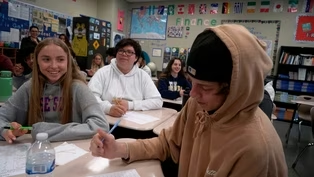
Video has Closed Captions
Clip: S5 Ep3 | 5m 30s | Discover how these San Diego high schoolers are learning basics about managing money. (5m 30s)
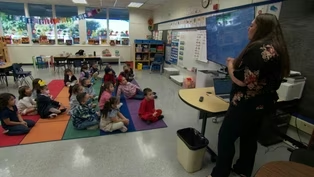
Video has Closed Captions
Clip: S5 Ep3 | 5m 9s | Visit a Los Angeles County school where “kinder readiness” is reaping rewards. (5m 9s)
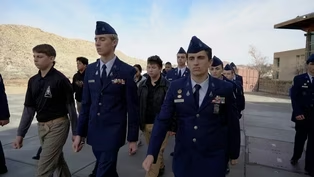
Video has Closed Captions
Clip: S5 Ep3 | 4m 43s | Check out a JROTC program in the desert with a focus on the Space Force. (4m 43s)
Providing Support for PBS.org
Learn Moreabout PBS online sponsorship
- News and Public Affairs

Top journalists deliver compelling original analysis of the hour's headlines.

- News and Public Affairs

FRONTLINE is investigative journalism that questions, explains and changes our world.












Support for PBS provided by:
Inside California Education is a local public television program presented by KVIE
Funding for the Inside California Education series is made possible by the California Lottery, SchoolsFirst Federal Credit Union, Stuart Foundation, ScholarShare 529, and Foundation for the Los Angeles Community Colleges.