
Traveling Through Time
Season 4 Episode 1 | 26m 20sVideo has Closed Captions
Utah has a rich history of learning and growth, join us as we roam through Utah’s past.
Utah has a rich history of learning and growth. Join the Wild Old Bunch, a group of passionate senior skiers, as they hit the slopes in search of the perfect run. Discover Utah's Black History on a mobile museum tour, following the bus to explore the state's fascinating past. Finally, ride along with James Fain, the renowned rodeo photographer.
Problems playing video? | Closed Captioning Feedback
Problems playing video? | Closed Captioning Feedback
This Is Utah is a local public television program presented by PBS Utah
Funding for This Is Utah is provided by the Willard L. Eccles Foundation and the Lawrence T. & Janet T. Dee Foundation, and the contributing members of PBS Utah.
Support provided by:


Traveling Through Time
Season 4 Episode 1 | 26m 20sVideo has Closed Captions
Utah has a rich history of learning and growth. Join the Wild Old Bunch, a group of passionate senior skiers, as they hit the slopes in search of the perfect run. Discover Utah's Black History on a mobile museum tour, following the bus to explore the state's fascinating past. Finally, ride along with James Fain, the renowned rodeo photographer.
Problems playing video? | Closed Captioning Feedback
How to Watch This Is Utah
This Is Utah is available to stream on pbs.org and the free PBS App, available on iPhone, Apple TV, Android TV, Android smartphones, Amazon Fire TV, Amazon Fire Tablet, Roku, Samsung Smart TV, and Vizio.
This is Utah
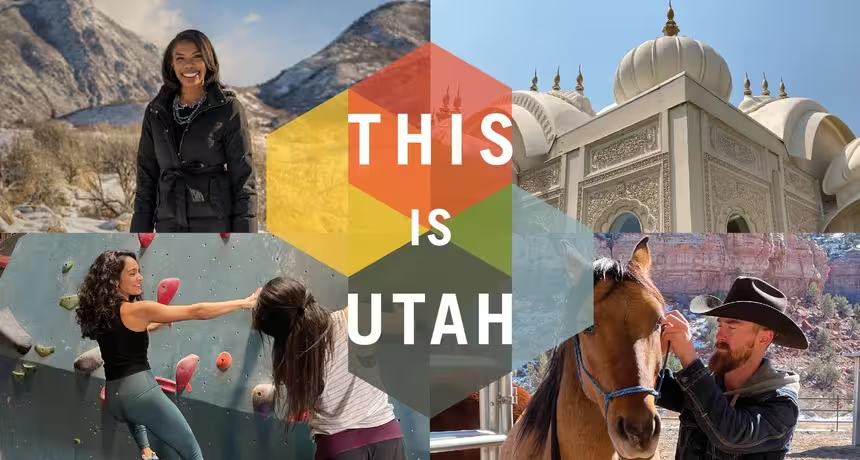
Liz Adeola travels across the state discovering new and unique experiences, landmarks, cultures, and people. We are traveling around the state to tell YOUR stories. Who knows, we might be in your community next!Providing Support for PBS.org
Learn Moreabout PBS online sponsorship(Soft Music) I'm so glad you joined us for this is Utah.
I'm your host, Liz Adeola.
We're really excited to explore the spirit of adventure in Utah throughout time.
Hit the slopes with The Wild Old as they share the secret to skiing through the decades.
Travel through time with the Utah Black History Museum Bus and understand the impact it's making in our state.
Plus, a peek inside the vast portfolio of a Utah photographer taking aim at preserving Utah's rodeo history.
This is Utah is made possible in part by the Willard L. Eccles Foundation, the Lawrence T and Janet T. Dee Foundation, and by the contributions to PBS Utah from viewers like you.
Thank you.
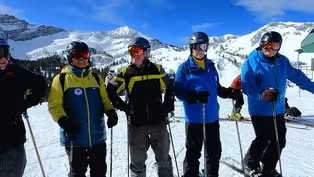
(Upbeat Music) - The lifelong passion of skiing is what binds the Wild Old Bunch together.
It's a group of about 100 skiers from all over the world who prove it's never too late to play in the greatest snow on earth.
(playful music) - It just feels good to get out on a day like this.
One of the reasons I enjoy skiing is 'cause my wife kicks me out of the house, basically.
She says, "Get lost."
You know, "We need our space."
- The Wild Old Bunch is a social group and a ski group both.
And we don't have any officers, we don't have any rules.
We don't have meetings other than to meet for lunch.
- Being out here, just being out here is so wonderful.
Clear blue sky, sunshine, and even when it's snowing, it's fun.
I'm not a great athlete, but modern equipment is very forgiving.
- [Robin] The freedom.
- [Bill] Yeah, yeah.
- And just being out there and catching this much fresh powder.
We're not this deep, but this much is perfect for us.
And catch that and go into some of these little areas that we learned from the Wild Old Bunch in the trees.
We call it the Cabin Run.
And it's just such a joy.
And I will say, not having snowboarders is an advantage for us.
- Yes.
(film reel clicking) - [Liz] Since 1973, (alpine yodeling music) the Wild Old Bunch has circled the slopes of Alta.
The name is a nod to Butch Cassidy's outlaw gang, the Wild Bunch.
Rush Speeden founded the group when he made an 8 millimeter ski movie highlighting his posse of skiers.
Today, the Wild Old Bunch is a group of gracefully aging seniors banded together by their passion for roaming the runs of Alta.
- (chuckles) Hanging around the Wild Old Bunch, listen to them talk about being up here and skiing with Alf Engen and Alf's ski lesson was "Watch me and do what I do."
(cheerful guitar music) - Skiing was starting to catch on in the United States.
This was the early 1930s.
And Alf came along after he'd become quite famous in Europe and then came here and got very famous.
He transitioned from Nordic to Alpine and developed all kinds of skiing techniques.
But the Forest Service employed him to traipse around the Wasatch until he found what he thought would be a great place for the ski resort.
And he crested the ridge from Big Cottonwood Canyon up overlooking Little Cottonwood Canyon and is purported to have said when he got to the ridge and looked out over Alta, and he said, "Ah, yes, here we have a ski resort."
(laughs) And that's how Alta came to be.
- My parents came from Norway, and so they had me on skis when I was a little kid, my brother and I, probably four years old I have a picture in the family album of me looking like a four or five year old.
(chuckles) So I started skiing with them about eight years ago when I turned 80 and started getting a free pass here.
And it's very nice to have people to meet, socialize with, ski with.
Just so pleasant to cruise down and see the scenery and talk to other people.
Skiers are all nice and friendly, I think.
- Oh, well, I ski fast, and so I'll come up and do like 20 runs, 50 miles an hour is a good ski, you know, coming off.
So just the exhilaration of being out here in the sun and the snow.
- Well, we were skiing all the areas around.
One reason we started skiing here is because there were so many different areas to go to.
But I think it's the camaraderie that we've experienced that has drawn us up and kept us coming up here, particularly Alta.
Most important thing is the people that we've met up here through the Wild Old Bunch and people that we've really grown fond of and have traveled with outside of Alta.
So it's been a social event as well as a skiing event.
- I came from Maine with my wife 18 years ago, because we couldn't ski there anymore.
We were getting too beat up.
We needed something softer.
- Well, first year I skied up here was in '57.
I was in high school, grew up in Ogden, and we used to ski Snow Basin, but we'd come up here.
This was one of our favorites, and I've loved it ever since.
Out of college, I moved away for 40 years.
So once I got back, I had to do some catching up.
- Well, the fresh air, just cool air outside and meeting people, kind of a camaraderie, exchanging pleasantries, sharing stories, and then ski together some.
It is a great pleasure (Wild Old Bunch laughing) of life meeting people and laughing, giggling.
- Well, once I put on my helmet and my face mask, and then I'm 25. Who's to know?
But, you know, being 81 and just getting out here and just going for it, I'll get, many days, 20 runs.
I'll get, you know, 20,000 vertical.
- Absolutely, and the Wild Old Bunch is part of what's made it so special, because it's such an enthusiastic group of old skiers.
- My wife likes to ski, but she has knee problems.
My kids like to ski, but they're working.
My grandkids are in school, and my great-grandkids are too young.
So I need this support group up here.
(chuckles) (cheerful guitar music continues) (Upbeat Acoustic Music) - The four women you see in this mural behind me are a part of a rich history here in Utah.
From one of the first black female pioneers to the first black woman in Utah to graduate from college.
In fact, there's so much history to explore that one group is taking these history lessons on the road.
(upbeat music) - I can make a little U-shape.
My name is Liz Lambson and I'm the Executive Director of the Utah Black History Museum, as well as an artist.
So George Floyd was murdered and the world blew up.
And the Black Lives Matter movement started taking off again.
And that's how I met Lex Scott, who was at the time, the leader of the Black Lives Matter, Utah chapter.
And she had this concept of taking a school bus and painting it and creating a mobile museum with it.
And so she invited me to paint this bus.
(upbeat music) Growing up, oddly enough, I took a lot of art lessons but I specifically took cartooning lessons, caricature lessons, and I loved animations.
I love bright colors so I definitely knew it would be really colorful.
And with this, I really also wanted to appeal to children.
A big audience of ours is school children.
Kids especially appreciate vibrancy and art that's accessible.
You know to have a pop-up museum that we can take anywhere and we have a mission and a goal to go around the entire state and share Utah's black history and national black history with all the people of Utah.
(bus driving) (group chattering) So we like to teach people about what's happened in our state.
You'll learn a lot there about pioneers, explorers.
Let's take some time to look at our artifacts and display and I hope you enjoy the museum experience.
(audience clapping) - Diversity is growing in Utah and I can definitely tell even over the last five years, we have more students of color.
I want my students to be able to see themselves within the curriculum.
There has been a black presence here even though it might not be very large there's always been a presence here.
I want them to know about the black pioneers.
I want them to know about the obstacles that the people who came before us had to face and how they overcame them.
And how we are now here in a more multicultural population.
- I was reading a poster and it was talking about the LDS church and its participation in slavery.
- Well, I knew we had slaves here but I didn't think it was as big as it was cause you hear about it everywhere but you don't really hear about it in Utah.
- Something interesting that I learned while we're here that kind of inspired me was when they opened up the NAACP organization here in Utah and Ogden.
Cuz when I've been living here, I felt kind of ignored.
When I try to voice my own opinions on like race issues and like my school or like just in the world.
And to know that there's a community looking out for me, it was comforting.
- I hope that my students will be motivated and encouraged by seeing the different artifacts.
I feel like this is a way for them to connect back to the community and find their roots here in Utah.
- I like that they decided to showcase the culture cuz not a lot of schools are deciding to, you know give out information about Black history.
(upbeat jazz music) - Utah Black History Museum turns one today.
It's our birthday and we are celebrating one year on the road with our mobile museum bus.
- It's so important that we preserve and capture our history for future generations so they can see from and how our ancestors also help build this nation and this state.
I am Utah State representative Sandra Hollins and I represent District 23.
I came out today because I wanted to see this wonderful collection of black history in the state of Utah.
And so when I was invited to be here, of course, I said absolutely.
I want to see this, I've got to see this.
- This section of our exhibit was prepared by a historian Taran Mitchell.
So we have pioneers, explorers, artists, writers and then Sandra Hollins.
- I didn't even notice that.
- You are part of our exhibit.
- Wow.
- Yes.
- That came as an absolute shock that I was featured there but I'm so honored.
I was so honored.
- Can you tell us a little bit more about this bill that you helped pass addressing slavery in Utah?
- I was surprised to learn that slavery was still in Utah's constitution as it is in the 13th Amendment of the United States.
And so when I found out about it, I set out to remove it.
So I wrote a resolution, it went on the ballot.
And the people in Utah voted 80% to remove it from Utah's constitution.
The majority of the people agree with it, so - Yes.
Wonderful.
Well, let me show you some more of our museum.
So you knew Joe McQueen - I knew Joe McQueen.
I have listened to him, went to his concerts and I decided to throw him a hundredth birthday party up at the Capitol.
And yet he met the governor and we had a lot of people from the community came out and celebrated him.
- Kind of the fascinating thing about history, here he is a poster in our exhibit but he's someone that you knew.
- Yes, yes.
- And it's awesome to have people like Joe, having been in our community really representing the culture from which it came.
It's hard to find artifacts- - Yeah - that are uniquely representative of Utah's- - Yes.
- history.
But this is part of Utah's specific black history.
There was a restaurant called the Coon Chicken Inn.
- Uh huh - And it was on Highland Drive in Salt Lake City.
Just sort of perpetuating this idea of having the black servant - Yes.
- Cooking for you.
And then setting it up in the form of a restaurant - Uh huh - you know with what is now a very offensive title and offensive branding.
- Yes.
- There's a lot of heavy material when you look at black history.
But we do wanna emphasize and highlight the Black joy and the Black excellence and - And look how far we've come.
- Yeah.
Yes.
You know, I got involved by painting the bus but I told everyone that I would not paint it if it was just gonna sit in a lot.
And so I was really determined to do all I could and contribute all I could to actually get it on the road and actually see it come to life.
It feels really fulfilling to have been so well received by the people of Utah in the past year.
I feel like the work that we're doing is making a difference.
Happy Birthday Utah Black History Museum.
(Soft Acoustic Music) - From small towns to the Capitol City, rodeo is a part of Utah's culture and history, a history that's been captured frame by frame by Utah's most prolific rodeo photographer.
(country western music) - We never really planned on making a career out of photographing rodeo.
It just evolved.
But I don't think of it as a career.
It's just something that happened (laughing).
I had just a common box camera.
I'd snap a few pictures around just for the heck of it.
And finally I bought a little camera that was like a 35 millimeter only it took just a hair larger frame.
The photos that I took with it, I did get published in "Radio Sports News" back in '61.
That was the start of it.
(country western music) I'm kind of spontaneous about a lot of things.
That's the way I shoot rodeo.
I mean, I shoot it as it happens.
(harmonica buzzing) - Oh, Jim, he's a cowboy.
He rodeoed, he rode bulls, loves the sport of rodeo and everybody loves Jim.
Everybody knows Jim.
We are a five generation rodeo outfit.
Jim has pictures of when dad was a young man and when grandpa was a young man and grandpa and grandma and us kids.
You know, pictures of me when I was packing the flag and riding and we got pictures of Jeff when he was riding bulls in high school and then my kids.
I got pictures of my daughter that Jim took when she was running barrels in high school and my son when he was team roping in high school and- - And I think every rodeo family in the Western United States has got the same story to tell.
(harmonica buzzing) - We lose so much of our history just because nobody thinks about it.
In Fain's case, he's everywhere.
Whether it's high school rodeo, whether it's college, whether it's PRCA, he's been on national covers for rodeo magazines all over the world.
- I look at it as trying to show the contestant in championship form and an eight second ride, if it's a good jump kick and the rider's doing good, I can get 10 good shots.
But back shooting film, I could generally tell whether I had a poor shot.
If I don't get a good photograph now on a good ride, I beat myself up over it.
- Most of us don't have the qualifications or the eye to know, well, was that a good ride or was that a bad ride?
I could go out and take the same picture at the same time and it would not look nearly as good as what he does.
He seems to be able to show such energy in the picture.
Jim has that talent of knowing the right moment to catch that picture in time.
It's a time capsule and for our little museum as we call it, he'll bring in and switch off pictures.
Something that he's had old or new or whatever it is.
And that to me is sharing with the public what it is he does.
(country western music) - I've shot a lot of stuff that people have never looked at.
I guess that's kind of the rodeo way too.
It's like you enter the rodeo, the stock's drawn for you, you nod your head and your talent's supposed to carry you through to win some money.
Photographing rodeo is kind of like that really.
You're dependent on your talent to deliver a product that the cowboy wants to buy.
Oh, it's totally on speculation, yeah.
It means you're not making any money (laughing).
(country western music) There's been so many images through the years that never seen the light of day that I wish people had.
I'd give it to them, it's such a good shot.
(country western music) I grew up in Phoenix.
A friend in grade school and he talked me into entering my first rodeo and I was a little over 12 but got on my first calf, fell off and it hurt (laughing).
Then I was hooked.
Went through a year at Arizona State.
In the meantime, I had gotten a job with the Park Service at Grand Canyon.
Yeah, what nicer place could you live than the North Rim of the Grand Canyon in the summertime.
(country western music) Working at the North Rim, Karen and I met.
She talked me into coming up to Utah State which wasn't hard to do (laughing), and Karen made her mind up early on that she was gonna go with me.
We didn't actually come to a verbal agreement.
We just, like I said, things just evolved.
It's a partnership.
You can't do it by yourself.
You're out there photographing so you can't be back here showing your proofs.
- I think she would be like the librarian when you go to get a picture from Jim, the librarian can take you to the right, you know, aisle, the right shelf, and pull that picture because she has recorded everything.
(country western music) - And I'm getting some gratification from these people that are contacting me now looking for images 30 years ago, 40 years ago.
Back then they didn't have any money (laughing).
These people that are, hey, this guy's got pictures that we can get still.
So they're interested.
(country western music) - I have a picture of Wendy, a bowing horse, at the Days of '47, during the opening.
This one that drew me to her right there.
That's a great photo.
- He noticed me then.
- And just before, he was great at this too.
Just before I got knocked out, he took a great photo of me on a bull at the high school finals and so yeah.
- Before he did the dead chicken.
- Before I was rendered unconscious.
Let's just leave it there.
- When you look at that, you remember that moment.
You remember when you was getting ready to come into the arena and you get butterflies and you feel like you're gonna have to hold your breath because, you know, you're nervous.
(country western music) Those pictures capture all those moments.
(country western music) (cymbal clanging) (guitar strumming) (Ubeat Guitar Music) We hope you've enjoyed traveling through time with us.
The journey continues online.
This is Utah is on YouTube, Facebook and Instagram.
Go ahead and hit the like button and share your favorite stories.
Until next time.
I'm Liz Adeola and This is Utah.
This is Utah is made possible in part by the Willard L.Eccles the Lawrence T .
and Janet T. Dee Foundation Foundation, and by the contributions to PBS Utah from viewers like you.
Thank you.
(Upbeat Music)

James Fain – Rodeo Photographer
Video has Closed Captions
Clip: S4 Ep1 | 7m 20s | Learn about the photographer from Utah who has been documenting rodeo for over 60 years. (7m 20s)

Traveling Through Time | Preview
Preview: S4 Ep1 | 30s | Utah has a rich history of learning and growth, join us as we roam through Utah’s past. (30s)

Video has Closed Captions
Clip: S4 Ep1 | 7m 50s | Follow the Utah Black History Museum that shares the history of Utah’s Black community. (7m 50s)
Wild Old Bunch: The Original Skiing Posse
Video has Closed Captions
Clip: S4 Ep1 | 6m 23s | Learn about the history of the Wild Old Bunch as they hit the slopes of Alta Ski Area. (6m 23s)
Providing Support for PBS.org
Learn Moreabout PBS online sponsorship













Support for PBS provided by:
This Is Utah is a local public television program presented by PBS Utah
Funding for This Is Utah is provided by the Willard L. Eccles Foundation and the Lawrence T. & Janet T. Dee Foundation, and the contributing members of PBS Utah.