
Signature Dish
Treasures of the Mid-Atlantic
Season 4 Episode 12 | 28m 52sVideo has Closed Captions
The Dabney in Blagden Alley, Fish Shop at The Wharf, Marcus DC in NoMa
In the season four finale, Seth celebrates the bounty of the Mid-Atlantic, uncovering creative takes on regional classics. On his first stop, he heads to Blagden Alley for a locally-sourced whole lamb dish at The Dabney. Next, he makes his way to The Wharf for rockfish massaman curry at Fish Shop. Finally, he tries a blue crab showstopper in NoMa at Marcus DC with their signature Mel’s Crab Rice.
Problems playing video? | Closed Captioning Feedback
Problems playing video? | Closed Captioning Feedback
Signature Dish is a local public television program presented by WETA
Signature Dish
Treasures of the Mid-Atlantic
Season 4 Episode 12 | 28m 52sVideo has Closed Captions
In the season four finale, Seth celebrates the bounty of the Mid-Atlantic, uncovering creative takes on regional classics. On his first stop, he heads to Blagden Alley for a locally-sourced whole lamb dish at The Dabney. Next, he makes his way to The Wharf for rockfish massaman curry at Fish Shop. Finally, he tries a blue crab showstopper in NoMa at Marcus DC with their signature Mel’s Crab Rice.
Problems playing video? | Closed Captioning Feedback
Where to Watch Signature Dish
Signature Dish is available to stream on pbs.org and the PBS app.
Providing Support for PBS.org
Learn Moreabout PBS online sponsorshipANNOUNCER: And now Signature Dish, a WETA original series.
SETH: Today on "Signature Dish," we're showcasing the treasures of the Mid-Atlantic.
We'll start with a feast cooked over the coals.
JEREMIAH: What I really love about wood fire cooking is that you have to cook with all of your senses.
It really is just the most primal form of cooking.
SETH: We'll put a global spin on a regional favorite.
And rockfish, hard to get much more local than that, right?
RIA: It is absolutely the state fish of Maryland, so we have to have it on the menu.
SETH: So incredibly flavorful.
And we'll pull out all the stops for a shellfish spectacular.
ANTHONY: And then the star of the show, right?
The butter crab.
You really can't go wrong.
SETH: And the moment I've been waiting for.
Wow.
I'm Seth Tillman, WETA producer and DC native, and I love good food.
Nice to meet you.
That's why I'm traveling to restaurants across the DMV, at each stop, looking for the one thing you just gotta try... that Signature Dish.
My celebration of great local eats kicks off in Shaw.
Tucked away in historic Blagden Alley, you'll find The Dabney, a standard bearer of DC's fine dining scene, run by chef and owner Jeremiah Langhorne.
JEREMIAH: I was born in the DC area, but then we made our way towards the Shenandoah Valley before eventually moving down to Charlottesville, Virginia, which is what I would still call home to this day.
SETH: Chef Jeremiah cut his teeth in Charleston, South Carolina's vibrant restaurant scene, most notably at the landmark establishment McCrady's.
JEREMIAH: McCrady's felt like home.
Chef Sean Brock was doing some really amazing things there, he had his own garden and was working with a lot of modern technique.
I spent the next seven years there working my way up from a stage all the way to being the head chef.
And realizing that I really wanted to come home.
I had seen a lot of things in the Chesapeake Bay and its watershed that reminded me a lot of what I saw in Charleston, but really wasn't being highlighted here at all.
SETH: In The Dabney's open kitchen, the massive hearth is the star of the show.
JEREMIAH: Historically, not only in America, but all over the world, a lot of people have cooked over wood fire.
The intensity of the heat that you can get out of it allows you to get this incredible sear, char, Maillard reaction, whatever you're looking for.
And also, it creates a depth of flavor that is really difficult to get in a pan.
So, in the Mid-Atlantic, the coastline gets a lot of love and everybody knows about Maryland blue crab and we know about oysters.
But if you go inland has this beautiful Piedmont region, there's gorgeous areas of Maryland that produce amazing grains and mushrooms and cheese.
So, we really look to partner with a lot of farmers.
What we want to do is take these beautiful raw products from the region and transform them into something amazing to share with the community.
SETH: I'm off to The Dabney, but first I'm meeting Chef Jeremiah up on his rooftop garden.
Chef.
JEREMIAH: Hey.
SETH: Good to meet you.
JEREMIAH: Welcome.
How's it going?
SETH: Well, I am excited about coming here to The Dabney.
And uh, have we stepped into your office up here?
JEREMIAH: Oh yeah.
This is my place of peace.
This is where I like to come and hang out in the mornings.
SETH: All right.
Well, it's a beautiful space.
What are you making today?
JEREMIAH: So today we're going to be doing one of our family style lamb dishes.
We're going to be doing all the different cuts of the lamb with all sorts of different accompaniments and seasonal vegetables and of course a bunch of beautiful herbs.
Like this one right here is purple ruffle basil.
Just came into season, so we're just going to clip a few of these.
They have a really, really deep flavor, a little bit more intense than traditional basil.
So, these will go on top of the lamb dish.
All right, why don't you let me take you downstairs and show you?
SETH: Let's do it, Chef.
JEREMIAH: Alrighty.
All right.
Welcome into the kitchen.
SETH: Ooh.
Got some serious heat coming off this thing.
Wow.
JEREMIAH: Oh yeah.
Yeah.
It's a lot.
So, this is our lamb.
We're currently sourcing it from Shenandoah Valley.
So, we've got the saddle right here.
We have some of the belly, we have the heart, and then we also have the rack here.
You're gonna love it.
SETH: The heart.
JEREMIAH: I promise you.
The heart's going to be fantastic.
Maybe we should start with the heart.
SETH: Why not?
That's a heart all right.
JEREMIAH: It sure is, right?
A big part of what we do in using the whole animal is to demystify.
You know, lamb heart in particular, it's very lean and it is pretty mild.
We basically just go through, kind of pull out some of the interior pieces.
We're going to pull a little bit of the fat off the back.
We're going to carve it really, really thin.
We're going to take some of the chimichurri, then give this a little marinade.
This is made from cilantro, parsley.
A lot of these herbs are getting picked up in our garden and we're going to give it a little bit of kosher, really dress this up and now going to be time to put it on the skewer.
What I like to do is always go into overlapping segments so that you have room for it to char around the outside and still stay cooked nicely in the middle.
All right, so now we're going to turn our attention to butchering our saddle.
This is kind of the... kind of the back of the lamb, right?
And so, we're just going to split straight down the middle, come down the side of the spine and then carve it off the rib, end up giving us a really nice, beautiful loin.
Just going to clean it up a little bit.
So, what we're going to do is get this seasoned up and then we're going to also do a little bit of pepper.
Really simple.
SETH: You want to let the protein be the star here.
JEREMIAH: Yeah, exactly.
SETH: Chef Jeremiah gives a similar treatment to a terrine made from braised lamb belly, as well as the rack of lamb before turning his attention to some local veggies.
JEREMIAH: So, it's not just about the meat here.
We really love our vegetables.
We're going to grab one of my favorite varieties here.
This is gai lan.
It's grown by Fireside Farms, so we're going to clean it up and get it ready for the hearth.
SETH: And this looks a little bit to me like broccolini.
JEREMIAH: Yep.
I like this one a little bit more.
The flavor is really fantastic, but it also has these gorgeous stems that are really juicy and really tasty.
You just have to peel the outside of them.
SETH: And this is something that I'm imagining is not going to be in season year-round.
JEREMIAH: Of course, it might go from this to cauliflower stems or it might go into turnips.
It just depends on what's in season.
SETH: It keeps your job interesting.
JEREMIAH: Yeah, exactly.
It's always interesting.
So, stem and the top, we're going to separate them.
A little bit of our garlic oil.
All right, the gai lan's all seasoned up.
So, this dough ball has been... SETH: After chef rolls out some house-made pita, it's time to get cooking on the hearth's roaring fire.
JEREMIAH: Let's get cooking.
SETH: Let's do it.
All right.
Hearth time.
And we are talking about some real serious heat right here.
JEREMIAH: Yeah, very intense.
The coals themselves are 800 to 1200 degrees.
So, Seth, to get the hearth started in the morning what we do is take our leftover menus from the day before and we make a little teepee of kindling and then the white oak gets piled on top.
Once the wood gets nice and hot, we'll add a little bit of charcoal to it.
And that's what we're really looking for is these beautiful embers.
So, to get this started, what we're going to do is just brush them with a touch of oil.
We're going to take our loin, get that guy down, the rack and the belly as well.
So, when you first drop stuff down, you really don't want to touch it or mess with it too much.
So, I like to feed it a little oxygen to help that get that initial sear going.
Cooking over the hearth is fun because it connects you in a lot of different ways.
Like, I'm looking at how much steam and smoke is coming off of it, I'm listening to the sound of it cooking and all those things are clueing me in as to like when it's time to maybe turn it, move it a little bit.
Loin we put down first, so we're just going to give it a little peek, right?
So, I think that's starting to curl a little bit.
So, I like to use a weight sometimes so we get that nice crust.
We'll check in here on our rack.
You can already see that's starting to char up really beautifully.
So now we're going to brush these guys with some of our mops.
This guy has a little bit of sorghum, some mustard, soy, some Worcestershire, and this is going to give us a lot of flavor and allow us to build up that wonderful crust on the outside.
The lamb belly is close to being done, so we're going to pull that guy off.
Once this rack comes off, we're actually going to take some of our chimi.
We're going to kind of rest it in it.
The last thing we're going to do is char off the gai lan and for that, we'll actually grab a basket.
SETH: And you're getting them right on the coals.
JEREMIAH: Oh, directly on the coals because we want to get that nice high heat char where like half of the vegetable is still kind of raw, juicy, beautiful, but the outside is heavily charred and has a really wonderful flavor profile.
And you're just basically like sautéing at this point.
Of course, we can't forget about the heart, right?
SETH: Don't worry, I did not forget the heart.
JEREMIAH: I think you're going to walk away with that being your favorite bite.
And what we're trying to do is just get nice crispy edges on that and then we're going to turn our attention to finishing off the rest of the dish.
And to plate this up, first we're going to lay down the farro salad.
Next to that, we're going to have the grilled belly terrine.
That will be finished with the charred fava bean condiment as well as a little bit of goat feta.
We will be putting the heart skewers on the side next to it.
Next, we have the rack.
The loin is going to get sliced and laid out on top of that.
Finishing touches are going to include a lot of the herbs from the rooftop garden.
So, we've got that beautiful purple ruffle basil.
We've also got some dill and some mint and some other great things from up there.
Then we will also have that gorgeous charred gai lan tossed with a little bit of lemon, garlic oil.
One of the final steps is going to be brushing the pita, throwing in the hearth, getting it cooked off and beautiful.
Once we're plated up, this beautiful family style lamb dish here at The Dabney will be ready to eat.
SETH: All right, Chef, this entire platter, it's an embarrassment of riches here.
Where do you recommend heading first?
JEREMIAH: We're going to get you on the heart first.
SETH: Oh, of course.
JEREMIAH: Got to get you one of these little skewers here.
SETH: All right, so just pull a piece off here and give it a rip?
JEREMIAH: Yep.
SETH: Oh boy.
Lamb heart time.
JEREMIAH: Very mild, right?
SETH: It is mild, but the Maillard reaction has really caramelized the outside so nicely.
Such a great flavor.
JEREMIAH: Perfect.
Glad you enjoyed it.
SETH: All right.
I'm a lamb heart guy now, but so many other places we can go.
JEREMIAH: Maybe going into the chops or a piece of loin is always a great way.
SETH: I'm going to go with a little bit of loin here.
JEREMIAH: Yeah.
Oh yeah, you got jammed up by our fancy knives, so they're upside down.
SETH: All right.
Little tip for the viewers coming in to try it, flip that thing over.
JEREMIAH: Fat melts in your mouth, really tender, crispy on the outside.
SETH: Oh.
But, yeah, that fat.
That is just a pop of flavor.
Looks like besides all the lamb here, we got some more exploring to do.
JEREMIAH: For sure.
So, this is our vadouvan yogurt.
And so, one of my favorite moves to do is to rip off a piece of pita and then give yourself a little dip in the yogurt to make a full-on sandwich.
Sometimes I'll even pull a little bit of the belly as well.
It's all been braised, so it should just be like fall apart, beautiful lamb meat.
Tasty?
SETH: We're going to run out of time on this segment pretty soon because there's so many different flavors to try, but since we are celebrating the mid-Atlantic, this fresh local produce, I gotta go for this.
JEREMIAH: Oh, for sure.
The gai lan's like a big favorite of mine.
SETH: All right, there is a nice little sharpness, almost kind of a piquant flavor on that gai lan.
Every bite on this platter was just top-notch.
I'll be thinking about this lamb dish for a long, long time.
Thank you so much.
JEREMIAH: Thanks for having me on the show.
Excited to be here.
SETH: Having had my fill of the land, I'm off to The Wharf to explore the bounty of the sea.
My destination, Fish Shop, led by Chef Ria Montes.
RIA: I was born in the Philippines in Calamba, Laguna, and then I moved to New York when I was six.
When you're in an immigrant family, the way that you stay connected to your roots is through food and food is a group activity in Filipino culture.
So, cooking together, eating together, I just naturally found myself in the kitchen.
SETH: Fish Shop DC is the first outpost of a renowned Scottish restaurant, located in the country's landlocked highlands.
RIA: Fish Shop Ballater is our sister restaurant.
They bring seafood to a community that otherwise doesn't have that.
I think it made sense for the company to pick this particular location because The Wharf has such great history.
The fish market was the first open air fish market and is still thriving.
It also made sense because of the Chesapeake Bay and the abundance that it offers.
You take a look at our sister restaurant, obviously their seafood's going to be very different from us.
But what we decided to really hone in on was the ethics of Fish Shop.
That was local sourcing, sustainability, and being part of the community.
One of the things that I enjoyed the most is putting together all of the chefs that I have, because everyone has different backgrounds and everyone has different experiences.
And so, you see that on our menu.
I always end up putting some kind of Filipino dish on the menu.
There's lots of influences that I bring in because I grew up in Queens eating Mexican food, I grew up eating Indian food, and so it becomes kind of a melting pot in my brain.
SETH: Chef.
RIA: Hi.
SETH: Good to meet you.
RIA: Good to meet you.
Welcome to Fish Shop.
SETH: Ooh well, I am excited for some great fish.
What are you making today?
RIA: Today we're making rockfish massaman curry.
SETH: Ooh, that sounds really good.
And rockfish, hard to get much more local than that, right?
RIA: No, it is absolutely the state fish of Maryland, so we have to have it on the menu.
SETH: And you're using a Thai curry to showcase this fish?
RIA: Yes.
Massaman curry is usually made with either beef or chicken, but here we're going to do it with fish.
So actually, we're going to start with making the curry paste.
What makes massaman curry different is that Thai curry is usually made with fresh ingredients, right?
So, garlic, ginger, cilantro, and fresh herbs.
Massaman curry relies very much on these dry, warmer spices.
So, you have cloves, star anise, cinnamon, coriander.
So, it's more like Persian or Indian style.
So actually, in Thailand, this is known as a Muslim Thai curry.
Now that we can smell the aromas of the spices, we're going to put them to the side.
SETH: So aromatic.
RIA: And then we'll cook the rest of our ingredients.
I'm going to start sautéing my Fresno chilies, shallots, garlic.
We're going to toast these until we get a bit of color.
So, once it's cooked through, I'm actually going to add my Makrut lime leaves.
It gives a bit of floral notes to the dishes, and then we're also going to put this to the side.
So now we're going to take all the ingredients that we just toasted.
I'm going to add it to the blender.
I'm also going to add a little bit of salt, shrimp paste, and a mace powder.
And then we're going to blend it up until it becomes a really nice smooth paste.
So, Seth, I've finished blending all of the ingredients together, and now this is the curry paste.
So, we're going to start with a little bit of butter.
SETH: A little bit of butter?
RIA: A little bit.
A lot of butter.
SETH: Never hurts.
RIA: Next, we're going to grab our delicata squash and we are going to let that cook in there.
So, after we've got the delicata squash cooking a little bit, we're going to grab our curry paste and we're going to let it caramelize in the butter.
SETH: Dropping a little flavor bomb into that... RIA: Exactly.
SETH: ...right there.
Wow.
RIA: I'm going to grab our shrimp paste.
The shrimp paste gives it a little bit of like umami, a little bit of funk to it.
So now we're going to grab our coconut milk, give this a nice quick stir.
This is tamarind puree that's going in next.
So, you get a little bit of tang in there.
SETH: And maybe a little bit of sweetness too?
RIA: Definitely a little bit of sweetness with our palm sugar and then a little bit of fish sauce to give it a little bit more depth of flavor.
So now that we've got everything in the pot, we're going to cover this and let it cook for about 45 minutes to an hour and develop some really deep flavors.
And here is the finished curry sauce, and you see how much thicker it is.
We're actually going to start by putting our curry sauce into the pan, and then next we're going to add our vegetables.
This is carrots, potatoes, and caramelized shallots.
So next we're going to season our rockfish with a little bit of salt, then we're going to do pepper and put it in the sauce so it can poach into the curry sauce.
SETH: And, you know, a lot of times when I have rockfish, it's been pan-seared or grilled.
Not sure I've ever actually had a poached rockfish before.
RIA: I think it kind of shows rockfish in a different way.
It's a very meaty fish, so it really stands up to the poaching process.
So now we're going to put it into the oven so the fish can cook all the way through.
So now we're going to finish the dish with a little bit of lime juice and fish sauce so that it brightens up the dish.
And then we're going to pair that with our house-made roti, which is like a Southeast Asian flatbread.
And we make an herb salad of mint, cilantro, parsley, and sliced shishitos.
Then our massaman rockfish curry will be ready to eat.
SETH: All right, Chef, this massaman curry looks amazing.
Going to get right for some of that rockfish.
RIA: Yeah.
Awesome.
SETH: Wow.
So incredibly flavorful.
That rockfish, it stayed firm through the poaching process, and I think the toasting of the spices just gives the whole dish kind of a nice, warm, toasty flavor.
RIA: Right.
Especially dry spices, you really want to try to extract all of those oils.
It's just a really complex dish.
You have, like, one bite and you get all these different flavors.
SETH: You know, there's this beautiful piece of roti sitting in the bowl here.
Are there other good ways to attack this dish?
RIA: You kind of just get your hands kind of dirty, but, you know, the best dishes... SETH: Happy to do it.
RIA: ...are usually like that.
And then if you want a little bit of the salad, because it just gives it a nice bright flavor.
SETH: All right.
Oh yeah, that is nice and crispy, but the herbs really do freshen and brighten up the dish.
And Chef, besides this amazing curry, there's a really beautiful dish sitting right in front of us.
What are we looking at right here?
RIA: This is kinilaw.
Kinilaw is a Filipino dish.
I like to describe it like Filipino ceviche.
It is fish that gets cured in coconut milk, and the best way to eat it is actually to scoop it into the lettuce cups.
All right.
There's some cucumbers in there, lemon puree and Fresno chilies.
And today we made it with tilefish, which is a deep-water fish that is caught off of the coast of the mid-Atlantic.
SETH: Wow.
Little hint of spice with those Fresno chilies, but just a really refreshing bite to go along with this much more rich massaman curry.
It seems like you've been given a lot of personal creative freedom in terms of how to design this menu here.
RIA: I definitely have, and I'm very grateful for it.
Between our two locations, we have such different kinds of seafood and different cultures, so it only made sense to stay true to our location.
Also, DC is a very international city and I want to be able to show that we are also an international kitchen.
SETH: Well, it comes across beautifully, and I've just loved this international celebration of what the Mid-Atlantic has to offer.
Thank you so much, Chef.
RIA: Thank you.
SETH: My Mid-Atlantic journey is wrapping up in NoMa.
On the ground floor of The Morrow Hotel is Marcus DC, opened by celebrity chef and restaurateur Marcus Samuelsson.
To run the kitchen, Marcus tapped local chef Anthony Jones.
ANTHONY: So, I grew up in Southern Maryland in Calvert County.
You know, being in Calvert County, we're so close to Chesapeake Bay.
Seafood's abundant.
There's all kinds of fresh crops and produce.
I always cook seafood heavy.
Marcus DC is a restaurant that focuses on food from the Black lens, but also from the whole cultural makeup that makes DC.
So, there's influence from Asia, from South America, Central America, and obviously Europe as well.
I try my best to focus on like Southern, African, Latin flavors, it's been part of my childhood and also my travels.
The thing that drew me to Marcus was his attention detail, the legacy that he was building.
The man is synonymous with American cuisine, but also Black culture and Black food.
Obviously working with Marcus, I can cook internationally.
Like crab, red rice, and okra, for some people, it might be a little weird, but for here, it obviously works.
I want the guests to get something here they're not going to get somewhere else.
We want you to feel relaxed, cut loose a little bit.
That special occasion, we want you to spend it with us because we're going to cherish it, whether it's the service, the food, the experience, the whole entire ambiance.
I want it to be literally one of a kind.
SETH: Chef.
ANTHONY: Seth.
SETH: Good to meet you.
ANTHONY: Nice to meet you too, sir.
How's it going?
SETH: Oh, I'm doing great.
Seeing one of my favorite things right here... ANTHONY: Crab.
SETH: ...Crab.
ANTHONY: Can't go wrong.
SETH: Absolutely love it.
What are you making today?
ANTHONY: So, we're going to make our signature dish here at Marcus DC, it's going to be Mel's Crab Rice.
SETH: Ooh.
All right.
Um, that sounds mighty good, but who's Mel?
ANTHONY: Mel is this gentleman.
He has a crab truck back where I'm from in Southern Maryland, Calvert County.
He's been selling crabs for as I've been alive.
So, for me, this dish, it definitely embodies my childhood, but also my learning and just everything I've picked up along the way.
SETH: And I can tell with all these ingredients, we have a lot of different flavors from all over.
ANTHONY: For sure.
A lot of flavors, abundance of flavors.
SETH: So how do you get started here?
ANTHONY: Before you came in, I actually made the red sauce to flavor the rice.
I got the pan nice and hot and I add in the red onions to caramelize those and deepen the flavor.
Once the red onions are nicely caramelized, I add in my aromatics, along with my garlic and chilies.
We're going to have a good amount of cumin, coriander, fresh chilies, along with some peppers.
Once the peppers and chilies are caramelized, I add in the tomato.
The next stage, I add in smoked paprika and toast that off in the pan.
It'll help the paste deepen in color, and once we've achieved that, I add in the chicken stock and then I'm going to blend it smooth.
We're going to add in the paste to flavor the rice, let it simmer, and I'm going to finish it off in the oven.
And then I'm going to flip it out onto a tray and let it cool off.
Drying the rice out in the fridge helps it crisp up when I'm cooking it.
So yeah, after all that labor of love, here's the finished product.
We're going to take it to the next step.
SETH: All right.
We have a really hot pan right here.
ANTHONY: That's the most important part or else you're not going to get a good sear on your rice.
SETH: Woo-hoo!
ANTHONY: So, the goal here, the intention is to get a nice crust.
The key is to leave the rice alone.
So, I know it's tempting.
I know it's hard to do, but you just got to sit back and just watch a little bit.
SETH: Sometimes as a chef, you just have to have to let go.
ANTHONY: Hands off.
Hands off.
Yeah, yeah.
So, you can see the crust is starting to build, we're actually going to just take the back end of the spatula.
Yeah.
So that's exactly what you want right there.
That's caramelization is texture.
SETH: That's like your socarrat or your tahdig with the Persian rice.
You're going to find this all over the world, right?
ANTHONY: Yes.
with every single bite, you're getting that texture and flavor contrast.
Obviously, you see the perfect sear, like you're so excited, you're ready to go.
You want to touch it.
You want to start moving it around.
SETH: I want to eat it.
ANTHONY: Don't.
You're only going to sabotage yourself.
Just let it go.
Get that secondary crust again on the other side.
So, we're literally going to push the rice to one side because we're going to make space to cook the remaining of our veg.
So just a touch more oil.
And then for us, obviously we're going to do whatever veg is in season, so a little bit of asparagus.
It's going to have some onions, fresh tomatoes, mushrooms.
Can't go wrong with umami.
SETH: Never.
ANTHONY: And then the last thing is going to be the bell peppers.
SETH: Wow.
ANTHONY: For me, seasoning it made the most sense when it came with fish sauce.
SETH: Oh, and fish sauce, you're just getting that absolute bomb of umami, right?
ANTHONY: Nothing but umami.
Then to help balance we're actually going to do some fresh lemon juice as well.
A little acid to help cut through all the richness.
Next, the most important part, before it ever goes to the guests, we have to taste it.
SETH: Of course.
ANTHONY: And always handy have a spoon on me.
SETH: All right, you're going to let me do the honors here?
ANTHONY: Of course you have to try it.
SETH: Yeah.
I mean umami for days.
ANTHONY: But it's not there yet.
It's not, trust me.
So, we're actually going to put that to the side for now and then we're going to just heat up the crab.
So, Seth for here, we have some local, beautiful blue crab.
And for that, we're going to heat it up with a little bit of a buerre monte that we make.
Crab goes best with, for me, butter.
Just want to heat it through basically.
And then lastly, we have a mix of herbs.
So now that we have all our components ready to go, let's start building this dish.
SETH: Oh, let's do it.
ANTHONY: So, as you can see, there's bits of crust and socarrat scattered everywhere in the whole entire dish.
And then the star of the show, right?
SETH: Of course.
The reason I'm here.
ANTHONY: Yeah, the buttered crab.
You really can't go wrong.
SETH: It gets a special place at the top of the dish.
ANTHONY: Where it belongs.
So right here we have our pickled squash and pickled fennel.
That extra acid is actually needed.
The dish doesn't look like it and it won't seem like it, but it eats very rich.
SETH: No, it seems pretty rich to me.
ANTHONY: And then for me, probably the most controversial ingredient in this whole entire dish is the okra.
SETH: Let's start some controversy today.
ANTHONY: Yeah.
So, we salt and cure it and then we ferment it in our homemade hot sauce.
For me, I think it's the texture that makes the dish sing.
And then obviously we need more flavor and more texture because why not?
We're here.
SETH: Let's hit it.
ANTHONY: So, we're going to have some crispy shallots.
And then lastly, some charred lemons.
Yeah, Seth, so this is pretty much it.
We're missing one last component.
Believe it or not.
SETH: Are we going to flambé it or something?
ANTHONY: You know what?
Marcus would love that idea, but no, we're not doing that.
We're actually going to add more luxury to it.
We're going to put an uni béarnaise on top.
SETH: Uni béarnaise?
ANTHONY: Uni, yeah.
I was like, how can we make this dish a little bit different and better?
Why not just do uni béarnaise?
So, this is our signature dish, Mel's Crab Rice.
SETH: A showstopper if I've ever seen one.
All right, Chef.
I don't even know where to begin with this beautiful dish, but I'm just going to serve myself a little rice, a little crab- ANTHONY: Well, I would say, are you okay with okra?
SETH: Love okra.
ANTHONY: Then I think we can be a little adventurous.
SETH: Mix it all up.
Okay.
ANTHONY: Let's just mix it up a little bit.
SETH: We're going to hide the crab in there along with everything else.
ANTHONY: Yeah.
Don't worry.
I'm going to leave nice little pockets though still.
There you go.
You have a nice one right there.
SETH: Oh.
Should we do a squeeze of lemon?
ANTHONY: I think a little bit of acid wouldn't hurt.
SETH: One last little bit of flavor.
And the moment I've been waiting for.
ANTHONY: I know, right?
It's okay.
SETH: I'm going to go with exquisite.
ANTHONY: Thank you very much.
SETH: Those little pops you get.
Because you first start with that little bit of crunch.
I think there was a little bit of okra in that bite and the crab, just swimming in that rich, delicious sauce.
Time for bite number two.
All right.
And a little fennel in that second bite.
And you know what?
That by itself just changes the flavor profile entirely.
ANTHONY: Exactly.
The acid helps.
We want to make sure that we pickle as much as we possibly can so we can hold onto vegetables throughout the season.
SETH: And you know what?
I'm seeing a little more crab on the side of this plate here.
I got to go back in.
And, you know, this is kind of a dish... You're not coming here and ordering this for one.
I mean, I mean this is almost guaranteed to bring in a crowd, right?
ANTHONY: Yeah.
This is one of the go-to dishes.
And whoever's with you, significant other, best friend, whatever the case might be, you're celebrating, this lands on the table, conversation stops.
Phones are out, cameras out, they're taking a photo of it.
And then you know we're like, "Hey, hurry up, eat it for it gets cold."
SETH: And we need dishes like this.
We need people going out and breaking bread together, right?
ANTHONY: Yes.
Yes.
And that's the whole point of food.
We want to bring people together.
We want them to be excited, have stories and memories and create those with us.
So, this for me, it's a part of my memory.
My childhood I'm sharing with the guests.
SETH: All right, Chef.
Next time I got a celebration, I'm coming back for this dish.
ANTHONY: Thank you, we'd love to have you in.
SETH: Cheers, Chef.
ANTHONY: Cheers.
ANNOUNCER: To find out more about great food in the Washington Metro area, visit weta.org/signaturedish.
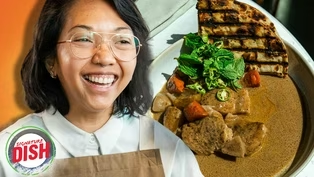
Chef Ria Montes Brings Filipino Flavor to The Wharf in DC
Video has Closed Captions
Clip: S4 Ep12 | 5m 29s | Seth visits Fish Shop DC where Chef Ria Montes blends Filipino roots with Maryland seafood. (5m 29s)
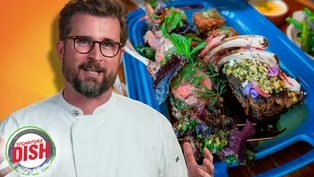
Go Inside The Dabney, One of DC's Best Wood-Fire Kitchens
Video has Closed Captions
Clip: S4 Ep12 | 7m 4s | Seth visits The Dabney in D.C.'s Blagden Alley. (7m 4s)
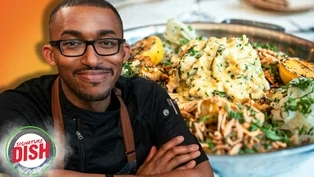
Marcus Samuelsson's DC Restaurant Serves Up Crab Rice Perfection
Video has Closed Captions
Clip: S4 Ep12 | 6m 29s | Seth visits Marcus DC where Chef Anthony makes Mel's Crab Rice. (6m 29s)
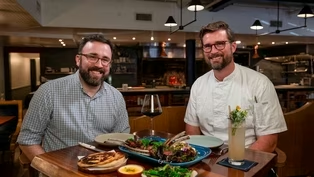
Preview: Treasures of the Mid-Atlantic
Preview: S4 Ep12 | 30s | The Dabney in Blagden Alley, Fish Shop at The Wharf, Marcus DC in NoMa (30s)
Providing Support for PBS.org
Learn Moreabout PBS online sponsorship
 New Episode
- Food
Christopher Kimball’s Milk Street Television
Transform home cooking with the editors of Christopher Kimball’s Milk Street Magazine.








Support for PBS provided by:
Signature Dish is a local public television program presented by WETA