
Trump Administration Plans to Exclude Nursing as Professional Degree
Clip: 12/3/2025 | 9m 45sVideo has Closed Captions
The move would lower how much money graduate nursing students can borrow for school.
The move has sparked pushback from nurses, who worry it would make degrees unaffordable and deepen an already severe nationwide nursing shortage.
Problems playing video? | Closed Captioning Feedback
Problems playing video? | Closed Captioning Feedback
Chicago Tonight is a local public television program presented by WTTW
WTTW video streaming support provided by members and sponsors.
Trump Administration Plans to Exclude Nursing as Professional Degree
Clip: 12/3/2025 | 9m 45sVideo has Closed Captions
The move has sparked pushback from nurses, who worry it would make degrees unaffordable and deepen an already severe nationwide nursing shortage.
Problems playing video? | Closed Captioning Feedback
How to Watch Chicago Tonight
Chicago Tonight is available to stream on pbs.org and the free PBS App, available on iPhone, Apple TV, Android TV, Android smartphones, Amazon Fire TV, Amazon Fire Tablet, Roku, Samsung Smart TV, and Vizio.

WTTW News Explains
In this Emmy Award-winning series, WTTW News tackles your questions — big and small — about life in the Chicago area. Our video animations guide you through local government, city history, public utilities and everything in between.Providing Support for PBS.org
Learn Moreabout PBS online sponsorship>> The Trump administration is planning to remove nursing degrees among others from the professional degrees category.
Starting in July, the change would lower how much graduate nursing students can borrow for school.
The move sparked pushback from nurses nationwide who worry it could make degrees unaffordable and deepen.
An already severe nationwide nursing shortage.
Joining us to discuss the move, our Eileen Collins, dean of the University of Illinois, Chicago Nursing College.
Lorna Finnegan, dean of the nursing school at Loyola University.
Chicago and via Zoom Rocks and spur Lark chief nursing administrator and interim director of the DePaul University School of Nursing Nurses and Dean's and leaders of nursing schools.
Thanks to all of you for joining us.
Eileen, what is the professional categorization of degrees and what would it mean for nursing degrees to be out of that category?
So the Department of Education defines a professional degree as a profession.
>> It needs a graduate degree and generally needs a license.
So in a nursing nurse, practitioners need to graduate degree in order to be a nurse practitioner also CRA nays or nurses who do Anastasia also need a graduate degree and they also need to take a licensure exam after they're finished with their degree.
If that pushes, if the a month at a nurse can borrow to go to school, gets pushed to where they can't afford it.
It really creates shortages throughout not only the city of Chicago, but the state of Illinois.
So, for example, many counties in the state of Illinois do not have any anesthesia providers whatsoever.
So if you nurses nurses fill that gap and they work with anesthesiologists in all kinds of different settings, we don't have those nurses becoming.
becoming nurse practitioners in Sierra nays.
Then it will create worst shortage than what we already have.
>> How could this impact students who are currently enrolled in graduate nursing programs and they're relying on these loans to pay for education.
So it won't impact the nurses who are currently enrolled will impact those students who want to enroll after July.
1st.
So the students who are currently enrolled are grandfathered in.
But the ones who want to start next year, for example, in the next academic year, they won't be able to access those loans and a big concern is they will take out loans, but they'll be from predatory lenders and then they'll have these exorbitant interest rates and they may have to drop out eventually.
Roxanne during the pandemic.
Of course, we all know that nurses were described as heroes on anyone who's ever needed.
Some nurses in the hospital knows the work that they do.
>> In your opinion, does this change signal a shift in how the government views the importance of the profession?
>> Thank you for inviting me to the conversation in the short answer is yes.
The 22 years, the Gallup poll, he's right.
Nurses as the most trusted profession in this country.
And on top of that, nursing is the largest workforce in health care.
So when we think about these shifts, it, we have to think about it from the stance of where it happens now in acute care.
If we're looking at a shortage that is already in process and we are looking at nurses that are at retirement age in leaving during the pandemic because of other stressors.
We have to acknowledge there's a breakdown in the availability of nurses, which we already know.
It's being impacted, those nursing statements that would be produced with steel.
Stand A halt because we would not be able to produce those to in 2023.
It was noted that they would 19 1977 vacancies for individuals that will here to teach at the graduate level.
So if that were the case, means that we had to turn away somewhere around 60,000 nursing students were qualified intelligible to into this space.
So when we think about this acute care is definitely going to be impacted because of the quality and standards that we have to meet to be able to provide quality and safe care.
>> Lorna, the change we know won't affect undergraduate nursing students, but it will make it harder for students to pay for graduate programs.
As we've discussed, describe what some of those graduate programs are pleased and the jobs of those students can typically take on after graduation.
>> So typically they can become an advanced practice nurse.
And there are 4 categories of advanced practice nurses.
Nurse, practitioners diagnose prescribe and treat illnesses and certified registered nurse anesthetist deliver an official clinical nurse specialist over see really complex care and nurse midwives deliver babies.
So besides advanced practice, it also affects the future pipeline of nursing faculty because nursing faculty year-old graduate prepared, preferably with a doctoral degree and also nursing researchers.
So it really, really has a wide is this a slippery right now is about the money that a nursing student, undergraduate nursing student can borrow.
But could this lead to other?
>> Other ways that the profession is further diminished?
Well, yes, I mean, especially when you think about reducing the pipeline of nursing faculty that will reduce the pipeline of students who are entering the nursing profession because there won't be enough faculty to teach them.
So ultimately it will worsen a very bad nursing shortage as it is.
And it really it it's really about public health that's going to have a negative impact on public health >> nothing nothing gets better with fewer nurses, nothing.
>> Eileen, the under Secretary of Education, Nicholas, can't has argued that these changes are intended to pressure the schools, the universities to lower tuition costs for students to that they don't have to take out such large loans.
Do you think that will be the case?
Will nursing schools respond with just lowering the costs?
>> We can't afford to do that as a nursing school.
If you think about it, the healthcare environment is increasingly complex there for the complexity of teaching students goes up.
We require complex simulation laboratories.
We require faculty who are at the top of their game and you can't hire faculty at the top of their game at a very low price.
So we don't want to water down in to loot the polity of of health care that our students can provide.
Right now, the United States has one of the best health care systems in the world.
And we had there because students, whether they be nursing students or positions or dentists are educated by people who are the top of their fields.
We want to continue that to so that the United States, Chicago, the state of Illinois, continues to provide excellent health care.
>> Lorna, sorry, Roxanne, I know that you've emphasized a diversity and equity and inclusion.
Excuse me.
That's not right, Laura, this question is actually to you.
Youve emphasize diversity, equity and inclusion at the Loyola Nursing School.
What impact could this change have on diversity of enrollment?
What it what it will do is it will create 2 tiered system because under represented and minority students are more likely to take out loans.
>> generally come from less less generational wealth and they have less access to private loans.
So therefore, there will be less under represent minority students entering advanced practice, Les faculty.
It will ultimately then affects care and access to care and health equity because underrepresented students are also more likely to work in underserved communities and deliver culturally can cordoned care.
Where where they are delivering care to patients just like And ultimately it will reduce access, especially rural areas.
>> And behavioral health areas and it will reduce the number of underrepresented faculty.
We've we've worked really hard increased nursing workforce diversity, and it's just going to take us on a slow back down again.
So it's it's really can have a great impact, the rocks.
And we've also seen federal funding cuts to hospitals that could affect tuition reimbursement for nursing students.
>> You have a doctor of nursing practice degree.
That's one of the programs that may become harder for students to afford.
How important is it to have multiple avenues of financial assistance when pursuing a degree like that in about 45 seconds?
>> The short answer is it cannot be when we think about individuals who pulled the same type of credentials that I represents about one percent of the nation and in doing that, we have to want a healthier and more just future.
And if you want to provide for this, we are the ones who wear the put in front to address many of the shortages.
And we are not there, too, look at the areas where we're heading the shortages, the physicians, which is true, an in-game, thank if we cannot address these then the profession that has carried this country through crisis, goes.
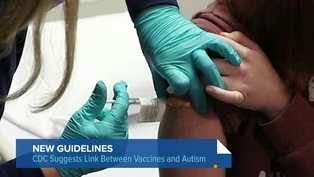
Health Officials Alarmed Over New CDC Guidance on Vaccines
Video has Closed Captions
Longstanding vaccine guidelines for babies and children could soon be upended. (9m 59s)
Providing Support for PBS.org
Learn Moreabout PBS online sponsorship
- News and Public Affairs

Top journalists deliver compelling original analysis of the hour's headlines.

- News and Public Affairs

FRONTLINE is investigative journalism that questions, explains and changes our world.












Support for PBS provided by:
Chicago Tonight is a local public television program presented by WTTW
WTTW video streaming support provided by members and sponsors.