
Trump’s Acquittal, Legislative Session Week 5
Season 5 Episode 25 | 26m 36sVideo has Closed Captions
Utah reacts to former President Trump's acquittal. Week five of the legislative session.
State lawmakers consider major policy changes as the end of the legislative session looms. Utahns and political parties react to our senators casting opposing votes in the divisive acquittal of former President Trump. Utah looks to the future as it recovers from the economic crisis.
Problems playing video? | Closed Captioning Feedback
Problems playing video? | Closed Captioning Feedback
The Hinckley Report is a local public television program presented by PBS Utah
Funding for The Hinckley Report is made possible in part by Cleone Peterson Eccles Endowment Fund, AARP Utah, and Merit Medical.
Trump’s Acquittal, Legislative Session Week 5
Season 5 Episode 25 | 26m 36sVideo has Closed Captions
State lawmakers consider major policy changes as the end of the legislative session looms. Utahns and political parties react to our senators casting opposing votes in the divisive acquittal of former President Trump. Utah looks to the future as it recovers from the economic crisis.
Problems playing video? | Closed Captioning Feedback
How to Watch The Hinckley Report
The Hinckley Report is available to stream on pbs.org and the free PBS App, available on iPhone, Apple TV, Android TV, Android smartphones, Amazon Fire TV, Amazon Fire Tablet, Roku, Samsung Smart TV, and Vizio.
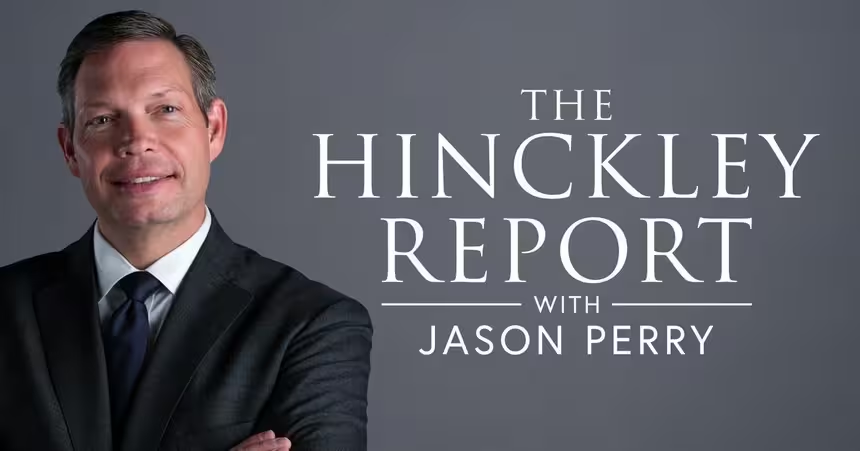
The Hinckley Report
Hosted by Jason Perry, each week’s guests feature Utah’s top journalists, lawmakers and policy experts.Providing Support for PBS.org
Learn Moreabout PBS online sponsorship♪♪♪ male announcer: Funding for "The Hinckley Report" is made possible in part by the Cleone Peterson Eccles Endowment Fund.
Jason Perry: Tonight on "The Hinckley Report" state lawmakers consider major policy changes as the end of the legislative session looms.
Utahns and political parties react to our senators casting opposing votes on the divisive acquittal of former President Trump.
And Utah looks to the future as it recovers from the economic crisis.
♪♪♪ ♪♪♪ Jason: Good evening and welcome to "The Hinckley Report" I'm Jason Perry, director of the Hinckley Institute of Politics.
Covering the week, we have Derek Miller, president and CEO of the Salt Lake Chamber and Downtown Alliance.
Taylor Stevens, state government reporter for the Salt Lake Tribune, and Dennis Romboy, political reporter for The Deseret News.
So glad to be with you all to talk politics tonight.
The national level, but very local implications.
I want to start with you, Dennis, on the impeachment trial.
The second time, we've had this former President Trump acquitted for the second time.
Seven Republicans voted for this conviction.
One of ours was one of them our own Senator Mitt Romney, but I want to talk about what the implications are not just for him, but for Mike Lee and where Utah is on this issue.
Not about just what happened, but about going forward.
First, you're reporting just yesterday on our most recent poll with whether or not the Senate should have convicted former president Trump 51% of Utahns said no, 43% said yes.
Dennis Romboy: You might think that could have been a little bit higher given his--the vote he got here the past election, I think it was around 58% of those something like that but people are kind of divided about that.
Obviously all Republicans much higher percentage said that he should have been acquitted.
There are some political implications for Senator Romney and for Senator Lee as a result of this.
We've seen petition started to censure Senator Romney but I've also seen a change.org petition thanking him for his vote.
Just today the Republican Accountability Project launched the ad campaign to bolster the senators who cross party lines and voted for the conviction of President Trump.
Jason: Let's break that down.
It's so interesting, Taylor, because there's no clear consensus on this.
Utahns are divided when you talk about them generally as Dennis alluded to.
They're not so divided when it comes to their party.
When it comes to that conviction it was 74% of Republicans said that he should not been convicted and 92% of the Democrats.
Taylor Stevens: Yeah, I think that this was a situation where people have their minds made up before they even took a vote, before they even came in and kind of went through that process.
A lot of people already knew what they wanted to happen and I think we continue to see that play out in the polling.
Jason: Mm Hmm.
So Derek, talk about how the candidates are looking at this.
You've advised governors been part of campaigns, what is happening inside the Republican party that you're hearing as they try to make room for two elected officials within their own party that cast two very separate votes?
Derek Miller: You know it wouldn't surprise you because I think you're probably hearing the same thing that you got some potential candidates out there, others who are being encouraged, maybe even recruited to run against both of our sitting senators.
Of course on one hand, you've got people who are saying I'm upset with Mike Lee because of his vote.
I may challenge him.
I may try to find someone to challenge him.
Same thing with Senator Romney.
Of course, Senator Lee up in two years, Senator Romney up in four.
I'm actually of the opinion that former President Trump is such a divisive character, the issue is so divisive, I don't see that as a winning platform.
At least not today because there's many people who would say you've got a challenge him.
You've gotta challenge one of the Senators because of their vote in this direction.
You've got to as many people on the other side of the issue, saying, we got to support that same senator for this-- for the opposite reason.
Jason: Yeah, it's just such a-- go ahead Dennis.
Dennis: With Senator Lee's strength within the party I don't see too much trouble for him in the convention and there may be someone that can get on the ballot and challenge him through the signature process next year, but I don't see you too much trouble ahead for him that way.
Jason: Well, let's break down those numbers a little bit too to your great points about that.
If you'll look at the raw approvals in this poll that Hinckley just did with the Deseret News, Taylor, Mike Lee, 45% approval, 41% disapproval.
I want to do that as it relates to Mitt Romney, 50% approval, 45% disapproval.
It's just so interesting how mostly these numbers have not changed for either one of them even in spite of their vote.
Taylor: Again, I just think that speaks to, you know, people have their minds made up about how they see these characters and I don't think that they really shifted their views from the last impeachment.
And so I don't think that they did anything unexpected here for Utah.
So the ones who agreed with them the last time, you know, nothing has really changed for them in this round of impeachment.
Jason: Well, let's talk about how the Republican Party and Utah is going to handle this 'cause I wanna read a statement because the person's had to answer this question this week is Derek Brown.
He's the chairman of the Utah Republican Party.
So people were asking him.
The question said how are you going to handle this?
You've got some say a lot of support from the Republicans for Mike Lee not so much in the Republicans for Mitt Romney, but how is the tent big enough for both of these two particular candidates here too.
I want to read this statement from Derek Brown, and maybe Derek Miller, if you'll take a second to answer what Derek Brown is trying to do here.
He says, "As a party, I think this is a great opportunity for us to think about the fact that we have two senators who experienced effectively the same set of facts and came to differing conclusion.
And that's okay.
That's normal.
That's healthy.
And I think that is a hallmark of a healthy political party."
That's a big statement for some very different views.
Derek: It's a good statement.
I'm glad that Derek made that statement.
I think he's doing an exceptional job in a very difficult situation under the best of circumstances, but under these circumstances, which a Republican president is getting impeached not once but twice and you've got your two senators on opposite sides of the issues, but the sum and substance of what Chairman Brown has said I think is so important and that is there's so much talk about unity, which I think is great, but how 'bout more talk about valuing diversity of opinion, valuing a diversity of thought.
I think we need more of that in our country.
I'm glad that he made that statement.
Taylor: I think another thing that's at play here is, you know, the Republican Party did see many people leave nationally and also in Utah.
And I think that you know there's a recognition that there is some work to do at home to kind of bring this big tent in and unify people locally as well.
And so you know Derek Brown has said there's work to do at home as well and we need to focus on that rather than these divisive issues.
Dennis: And Derek Brown's job is get Republicans elected, right?
So Mitt Romney may not fair well in a state convention but in a primary election or in a general election, he's likely to attract those moderate voters that have kind of try to stay with the party.
As far as you know Mitt Romney's concerns, so.
Jason: So, Dennis, to that great point, I mean, we almost have to identify the fact that there are some national polling going on right now that's including Mitt Romney on the list of potential candidates for run for President.
Dennis: I don't think that's ever ended since his last run in 2012.
I think his name is continued to be you know bandied about as a potential candidate.
He's repeatedly said you know twice is enough and I'm not doing this a third time.
He'll be what 70--he's 73 right now.
The next presidential election he would be 77.
I mean, Joe Biden is what around that age himself.
So it's not out of the realm of possibility I guess, but I just don't see that happening.
Jason: Most recent poll he picked adjacent 4%.
Yes Derek.
Derek: I was just going to say I think the interesting question is not is Mitt Romney going to run for president again.
The interesting question to me is will he run to be a US Senator from Utah again.
Dennis: I think that's a great question.
He hasn't really revealed that as well, you know, and I think I've seen a couple of fundraising emails come through from him.
So I don't know if that's a signal or not.
Mike Lee on the other hand is a full court press on fundraising right now.
Jason: So Taylor, to this really great and insightful point here too.
Some people have made the comment that he's taking the kind of votes of a person that's not planning to run again.
These are the kind of controversial votes that you make when I'm not really worried about political ramifications.
Taylor: Yeah, we've seen Romney also talk about his faith and how he has been an outsider in many at times in his life and how that has given him, you know, the strength to make moves that not everyone agree with that he doesn't have to follow the pack.
And so I think it could also speak to his personal values and faith and may not necessarily signal that he doesn't plan to run again.
Dennis: I think he had an epiphany of sorts too because in the past he made some decisions out of political expediency and he said I'm not doing that anymore.
I'm gonna vote my conscience.
I'm going to go with my faith.
I'm going to go with my gut and my heart on these votes.
Jason: We'll watch these races very closely 'cause there's a lot and as Derek mentioned, he says to us four years to try to make his case here, even the state of Utah with what he wants to do.
We need to get into the legislative session.
A lot has happened even since the last week in our program.
A lot of bills moving forward and some are just popping up.
This is the time when you start seeing some of these interesting bills, but one is a theme that we heard through the summer as our legislature dealt with a pandemic.
And Taylor, I'd like to hear what you're hearing about efforts to corral the governor's power specifically when it comes to the emergency declaration powers.
This is a struggle that we've seen play out.
Legislature's taken a move.
Taylor: Yeah, as you mentioned, we've been hearing conversation about this throughout the interim, throughout the summer, and we finally saw a bill that was released on Tuesday by leadership in the house and the bill does seem to have some bipartisan support.
Senator Luz Escamilla, a Democrat from Salt Lake City has come out in support of it and it just kind of speaks to this push and pull between who should have power during a long term emergency because lawmakers say that the Emergency Powers Act we have now never contemplated a pandemic.
It was more a wild fire, an earthquake, you know, something short term 30 days.
Jason: Derek, give us some context on this because you actually helped with the whole response effort on behalf of the state.
You continue to help advise.
What's at the heart of this power struggle?
What are the legislators trying to reclaim?
Derek: Well, I think as Taylor pointed out at the heart of the matter is the eternal struggle between two branches of government.
And we see it playing out on this particular battlefield, which is a unique battlefield you know we'd never dealt with a pandemic not in our lifetimes at least.
I saw earlier, there's-- obviously wanting to take charge off being those-- needing to take charge, but the legislature didn't want to be left out and felt left out in the early days of the pandemic.
It became highly controversial in very important ways because Governor Herbert was issuing emergency declarations that were shutting some businesses.
People were losing jobs.
It's hard to even remember let alone articulate just how many uncertainties and unknowns there were way back in March and April of last year.
But the legislature wants to be involved, I think Governor Herbert did the right thing in getting them involved quickly.
But I think now the legislature says hey, we don't want a repeat of what was happening in March and we don't want to have to rely on the good graces of the governor to have a seat at the table.
We're gonna create a seat at the table.
Frankly, they probably need to have one in my opinion.
Taylor: One thing that's interesting in this conversation now and that the governor mentioned yesterday is that the legislature has all along had the power to call itself into a special session.
You know the voters gave them that power recently and so they didn't need the executive branch to give them that power to make these changes.
And so he says you know I wish that they would be more involved.
I think that they should have been but they didn't want the political fallout of making these tough decisions.
And now that we are sort of further on in the pandemic now they're kind of trying to take back some of this power and act like they haven't had a role to play all along.
Dennis: It is a unique situation, but like Taylor mentioned the legislature can call self into special session, but that power only came to be maybe three years ago, right.
So we've seen this kind of effort over the last three or four years for the legislature to try to take some back-- some power or maybe more clearly the-- maybe balance of power out a little bit more.
Jason: So, Dennis, to that point because they'll-- go ahead Derek.
Derek: Well, I was just gonna say Taylor mentioned special session and back in April and May when the legislature did call itself into a special session, one of the specific things that did was to create an Economic Response Commission.
And it was made up of legislators, it was made up of folks from the private sector.
I was asked to sit on that commission.
I thought that commission was very effective in making suggestions to the governor.
At the end of the day it was the governor's choice, but I can tell you as someone who sat on that commission as well as chaired the Governor's Economic Response Task Force, we would not be in as good a economic position as a state were it not for that legislative created commission that was really looking at data and frankly pressing the governor's office to make some tough decisions, but some important decisions.
Jason: To this same issue here because it's not just really confined just to the governor's office, right, Dennis?
There's also a bill to bring back some of the power from the Attorney General for the state of Utah, Sean Reyes and his ability to enter into lawsuits and to sign on to lawsuits from other states.
Dennis: I think that was a direct result of Sean Reyes involving the state in that Texas lawsuit tryin' to overturn election results in four states that Utah is not one of those states.
And even the Governor Herbert and then governor elect Cox, both condemn that action and said Utah shouldn't be involved in elections in other states.
And I think that's what prompted that bill and our Attorney General's involved the state in a number of lawsuits, especially ones that well the Democrats aren't fond of.
Obamacare and such things like that.
Jason: There's another slate of gun bills, Taylor.
Every session we see some of those.
Some sessions some of them start to gain some traction, sometimes they don't but let's talk about a couple of those.
One in particular already signed by the governor the constitutional carry bill.
You can conceal a weapon without going through the class or getting a permit or getting a background check now if you're 21 plus years old.
What is there anything different about this year than years past when Governor Herbert for example, vetoed a similar bill?
Taylor: I think one thing we have seen that's different than say last year for example is there were a lot-- there's a lot more momentum behind gun control bills in the last session on the heels of Parkland and March for Our Lives.
And I think we're seeing a little bit less momentum for those types of efforts, which has been overshadowed by the pandemic and other issues.
One thing that we are seeing with gun bills this year that I think is heavily influenced by the pandemic and some of the mental health challenges is we are seeing a slate of bills coming forward that deal with more safety training, more, you know, kind of going from that mental health angle of making sure that people who are struggling, you know, that they have avenues to make sure that they're not putting themselves in a position of danger with their firearms.
Jason: Derek, we're also not only that when we also have a bill, allowing maybe for a gun safety class in high schools.
We're seeing that but also a bill by Representative Ellis that allows someone to voluntarily surrender a weapon, if they're having a mental health crisis of some sort.
Derek: So the thing that surprised me the most about the concealed weapon permit going away and having the so called constitutional carry is how little controversy it seems to have generated and you know maybe that's just a virtue of the pandemic and it's difficult for people to weigh in or be up at the Capitol in any sort of large group or mass demonstration.
I remember serving in the Governor's office the last time this came up and as you mentioned, Jason, Governor Herbert vetoed that and they were not able-- the legislature was not able to muster enough votes for a veto override but it was highly controversial.
I hear almost nothing about it today on the note of taking the gun safety class.
I'm a concealed carry permit holder.
I guess I don't need the permit anymore or soon won't need it anymore, but I only bring it up because the real value for me in getting that permit was going through the mandatory safety course.
I found it even though I had been around guns my whole life and have used them, it was highly valuable for me.
So I hope that the legislature will do more to to make those courses not just available but to make them part of getting a gun.
Dennis: A component of that training with a suicide prevention module, you know, brief video talking about suicide prevention and not as many people will be exposed to that piece of it if they don't take the training now if it's not required and I think some people in mental health fields and deal with suicide are a little bit concerned about that.
Although I guess Representative Ellis was successful in getting some of that money from the program-- permit program diverted to to mental health prevention or intervention and help.
Jason: It is so interesting and it is interesting that it went up through the legislature so quickly, right?
Even signed before the end when this used to be one of those issues that would occupy a lot of this the legislative session.
One that is Taylor, talk about one bill that has been occupying a lot of time and a lot of a lot of commentary in the press too is about transgender athletes, particularly transgender female athletes in sports.
And we've talked about on this program for the last couple of weeks, but it took a little turn this week in terms of people supporting and opposing it.
Talk about what's happening right there, noting of course, that collegiate sports was taken out of the bills, so it applies only to high school athletes.
Taylor: Yeah, one thing that we saw happen this week.
So first of all the bill passed through the House and so that signals some support at least from, you know, a majority of lawmakers there.
We'll see how it goes through the Senate, of course, but the next day you know the Governor did say that he will not sign the bill in its current form.
He's not supportive of it and he feels like it is, you know, sort of going to provide some challenges for community that already is very vulnerable and that he wants to see it be more inclusive and see Utah be more inclusive to the LGBTQ community.
Jason: So this is a big statement, Derek, from the governor.
People are wondering what he's going to say.
The chamber has weighed in on this as well as Salt Lake Chamber has as well so the descendants.
So, let's take this up it passed by the House with what you would say is a veto proof majority in the House.
The Senate has to take it up now with comments from not just our governor, but also the Salt Lake Chamber.
Derek: Well, I am so far from being close-- anywhere close to being an expert on this issue.
It is such a delicate issue.
It is such a nuanced issue.
It is such an emotionally charged issue.
I think Governor Cox was correct when he said we need to tread lightly here and this is not something we ought to rush into.
We shouldn't be making rest rush decisions, one way or the other, I think his comment yesterday was we need to hit the pause button on this.
That's why the chamber's position is that it ought to be decided by local school districts.
We understand that local school districts are already looking at it closely.
It ought to be done in consultation with medical experts.
And I think based on a poll that I saw this morning from the Hinckley Institute, while not a majority of the people but the highest percentage of the people felt the same way that it ought to be decided by school districts and consultation with medical professionals.
Jason: Yeah, Dennis, let's break this out because you wrote the story because that is the most important point here in this poll, which asked if transgender women should be allowed to compete.
It was 61% of Utahns said no, 16% didn't know which goes to the complexity of this but what Derek just said is the most important part is who should make the decision about it.
Dennis: And the poll showed that it should be the High School Activities Association or in in the case of a collegiate sports NCAA and I think only 5% of people said government should make this decision and here we are as a government trying to make this decision.
I thought that was very interesting.
Yes I agree.
Taylor: I think it's important to note that the Utah High School Activities Association does have a policy on this and they have not come under any problems with that policy.
Also the fact that there are no women in Utah schools, you know young girls, who are transgender who are participating in sports.
And so you know while the sponsor says that she sees there is a need to you know protect women sports.
There are other people who say this is kind of a bill in search of a problem that doesn't currently exist.
Dennis: There was a bill in Idaho passed last year that a federal judge immediately put a hold on after a lawsuit was filed.
I would suspect if this were to pass here the same thing would happen.
However, there could be some economic backlash and maybe Derek could speak to that better.
Jason: Maybe starting the economic part of that Derek, because I have some other economic questions for you also.
Derek: Well, of course, you know it'd be conjecture to say what would or what wouldn't happen, but we've certainly heard from some of our members of the Salt Lake Chamber that they're concerned about their ability to bring future events to the state of Utah.
We saw what happened and in North Carolina.
I'm not necessarily trying to say that what happened in North Carolina with the so called bathroom ban is exactly the same thing.
I guess some would argue that it is but the point I think important point is is that there are often economic consequences if a state gets a reputation as not being sensitive to this issue.
And I think that's the one thing that we all ought to want to be regardless of the opinion, whether we're in the 60% or the 17%.
Or the remainder.
We all should want to be sensitive to issue.
Jason: This does lead to a couple of distinctions the state had because the sign that you put on the state does matter and I want to talk about a couple of distinctions, Utah did get this last week that you helped work on not just-- with the governor's office economic developed but also with the chamber.
A couple of our cities hitting the number one.
In fact, the Provo City jumped into the number one best performing city in the country.
That is a pretty big distinction.
Derek: Well, I'm feeling pretty good today 'cause I'm a native of Provo.
I grew up in Provo.
So that's my hometown and I'm also a resident of Salt Lake City, and president of the Salt Lake Chamber.
So I-- the Salt Lake-Provo connection is pretty strong today.
You know to have two cities in one state that are in the top five is pretty remarkable.
And what I really want to highlight is just the fact that I think our prospects are also brighter than ever.
You know one of the things that the pandemic has unveiled is this disconnect between where you live and where your job is located.
I think Utah is gonna benefit very well from that.
In fact already is when I talk to my realtor friends in Park City in St. George They tell me, we got people moving here from all over the country, because they've just figured out they can live somewhere different from where their job is located and Utah's where they're choosing and bringing all that talent to the state will bode very well for our economic future.
Jason: That's a great distinction.
I wanna highlight one other point that's underlying some of this around the country, but in the state of Utah.
Taylor, a little bit on the impacts of Covid-19 on jobs, but specifically jobs for women.
An interesting and very concerning report just came out in December, the country lost 140,000 jobs all of them women.
This is a big issue what people are calling the she session.
What is happening right now getting women back in the workforce.
Taylor: Yeah, we are seeing that women have had to make the decision to leave their jobs.
Many times we know women are the primary caregivers that they take on a lot more of those challenges and so with child care closed or more expensive with belt tightening with Covid, we have seen this have a big impact on women and that's something that we're also exploring on the impact on Utah women at the Salt Lake Tribune.
We have a reporter who has dedicated to covering women and the impacts of Covid is one of the issues that she's looking into right now.
And so there's still I think a lot of work to be done to really get a good handle on that but we do know that this pandemic has hit women hard.
And we'll see you know once things start going back to normal if women are able to make up the gains that they have made in so many years.
Jason: And our last 30 or 40 seconds, the Tribune did a survey of our legislators and at least one piece of legislation emerge the session that may help with this what is it?
Taylor: Yeah, you know, there are a few bills around child care that would help with that.
You know just a lot of ways that we're looking at the impacts on women and, you know, we'll see where those end up going.
Jason: So watch this closely.
This is an issue the whole state of Utah takes note of.
Particularly when it comes to the list were starting to rise on.
Thank you for this and thank you for your very thoughtful comments this evening.
And thank you for watching "The Hinckley Report."
This show is also available as a podcast on PBSUtah.org/HinckleyReport or wherever you get your podcasts.
Thank you for being with us.
See you next week.
♪♪♪ ♪♪♪

- News and Public Affairs

Top journalists deliver compelling original analysis of the hour's headlines.

- News and Public Affairs

FRONTLINE is investigative journalism that questions, explains and changes our world.












Support for PBS provided by:
The Hinckley Report is a local public television program presented by PBS Utah
Funding for The Hinckley Report is made possible in part by Cleone Peterson Eccles Endowment Fund, AARP Utah, and Merit Medical.