
Turning Back the Clock
Season 8 Episode 12 | 26m 48sVideo has Closed Captions
Host Angela Fitzgerald tours the Paine Art Center and Gardens
We’re turning back the clock as host Angela Fitzgerald tours the Paine Art Center and Gardens, a historic mansion in Oshkosh. She learns about Nathan and Jessie Kimberly Paine. Angela meets up with Laura Fiser, Curator of Collections and Exhibitions, as they delve into the historic past of the building. The adventure continues as we connect with stories from across the state.
Problems playing video? | Closed Captioning Feedback
Problems playing video? | Closed Captioning Feedback
Wisconsin Life is a local public television program presented by PBS Wisconsin
Funding for Wisconsin Life is provided by the Wooden Nickel Fund, Mary and Lowell Peterson, A.C.V. and Mary Elston Family, Leon Price & Lily Postel, Stanley J. Cottrill Fund, UW...
Turning Back the Clock
Season 8 Episode 12 | 26m 48sVideo has Closed Captions
We’re turning back the clock as host Angela Fitzgerald tours the Paine Art Center and Gardens, a historic mansion in Oshkosh. She learns about Nathan and Jessie Kimberly Paine. Angela meets up with Laura Fiser, Curator of Collections and Exhibitions, as they delve into the historic past of the building. The adventure continues as we connect with stories from across the state.
Problems playing video? | Closed Captioning Feedback
How to Watch Wisconsin Life
Wisconsin Life is available to stream on pbs.org and the free PBS App, available on iPhone, Apple TV, Android TV, Android smartphones, Amazon Fire TV, Amazon Fire Tablet, Roku, Samsung Smart TV, and Vizio.
Providing Support for PBS.org
Learn Moreabout PBS online sponsorship- The following program is a PBS Wisconsin original production.
- Coming up on Wisconsin Life: meet an artist sharing her powerful poetry.
- Grief held me like an ill-fitted suit.
- An illustrator turning kids into superheroes, a woman telling stories through beadwork, and a pair crafting wooden toys for the holiday season.
It's all ahead on Wisconsin Life.
♪ ♪ - Funding for Wisconsin Life is provided by Lowell and Mary Peterson, Alliant Energy, Stanley J. Cottrill Fund, American Transmission Company, Focus Fund for Wisconsin Programs, and Friends of PBS Wisconsin.
- Hi, I'm Angela Fitzgerald.
Greetings from the Paine Arts Center and Gardens.
We're stepping back in time to visit this English-style estate turned museum.
These sprawling grounds, formerly owned by Nathan and Jessie Paine, call Oshkosh home.
Welcoming visitors to not only tour the well-preserved mansion but also the gardens, providing stunning views of this architectural masterpiece.
Nathan Paine made his fortune by operating a successful family lumber company, while Jessie was the daughter of one of the founders of Kimberly Clark, the well-known paper mill.
Construction of the property began in 1927, and the couple hoped to one day call this place home.
They would never get that chance.
The Great Depression hit, and all work on the home was stopped by 1932.
It wasn't until 1946 when construction began again, and plans were formally made to turn the home into a museum.
Today, guests are welcome to tour the living museum with exquisite furnishings, beautiful artwork, and changing exhibitions showcasing local and national artists and collections.
♪ ♪ We'll continue our tour of this expansive home, but first, let's travel to a different part of the state as we go to Madison to meet a poet who shares her powerful art with the world.
- Isha Camara: And how can I forget Miss Lord promised?
This is not an act of self-indulgence.
This is an act of political warfare.
This is an act of self-preservation.
Which means, I-- sorry.
[laughing joyfully] Okay.
I completely was like, "What's the poem?
"” Okay, okay, sorry.
[humming] I often write poems, like, in reaction to like certain events that are happening.
When they said college was going to be hard, quite frankly, that was an understatement.
There were times grief held me like an ill-fitted suit... Or, like, more high-intense emotions like irritation and anger, which, I think all of my emotions are valid.
♪ ♪ My name is Isha Camara.
I use she/her pronouns.
I'm an Aries.
That's really important to me.
[laughs] ♪ ♪ I think, like, on campus, I'm often known as, like, "“Isha, the First Waver"” or, like, "“Isha, the Makeup Girl"” and, like, I love that.
I would absolutely love to always be identified by my make up.
Hi, just wanted to show off my outfit.
Okay, get into the face.
[tape rewinding sound effect] And I have my matching mask.
I'm going to go write poetry with a friend now, okay, bye.
[button clicks] [traffic sounds] Poetry is kind of like second nature.
Like, I could be walking down from the grocery store and like get a thought in my head and put it in my notes just so I won't forget it.
[hip-hop music] I'm in the eleventh cohort of First Wave's Hip-Hop and Urban Arts Program, representing my god, my mama, and Southside Minneapolis.
I was home for Ramadan, too.
Ramadan happened April to May, and Eid was May 25th.
George Floyd was killed, and I was already doing art in Minneapolis, raising money.
And then, I came back to Madison to focus on my summer classes.
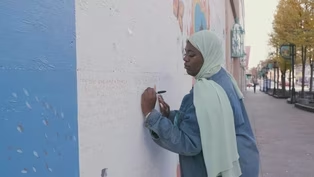
And then, I was asked by the Overture Center slash the City of Madison to do the mural.
♪ Don't need no caption No, we livin' lavish ♪ ♪ Drip, drip, drop I know you see the fashion ♪ ♪ I know you see the fashion ♪ (I know you see the fashion) ♪ I know you see the fashion ♪ ♪ It's that sauce you never could imagine ♪ ♪ Whoo ♪ The poem is called, "“Have you ever watched the slow bloom of a flower and called it revolutionary?
"” I think it's something that I don't talk about as often in my poems, which is just about like healing.
Healing is not often depicted as emotion, but more as an action, and I'm like, you know, for me, healing is kind of, like, an event, right?
It's like a process.
Like, you're doing so many nitpicky things, and I think those are the things that I like talk about in my poems, and, like, that's what I wanted my mural to like engage with, right?
Are we saying, "“Healing is just as important as this revolution, as this protest?"
[honking horn] Whoever watched the slow bloom of a flower and said, "Revolutionary."
The camera flickers low when I call myself off the streets from my porch.
Watch the sky sizzle into smoke and blue water as I latch the door close and check it twice.
I'm this Black Muslim woman who got to have her own little space in the city.
That's, like, a lot for me, and that's, like, enough for me.
So I think that's like all of the things that I was thinking about, like, when I was making this mural.
[poignant piano music] - We now head to Germantown, where an illustrator is using his talents to help kids discover their superpowers.
♪ ♪ - Bryan Dyer doesn't have a superpower, but he's always loved stories about people who do.
- Bryan: Superheroes, in particular, were my thing growing up.
Like, for the longest time, I was gonna be a comic book artist.
[pen scratching] - Angela: And like those heroes, he planned to use his abilities for good.
- I thought, later on in life, when I'm a millionaire artist and I have, you know, money to burn, and I've got all this free time, I would love to do art for kids in the hospital.
- Angela: Like many origin stories, there were a few hiccups along the way.
After college, Bryan struggled to find steady illustration work until one day he had a conversation with his sister.
- I explained to her this idea I'd had for creating superhero illustrations for kids in hospitals.
And once I gave her that whole pitch, she thought, "Well, why don't you just do it?"
- Angela: Bryan created 'You Are The Hero.'
It's a non-profit organization that creates superhero portraits for kids with chronic illnesses, free of charge.
[Legos clattering] Kids like Jayden Hebberth.
Jayden loves Legos and talking about his favorite superheroes.
- Iron Man, Captain America, the Hulk.
[uplifting music] - Angela: At 15 months old, Jayden was diagnosed with retinoblastoma, a form of eye cancer.
He endured seven months of treatment before being declared cancer-free.
[uplifting music] His right eye had to be removed.
- Kristin Hebberth: And I sent in a picture, and he's like, "What kind of powers do you want?
And so, we're like, of course, like bionic, amazing vision 'cause he's only got one eye, so.
And then, like, really cool glasses.
- Angela: Bryan lets the kids pick their hero's name, colors, and superpowers.
He takes care of the rest.
[triumphant music] Meet Super Jay!
- And, I like, just started bawling.
I was like, "Oh, my gosh, Jayden, look at it.
It looks just like you."
And Jayden was like, "Oh, my gosh, that's so cool!"
- Seeing him and his mom just embrace it and saying, you know, "He's got the super eye, and he's got these super goggles," that was a really fun one to do.
- Angela: Keegan Denecke was seven years old when she started having severe shoulder pain.
Her parents took her to a doctor for testing.
- Paul Denecke: So, we went into the pediatrician, and he mentioned blast cells and leukemia, and those are the only two things that we heard.
Everything else is just a blur.
[somber music] - Angela: Keegan spent two years and two months in treatment for leukemia.
- Keegan: It's a lot of bumps, and there's a lotta high points, but there's also a lotta low points, and it's hard, but you gotta battle it out.
- Angela: A battle that was no match for Keegan's alter ego, [triumphant music] Star Girl!
- My favorite colors at the time were purple and pink, so I chose those and yellow for the star.
[pencil scratching] - Angela: Keegan's been cancer-free since December 2015.
Her dad says Bryan's drawing helped them through the hard times.
- I don't know that people fully understand that when you're going through that treatment, the little things mean so much.
So, to see something like that, to see your daughter as a superhero, is really uplifting.
It's really a cool thing.
- Your illness is not your identity.
You know, you are the hero.
This is what you are.
This illustration, this is how everybody sees you, and this is how you should see yourself.
[uplifting music] - Angela: Liam Kirsch saw himself as a dinosaur.
At 13-months-old, his fussy behavior worried his parents so much that they took him to the hospital.
- Stephanie Kirsch: It ended up being a grapefruit-sized tumor, and so we were admitted that day.
It took a couple weeks, like a week or so, to figure out what kind of cancer it is, and then that's when he was diagnosed with rhabdomyosarcoma.
- Angela: A cancer that affects muscle tissue.
Liam received chemotherapy and entered remission, only to see the cancer return.
That's when he became Bryan's first 'You Are The Hero' drawing.
Choosing a name was easy.
[heroic music] Dino Liam, the cancer crusher.
- Yeah, he loved it.
He loved it 'cause then in his head, as a kid, you know, he really thinks he is a dinosaur in a way.
[laughs] - Angela: While Bryan's drawing provided a boost, Liam's cancer battle was only beginning.
After another year in remission, it came back a third time.
- Joe Kirsch: This was kinda what he was used to, was his whole life was at the hospital and dealing with it, and he handled it, handled it like a champ and-- - It almost just became our normal routine after a while, though.
You know, it's just how we lived.
[somber music] - Angela: The tumors multiplied, and Liam was moved into hospice care.
On August 13th, 2017, Liam passed away.
He was four years old.
[somber music] - Stephanie: He passed away, and we had to follow the hearse.
You know, the hearse came and picked him up, and then we followed that to the funeral home.
That was it.
And then, you have to turn around and go home.
No, it's terrible.
[wind blowing] - Angela: His parents made sure his spirit lived on by putting Bryan's artwork on Liam's tombstone.
[somber music] - Obviously, I am incredibly... humbled by that, by their choice to do that.
And I visited it myself.
It took me about a year before I could finally muster up the kind of emotional fortitude to go and see it.
I went by myself.
And it was a very emotional experience for me.
Like, I just kind of stood there quietly for a while.
[somber music] - The girls will be in the car, and we'll drive past, and they just wave out the window and say, "Hi, Liam."
So, it's... Really thankful for it.
[somber music] - Angela: It's a tribute to the impact of You are the Hero.
- Bryan: The response from parents and response from the kids, in particular, like, that's why I do this.
- Angela: In almost five years, Bryan's drawn more than 140 illustrations.
- Paul Denecke: Every time I see him, I thank him and thank him for what he does and what he did, not only for my daughter but for all these kids.
- Stephanie Kirsch: We just think it gives them kind of an outlet to, you know, see themselves in a different form and see the strength that they do have.
- It just lifts their spirits up, and it lifts everybody's spirits up.
Like, who doesn't wanna be a superhero?
- Angela: So, while Bryan may not be more powerful than a locomotive or able to leap tall buildings in a single bound, he's used his talent to help those who need it the most.
And that's pretty super.
- It is an absolute joy to work on this stuff.
I sit here, four years later, and I can honestly say to myself, "I can't imagine doing anything else with my life."
[inspirational music] - We're in Oshkosh on an excursion to discover what the Paine Arts Center and Gardens has in store for visitors.
Grand architecture, luxurious furnishings, and an ever-evolving collection of artwork.
The Paine Art Center and Gardens is a historic treasure in Oshkosh.
I journeyed outside of the mansion to meet with Laura Fizer, who is in charge of keeping the collection fresh for new and returning visitors.
How are you doing today, Laura?
- I'm great!
- How are you, Angela?
- I'm doing well, thank you.
So, can you tell us about your role here at the art center?
- Sure, I'm the curator of collections and exhibitions at the Paine.
So, that means that I work on everything inside the mansion.
So, our historic period rooms.
The mansion dates from the 1920s, And we have an art collection that I manage.
Paintings, sculptures, furnishings, textiles, decorative arts, and then, I also work on our exhibitions program here at the Paine.
I would say one of the most fascinating parts of the interior of the Paine is that they were very thoughtful about their choices and not just what they were purchasing for the rooms, the artwork, and the furnishing, but also in a bigger picture.
So, they wanted each period room to represent a different style.
All of those first-floor rooms were designed and furnished with visitors in mind.
And what they would see-- They were very much presentation rooms meant to wow.
- So, aside from being like an art hub for Oshkosh, can you tell us anything else about, kind of, the significance of this space for the community?
- Sure, well, the Paines wanted to create an oasis, if you will.
A place where once you enter the gates, you're kind of transported to an English-style country estate featuring, you know, the highest quality building design and materials.
And so, I feel like when you come to visit the Paine, it's the totality of the design of the full environment, both the outdoors and the indoors.
They worked tirelessly to make this dream happen.
And some people say, "It's sad that they never lived here," but I think that we're very much fulfilling their purpose in providing inspiration, education, and culture for the community.
- Thank you so much for that, Laura.
There's so much detail around every corner.
From luxurious furnishings to intricate woodwork, the home itself is a work of art.
We continue our exploration of art in Wisconsin as we visit a Stevens Point artist telling stories through raised beadwork.
♪ ♪ - All I know is I was gifted with great teachers.
And so, now I'm at a place in my life where I need to thank them and pay forward what they have given to me.
And the only way I know how to do it is with a needle and thread.
[friction as needle threads through backing material] [soft music with drumming] My name's Karen Ann Hoffman, and I'm an Iroquois raised beader.
I live in Stevens Point, Wisconsin.
I've been doing this kind of beadwork ever since I took my first raised beadwork workshop.
And I'll betcha that's going on 25 years by now.
[soft music with drumming] Iroquois raised beadwork is a rare and beautiful form of Native American beadwork.
A lot of Indian people use beads, but only members of the Iroquois Confederacy use beads and velvet in this embossed, raised combination.
In the middle 1800s, there was this whole network of Iroquois people who were using raised beadwork as an economy.
And those are the pieces most Americans are familiar with now.
But there's another strain of Iroquois raised beadwork, and those are things that are made for inside the community.
And so that's clothing, that's regalia, that's ceremonial items.
Those are things that the outside doesn't get a chance to look at.
[soft music] And now, there's this third stream, the stream that I'm involved in.
This use of ancient techniques in very contemporary art forms.
It's my passion to create pieces that have never been made before, but are deeply, deeply linked to those pieces that give rise to our art forms, 10,000 and 12,000 years ago.
I put our origin story in here, into these pieces.
I put the stories of the stars into these pieces.
I put the stories of how the earth came into being into these pieces.
I put the stories of contemporary political climate into these pieces because they're all part of our Iroquois heritage.
[sound of needlework] I think it's critical for all people to know who they are.
And I think that sense of identity is what keeps all of us grounded, keeps all of us making good choices.
And these things are what I try to express with such simple materials.
Little bit of thread, a steel needle, some glass beads, a bit of fabric, boom.
I hope that someone will pick up these gifts and carry them on forward, but I know that it's my responsibility to be this link in this chain.
I think sometimes when I'm beading, I swear, I hear those old people whispering in my ear.
You know I swear I hear them saying, "That's good, Karen Ann.
"Keep going, Karen Ann.
Do a good job for us."
And I can't disappoint them.
I can't.
[peaceful music] - Lastly, we go to La Crosse to catch up with a pair of elves as they work to bring joy to children during the holiday season.
[playful music] - Wooden toys are a timeless classic.
- I think people like wooden toys.
There's something kind of earthy about them.
- I remember playing with-- Some of my favorite toys when I was a kid was wooden toys.
- For Scott Cooper and Kurt Grunwald, woodworking is a family tradition.
- Kurt: I think 3-inch wheels would be too big, Scott.
- I think you're right.
[chuckling] - And now it's become a holiday tradition.
- My friend Kurt and I, we were helping out at the Salvation Army with their Thanksgiving drive.
- They'd be handing out food.
And there would be Christmas toys there that people could pick something out for their children.
- Scott: We thought it'd be nice if they had a new toy.
- It just seemed natural that two woodworkers would make wooden toys.
[circular saw buzzing] [drill whirring] [saw buzzing] - And so it began.
The elves, as they call themselves, started making wooden toys.
♪ ♪ - Scott: The first year, we made little toy grasshoppers that you could pull, and their legs would move.
We found kids like things they can kind of pull around and put stuff in.
Each year we do a different toy.
[propeller blades vibrate] [saw buzzing] - Twenty years later, the elves are still at work, and the ideas keep coming.
- So, it's like a semi-truck with a flatbed trailer that we can put six Matchbox cars onto.
And there'll be a ramp on the back so they can drive up and onto it.
And then, the ramp flips up so when they drive away, the cars don't all fly off the back.
[buzzing] - Over the years, the elves have grown in number.
- Scott: So we now have five woodworking elves.
We have an accessorizing elf.
We make 50 of them.
So, we get little stations going and everybody, kind of, gets their part of the job.
We could divide up the cabs if people want to take them back and sand them.
- I really enjoy working in the shop.
I really enjoy working with wood.
And I really enjoy getting together with a group of fun guys who like to do some work, too.
- We'll sand them all, polyurethane them, and then we'll drill all the holes.
- It's a kind-hearted tradition that's been extended to the UW-La Crosse campus, where most of the elves work.
- All right, I'll see you guys.
I gotta run over to class.
- And where Scott teaches biology.
- NanoDrop is usually pretty accurate.
- When Scott's students learned about the project... well, the holiday spirit spread.
- Now, it's kind of become a Christmas tradition.
Towards the end of the semester, they all help paint toys.
I think it helps them blow off steam around finals week, yeah.
- The "science of giving" is a lesson taught right alongside medical research.
- We're going to be transforming either the AXL plasmid or the AXL-KD plasmid into your individual cancer cell line.
- Students and teachers working on life's problems at opposite ends of the spectrum.
- You always think, nowadays, everybody wants electronics, and, you know, plastic toys, and stuff like that.
But I think kids do gravitate towards wooden toys.
- So, as summer gives way to autumn [saw buzzing] the sounds of the season already echo into the night [nail impacts wood] into the toys and into the hearts of young children.
[sander whirring] - Scott: We know it's making a difference.
- Well, I hope they're enjoying them, as much as I did when I was a kid.
I just hope that they have a good Christmas, really.
♪ ♪ - Our state has so many different places to explore, like here at the Paine Arts Center and Gardens.
To discover more, visit our website WisconsinLife.org.
Be sure to connect with us by emailing Stories@WisconsinLife.org.
We'll meet again soon.
I'm Angela Fitzgerald, and this is our Wisconsin Life.
Bye!
♪ ♪ - Funding for Wisconsin Life is provided by Lowell and Mary Peterson, Alliant Energy, Stanley J. Cottrill Fund, American Transmission Company, Focus Fund for Wisconsin Programs, and Friends of PBS Wisconsin.
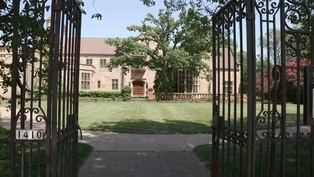
Angela Fitzgerald Tours the Paine Art Center and Gardens
Video has Closed Captions
Clip: S8 Ep12 | 2m 36s | Angela Fitzgerald tours the Paine Art Center and Gardens (2m 36s)
Video has Closed Captions
Clip: S8 Ep12 | 3m 43s | Performance poet uses empathy to build understanding. (3m 43s)
Providing Support for PBS.org
Learn Moreabout PBS online sponsorship













Support for PBS provided by:
Wisconsin Life is a local public television program presented by PBS Wisconsin
Funding for Wisconsin Life is provided by the Wooden Nickel Fund, Mary and Lowell Peterson, A.C.V. and Mary Elston Family, Leon Price & Lily Postel, Stanley J. Cottrill Fund, UW...