Two Main Street with David James
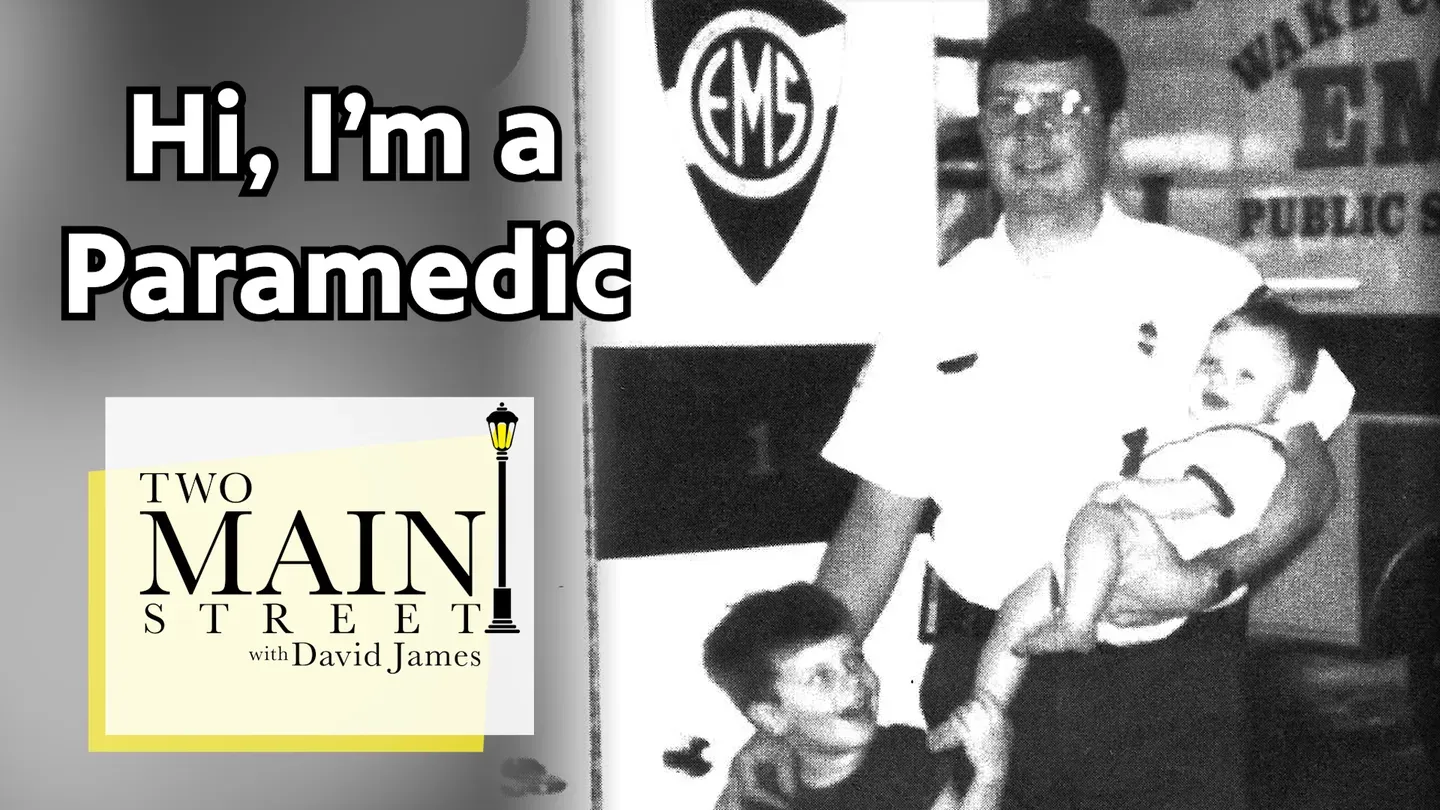
Two Main Street - Hi, I'm a Paramedic
Season 5 Episode 9 | 58m 9sVideo has Closed Captions
A conversation with retired paramedic Jeffrey Hammerstein and his new memoir.
A conversation with retired paramedic Jeffrey Hammerstein. He has a new book about his career in medicine and as a paramedic titled "Hi, I'm a Paramedic." The Evansville native spent 35 years working within the Wake County EMS System in Raleigh, North Carolina. In addition to serving as a paramedic on an ambulance, Jeffrey also worked as a field training officer, district chief, and EMS public inf
Problems playing video? | Closed Captioning Feedback
Problems playing video? | Closed Captioning Feedback
Two Main Street with David James is a local public television program presented by WNIN PBS
Two Main Street with David James
Two Main Street - Hi, I'm a Paramedic
Season 5 Episode 9 | 58m 9sVideo has Closed Captions
A conversation with retired paramedic Jeffrey Hammerstein. He has a new book about his career in medicine and as a paramedic titled "Hi, I'm a Paramedic." The Evansville native spent 35 years working within the Wake County EMS System in Raleigh, North Carolina. In addition to serving as a paramedic on an ambulance, Jeffrey also worked as a field training officer, district chief, and EMS public inf
Problems playing video? | Closed Captioning Feedback
Where to Watch Two Main Street with David James
Two Main Street with David James is available to stream on pbs.org and the PBS app.
Providing Support for PBS.org
Learn Moreabout PBS online sponsorshipFrom the WNIN Public Media Center in Downtown Evansville, I'm David James.
It's a high stress, adrenaline pumping job, not knowing when that ear piercing alarm will go off and then speeding in an ambulance to a strange destination where a patient or patients need immediate medical care.
It could be a call to a traffic accident, a mass shooting, or a heart attack.
So who are the first responders?
Who would want to do this?
How are they trained and what toll does it take on them and their families?
In this program, we'll meet a retired paramedic who rose through the ranks to become a supervisor and is now the author of a new book about growing up in Evansville with dreams of being either a rock star or a paramedic.
Like Johnny Gilroy on the iconic TV show ‘Emergency!’ Well, first, some background modern day emergency medicine is a relatively new field.
In fact, the paramedic profession of advanced pre-hospital care began in Pittsburgh in 1967.
‘The Freedom House Ambulance Service’ was the first emergency medical service staffed by trained paramedics.
By the way, all black men recruited from the Hill District of Pittsburgh.
Doctor Peter Safar is considered the father of paramedicine for his work on resuscitation techniques and the importance of rapid medical intervention.
Before paramedics, emergency medical care was usually provided by firefighters, police officers, and ambulance crews with limited training in advanced medical care.
Here to share his journey riding in ambulances and answering distress calls at all hours of the night is my guest, Jeffrey Hammerstein, author of ‘Hi, I'm a Paramedic: How a Timid Soul Found Purpose.
So Jeffrey, welcome to Two Main Street.
Thank you.
David.
It is just a pleasure to be here in my beloved hometown of Evansville and happy to be here and talk about it all.
Well, good to have you back.
And let's talk about the Freedom House Ambulance Service.
That's a unique story.
It's a very unique story.
So this is, as you said, Pittsburgh, mid-sixties.
Freedom House was actually a, a center for resources for people who were underserved in the community.
Needed some support here and there.
And there was a lot of trouble with the EMS response, as across the nation, different standards, not necessarily a lot of intervention, a lot of times just transportation to the hospital.
So different places started developing, ways to care, provide better care for people.
But freedom House was such a strong example of that.
The groups there, like, Peter Safer, as you referred to, realizing, hey, we can teach people to not just give a ride to the hospital, but for people who are really sick, teach them to do time critical interventions that will really make a difference in patient outcome.
And when it's all said and done in EMS, that's what we got to measure is patient outcome.
How do we make these folks better?
So they made a big investment in that, demonstrated that we could take these folks and teach them.
They don't have to be physicians to do these important things.
And they proved it left and right.
An interesting thing about that is a lot of that history was not well known until recent years.
And it outside of Pittsburgh anyway.
And one of the things that helped get that history known was a book called ‘American Sirens’, that really walks through Freedom House and explains how all of this happens because there was an underserved area.
Yes.
Pittsburgh.
Yes.
All right.
Now the book starts with your childhood and Evansville's and, then we go on to North Carolina, where you became an EMT at age 18.
Is that right?
That's right.
Now you write this was an unlikely career choice because of your many phobias.
Well, so and as much as anything, I was just a scared, easily frightened little kid.
I think one of the best ways to put that, our best example is, my father grew up on West Michigan Street, right where it intersects with, Streator a couple doors down.
And we would go there to when I was a young kid, we'd go there to visit my grandmother.
And if you approach from the South, I think it is.
It's a pretty steep hill going up, Schraeder.
And if you approach from the north, it's like driving up a wall.
And so every once in a while we would approach from that, that side.
And as we go up that hill, I would think we're not going to make it.
We're not going to make it.
And I would I would just start crying.
I don't know what I thought was going to happen, but but my interpretation is we're going to roll backwards.
We're going to go off a cliff, the car is going to burst in flames and we're not going to live through this.
And it turns out we made it right up the hill.
You’re a worst case scenario guy.
Straight to it.
Straight to it.
And that's what I needed, that reassurance, for everything.
And then it started to dawn on me at whatever subconscious level that I wanted to be, that reassurance for other people because I needed it myself so bad.
So what did your family think about your career choice?
Eventually.
Oh, behind it 100%.
But you know, my, my mother supported anything that I wanted to do and knew that as a small child, before I even knew what I was doing myself, I was watching emergency and intrigued by that.
And we grew up on Rother Wood, in Bellamy Pass by a half block up.
And so there was a pretty steady flow of ambulance traffic going from wherever they're coming from to Saint Mary's Hospital over there.
And I heard the sirens and I had to see it.
And it was it was dramatic.
So she did a lot to help point me towards that, including, she did, she was earning her masters as an adult at UE and, the library had some books that were getting rid of whatever it was.
And we found this EMT textbook, and, I just started reading that, like, a novel, and it's like, this is what I was going to do and really never looked back.
So what's been the reaction to the book so far?
I, I've been humbled.
You know, anybody that's done anything like this, this whole thing exists in your head and on your laptop, right?
For the most part.
And and you you have to move forward based on some sort of self-confidence that what you're saying makes sense.
And what you're saying is readable or what you're writing, I guess.
And that you have a message.
Now I had some help along the way, without a doubt.
My, when I first started writing, I'm from a family of writers.
My parents, brothers and sisters all do.
They have done all sorts of writing more in professional settings, in whatever their role was.
But, on those early chapters, my sister Julie read through and had some really encouraging things do this, do that, keep going down this pathway in.
You're in good shape.
My brother Kenny, when I had this humongous draft that needed to be so much shorter, he set and read the whole thing and had encouraging words right there.
Now granted, they’re biased, their family.
But I had some help, from a couple of other authors.
One, you've talked before Eric Jones, right up in Evansville.
So I connected with him, and he did an amazing amount of work to help me and encourage me.
And that was really beneficial.
But so you're talking about the reaction.
So still, even though these people are saying, yeah, you got something here and you have a certain level of confidence until you get it out and people start seeing it, you don't really know, right?
Did your wife push you to write this book?
But the reason I wrote this book is my wife, Leticia.
Leticia?
Yeah.
She, we actually, we visited my cousin Chris here in Evansville, in summer of 2020.
And we were driving back, and so I had a retirement date set back that was going to be the following spring.
And so, as anyone does, when you're going to retire, you start to reminisce and think about what you've done and seen.
And I was really joyfully thinking about the magic of early on in a career.
It's budding.
You're doing these exciting things.
And so as we drove, I just described in minute detail that very first call that I ever responded to and because I remember Crystal clear and she just started in, you need to write a book, you're going to write it, you write a book.
And and so I was like, well, okay.
And it felt a little cheesy to say, I'm writing a book at first.
So I just decided, alright, I'll write the story of that day like I'm writing a journal or something.
And then, I did that and say, well, okay, well, I'll write down what what would logically come next.
And then all of a sudden over four years.
Okay, so I'm writing a book.
Okay.
Let's go back to that first call that you remembered so well.
Okay.
So how old were you then?
Well, I was 18, and and I was ready to go.
And yet, even at 18, for most of my life, this is what I was going to do.
Now, when you're 18, most of your life is not that many years, but it goes back to like, 7 or 8 years old.
This is what I'm going to do.
And so it came down to it.
I was certified as an emergency medical technician, so I was qualified to be on an ambulance.
And when I first joined the Garner Saint Mary's Volunteer Rescue Squad, just to kind of rally.
Yeah, right outside of Raleigh.
It was time the the crew took me on as a volunteer and they said, come saddle with us, this first shift, and then we'll get you assigned to a shift at some point.
But you ride along as a third person observer and so I showed up that morning just so anxious because I think, you I might really actually respond to a 911 call.
I don't know if I can do this or not, because I know now it's real.
Yeah.
And I thought we probably wouldn't even run a call today.
It's a quiet morning.
I was not there 20 minutes before the buzzer started going off, rattling the entire building.
And I'm like, oh no, I'm in trouble.
And so the crew came and we got in the back of that ambulance and I buckled in and the lights started flashing.
I didn't know if I was going to make it or not.
I started feeling sick in my stomach.
I started thinking, I'm going to lose something here in a little bit.
And then we pull out and the siren starts blaring, and I just didn't know what I was going to do.
And I thought, I, I don't have any choice.
I'm stuck.
Right?
I can't get out, take a deep breath and get through it.
And I did calm myself down.
The really moving thing to me, though, we got to this house.
It was really a, what would be a routine call in the EMS.
There was an older gentleman that was having chest pains, and we got there and, John was the one in charge of taking care of the patient.
Susan was driving that day, and we walked in and brought all of our stuff in.
And the man was sitting there with some discomfort, and John sat down and started asking him, all these questions, as we do.
Where is your chest pain?
How long has it been happening?
What does it feel like?
Do you feel anywhere else?
And I was dumbfounded because I've been trained to ask all these questions.
But I was sitting here thinking I could never have come up with those questions right now.
I was in such a whirlwind that I was on an actual call.
This is not classroom.
This is a real person, and I was just blown away by his ability to calmly work through that, and that allowed me to process and start to think through, okay, you got to figure out how to actually do something and not just sit back and be terrified.
You have to assess the situation.
You have to assess it, and then figure out what you're going to do about it.
Well that's the, Glasgow Coma, right?
Oh, well, that's part of it.
Yeah.
That that assesses how alert and oriented a person is to what's going on.
So different illnesses or even head injuries of that type thing.
Yeah, it tells us a lot.
That's a lot with the verbal visual and motor.
Right, right, right.
And you and my wife is, is a paralegal, and she looks at medical records and, I told her I was talking to a paramedic and she said, well the Glasgow.
I know all about that.
You said you want to be a number 15.
You want to be a 15.
That's a perfect score.
And the funny thing about that particular score is even the deceased score three, on that.
So the low score is a three.
I never quite understood how you could score, but the range is 3 to 15, so, that's that.
I don't know what to tell you.
That is strange.
My guess is Jeffrey Hammerstein.
He's the author of his, Lou's latest book about.
Hi.
I'm a paramedic.
How a timid soul found purpose.
It's his, journey, riding in ambulances and answering all kinds of calls So, Jeffrey, what's the difference between an EMT and a paramedic?
Excellent question.
I think those terms are generally used, synonymously in public, but they're not.
There are two, distinct things.
So EMT, emergency medical technician, is a basic level of care.
So it's, patient assessment skills, vital signs, splinting, bandaging, that type of thing.
Listen to the breath sounds, all different things to to take basic care, emergency CPR, choking, and take care of people and in many cases transport them to the hospital.
What a paramedic does is it introduces an advanced, form of clinical intervention, so much longer training and education.
But that's where we start to bring in things like IVs and a multitude of medications and breathing tubes that go into the lungs in 12 lead EKGs, in a number of skills and, treatments that are a much higher level of care is pretty much the standard across most of the nation.
So what was obviously had a lot of training, EMT and paramedic was the toughest part of the training to become an EMT and then become a paramedic.
So with EMT training, I think that to me, the thing is, or what should make it tough is you got to know that it matters that you're learning and understanding the material.
Because the things that you're going to use, you're going to use where really matters quite a bit whether how, how well you did, how well you studied it.
When you go from EMT to paramedic, it, it gets academically much more, difficult as you would expect.
So you're not just, in and I don't I don't mean this demeaning to EMT is in the least.
It's less the process of doing the splinting in the bandaging and the CPR, etc.. But now with the paramedic, you're learning in depth, about cardiology, about pharmacology, about, respiratory issues, cellular function, all of these different, more in-depth clinical things in medical things, anatomy and physiology, and then learning to interpret things like a 12 lead EKG and, and, learning which medicine is appropriate for this condition because it matters whether you go this route or that route.
And what is the dose and what's the effect.
So that's that's where the challenges come.
And I think that's where those split second decisions in a lot of cases, they are in a lot of cases.
Now, the other kind of misnomer to the public, probably, is it's under 10% of the calls that we run, right?
Whether it's where it's at truly moment to moment, immediate life threatening situation.
A lot of them are much more routine, those in-depth, or those advanced skills that we use that we learn and we want to use them, we don't use those most of the time.
Most of the time it's more assessment and human interaction in, in just taking care of people as people, as we move and navigate to whatever it is that they needed the moment.
Okay, you've got your EMT certification and you want to become a paramedic.
What's the course level for that?
So it varies.
In on one end, there may be, a year long, technical school course, that you can take, you know, twice, twice a week at night, that type of thing.
That's not everybody by any means.
There are two year degrees.
There are four year degrees in EMS.
So it's depending on what route that person wants.
And that's, you know, that's a big issue.
As a profession, EMS wants that that higher level of education and training.
And part of the challenge of that is that we need so many people to fill these roles, like a lot of professions.
Again, that it's difficult to get enough people through college level courses to be able to have that standard as one thing.
So what becomes the real standard are the typically states, there's a national certification that some states recognize.
Matter of fact, that's the more common thing.
But that's the standard for how this person has been trained.
If they can go through this training to be certified here, then they're qualified to to perform on that ambulance.
It's those that, that maybe have other things in mind, maybe leadership within the EMS that may tend to go towards the higher four year degrees, but it's.
Yeah.
Oh, who are the instructors?
A lot of times they're retired paramedics or paramedics that were, that were on the road for a while and decided that they're not going to keep doing the ambulance thing and look for different, career choices.
There's a lot of physicians involved in that training as well.
So in some cases in our example, what I grew up in Raleigh was White County EMS.
So that's a third service.
There's all different types of ways EMS is delivered.
We're all kind of all over the place with that.
But in our case, it's a local government providing the third service in the third service refers to not the police department, not the fire department, but a third service that is EMS.
Okay.
So how were you notified you passed the course?
Well, like any school, you're going through college classes and you're either passing in by the time it comes to either graduate or not.
You, you know, whether you're going to work for the.
Is there a ceremony involved when I'm like, well, there's certainly the ceremony that you do any time you graduate something from, from any kind of school.
But yeah, I mean, you know, you got to celebrate.
I mean you get like a badge or something.
So you get your certification that qualifies you to work at this level in the field.
Yeah.
Then you got to get the job which is probably not too difficult if you're qualified because because we don't have enough.
So it's when you go to whatever agency.
So I went to Wake County EMS, interviewed, got hired, got issued uniforms, got issued a badge, you know, patches on the sleeves that have the agency in the certification.
And that's that's where that part comes from.
In with the badge.
Now, you write in there about green slacks or something like.
Yeah.
So in your book I do.
So, when we still lived here, some of my parents and siblings went on a fact finding mission to Raleigh to see and found some opportunities.
So they decided the family is going to move there.
My brother Kenny went with them.
My sister Carol and I stayed here.
We were still in our last couple of weeks at Bossy High School for for that year.
And so my mother called and said, yeah, you're going to move here at such and such time, whatever.
And then Kenny got on the phone because he knew the stuff I really wanted to know.
And he said, the ambulance is here are green.
I'm like, what do you mean they're green?
He said, well, the stripe they had, they have green stripes.
And we're used to the orange stripes here.
And they wear green pants.
And so that that became it turns out I got here and had got my own green pants and learned that that was kind of like that was a well known thing throughout Central North Carolina's the people in green pants or White County EMS.
And so, so okay, so, now you're in Evansville and, and your family got it.
Your dad got a job, in North Carolina, that's why the family moved.
But then you moved back to Evansville.
I did so, so I was 16 years old when I moved.
Okay.
And so at 16, I didn't get a choice.
It was to start with is just like, well, okay, this is what's happening to leave all your friends at high school, right?
And you're just coming of age and and getting out of bicycle distance.
Now you're getting into driving around distance in and you know, it's your hometown.
And so it's like, okay, we moved and I met people there.
But over the next couple of years I started to get pretty homesick.
And like, I want to go home.
I want to go home.
My brother Kenny stayed here because he was he decided not to move at the time.
And my brother Vince was here also, actually.
And so I had played in my brother Vince, his band.
He went to high school with Mark.
He was dating my sister Julie.
Some, but they put a band together.
I was the bothersome little brother.
I talked my parents into getting me a guitar, and then they taught me how to play it.
And then, I took them in to let me in.
The band.
It's a band called.
Well, so it went through a lot of different iterations, with different members and things.
By the time I was leaving, it was called Stop the Car.
Now stop the car.
Got a pretty notable regional following over the next.
So where do you play?
All around town.
But then by the time I came back, because I was determined I was coming back home.
I'm not staying here.
I'm coming back home to Evansville.
So I came back home, started playing the band.
We played the Ross a lot.
Oh, Russ theater.
Yeah.
So, escape from which mountain is a little kid at the Ross?
And then maybe a couple of dozen Rocky Horror Picture Show.
It was a little bit older.
Yeah, I remember those.
Yeah.
And then.
And then playing rock and roll guitar on the stage and in those later years, and that's what it was all about for a little bit.
But then you go back to North Carolina.
I went back because.
So maybe I just needed to.
Sow those rock and roll oats for, for a little bit.
I started thinking about being a paramedic is what I really was determined I was going to do.
I would have given anything to be a rock and roll star, but I didn't know if that was going to happen.
Where, as in North Carolina, I was certified.
I had connections to Garner Rescue Squad and Wake County EMS.
All I have to do is just walk into a lifelong career.
And so I made probably the most mature decision in my life to go pursue that.
And and then that's what I did.
But then more music came later, too.
So that was that was a lot of fun.
Okay, now let's go back to the, the ambulance runs.
Okay.
You say in those early days and as as an EMT, you learned that you don't make judgment calls because you come across people that, you know, drank too much, they drunken driving, or they've done some crazy things.
So it's easy to judge these people as well.
They probably deserved it.
But you don't do that.
Well, you can't, I well, we have to be honest, you know that that not for us to do.
And certainly there are those among us who are better at it perhaps, than those, than other, you know, under the circumstances, you know, right.
So when you're, I mean, when you're out there, people make a lot of bad decisions that put themselves in difficult circumstances.
And it's not for us to say, well, you shouldn't have been doing that in the first place because, you know, but for the grace of God, there you go.
I that kind of thing.
But you have to be focused on the task at hand.
I think it's when there's, when there's less critical medical situations going on that sometimes some among us get a little judgy or about, well, you don't need us.
You don't need the high and mighty me.
You need you should have done this, or you should have done that.
And what I learned a long time ago is we if you let yourself get in that headspace, not only you're not serving the people who call us well, you're not serving yourself well, because if you're caught up in deciding, ‘well this person doesn't deserve an ambulance’, ‘this person doesn't deserve a paramedic’; You're making yourself unhappy.
You're making yourself feel dreadful and people go to the hospital in an ambulance because they don't have or don't know of any other access to health care.
And we can say that's right or wrong, but that is a national health care issue.
The best way I know how to put it, nobody's ever going to solve that from the back of an ambulance saying, ‘well you shouldn't go here’ ‘you should have done this right now’ So a couple of terms here.
We talked about the Glasgow Coma score, something called Ocean Boy.
What's that?
Oh, well so, so we every time we're dispatched, we get what's called a ‘called nature’.
The nature of the problem.
And Ocean Boy is just a radio way of saying ob for obstetrical at home sitting, etc.
So it it is not an uncommon response at all to go to somebody who is in labor.
That needs to get to the hospital to have a baby.
Most of the time we will never have any interaction with delivery, but there are certainly times where we do participate in delivery, sometimes at home, sometimes on the way to the hospital.
Have you delivered?
I have, I have four times.
And it's funny because somebody may be in EMS for five years in the liver 12 times somebody may be in EMS for 35 years, and only it happens four times.
But it it's an amazing, amazing thing.
And I, I can't say I deliver the baby.
Mom delivered the baby.
Moms have been delivering babies for a long time.
I was there to help.
Right.
Right.
Have you had any follow up on these children?
I haven't, and so those go back far enough in time, where there's very little follow up.
So typically we take care of people, we do the thing, we get into the hospital, and then it just that's that's where it stops for us.
Now that in some of the cardiac arrest survival stories, we've gotten we've had a lot more interactions, more recently.
But that's where it stopped.
So mine were long enough ago.
I mean, someone would be approaching middle age by about now.
And so I just I haven't, unfortunately.
And now, obviously before, G.P.S., how were you able to quickly to find these addresses?
Well, you're introducing the word quickly.
You know, and that may, may not always be appropriate.
So, it was it was a trick a lot of times, we had these street indexes, and we had to have the right spelling of the word, whether it was a street or road or an avenue.
Oh, yeah.
All of that makes a difference.
The block number makes a difference.
Then you got to look it up in this book.
And then you got to hope you're finding it.
And and it was, it was a big trick sometimes.
And sometimes directions were sketchy, landmarks that look like all the rest of the landmarks along the way were sometimes, especially if you get out of the city.
Out of the city, yeah; it's go past the grove of trees around the pond, at this dirt road intersection.
And there's a there's a pickup truck in the driveway that's like, oh, okay.
That that ought to do it.
Now, in the book, you write about the patients who were already dead or dying when you arrived on the scene.
People can read about those horror stories in the book.
So let's talk about, some of the folks you were able to save your success stories, any that stick in your mind?
There's so many.
And again, a lot of those success ones, you don't necessarily know the, you know, it was a good outcome, but you don't necessarily hear back.
But there was there's one that sticks out that, I've always had a fear of choking, particularly as my kids were growing up.
It's like, oh, sure, that's a big bite.
We be careful to add up all of that.
As a responder, you're in a much more objective frame of mind.
You got to do what you got to do.
We went to a choking call one evening, and there was a 12 year old girl, and we walked through that door in her parent's house.
She's choking.
She's got a chicken bone in her throat and was like, oh, that doesn't sound good.
And she was standing in the kitchen, statue still with her mouth hanging open, just drooling down her cheeks, kind of bent forward and just looking forward.
And I took a light and I looked to the back of her mouth and I could see a so it looked like a femur of a Tyrannosaurus rex sticking up in the back for its roots.
And I thought, oh no, this is going to be tricky because it was really caught.
So I got up here was what's called McGill force.
It's this little grabby tool that has it's contoured to be able to reach around things.
It's about that long, and so I had somebody sign the like, and I reached back in there and I thought, I got to be right the first time I if I touch the back of her throat with the tip of these, that's going to trigger a gag reflex and she's going to be in trouble.
She was being so good.
She was just frozen that movement muscle.
And I grabbed onto that bone.
I thought, I have one chance to pull it out because if it slips off, it's going to absolutely trigger her gag reflex no matter what.
But if it slips off and gets away and I don't get it pulled out, she's in trouble.
Right?
And so I did there.
I didn't count down or anything because I didn't want to create any anticipation.
And I grabbed and I held tight, and I yanked that thing out, and she gagged, hacked, and coughed and cleared it up in 30 seconds.
She was like, ‘okay, I'm good.’ It's like you moms, you want us to get her evaluated at the hospital?
‘No.’ She's like, ‘I'm good.
I’m gonna finish supper.’ Oh my gosh.
And so we're like, ‘alright, have a great day.’ We'll catch you next time.
Could have gone south.
It could have been really bad.
So that was that was that was fulfilling the celebration.
Okay.
Now, we talked about your wife.
Leticia, how did you guys meet?
Well, we met twice without me knowing it.
Well, she was in the medical profession.
So she was a medical lab technician.
Okay, so she worked in the lab at Wake Medical Center.
And as I was going to paramedic school, I got a job in phlebotomy, which is drawing blood from all the patients.
And so, I would draw blood and we'd get, like, stick 60 patients through the course of the morning.
And come back with these big loads of tubes of blood.
But there was this one particular test.
So if you do that, you have to go back to this other lab called the Micro Lab and deliver it back there.
And I always wouldn't go back there because cutest girl in the world, I've ever seen that work back there in the lab.
I was way too shy to say anything to.
I'm not going to do that.
But I was like, maybe she'll turn around and look and I can see her.
And so I knew about her back there.
And then, I was with Garner Rescue Squad at the time.
Well, Clayton Rescue Squad, in the next county, called us one day and say, hey, can you send a crew to come cover as well?
We have a Christmas party.
Absolutely.
So me and my partner, Mike Jennings went down there and we were sitting in there eating with them, and the most beautiful girl in the world ever seen was sit and laugh and just die on the table.
So, maybe I should go talk to her.
I was like, no, I'm too shy to go.
So I'm just not going to do that.
Timid me.
Well, it turns out somebody at the lab at Wake said, you know, let's see-- You know, my friend Leticia, I'm like, I don't know who that is.
And she said, she said she saw you at a rescue party once.
And I started thinking about the Garner rescue parties that we had.
And I thought, I don't know if, I don't know if anybody who had seen me at a Garner rescue party should want to be talking to me, because they get a little out of control sometimes.
But but it turns out the the young woman at the Clayton rescue party and the young woman in the micro lab that I always wanted to go see was in fact the same person.
And that was that.
And here we are.
There we go.
And children, we have a we have a 34 year old son named Neal, who is a police officer and a 30 year old daughter named Shelby, who is, who works in the legal office and, in a grandson.
Our son, is married to Jessica and has our grandson, Wyatt.
And, I couldn't be happier.
Life is good, and life is good.
Good.
Okay, let's talk about some of the strangest ambulance runs you've ever made.
I mean, you can't make this stuff up, can you?
You really can't.
And people say that all the time.
There are things that you just have to let be funny.
Even if it's if if it's not so great circumstances for them.
We we were sent to a pedestrian, struck, one afternoon, and we went down.
There's an old gas station along this road where the pumps were still very close to the road.
And for this person to got hit by a car, a card ran off the road and run out near the gas pumps.
So we found we found the guy, and they said, here he is, right here.
So I went out and talk to him.
I said, sir, we were.
Is this you?
Were you okay?
Are you hurt?
And only thing he would say to me was my life.
My life, all my life.
That's all he would say to me.
My life, my life, my life.
And, I assessed and for all I was worth.
And he didn't seem anywhere.
And come to find out, he was never hit by the car.
It just it just frightened him.
And I'm.
I'm honestly not making fun of that.
I know, I get it.
It was in an, well, not an impactful, literally moment for him, but it was emotionally impactful for him.
And and so we ended up transporting him to the hospital to be evaluated.
And the whole way to the hospital, he just kept saying my life.
And I felt for him, and I hope we got him what he needed.
I hope so too.
There just bizarre things that you don't.
They don't teach that necessarily in paramedic school.
You're going to you're going to take care of people who almost got hit by a car or some.
Will you have mental health issues to do serious of those?
We do.
And in particular, even with this, I don't want to sound like I'm belittling that in any means, but, well, talk about public perception of what EMS is.
And, versus reality.
We respond to a lot of mental health issues and, I think pop culture in general, and by whatever means, people tend to equate a mental health crisis with violence and that it is overwhelmingly not the case.
We we go to mental health crises over and over and over again, very, very seldom is there any violence involved.
It's it's people who've got whatever complex set of circumstances they've got going on.
They don't know how to navigate it, or perhaps the family doesn't know how to navigate it.
They know they need help.
And so that's what we're here for is if you are in a fix and you don't know what to do next, and you feel that anxiety, that desperation, you can call us and we will come out and we will help you figure that out, whether it's an immediately life or death situation or not.
And it a privilege to be able to do that.
And so often law enforcement responds alongside with us.
I talking about backup.
Yeah.
Because sometimes under some circumstances, many of these situations may involve, overdosing on a medication or, or suicidal ideation as part of it doesn't mean it's happening.
But the potential is there.
And so we sometimes have law enforcement well, often have law enforcement with us.
You know, to help us work through that if there are risk factors.
But I'll tell you, over decades of responding to hundreds and hundreds of mental health crises, at least in my own, locale, all I've seen are police officers there that are this team of professionals helping advocate for whoever needs our help and get us to the right place.
And sometimes people get really concerned about law enforcement being there.
And I'm not saying there aren't issues.
Anybody can demonstrate a situation where maybe somebody felt triggered or whatever.
But it's just been nothing but professional interactions in my experience.
My guest is Evansville native Jeffrey Hammerstein, author of a new book about his career in emergency medicine.
It's called.
Hi, I'm a Paramedic.
How a timid soul found purpose.
It's it almost sounds like a children's book at first.
How, ‘Hi, I'm a paramedic’ And then you have that as that second line there.
How you found purpose.
Now, being a paramedic, of course.
I guess there's some burnout in the profession.
Were you ever close to burning out?
Oh, sure.
It's.
I mean, anything that anybody's in for any length of time, you can you can certainly get to that.
And, so there's monotony in any job.
There's, it seems like we're doing this flashy, super duper movie worthy stuff all the time, and that's that's just not the reality.
And people need to understand that coming into EMS, the bulk of the time is a much more routine, honestly mundane from a, from a technically challenged point of view.
And it's just over and over and over again.
But then you add to that difficult shift work, which brings in the just utter exhaustion that you didn't know was possible until you're just working these shifts and working these shifts and, and doing this stuff with no sleep, this very physically demanding stuff with no sleep.
And then add to that that even though it's not most of the time, you're still regularly exposed to extremely difficult situations that people are going through.
You know, the word tragedy is easy that comes to mind.
That's part of it.
And, and working through that and knowing that the steps that you're taking matter, they're very important.
You kind of got to do this right.
But what I found was as heavy as that was, just seeing the the situations and conditions that people live in.
You know, I grew up protected, in a warm, loving, supportive home that was physically intact too.
One of six children.
One of six children.
So it was crowded, but it was intact.
But then to be walking in at 3:00 in the morning to a really sick little kid, that doesn't have medicine, doesn't have food.
The-- you know, we're trying to step carefully because the hallway floor is on the verge of collapsing through to the crawl space.
There's rain leaking in.
There's, whether it's roaches or rodents running around in and just people living in these situations that you just don't realize that everywhere around you it exists.
And that gets difficult, that that carries a weight.
Did you take that home with you after, on some of these runs?
In a lot of ways, you can't help it; I came to realize people say, well, that's the real world that, you know, the the tragedy, the tough life.
That's the real world.
And I really started pondering that through the arc of my career.
Is that the real world?
Well, I have the privilege of going home to my wife and my kids where we are safe and secure, and I have enough to eat, and I can pay my bills and I can heat my home.
It is that not the real world.
So it's kind of like, well, which is it?
And I realized that I was toggling back and forth.
When I get dressed, kiss my kids and wife goodbye and get in the car and head to EMS, I'm flipping a switch.
That's not real anymore.
I got to be in this frame of mind and see these things and that that carries on you too, over time.
Okay, let's get a few scenarios here for you.
Okay.
Let's say you get a call where a farmer has plowed over a nest of hornets.
He's been stung numerous times, has trouble breathing.
So what do you do when you arrive?
Well, so Has that happened?
I've certainly been to the multiple stings.
I don't know if it was a farmer.
But, you can also equate it to, multiple dog bites or whatever.
The thing is, and it seems like kind of what you're bringing in is there can be a risk to you too.
So one of the things that is really taught in, in the last 15 or 20 years, or give or take however long, that wasn't taught when I was first coming up, is that responder safety has to be first.
Okay.
The reason that has to be first is because it.
Well, you can argue a couple different ways, but I can't do anybody any good if I'm getting hurt or killed myself.
That doesn't help anything.
So when you say that about being stung by a bunch of bees, the first thing I got to think of are we walking into a situation where we're all just going to get stung?
Also, because it is brutal as this sounds, we can't go ourselves and get all stung up into anaphylactic shock.
And pull him out if that's a risk to us, too.
And a lot of cases, the fire departments are responding along with us, and I could see a scenario where they may be suited up and turnout gear and essentially quickly impervious, to the bee stings and maybe pull them out.
They're pulling them out of burning buildings cause they're pulling them out of, entrapment in cars for us.
They're pulling them out of flooding rivers for us.
In this, too.
And then we're taking over, patient care from there.
So with that in particular, the first thing that we're looking for is an anaphylactic allergic reaction.
Not everybody is allergic in that way.
And it won't necessarily happen.
But if it does, that can be a dire emergency that we got to treat, immediately.
Okay.
A teenage girl suddenly collapses during cheerleading practice at school.
She's unresponsive with a history of diabetes.
So the very first thing's always regardless of what's wrong, are they breathing?
Do they have a pulse?
And in this case, she would.
So once we have that out of the way, then we would go to try to figure out did see was he injured?
Is that was she unresponsive because she fell and hit her head.
Does anybody know anything about her?
Are there any other indications for what would be going on?
But part of that, automatic response would be evaluating blood sugar, because that can be a hidden problem in any reason somebody is not as conscious as they were before.
Their glasscow coma score is lower than 15.
So checking a blood sugar is part of that, automatic response.
And if that's what the problem is, we can usually get that turned around in a matter of minutes.
And one more here.
A shooting victim outside a bar, a man bleeding from a wound to his abdomen.
There was a crowd gathering around him, and this could go from bad to worse.
So in my first years, we would have been heroic and we would have rushed in and grabbed him up and started treating him and getting him out of there and take him to the hospital.
That's not how we do anymore.
And nor should we.
Now, let me also add protocols are very different for different systems across the nation.
But in my system, we would not have approached that scene.
Law enforcement would be sent in first.
We wouldn't even be visible.
We would, we would stage out of view, okay.
So they could go in and make sure nobody's shooting and killing right now.
Right.
Make sure that the scene is quote unquote safe.
Sure.
Now, safe is relative.
It just means nobody's shooting and killing right now.
Then they call us immediately and we go straight in, grab them up and start doing our thing with them.
But just like we said before, we do no one any good if we show up in our in the middle of gunfire.
Now we're part of-- and not just not a solution.
We're now part of the problem because we're increasing patient count ourselves.
Now, how long have you been in the emergency medical field?
1985.
I ran my first call in 1985.
Now advancements, You talked about CPAP in the book?
Yes.
Lots of advancements.
CPAP [Continuous Positive Airway Pressure] Most commonly known as the “marriage saving device” For snoring, right.
That people fit across their face, and run a little to to the side table to reduce snoring.
And I'm not too proud to say, that I have, helped maintain my own by being a CPAP customer.
A happy CPAP customer for the last however many years.
Whatever.
So it's continuous positive airway pressure.
That is a back pressure to the airways that keeps them in inflated, essentially, so you can breathe in and out, whereas if you don't have it, they just kind of collapse.
So the much more powerful thing in a clinical setting for an EMS response.
So there's there's a situation called heart failure.
Essentially what's happening is, the heart's not beating strong enough that it the whole system is a plumbing system.
So blood is backing up in the vessels, in the lungs, there are little air sacs called alveoli.
The blood pumps pass those.
We take in oxygen and send it to the blood.
The blood gets rid of waste, and we breathe that out as carbon dioxide and heart failure that can back up, increase the pressure and push fluid from the bloodstream into those little air sacs.
And they take up space, lessen the the space for gas exchange.
You're literally drowning in your own fluid.
So all we had for these folks before, from an EMS perspective is we get there, try medicines.
It didn't work for a little bit.
And these folks, by the time they call us, they are worn out.
They've been fighting to breathe for the last long time, and they can't do it much more this when they call.
So what we have for them is to put a tube into their lungs and push back on that, which they get a little bit better, they maintain.
But they're there now.
They're going to be in the ICU for days trying to wean them off that tube.
Then comes this new technology for us: CPAP.
It's a big mask, much more forceful air, 100% oxygen.
It goes in and it doesn't just open open airways.
It pushes back.
It offers a push back on that pressure inside the bloodstream.
That's letting those alveoli filled with fluid pushes back and pushes that fluid back out of it in 100% oxygen.
And now we're doing gas exchange like we should.
And so these people are going is like, I'm going to have to put a tube in his lungs and he's not going to really get any better.
There was one night we had just gotten it.
So it's like, well, let's see if this newfangled thing, works.
And so we do it and we put it on in just a few minutes.
He was perking up and it was blowing my mind.
I said, ‘are you feeling any better?’ he said, ‘yeah, yeah, I'm a lot better.’ I was just dumbfounded that this guy that would have been on the tube and squeezing the bag in there, to ventilate for him.
And now he's saying, yeah, I'm way better.
And it was, it was is my EMS miracle number three of all of them.
And it's just amazing.
So we're happy to see advances like that.
What are the other two?
Well, the first one was the first time I ever saw, a medication called D50 [Dextrose 50] So you mentioned, low blood sugar hypoglycemia, diabetic patients.
So we respond to when they get when they get gone, their bloodstream gets really low.
They are completely unresponsive.
I mean, it's dangerous.
It's really dangerous.
You can yell, scream, jump, throw them across the room.
They don't wake up.
You put an IV in their arm, give them an amp of D50, we call it.
And in a minute, 90 seconds, they're waking up like, ‘oh, what are you all doing here?’ And so the first time I saw that, I was the I was only a few weeks in absolute miracle.
The second miracle you spoke on also, before, which is trying to find addresses.
And eventually we had a system upgrade where when it's dispatched, it automatically included the page number in grid of the map to show you exactly where this house is.
So instead of 3:00 in the morning with 32 minutes of sleep through sleepy eyes and not enough light trying to look up the right street spelling, and whether it's the street or road or avenue and the block number, now it's just say, well, it's right here on this page.
Look right there.
So that was a miracle and I appreciate it to this day.
So what do you see for the future of emergency care.
The the biggest thing to me in, in the continuum of these advancements are the, the push towards and the path down evidence based medicine.
So we get new equipment, the CPAP, the 12 Lead EKG, the GPS, the new process.
But what has really taken on is the research into all the different things we're doing.
We so we give this medication called atropine.
Well, why do we do that?
Well, that's because what we've always done and somebody else did it here and maybe we probably should do it theoretically.
That's a good idea.
Well, maybe that's not good enough.
Let's find out whether it works.
So in that in this just one little bit example, there's hundreds of really evaluating, ‘what are we doing?’ ‘how does it work?’ ‘does it make a difference?’ ‘what's the risk benefit?’ ‘should we keep doing this?’ ‘should we look for something else?’ ‘should we do it more?’ ‘what's the right dose?’ So evidence based medicine is really taking a stronghold, as it should.
And and that's where I see a lot of thrust.
That and figuring out how to navigate patients for the right reasons to to the right places, for the right reasons.
So we spoke earlier of everybody that we respond to, doesn't need a paramedic ambulance ride to the hospital.
We make it they call 911 because they need help.
They didn't know what to do.
Well, you don't need an emergency department.
What you need is this type of service here.
So instead of using this ambulance, take you here to sit for 17 hours before we get you over there, let's see if we can skip that, put the ambulance back into service and get other resources to get you to a better fit over here.
Those two types of things I think are where the future goes.
What advice do you have to someone who's thinking about a career in emergency medicine?
I wouldn't trade it for the world number one.
But number two, you have to be realistic about the brochures and the TV and pop culture representation of emergency services, because it's not, you're not a superhero flying, saving lives every time you turn around the glitzy stuff, it happens, the dramatic stuff happens.
But most of the time you're doing a much less, acute level of care.
What you have to do is find reward and fulfillment out of helping the person who is struggling in this situation.
You respond to people you may not be able to.
They don't need an IV or a medication, but what they do need while you're getting them somewhere is maybe somebody to act like they matter, or one way or another.
And it may be the first time that week anybody ever did so this 30 minutes with you, I'm going to treat you like you matter.
Not only is that way better for you, that's better for me, because I'm not getting all caught up in what this person doesn't need an ambulance.
I'm spending time with somebody with the privilege of being the one that responded when this person called for help.
And there's a lot of value to that.
That's why you found purpose.
Found purpose?
Yeah.
Now, as a public information officer, you were spreading the word about the paramedics in and, the their important role in the community.
And, people get it.
The people we reached do, there are, as you know as well as anybody, there are more people out there than you reach.
I think people have very little-- And I don't mean this in a demeaning way at all.
People have very little understanding of what EMS actually is.
We have the pop culture picture and hurry up and get here.
And that's probably about where it ends.
So my objective in all the media interactions I had was to make people understand how we work, what we do, how we try to mitigate certain issues in and treat things so that you have a better understanding of who we are.
We belong to you.
We belong to the community.
But you should understand who we are and how we work.
And the people we can reach are sometimes blown away.
‘You guys can do that?’ ‘You do all of that?’ It's like, yeah, and we want you to understand because we're spending your tax dollars in a lot of cases to do this.
Well, I want to end the conversation, Jeffrey, with a retirement letter you received from Rene in the EMS department.
You include this in the book and in the book.
You also mentioned the racial bias in the Raleigh area when you first started of these ambulance runs, and you said you were determined to try and change the status quo.
Now, in the letter, Rene writes about her initial anxiety being the only black woman in the workplace, especially having to change her hairstyle and how white police officers would view her.
But, she writes, you “made her and others feel safe” and they “trusted you” And she closes by saying, “if I can be half the person to someone else that you were to us, when I retire, I will feel accomplished.
Thank you for your service, your life of service.
Hammer time.” So drop the mic on that one, right?
So, uh-- ah-- humbling is doesn't quite catch it.
I couldn't be more proud of that.
So I think an important thing to say is, yes, I experienced that when I first got into EMS, locally in Raleigh.
We also know that was culture around the nation, around the world, for that matter.
That kind of bias.
Emergency services in a lot of places tend to be a white male thing that's changed dramatically since, but there were a couple of individuals that were that could be kind of egregious with that.
And I thought, ‘I just don't think that this is who we should be’ I was too new to say who we are because it wasn't my place to say it, but I thought this this doesn't feel right to me.
These individuals are overwhelmingly good, helpful servants, all over the place.
But it really bothered me a lot.
And I decided if I ever got there, that I was going to do what I could, and I was I was incredibly privileged to get to a leadership role many years later, where we could do things to not only help make sure that we were drawing in people from all walks of life to come be part of us and help us take care of people because our community is people from all walks of life, and we all deserve that representation.
And not only that, but then to be able to help design and build and perpetuate programs, where we could go out to the community and connect, for example, we brought, dinner to a black church in Raleigh and served dinner and then sat down and have a conversation and just said, what have your experiences been?
And ‘do you trust us to take care of you and your loved ones in an emergency?’ Just launched the whole conversation with that.
We had night-- we had to set it down at 90 minutes because everybody had to go home and go to bed.
But some of the most fulfilling and inspiring conversations and revealing and honest conversations that we had, and it just outside of the clinical stuff, is one of the most meaningful things, for me to be able to do it at Wake County EMS.
That was March.
That night was March of 2020.
We had several more lined up, and then they all got canceled because of Covid.
And that is that is my unclosed loop, in EMS.
But we got to take the wins that we get here, and hope we go from there.
Well you changed, Renee's life, and she has purpose, I'm sure now, in EMS.
My guest has been Jeffrey Hammerstein, retired paramedic, a native of Evansville, author of: ‘Hi, I'm a paramedic: How a Timid Soul Found Purpose’ Jeffrey, thanks a lot.
It's a great read.
Congratulations on the book.
Thank you very much, I appreciate it.
It's been an absolute pleasure talking to you, David.
Well thank you.
I'm David James, this is Two Main Street.
 New Episode
- News and Public Affairs

Top journalists deliver compelling original analysis of the hour's headlines.
 New Episode
- News and Public Affairs

Today's top journalists discuss Washington's current political events and public affairs.
 New Episode
 New Episode
 New Episode
 New Episode
 New Episode
 New Episode

 New Episode
Support for PBS provided by:
Two Main Street with David James is a local public television program presented by WNIN PBS