Two Main Street with David James
Two Main Street - Indiana Donor Network
Season 5 Episode 2 | 50m 12sVideo has Closed Captions
This week David talks with two families. A receiving family and a donor family.
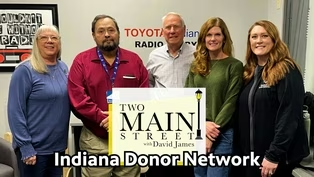
Last year there were a record number of organ donations in Indiana. This week David talks with two families. A receiving family and a donor family. A Gibson county man who received a new liver and kidney. And a mother and daughter whose loved one became a donor after a tragic accident.
Problems playing video? | Closed Captioning Feedback
Problems playing video? | Closed Captioning Feedback
Two Main Street with David James is a local public television program presented by WNIN PBS
Two Main Street with David James
Two Main Street - Indiana Donor Network
Season 5 Episode 2 | 50m 12sVideo has Closed Captions
Last year there were a record number of organ donations in Indiana. This week David talks with two families. A receiving family and a donor family. A Gibson county man who received a new liver and kidney. And a mother and daughter whose loved one became a donor after a tragic accident.
Problems playing video? | Closed Captioning Feedback
How to Watch Two Main Street with David James
Two Main Street with David James is available to stream on pbs.org and the free PBS App, available on iPhone, Apple TV, Android TV, Android smartphones, Amazon Fire TV, Amazon Fire Tablet, Roku, Samsung Smart TV, and Vizio.
Providing Support for PBS.org
Learn Moreabout PBS online sponsorshipFrom the WNIN Tri-State Public Media Center in Downtown Evansville.
I'm David James and this is Two Main Street.
Right now, more than 1000 Hoosiers are waiting for an organ transplant.
Another 1000 Kentucky residents are on the list.
And that number jumps to 4000 in Illinois.
Many of these patients are holding out hope for a second chance at life.
Every eight minutes, someone else is added to the growing list.
And unfortunately, every day, 16 people die awaiting a transplant.
The good news is that organ donations are on the rise in 2024, the Indiana Donor Network reported a record number of donations, a 22% increase over the previous year.
1388 donated organs, saving more than 1200 lives.
Now, each donation, of course, involves a personal story.
One family's loss becomes another family's miracle.
From heartbreak to healing, it's sharing the gift of life.
My guests are here to share their personal stories as we learn more about the donor process and how you can get on board.
Tiffany Scamihorn is the widow of a Deaconess Hospital donor.
Trevor Scammell horn and her daughter Shelby Reed, a family liaison for the Indiana Donor Network and later Gary Schmidt of Princeton, will join us.
He's the recipient of a donated liver and kidney who underwent successful transplant surgery in October of 2024.
So let's start with this mother daughter duo.
Welcome to Two Main Street, ladies.
Shelby, tell me about your dad, Trevor.
Yeah, well, I want to say thank you for having us and any.
I was telling my mom any day that we get to to be together and talk about dad is a good day.
So we're very thankful to be here with you, and share his story and our story as it is continuing on.
My dad, Trevor, was a very special person.
He was 50 years young when he tragically passed.
And we get to continue to honor him in, in very special ways.
One of those being that he was able to give the gift of life through organ donation.
But, yeah, I kind of lots of things to talk about, dad, as far as who he was as a person and kind of his story.
But let's go talk to mama.
Yeah.
How long?
Oh, you guys married?
Oh my gosh.
Well, we met in high school, so we were high school sweethearts.
Started dating when we were 18.
Got married at 22 and were married 28 years.
Now you will from, Vigo County.
Yeah.
Both from Vigo County.
We went to the same high school, and it was pretty big class of 1989, and didn't even know each other until the week before we graduated.
It was that big.
And then we met in high school.
Met in high school right at the end of high school.
And kind of our sweet little love story and, you know, got married and had our careers and three wonderful children and.
Yeah.
So, no, I was very much involved in 4H.
Is that right?
Yes.
Yes.
And I think they honored him with a scholarship.
Is that right?
Yes.
Yep.
You did.
That was one of our proud things we did for Trevor.
In his honor is created a 4H Foundation scholarship all through the 4H Foundation.
And then each year we're able to give, Well, as of now, 14 scholarships in the last three years to 4H seniors in Vigo County.
We've had a little bit of extra money to kind of spread that scholarship out a little bit, so that's pretty proud.
I'm sure that was really good to do that.
Definitely.
Now, Trevor was only 50 years old when he died in 2021.
This, of course, was unexpected.
What happened?
You want to take that, Shelby?
Yeah.
We can both kind of talk about it.
Mom was there with him.
Okay.
So we'll start with their story.
And and when our journey began and then we'll kind of.
Yeah, I guess when I, we've gotten to talk about our story a couple of times now at the Evansville Tree Lighting and then again at the Gift of Life celebration.
But yeah, our story kind of began on July 30th of 2021.
We were on vacation and just, unexpected kind of freak accident.
And he suffered a traumatic brain injury and was lifeline to deaconess under that lake.
Barclay, you said.
Yeah.
We were at Lake Barclay vacationing at a resort there, and, Yeah.
Can you tell me what happened?
It was we'd spent the day on the lake and having a great time just being together with seven other couples, and the ladies decided they'd had enough and were ready to kind of call it an evening, and the guys weren't quite done, and they wanted to go hang out some more, like, all right, go ahead.
And they're you're on golf carts, gas powered golf carts to get around here and there.
And, just kind of one of those freak accidents where he was on the back and, fell off and hit his head just in the worst possible way.
That is so ironic.
A friend of mine died the same way.
Yeah, he was on the back of a golf cart.
Yeah, and they hit up some kind of something or rock or something, or a divot or something like that.
Threw him off the back and he hit his head, and that was it.
Yeah.
And then you said, But he was still alive when they, life flighted him to Evansville Deaconess Hospital.
Midtown.
Yep.
On July 30th.
Okay.
Evening.
And, of course.
And that's when you had to make a difficult decision.
I guess they said he they couldn't save his life.
Well, we fought for 17 days.
Oh, really?
We were in the ICU for 17 days, and the doctors were wonderful.
The support staff, the nurses were phenomenal.
They became our little angels at night, helping us.
Well, I felt like I was helping because I was in the room every night, every day.
And I thought I could help it.
Yeah.
So what I know that was of course, that was a obviously a very difficult time.
Yeah.
How did they approach you about the donor process?
Yeah, it was probably about it was about 17 days in and he had, herniated and knew that it was probably, you know, we were at the point where he wasn't going to make it, and we were just kind of facing that reality.
And then Indiana donor net work came in and like, all right, how about organ donation?
And immediately our kind of tragedy turned to, you know, a little spark in my eyes, like, hey, you know, maybe Trevor can be a hero now.
And he was.
He was able to donate.
Heart.
Liver, lungs, both.
Kidneys.
Tissue.
Yeah.
Wow.
Yeah.
So you had some time to think about this while you were at Deaconess.
While you're waiting those 17 days.
So for 17 days, you're really.
We were just hoping for that miracle.
Oh, really?
Oh, yeah.
The doctors and nurses.
Everyone's main focus is just trying to save his life.
And we were just all in it together and hopeful.
Unfortunately, there was one day kind of where that 17 day mark kind of hit where, there was no, no more hope based on his, scans and just the progression of, how he's kind of how he clinically declined.
So at that point was kind of we never really thought about it or talked about it because we were still trying to get dad to go home with us.
We were still fighting for him.
But, you know, kind of when that that switch happened, having the face of Indiana Donor Network come into the room and just start being there.
And just as a support person and giving us an opportunity to, have something maybe good come.
It was a quick decision.
And for both of us, for mom especially, and then just for the whole family to say, yes, of course, just to leave that lasting legacy.
And so that experience led you to become liaison with the network, right?
Yes, yes, yes.
It was it was a very tough time as a family and still is.
You know, every day is a struggle.
It also inspired us in all different ways to kind of honor him and kind of find ways to keep going.
And my big thing was, I was so touched by the way that we were supported through Indiana Donor Network and in those really, really fresh moments of, grief and knowing that we were we weren't going to get to take our person home.
I felt like, you know what?
Is there some way that I could help another family going through this same thing one day?
And that kind of began my journey of pursuing, and trying to work and be involved with Indiana Donor Network.
Now, was there, Hero Walk or something like that when they.
Tell me about that.
Yeah.
So we've been supported with by Indiana Donor Network for a lot of this whole last few years.
But during those first few days, one of the first things that they did was organize an honor walk, for dad.
And it was just a really beautiful way where the hospital, lined the halls.
And then our family, could follow dad as he went down his journey and went towards his path of being an organ donor.
You know, 17 days you get to know a lot of the hospital staff.
And they, you know, whether it was just conversation and just true support from those doctors and nurses.
So being able to see them line the halls in honor of him and knowing they did everything they could, but now he's going to get to continue to live on just in a different way than what everyone had originally hoped.
Was really, truly special.
So that was one of those first things that we got to see how Indiana Donor Network would help us honor dad.
And of course, it's very time sensitive when the when they start retrieving these organs, they have to get the heart and lungs and kidney what is ours, right?
It just depends.
But, yeah, you know, the our support person would keep us updated throughout the process.
Kind of just keep us updated as far as when recipients were found.
I know those numbers that you said at the beginning, there's so many people that are sick and waiting for these gifts.
So it is a-- it is need to move quickly because some of these recipients, they're very sick and you have a limited amount of time to get these organs because they deteriorate.
Yeah.
Yeah.
So, you know, once they were able to find recipients for all of his gifts, it was a pretty quick process as far as them keeping us updated.
Okay.
His surgery was complete.
He was able to save this many lives with this many gifts.
And, you know, at that point, we were home and just really trying to process.
So getting those little bits of information and updates that.
Okay, dad was able to do this and save this person's life really kind of helped us those first few days.
Have you heard any follow up on these recipients?
Yeah.
Well, tell me about that.
Well, I first heard back in September of 21, and we get a little update from Indiana Donor Network as far as which organs were matches.
And so heart we knew like an approximate age.
And if it was a male or female and we knew each kidney went to two different recipients.
Bilateral lung went to one, and then a liver and then tissue was something we would know about later.
And then we got another update, I think maybe a year after that.
And then I am in contact with the heart recipient.
So I've, I know who he is.
And we text back and forth now.
Well, how old is this person?
He got Trevor's heart.
He had just turned, I believe, 70, in July of 21 and got Trevor's heart in August of 21.
And now this year, it'll be four years.
Well, that's a special guess, isn't it?
Yeah, it's pretty special.
Especially when my grandson was born.
I was excited to kind of send him pictures of.
And his name is Augie Trevor.
So he's another little piece of Trevor that we have here.
So when did you decide to become a family liaison?
How long have been working with the network?
Yeah, it'll be two years this spring that I've been working with Indiana Donor Network.
And it was a pretty quick decision.
I think when you go through something so traumatic, as a family, and you experienced something like that, you kind of your perspective starts to change.
What can I do to make a difference?
If you have any social work background, I do not.
I was actually in hospitality, so not really much medical background at all.
It was, you know, how to talk to people.
There you go.
It was truly just a passion.
Just truly, that experience shaped me.
And I thought, there's got to be a way.
There's got to be a way that I can.
I can help people through the same thing that we went through.
And just be that.
Be that person.
So yeah, pretty quickly afterwards, I started pursuing and trying to get in contact and apply for Indiana Donor Network.
And I've had just the most amazing experience and support with leadership and just the organization as a whole, not only backing me as a donor family and continuing to allow me to honor my dad, in very special ways with my family.
But now I get to work with other donor families, and help them honor their loved one the same way.
Well, the statistics are incredible.
More than 100 organ transplants are performed in the U.S.
every day.
And what's the average wait for a transplant?
Do you know that the average wait.
Yeah.
I do not know that answer.
I would have to get our sheet to look at that.
But, I know that there's so, so many people waiting, and unfortunately, we are losing.
I know you had said that at the beginning.
I think it's even 17 individuals now that we lose waiting for a gift.
So we know that the need is so, so great.
I have a personal.
My neighbor was needing a new liver.
He was placed on a waiting list and received a transplant just four months later.
So that's probably an anomaly to get one that quickly.
Now, the process, he says, was speeded up because he agreed to accept a liver with hepatitis C, which he which he said could be later cleared up with medication.
And it's been six years since his transplant, and of course, that liver did not have hepatitis C, so he lucked out there and it's been six years since his transplant.
Successful transplant.
My guests again are Shelby Reed and Tiffany Scamihorn, sharing their personal story about the death of Trevor and the decision to donate his organs to save lives again.
How many organs?
And what did you say is.
All right.
Heart, lungs, both kidneys, liver.
And how many people did that?
Well he saved 5 lives.
And, you know, enhance and touch even more lives with this tissue donation.
What a legacy.
What a legacy.
Now, later we're going to share information about, being an organ donor and, answer some of those, frequently asked questions.
And next, my conversation with organ transplant recipient Gary Schmidt of Gibson County.
He's alive and well with a donated liver and kidney.
We're going to hear his story next.
I'm David James.
This is two Main Street.
We'll be right back.
Welcome back to Two Main Street.
I'm David James, and we've been talking to the wife and daughter of an organ donor who in death gave the gift of life and later returned to my conversation with Shelby Reed and Tiffany's Scamihorn.
But now let's hear from a donor recipient and his wife and the wife, of course, playing an important role of caregiver after the transplant surgery.
Gary Schmitt is here from Gibson County with his wife, Tara.
So welcome guys.
So good to have you here to share the story of the Indiana Donor Network.
So, Gary, what do what organs do you have now?
New organs.
I have a new liver and kidney.
Both.
How are things going?
Very well.
It's unbelievable.
When was your surgery?
It's, October 5th and 6th, I believe of 2023.
They did the liver the first day, and then they didn't totally staple everything up or sew it shut.
They left it kind of a with a girdle for 24 hours.
Then you went back to surgery to open it up to make sure the liver was functioning.
And then they closed it up with 56 stainless steel staples.
And then over on the left side, they cut a little slit and made a pocket, cut it into the plumbing that was there and left my original kidneys intact and put a new kidney.
Between the original kidneys and the bladder over on the side.
They just plumbed everything in and hooked up the arteries.
And it's a miracle to me.
I don't know how they do it, but they're really good at what they do.
Plumbers, aren't they?
They're very good plumbers.
Okay.
So usually it's the spouse who sounds the alarm.
So what?
We're Gary.’s symptoms, Tara?
When it first started quite a few years ago, he was just kind of lethargic.
Every year it seemed like it got a little worse.
Every year we went to see a new doctor.
And finally, a few years later, they decided to send him up to IU because he needed to see someone in IU.
And they told us that he had a bad liver and so we would have to wait for a new liver.
Well, by the time everything was done four years later, he not only got a new liver, he got a new kidney.
So you were on the waiting list for how long?
Two years and nine months, I believe.
It actually started with the blood test in 2009.
It showed elevated liver enzymes.
And my doctor, Michael Clarke in Princeton, referred me to a gastroenterologist and Deaconess, in Evansville.
And he did some more testing and some cat scans.
Found out my liver was enlarged and had some scarring tissue and that kind of stuff.
So we had an annual appointment for several years, and it got worse.
And he decided we need to do a biopsy.
So they stuck a needle in it, a biopsy, and sent it to the pathology lab.
And then they said it had progressed from Nash into full blown cirrhosis, and we were already in stage four.
Well, that's the last stage before he it either which completely or turns into cancer.
Either way we were we were on the tail end.
So I was stuck with, basically a terminal illness.
And so then I got referred to an IU, transplant team.
Now, my, my neighbor, I mentioned that in the earlier segment, he had a liver transplant.
His, early symptoms were retaining body fluids in his ankles, legs and abdomen, a jaundice and lower energy.
Any of those?
All of that!
All of the above.
Really?
When an organ--.
Those are classics.
When an organ starts to fail it, it works everything over time and creates a lot of fluid which builds up in your lower legs and all your tissues swell.
Your-- my legs swell to the size of oak trees.
My goodness.
And you also get what's called a side is it's pockets of fluid that build up in your abdomen.
And they can actually stick a needle in there and hook it to a vacuum bottle and pull off several quarts, several liters of fluid.
Okay.
And for the, for the leg, when it's in the tissues, you take a lot of diuretics like you've heard Lasix late stage and torsion and those kind of things.
And I could lose them.
Yeah.
I could lose about ten, 15 pounds in a week when I got really swollen.
Just from that.
Now, when you were on the waiting list, you didn't know when you're going to get a call, did you?
Were your bags packed, ready to go?
Of course!
You had to pack a bag a go bag and be ready because when you get the call, you've got to be at the hospital as soon as possible.
You've only got a matter of hours.
And they give you plenty of notice before they leave to actually go procure the organs.
Okay?
You're already up there doing tests because you go through 27 vials of blood, swab for Covid and a bunch of other things to make sure that you're physically fit to get it on the list.
Even we go through an entire regiment to check your frailty.
You got to jump up out of a chair without using your hands ten times.
You got to run up and down the whole sprint.
You got to do a grip test.
You go through a pulmonary function test where you check your capacity of your lungs.
You do a heart, sonogram or whatever it is.
And then I actually did a, the heart cath where they had to run the camera up through my veins to make sure it was in good shape, because it's a really tough operation.
It's 7 to 9 hours, and if you're not physically fit, you may not make it through the operation.
And what was the operation that was like?
IU Health in Downtown Indy.
Okay.
So you guys are hopped in the car and- Off we went.
Went up to Indianapolis.
Yeah.
And we had one false start.
They call us on a Saturday night and we couldn't sleep to be up there 6:00 the next morning.
So of course you don't sleep.
You think you're making sure everything's ready.
You take off in the middle of night and get up there before the help even arrives.
The lights aren't even on in the place that we went at the clinic, so we laid there all day and took all kinds of tests to get another 27 vials of blood, Covid test, everything else.
And I didn't take my medicine with me because I'd never done this before.
So I wasn't taking my medicine all day long.
And then a surgeon comes in middle of the afternoon.
I'm sorry.
The organ that we got is no good.
It's scarred and fatty, and we're not going to replace your bad liver with another bad liver.
So you’ll just have to go home and we'll try it again.
Well, so that was a little disappointing, but we spent the night in Indy.
Our son had flown in from, Oklahoma City and spent the night with us, and he had to go back to work the next day.
So we've been on home.
And by the time she got to Terre Haute, going down 41, I became unresponsive.
I hadn't taken any medicine.
My ammonia built up.
So I had a- what’s called an he episode.
When ammonia builds up into your in your blood, that goes to your brain.
So I went into a coma.
She took me directly to, Deaconess Gibson, and I was there for about three days in a coma before I woke up.
And not too long after I woke up, the phone rang and it was, are you wanting me back up there?
They had another liver, so she went home to grab the wires and cables for the phones and computer and whatever, go back.
And meanwhile I had him give me a bowl of soup from the kitchen because I, you know, supposed to eat right before surgery.
But I knew from experience I was gonna be up there 8 or 10 hours before surgery, and I hadn't eaten in three days.
And he all did.
So I say, bring me a bowl of Kevin's potato soup because I really like it.
And that's what I had.
Then we jumped in the car and went to IU.
And about a little after midnight, I guess that night they took me into surgery.
Tara, what an angel.
That must have been a chaotic week or so.
I was I thought I was prepared for it.
Every season.
I emptied out my suitcase and put different clothes in, but I went home as soon as we got the call.
When he was at the hospital in Princeton, and, I went home, grabbed my stuff, went back, picked him up, and on we went.
Got there, went through the whole thing.
So he just out of a coma and then back in the car.
Go back up to Indy?
Yeah.
Oh, my God.
It was one of his.
One of many comas.
And several times they didn't expect me to wake up.
He was it was more than just that hectic.
It was a hit.
He had a couple of years.
He had comas for months.
Oh, my.
The last few months, Deaconess Gibson kept him alive.
They were so good for him.
They, the doctors and the nurse practitioner.
I can't say enough about them.
And, the fourth floor, what we call the angels, kept him alive because he would come home, be home for a day, day and a half, and then have to go back in because his H.E.
would skyrocket so fast you couldn't catch it in the very beginning, I could look at him and I could tell and I could get him in the car.
But towards the end it was 2 or 3 days there, one day home, 2 or 3 days back.
So I think it was October of 21.
I got on the list officially in like January 21st, I believe it was that October was when I really learned about ammonia buildup in the brain each episode.
I'd never had one before.
I don't even remember.
But I ended up in the emergency room and it was so bad, I guess I was fighting everybody, and they were trying to hold me down.
And so they me and I ended up being intubated, and they called a helicopter and it was too windy.
So I ended up in an ambulance all the way to the north side of, Indianapolis at Ascension.
And I lay in a coma up there for between 9 and 12 days.
I don't remember the exact dates, but for a long time I was just totally out of it.
And so it was rough.
Yeah.
So you got a new, liver and a kidney and, what was the recovery like?
I mean, the immediate recovery the first few weeks, first few weeks was pretty.
If I was in a rehab hospital, actually, north of Speedway, rehab hospital, Indianapolis.
And they made me get up and walk every day and do all kinds of things, fold clothes and practice getting in and out of bed and making sandwiches in the kitchen, fake stuff just to see what I can do.
And memory tests kind of.
Things like puzzles and a lot of different things.
Now, how often do you get tested to make sure everything's working properly?
I have blood test every month.
It was twice a week, then it was twice a month that I'm down to once a month now.
And then I still see my liver and kidney.
Doctors in Indianapolis.
Usually it's a virtual, visit by my computer.
But I did go up at least once a year to see one or the other or both of them.
And, so what can or can't you do now that you could when you were healthy?
You're not supposed to lift very much right now.
And I ended up with a hernia in the top of my incision center of my chest.
I've got to have a repair done sometime this summer.
But it really affects things like, your immune system is really low, so you can't be around a lot of sick people.
The check really misses it.
Anti-rejection drugs make you real susceptible to sunburn.
So.
So you have to use SPF 50 or higher.
80 or 100, sunblock, wide brimmed hats, long sleeves, sun exposure.
You could get sunburn.
So easily if turned into skin cancer.
Oh, on.
Really easily.
Oh, and also germs in the soil.
I used to garden a lot.
I had to wear gloves and especially rubber gloves and double glove because I still put, seeds up for Lyle Station and, now you, of course, have a sense of humor, which I'm sure helps you, get through all of this.
Oh, yeah.
There's a photo of you wearing a t shirt that says contains recycled parts and, also a kidney, a liver transplant, a warrior.
And I understand you were part of a support group as well.
We have a wonderful support group, and I'm not sure I really made it through without them.
They call themselves ‘The Tribe’.
When I was in the hospital in Indy, earlier, they asked me if I wanted to join a support group, and I thought it was going to be like AA?
I'm going to walk in.
Hi, my name is Bob, and I've got a bad liver.
Hello, Bob.
But it was nothing like that.
I thought we're gonna have to meet in person.
I said, I can't drive to Indy once or twice a week or twice a month or whatever for a group, because it's an all day drive.
They said we can do it virtually.
Not a problem.
And so I sat in on a couple of them, kind of tentatively wondering what it's all about.
Really great people answered questions.
I finally start asking questions.
I just listen for a while, and finally I had some questions.
So I'd ask.
And boy, they would even answer everything.
And I got to know some of those people.
And we got to texting back and forth.
And when I get really sick and down and ask some questions.
So why don't I bet he's up there?
Craig, who lives in Speedway, would actually call me on the phone and would sit and chat for a little bit, and that helped me through some really bad days, you know.
And Craig's wife came and sat with me at the hospital until our son got there.
It's just amazing what the support group can do.
For us.
So, Tara, tell me, what kind of a patient has a Gary been at home?
Oh, you know, I know she's been, We had good days, and we have bad days, but the good days always outweigh the bad days.
Well, that's good.
That's good to hear.
So it was not easy.
But doable and worth it.
Did you have any support?
I have, we had a major support from our church.
We go to a small country church and every week they would send cards, they would call, they would text.
In fact, one time up at IU went on our first trips up there.
The church had sent, cards and drawings from the kids, and we put them on the wall and our doctor delivered, after a kidney doctor, kidney doctor, doctor.
Jan, when he called up to talk to Gary about a year ago and he said, Gary, are you ready to resume life and go out in public?
And Gary said, yes.
And he says, have you been to church?
And Gary said, I've snuck in twice, but they didn't get close.
And we got up and left before the last song.
And he said, I want you to go to church now and go every Sunday.
That's how great our doctors were.
They know the importance of socializing.
Yes.
Get back, get back on the horse.
Okay.
Now of course.
Gary, now you are a walking example of just how a selfless act and give someone a second chance.
That has to be very humbling for you.
That's probably one of the toughest parts of the recovery.
You're so happy that you've.
You've got a life because you had one foot in the grave before the surgery.
And after you're finally home, you're through all the therapy, and you're sitting in your recliner all happy, a glow.
You know, you've got a new life.
Then it hits you like a ton of bricks while you're celebrating.
Somebody is grieving, and they just went to a funeral for a loved one.
That's right.
That's hard.
Yeah.
Do you know anything about the donor's, a man, a man in his 40s from Illinois.
That's.
That's all I've found so far.
I really I wrote him a letter, and I haven't heard back from them yet.
And that was hard.
You know, sometimes you hear back from the donors or their families.
Most of the time you don't, I don't, I don't know what the percentage is, but yeah, but we thank the donor and we thank the family every night.
Yeah.
So what message would you have to people out there that may be kind of on the fence about becoming registering as a donor.
I mean it's quite a legacy wouldn't it.
It's a gift of life to someone who's not ready to go.
It, we have so much to live for.
We can spread the gospel.
We can spread, donate life.
How important it is.
It's our, goal now to help save other people's lives and to have your loved one's life continue on.
And you got.
You're doing well, Gary.
It's amazing.
One donor can actually affect the lives of over 80 people.
I mean, major organs.
There's 6 or 7 lives, right there that you can save and but people don't know about maybe the cornea transplants, the tissue and bone and the heart valves and all kinds of parts and tissue and stuff that, that you can use that could affect another 75 people.
It's a lot.
Well, Gary Schmidt and Tara Schmidt, thanks for sharing your story.
Very emotional.
And I know, you have great respect for the, for Tiffany Scamihorn and Shelby Reed.
And we love our donor families.
We respect them very much.
Definitely.
Well, coming up, Shelby and Tiffany will join us again with more information on how to sign up to become a donor and a become an organ and tissue donor.
And we'll answer some of those frequently asked questions, what can be donated, and is there an age limit to donate?
I'm David James, this is Two Main Street, we’ll be right back.
Welcome back to Two Main Street.
I'm David James.
My guests have been sharing their personal stories about a loved one donating, life saving organs.
And the second chance of life from a donor hero.
And we just heard from Gary Schmidt, who received a new liver and kidney, and from Gary's wife Tara, who has played the important role as a caregiver.
Shelby Reed and Tiffany Scamihorn are back to answer questions about the donor process.
Shelby is a family liaison with the Indiana Donor Network.
Shelby's dad and Tiffany's husband, Trevor, was a donor.
Now, when you talk to other families about becoming donor, a donor, what are some of the most asked questions?
Guys?
Yeah, I think, when you're in that very raw moment with these families, and they're losing their loved one, there's not a lot of questions.
Right off the bat.
It's more or less just, as my family advocate role with Indiana Donor Network, it's just supporting them through the entire process.
Questions come up as we go through things, of course.
But truly, in those moments, it's about, just supporting those loved ones and offering, them all different kinds of opportunities to honor their person.
So that's sometimes a big question is how can our person live on and how does that work?
And we tell them how through the gift of life and how Indiana Donor Network will continue to walk beside them before, you know, during and after the process for years to come, which has been our experience as a family, too.
We've, had the opportunity to continue, as we talked about earlier, to honor dad through a couple different, different events that they hold in scholarship and scholarships, and they support us also.
So another thing a lot of families ask is how can we contact the recipient one day?
Which I get to say, you know, we have a beautiful aftercare program and, team members that support you through that entire process.
They can help you write letters to the recipients.
And then eventually you can potentially talk to them one day, meet one day.
Of course, both parties have to agree.
And in our experience, we've had the pleasure, of getting to talk and know dad's heart recipient a little bit.
And even just hearing Gary talk about the difference that it's made in his life, we get to hear how it's made the difference.
And we were just talking about how his heart recipient got to make the comment that I get to walk to my mailbox now, you know, eventually earlier, before his transplant, it was a struggle.
Now he can do yard work and truly get to live on in him.
Now, is there any age limits on donation?
Yeah.
So that is a that's another question.
And even myself, before I got involved with Indiana Donor Network, you don't know, you think, oh, maybe because of my medical history or because of my age, I'm not eligible to donate.
With the advances in medicine and truly just the collaboration with hospitals, we are able to be.
There's no age limit.
You can gift.
It just depends.
And every organ is different.
So truly, we encourage people to just always say yes and sign up, because even if you think, oh, I might not be able to donate, donate because of this, there's still a chance that you can.
So, Tiffany, this whole process, you've met a lot of people, I guess, and heard a lot of stories.
What's this been like?
This, this, these few years?
That's hard.
I don't know if I can say the word sucks on the radio.
All I, I know, it sucks.
It's just sounds terrible.
I mean, it's yeah, but it's part of life.
And sometimes you are dealt things that you're not expecting, and you have to figure out how to navigate around it and through it to continue on, because we created three amazing children, and they deserve to have that kind of amazing life that we got to have.
And now, you know, with my grandson.
Yeah, we've met a lot of people along the way that have had the same tragedies and sometimes even worse.
You know, the people die even younger.
They leave even younger children.
And so I feel fortunate that I had Trevor as long as we got to have him, obviously we wanted him longer and, and I was, I was going to say one thing about I have had a few friends that know our story and they said, yeah, when I go to the BMV now and they say, do you want to be a donor?
Oh, I always say, yes.
I listen better now to to make sure I say yes to be a donor and put that on my license.
So that's it's nice to hear that people are listening kind of to that story.
And that's an easy way to become a donor, right.
Yes, yes.
Yep.
You can say yes when you're at the BMV.
There's multiple different ways to sign up.
So you can, different ways to sign up to be an organ donor.
You can sign up online with Donate life indiana.org.
Yes, at the BMV, of course.
You can apply online when you apply online for your hunting fishing licenses.
They will ask you as well.
And you can say yes to being an organ donor.
When they when you apply for those licenses, you can also now sign up when applying for professional licenses to work in the state of Indiana.
And that's through the Indiana Professional Licensing Agency.
And you can also say yes on your health app on your iPhone or iPad.
There you go.
Okay.
And I was this is amazing that you can donate your kidneys, heart, lung, liver, pancreas, small intestine and tissues, corneas, skin, heart valves, bones, veins and tendons even.
Yeah.
Yeah, I know it's it's amazing.
It is amazing how many lives I would affect.
Well any other stories you want to share after networking with other families.
What they've gone through.
Yeah I know each one is an individual story is unique.
Yes.
Every story is truly, truly unique.
And, I can honestly say every family that we work with, you're just so touched.
And I know it's hard to say the word.
It sucks, but we talk about it with these families that this is this sucks.
It's hard.
This is, you know, every part of your being and even us, when we're in these moments with you, as you're saying goodbye, just wishes for the alternative, right?
You wish your person could just get up and go home with you.
And unfortunately, when the hospital has done everything they can and to save your loved one and you know there is some good that can come out of that tragedy when it goes the other way and you are saying goodbye, having the opportunity to talk to this family and give them a little bit of light like we were given and a little bit of hope by saying your loved ones legacy, their story.
It doesn't have to end here.
Trevor became a hero.
And like his heart recipient that I've spoken with on the phone and he said, Tiffany, there is not a day that goes by that I don't thank Trevor and I think of him on a daily basis.
Yeah, that's good.
Has to be a comfort.
Yeah, it felt good.
I'm like, yeah, we do too.
We think about him every day and heart beating.
Yeah.
And he was able to give you more time with your grandchildren and more time with your wife and to continue on.
Yeah.
So, I found it interesting too, that people who have agreed to organ donation, they are given more tests to make sure they're actually dead because those organs are removed.
Some people are concerned that they might be in a haste to take their organs.
Yeah.
So or Indiana Donor Network does not get involved, with any of these donation conversations until the hospital is done.
You know, they're completely a separate entity than us.
They've done everything they can to save your loved one's life.
And, they walk through that with you.
And in our personal experience, that's exactly what happened.
Unfortunately, there was some testing that had to take place, with our with dad that showed that he did, in fact, lose all brain activity.
And he was, declared that his brain had, in fact, died.
So at that, not until that point when he had a legal time of death, was when we heard from our family advocate, and then was able to move forward with honoring him in that way.
So, yes, there's donation does not take place until there has been a time of death.
Right now under centers of Vanderbilt transplant center clinic at Deaconess Gateway Hospital and, they work with prospective donor recipients.
And there's pre transplant testing.
That's always good to know.
To know there's no transplants done here.
And that Deaconess right?
I'm not familiar with I think they've referred everybody.
Yeah okay.
Yeah I know Trevor was taken to Indianapolis.
Yeah I think that's where surgeries and the larger hospitals.
Now, are there any costs involved in the donation process?
No.
So, that could typically be a question that's asked sometimes too.
But once, your loved one, we have started the donation process.
All costs go to Indiana Donor Network.
So there are no medical costs associated for the families.
Now, can a person under 18 can they register or do they have to have parental consent?
So you can register any age, parental consent under the age of 18 would be who we would talk to when it came time to, for them, for their child to potentially gift, but truly, it's just kind of when we talk to these families, it's tell us about your person.
What kind of person were they?
Did they were they giving person?
Did they seem like they wanted to help others kind of.
What way do you want their legacy to continue on and live on?
And, you know, most people, they really, truly feel like organ donation is a good thing.
Well, apparently the word's getting out because, yeah, donations are up.
Organ donations a record year for Indiana Donor Network.
That has to be very, rewarding to hear that.
More lives saved.
Of course.
You know, on the other side of it, we have very, very grieving families, that have just lost their person.
And that's it's always devastating.
But the more families that we can give time and, you know, just truly allow them a second chance at life is always is always a good thing.
I find it very interesting that, if there was an automobile accident or something the the time, from an accident and a person's death to getting these organs to the people who need them.
That has to be, I guess, planned, pre-planned by the hospitals.
Of course.
Not necessarily.
So, again, any major accidents that happen, the main focus by hospitals is, is, you know, to save that person's life.
Unfortunately, if that's not able to happen and families make difficult decisions to, to, you know, stop care or any aggressive care, then that's when, you know, we can offer that opportunity for their loved one to be a donor.
And we work with families on their timeline and try to, you know, make things as smooth of a process as we can.
Again, being closely working with these hospitals allows for that collaboration to best support these families.
I can truly say when we have families, and our donor heroes that have registered and said, yes, that takes a big weight off these families shoulders.
Tell me about the Indiana Donor network I'm not familiar with.
How do you have offices around the state or how does that work?
Yeah.
So Indiana Donor Network, is a nonprofit organization.
Our main, office is in Indianapolis, Downtown Indianapolis.
We actually have a private ICU there as well.
And we but we cover the entire state.
So we have staff and offices positioned all, regionally, all around the state of Indiana.
So that way we can serve as many families as we possibly can.
What would Trevor think of all this?
Oh, wow.
He would have to be very proud of you guys.
I think so, and I think that's in part why we chose to do it too, because he was he was a force.
He was he walked into the room and you knew Trevor was there and loved people, and people absolutely loved Trevor.
And to know that he was able to, you know, give gifts, and keep honoring him.
I think he would be pretty proud of us that.
What do you do for a living?
Trevor was, He was.
I want to say he's a farmer.
He was very into agriculture.
He was a facility manager for, a Nutrien Solutions there in the last several years.
But really, first and foremost, he was a farmer, a farmer of, livestock and a farmer of crops.
Loved anything to do with, raising livestock, farming around.
And he instilled that love in his children.
So they showed goats for a lot of years.
And he was very proud of them, especially showing at the Indiana State Fair.
And he blue ribbons, a lot of them.
Oh, really?
Oh yes.
Yes, they did quite well actually.
Well, I read the obituary and of these he like to be getting in the dirt.
Yeah.
He's like found the holy dirt.
Yeah.
Yes.
Yeah.
Once you get these you made it to get his hands dirty.
Yeah I that too.
Yes.
He in.
Yes.
He he taught his children well as far as being able to work the ground or run a tractor or lawnmower and plant a garden.
Yeah.
That's, that came later.
But Shelby Reed and Tiffany Scammell horn, thanks for sharing your personal story about Trevor and encouraging others to, to become an organ and tissue donor.
And again, let's one final pitch here.
How can you become how can you register Shelby?
You can say yes, multiple different ways.
We you can sign up on DonateLifeindiana.org.
You can say yes when you're at the BMV.
You can also say yes when you are getting your hunting fishing licenses, which I think we're coming out of hunting season, but maybe people will be getting out to fish in this nicer weather.
So don't forget your license.
And then also you can sign up through when you get your professional licensing in Indiana.
Now, for any businesses.
And you can also sign up.
I think there was one more way of forgetting, oh, through the health app or on your iPhone or iPad.
So and again, Indiana, the older network reporting a record number of donations in 2024.
That's great news.
Thanks a lot ladies.
Thank you for having us.
I'm David James and this is Two Main Street.
Two Main Street - Indiana Donor Network Preview
Preview: S5 Ep2 | 3m 30s | Last year organ donations were on the rise. David talks with a receiver and a donor family. (3m 30s)
Providing Support for PBS.org
Learn Moreabout PBS online sponsorship
- News and Public Affairs

Top journalists deliver compelling original analysis of the hour's headlines.

- News and Public Affairs

FRONTLINE is investigative journalism that questions, explains and changes our world.












Support for PBS provided by:
Two Main Street with David James is a local public television program presented by WNIN PBS